
The 2024 ASPS Procedural Statistics, released in 2025, reported that more than 800,000 aesthetic patients used weight loss medications prescribed by ASPS member surgeons in 2024. Of GLP-1 patients under ASPS member care, 20% had already undergone plastic surgery, 39% were considering surgery and 41% were considering a nonsurgical procedure. Buttock and thigh lifts rose 3%, upper arm lifts 2%, neck lifts 2% and tummy tucks 1% from 2023. For surgeons, it confirmed a defined, research-heavy patient group that needs clear, honest education.
For several years, GLP-1 weight loss medications have changed how many Americans approach their health. By 2025, plastic surgeons were seeing the next chapter in their consultation rooms: patients who had lost significant weight and wanted help with what weight loss alone could not change.
In June 2025, the American Society of Plastic Surgeons put numbers to that trend for the first time. This retrospective looks at what the data showed, what it means for how plastic surgery practices market today, and where typical agencies get this patient group wrong.
What actually happened in 2025
The ASPS 2024 Procedural Statistics press release, published in 2025, reported that overall demand stayed steady despite economic uncertainty. Cosmetic surgical procedures rose 1 percent and minimally invasive treatments 1.5 percent year over year. ASPS counted nearly 1.6 million cosmetic surgical procedures, led by liposuction at 349,728 and breast augmentation at 306,196, with tummy tucks third at 171,064.
The new element was weight loss. ASPS said that for the first time its report measured the prescription of weight loss medications by its members, finding more than 800,000 aesthetic patients using them in 2024. It reported that 20 percent of GLP-1 patients under the care of ASPS member surgeons had already undergone plastic surgery, 39 percent were considering a surgical procedure and 41 percent were considering a nonsurgical procedure.
Lift procedures moved too. ASPS reported buttock and thigh lifts rose 3 percent, upper arm lifts 2 percent, neck lifts 2 percent, and tummy tucks, facelifts and forehead lifts 1 percent each. ASPS also stated plainly that body contouring is not a substitute for weight loss surgery. The full figures are on its statistics page.
The same year brought other changes for weight loss patients, including the end of the FDA’s GLP-1 shortage listings, which we covered in our retrospective on the shortage ending.
Why this mattered for plastic surgery practices
The figures are modest on their face. A 3 percent rise in lifts is not a boom. But the GLP-1 numbers describe something more important for marketing: a large, defined group of patients who are actively thinking about surgery, and a larger group considering nonsurgical options.
These patients tend to share some traits. They have usually been on a long health journey. Many have done a great deal of research. Many are cautious about cost, timing and recovery. And many feel strongly about how they are spoken to. Marketing that treats them as a quick sale, or uses language that feels judgmental, will lose them.
They are also searching. They ask about timing after weight loss, about loose skin, about combining procedures, about recovery and about cost. They ask search engines, AI assistants and online communities. The practices that answer those questions clearly and honestly are the ones that earn the consultation.
What typical agencies get wrong
Many agencies rushed to create GLP-1 campaigns built on trendy phrases and before and after shock imagery. Some promised dramatic transformations. Some lumped every post-weight-loss patient into a single package offer. That approach invites both regulatory risk and patient distrust.
Advertising for surgical procedures has to stay truthful and not misleading, results vary, and medical claims need support. Photos require consent and should represent typical outcomes fairly. Platforms have their own health and before and after policies, which we covered in our retrospective on 2025’s Meta health ad restrictions.
We approach this patient group the way a premium practice should: as a long-term relationship built on education and trust. That means content that answers real questions, a consultation process that respects how much research patients have done, and follow-up that does not pressure.
What it means for a practice today
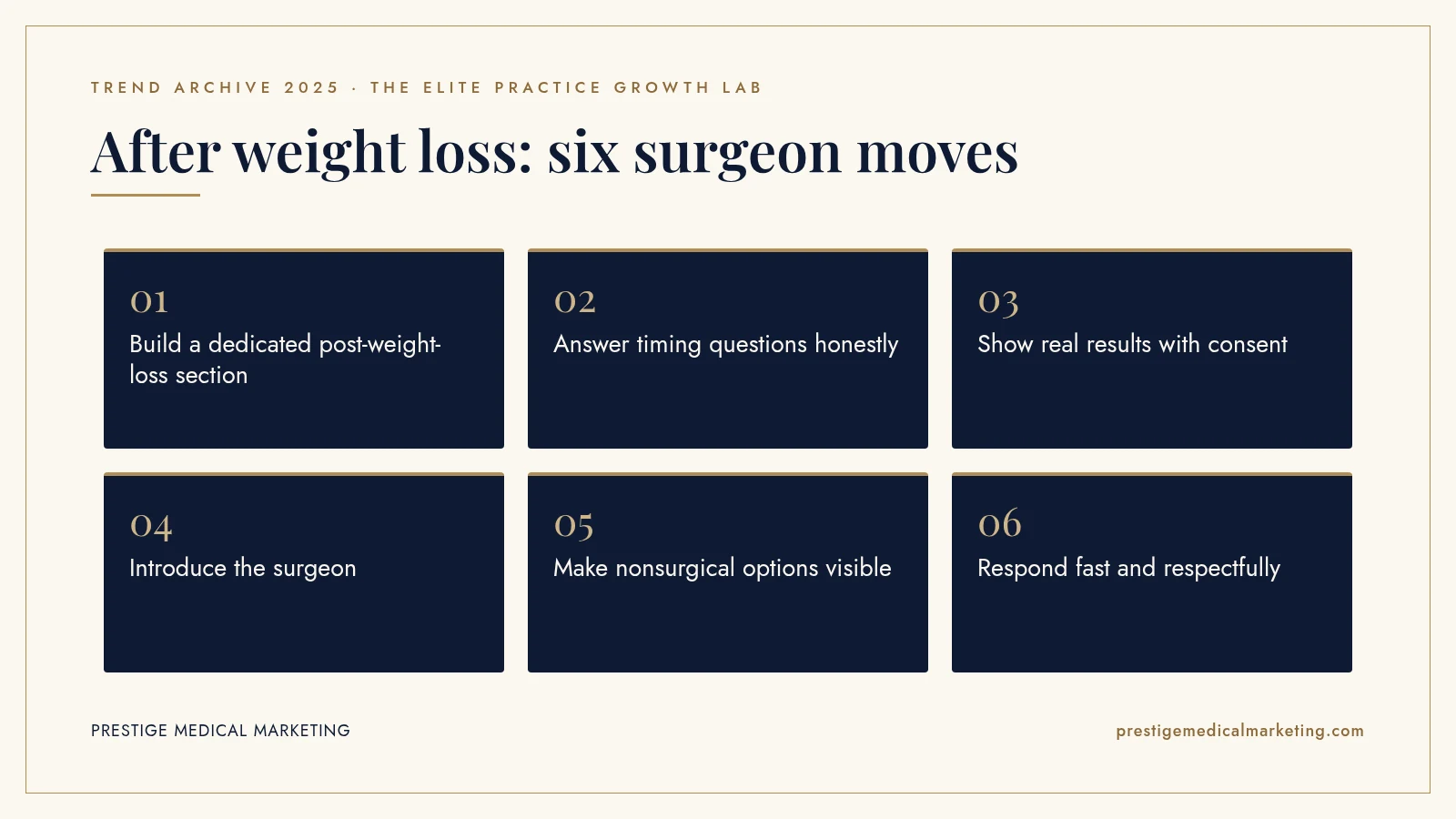
1. Build a dedicated post-weight-loss section
Create clear pages for body contouring after weight loss: tummy tuck, arm lift, thigh lift, lower body lift, breast lift and combined procedures. Explain who may be a candidate, why stable weight matters, what recovery involves and how costs are typically structured, without promising specific results.
2. Answer timing questions honestly
Many patients want to know when to schedule surgery after weight loss. The honest answer is that it depends on their weight stability, health and goals, and that the surgeon decides in consultation. Say so clearly. Patients trust practices that do not overpromise.
3. Show real results with consent
Before and after galleries should feature consented patients, a range of outcomes and clear notes that results vary. Organize them by procedure so patients can find relevant examples quickly.
4. Introduce the surgeon
Post-weight-loss surgery is a major decision. Patients want to understand the surgeon’s training, approach and experience with combined procedures. A real introduction on your website, in the surgeon’s own words, does more than any slogan.
5. Make nonsurgical options visible
The ASPS figures show many GLP-1 patients are considering nonsurgical procedures. If your practice offers skin treatments, injectables or other nonsurgical care, make that path visible. It can be a patient’s first step with your practice.
6. Respond fast and respectfully
These patients often contact several practices. The one that answers quickly, explains the next step clearly and follows up thoughtfully usually earns the consultation. Our guide on call handling and lead leakage shows where practices lose these inquiries.

Social media and video
Many post-weight-loss patients follow surgeons on social platforms long before they book. Short videos in which the surgeon explains a procedure, answers a common question or walks through what recovery involves can build familiarity and trust. Keep them educational, accurate and compliant with platform rules and consent requirements. Avoid sensational edits. The goal is for a patient to feel they already know your surgeon when they walk in.
The search side
Post-weight-loss patients ask long, specific questions, the kind that increasingly trigger AI Overviews and AI Mode answers. That means the practice cited in those answers gains visibility, even when fewer people click. Pages with clear headings, honest answers and visible expertise have the best chance. Our plastic surgery SEO guide covers the fundamentals, and our retrospective on 2025’s core updates covers how quality changes affected surgeon websites.
Local visibility matters too. Patients want a surgeon they can visit for consultations and follow-up. A strong Google Business Profile, consistent reviews and accurate information help you appear when they search nearby. Our maps and AI search service handles that work.
Ten questions your website should answer
Post-weight-loss patients tend to ask the same core questions. A practice that answers them clearly, in plain language and in the surgeon’s voice, becomes the obvious place to book a consultation. Consider covering these on your procedure pages and in a dedicated guide:
- How do I know if I am ready for body contouring after weight loss?
- Why does a stable weight matter before surgery?
- Which procedures address the abdomen, arms, thighs, breasts and face after weight loss?
- Can procedures be combined, and how does the surgeon decide?
- What does recovery involve, and how much time off is typical?
- What are the risks, and how are they managed?
- How are costs structured, and are financing options available?
- Are there nonsurgical options worth considering first?
- What happens during a consultation?
- How do I choose a qualified plastic surgeon?
Each answer should be honest about uncertainty. Phrases such as “your surgeon will discuss this with you in consultation” are not weak. They build trust.
Language that respects patients
Weight is personal. Many patients have heard judgmental comments for years. The tone of your website, ads and phone conversations matters. Focus on goals, comfort and confidence rather than flaws. Avoid slang that trivializes a patient’s journey. Describe procedures and outcomes accurately. Train your front desk to speak with the same care. Patients notice, and they talk about it in reviews.
Pricing and financing clarity
Cost is one of the most common concerns. Many patients have already spent significant money on medications and programs. You do not need to publish every fee, but you should explain what affects cost, what a quote includes and whether financing is available. Practices that are transparent about the process tend to attract better-prepared consultations and fewer surprises. Our guide on reputation and premium pricing explains how clarity and reputation support premium fees.
What a great consultation experience looks like
For a post-weight-loss patient, the consultation is often the deciding moment. Make it easy to book online or by phone. Send a clear confirmation with what to bring and what to expect. Give the surgeon enough time to listen. Provide a written summary of recommendations and costs afterward. Follow up with a personal message, not a sales script. Each step signals the kind of care the patient can expect after surgery. Our booking engine helps practices make that journey seamless.
Partnering with weight loss practices
Many patients who consider body contouring are under the care of a weight loss clinic, primary care physician or other provider. Relationships with reputable providers can help patients get coordinated care. Keep them professional and compliant, and get legal guidance on any arrangement involving compensation. Our weight loss clinic marketing guide covers the other side of that relationship.
Measuring what works
Track this patient group separately where you can. Note how many consultation requests mention weight loss, which pages they arrived from, how many book surgery and how long the decision takes. Many post-weight-loss patients take months to decide, so judge campaigns over a longer window than you would for injectables. Separate branded from non-branded search performance so you can see whether new patients are finding you, not just existing ones. Over time, this data shows which content and channels bring patients who are ready, and which bring browsers. Our predictability and scaling guide covers how to build reporting that connects marketing to booked procedures.
What 2025 does not tell us
The ASPS figures describe its members’ patients and procedures in 2024. They do not tell us how many GLP-1 patients will ultimately choose surgery, how demand varies by region or how future medications might change the picture. The percentage changes in lift procedures are small, and one year’s data is not a long-term trend. We do not have reliable public data on how marketing to this group affects conversion. Use the numbers as context, not a forecast.
The premium practice advantage
Typical agencies chase trends with loud campaigns. Premium practices meet a new patient group with clarity and respect. They explain options honestly, introduce the surgeon, show real results, respond quickly and let patients decide in their own time. That is how trust is earned, and in plastic surgery, trust is what fills the surgical calendar.
That is how we work with plastic surgery practices and other specialties across every field we serve, from Austin for practices nationwide.
The bottom line
In 2025, ASPS reported that more than 800,000 aesthetic patients used weight loss medications prescribed by its members in 2024, with many considering surgical or nonsurgical procedures. Lift procedures grew modestly. For plastic surgery practices, the opportunity is to become the trusted, honest resource for patients after weight loss, with clear content, real results and responsive service.
Check if your market is open. We take one practice per specialty per market. Request a market check or call (716) 400-0084.
Frequently asked questions
What did the 2024 ASPS statistics say about GLP-1 patients?
For the first time, the report measured weight loss medication prescribing by ASPS members and found more than 800,000 aesthetic patients using them in 2024. Of GLP-1 patients under ASPS member care, 20% had already had plastic surgery, 39% were considering surgery and 41% were considering a nonsurgical procedure.
Which body contouring procedures grew?
ASPS reported buttock and thigh lifts rose 3%, upper arm lifts 2% and neck lifts 2%, while tummy tucks rose 1% and remained the second most popular cosmetic surgery, behind liposuction.
Is body contouring a substitute for weight loss?
No. ASPS states that body contouring is not a substitute for weight loss surgery. Marketing should be clear that these procedures address shape and skin after weight loss, and that candidacy is decided in consultation.
How should a plastic surgery practice market to GLP-1 patients?
With education rather than hype: clear pages on procedures after weight loss, honest information about timing, candidacy, recovery and cost, consented before and after photos and a consultation process that respects how much research these patients do.
Should plastic surgeons partner with weight loss clinics?
Referral relationships with reputable weight loss and primary care practices can make sense, provided they follow applicable referral and advertising rules. Get legal guidance on any arrangement that involves compensation.
Where can I see the full statistics?
ASPS publishes its procedural statistics on PlasticSurgery.org. The press release announcing the 2024 report summarizes the key figures and links to the full data.