
Plastic surgery SEO wins the months of research a patient does before booking a consult. It takes one in-depth page per procedure, visible surgeon credentials, consented before-and-after galleries, steady real reviews, a complete Google Business Profile and tracking that measures booked and attended consults, not clicks.
A surgical patient rarely books on impulse. She reads, compares surgeons, saves galleries, watches videos and asks friends. By the time she calls, she has already decided whose name she trusts. Plastic surgery marketing is the work of being that name, at every stop of the research. SEO is how you show up at those stops without paying for every click.
What plastic surgery SEO has to win
Demand is steady. The American Society of Plastic Surgeons’ 2024 Procedural Statistics counted nearly 1.6 million cosmetic surgical procedures and more than 28.5 million minimally invasive procedures in the U.S. The top surgeries were liposuction (349,728), breast augmentation (306,196), tummy tuck (171,064), breast lift (153,616) and eyelid surgery (120,755).
The patients are out there. The question is whether they find you or the practice with a better website. Three surfaces decide it:
- Procedure searches. “Mommy makeover cost,” “deep plane facelift recovery,” “rhinoplasty surgeon [city].” Each needs its own page.
- The map pack. Patients still want a surgeon within driving distance for consults and follow-ups.
- Surgeon name searches. Once a patient hears your name, she searches it. What she sees next decides whether she books.
There is also a newer channel. The 2024 ASPS report measured weight loss medication use for the first time and found over 800,000 aesthetic patients using it, with 39% of GLP-1 patients considering a surgical procedure. Body contouring after weight loss is a real and growing search category. Practices with honest, detailed pages on it will own that traffic.
Where plastic surgery marketing goes wrong, and how we do it instead
They count leads. We count attended consults.
A practice can grow form fills every month and still see the same number of surgeries. We track each inquiry from first click to booked consult, attended consult and scheduled surgery, then report revenue by source in our monthly ROI reporting.
They write thin procedure pages. We write the page a patient bookmarks.
Three paragraphs and a gallery link will not outrank a surgeon who explains candidacy, technique options, recovery week by week, risks, results and cost in plain English. We build the bookmark page.
They hide the surgeon. We put the surgeon front and center.
Patients choose surgeons, not logos. Board certification, training, years in practice, procedure focus and the surgeon’s own voice on video belong on every procedure page.
They push “free consult” ads. We qualify before the calendar.
Free consult offers fill the book with people who were never going to schedule surgery. We qualify on the page with ranges, recovery facts and candidacy details, so the consults that land are worth the surgeon’s hour.
They lock you in. We earn it monthly.
Month-to-month terms and one surgical practice per market. Your marketing partner should not be selling the same playbook to the surgeon across town.

Check if your market is open. We work with one plastic surgery practice per market. Request a market check or call (716) 400-0084.
The plastic surgery SEO plan, step by step
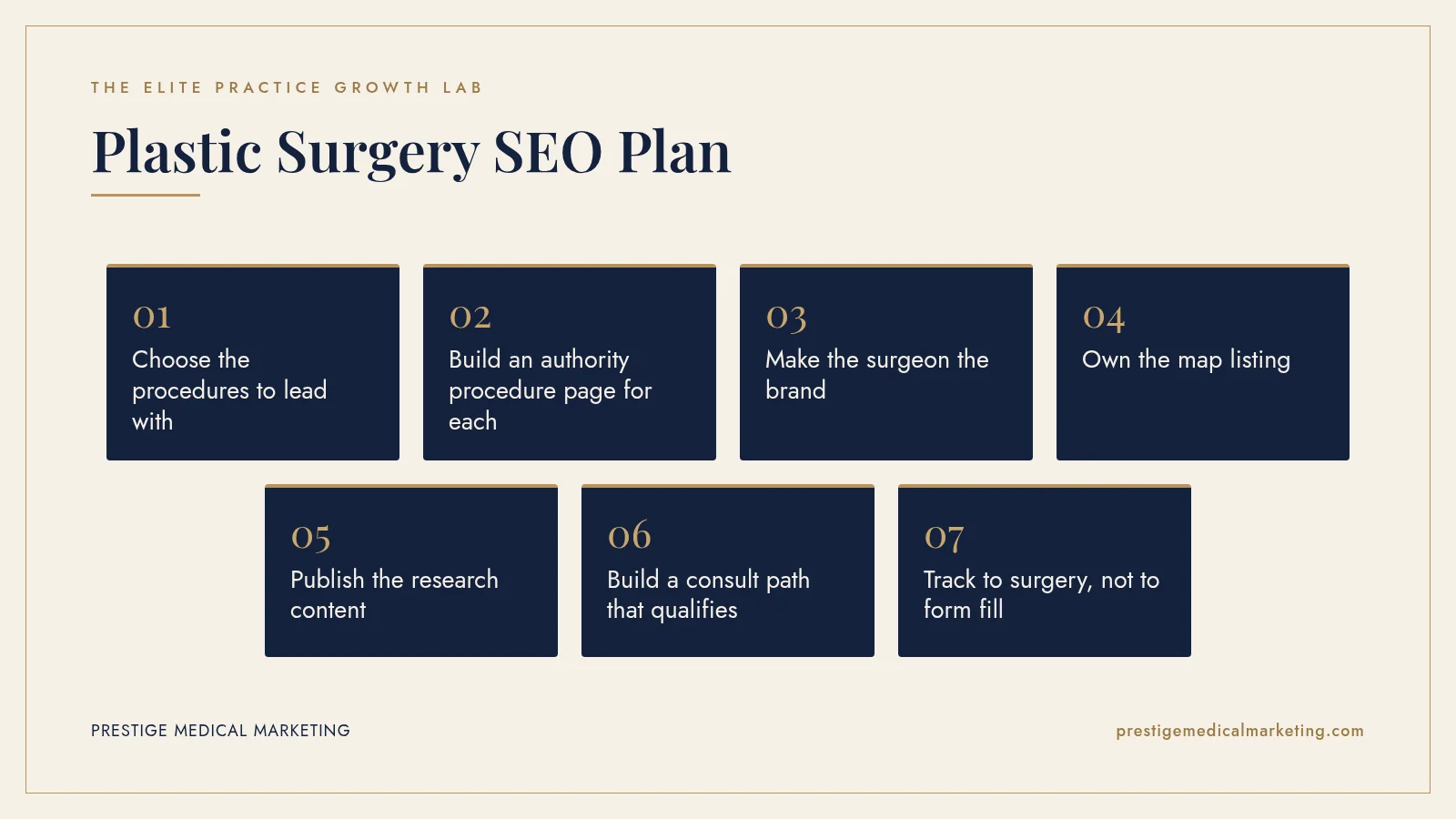
Step 1: Choose the procedures to lead with
Pick five to eight procedures that match the surgeon’s strengths, OR capacity and margin. Those get the deepest pages and the first content investment. Everything else gets a solid page and waits its turn.
Step 2: Build an authority procedure page for each
Cover who is a candidate, techniques and when each is used, what happens on surgery day, recovery by week, risks in honest language, expected results, typical cost range and what it includes, and the surgeon’s approach. Add consented galleries with captions describing the goal and procedure.
Step 3: Make the surgeon the brand
A detailed bio page, credentials verified and linked where possible, conference talks and publications, and short videos answering real patient questions. This is the experience and expertise Google describes in its helpful content guidance.
Step 4: Own the map listing
Set the right primary category, list every procedure as a service, add real photos of the practice and team, and keep hours and booking links accurate. Then earn reviews steadily, never in bursts and never paid for.
Step 5: Publish the research content
Comparison and decision pages win months of attention: “breast lift vs. augmentation,” “tummy tuck after GLP-1 weight loss,” “what recovery from a facelift really looks like.” Each links back to its procedure page.
Step 6: Build a consult path that qualifies
A short form with procedure, timeline and budget range. Fast follow-up by a trained coordinator. A clear explanation of the consult fee and how it is credited. Missed calls go to a 24/7 AI receptionist instead of voicemail.
Step 7: Track to surgery, not to form fill
Connect call tracking, forms and your practice software, so each scheduled surgery traces back to the page and channel that started it.
Before-and-after galleries that help search and sales
Galleries are the most visited pages on most surgical sites and the most neglected for SEO. Fix that with a few habits:
- Organize by procedure, and link each gallery to its procedure page and back.
- Write a short case note for each set: patient goals, procedure performed and time since surgery.
- Use consistent lighting and angles. It reads as honest, because it is.
- Get written consent for every image and follow it exactly.
- Never retouch results. The FTC treats misleading imagery as a deceptive claim, and patients notice.
Reviews and reputation for surgeons
Surgical patients read reviews closely. BrightLocal’s 2026 survey found 97% of consumers read reviews for local businesses, and 31% will only use a business rated 4.5 stars or higher, up from 17% the year before. Ask every patient at the right moment, usually at a positive post-op visit, with a direct link. Reply personally and keep protected health information out of every response. Our reputation and premium pricing playbook covers the full system.
Content for a long research cycle
A breast augmentation patient may read about implants for a year before she calls. A facelift patient may research longer. Your content has to meet her at each stage, and each stage has different questions.
Early: “Is this for me?”
Candidacy pages, comparison guides and honest explainers about what a procedure can and cannot do. These pages build trust before she has a surgeon in mind. Write them in the surgeon’s voice, not in brochure language.
Middle: “Who should I trust?”
Surgeon bio, credentials, philosophy, galleries, reviews that mention specific procedures and short videos. At this stage she is comparing three or four names. Detail and transparency win.
Late: “What happens next?”
Consult process, what to bring, financing, cost ranges, scheduling lead times and recovery planning. A patient who finds clear answers here books. A patient who finds a phone number and nothing else keeps comparing.
Each stage links to the next. An early guide points to the procedure page. The procedure page points to the surgeon and the gallery. The gallery points to the consult. That path is what turns readers into scheduled surgeries.
SEO and paid search work better together
SEO takes months to mature on competitive procedure terms. Paid search fills the gap and tests which messages and procedures convert, then organic pages carry more of the load over time. The two share data: the search terms that produce booked consults in paid campaigns tell you which organic pages to build next. Run them as one system with one report, and you stop paying twice for the same patient.
Keep ads compliant. Google’s healthcare and medicines policy restricts some treatment and drug claims, and Meta reviews before-and-after imagery closely. A marketing partner who knows those rules saves you from disapprovals and account flags.
Questions to ask any plastic surgery marketing agency
- Who owns the website, domain, ad accounts and analytics? The answer should be the practice.
- How do you measure success? Listen for attended consults and scheduled surgeries, not impressions.
- Do you work with another surgeon in my market? If yes, ask how they decide whose pages rank first.
- Who writes the procedure content? It should be written with the surgeon’s input and reviewed by the surgeon before it goes live.
- What are the contract terms? A confident agency does not need a twelve-month lock-in.
If an agency hesitates on any of these, keep looking. The right partner answers all five in plain language on the first call, shows you a sample report, and explains exactly what the first ninety days will produce for your practice and your surgeon.
Measure what the surgeon cares about
- Consult requests by procedure and source
- Booked and attended consult rates
- Consult-to-surgery conversion by coordinator
- Revenue by procedure and source
- Cost per scheduled surgery across SEO and paid
When these numbers are visible, budget decisions get easy. You stop arguing about traffic and start funding what fills the OR. See how we approach it on our plastic surgery marketing page, and how the same system extends to injectables on our med spa page.
Want more consults from patients who fit? Check if your market is open or call (716) 400-0084. Austin, Texas headquarters, practices nationwide.
Put this playbook to work: see how it applies to the Prestige System for medical practice marketing and dermatology practice marketing.
Frequently asked questions
How is plastic surgery SEO different from med spa SEO?
Surgical patients research longer, spend more and care more about the surgeon than the brand. That means deeper procedure pages, stronger credential signals, larger galleries and a consult process built for a decision that can take months. Med spa SEO leans more on map visibility and rebooking.
Which procedures should a plastic surgeon prioritize in SEO?
Start with the procedures that match your training, capacity and margin, then check local demand. Nationally, ASPS reported liposuction, breast augmentation, tummy tuck, breast lift and eyelid surgery as the top cosmetic surgeries in 2024, but your mix should follow your practice, not the national list.
Should a plastic surgeon list prices online?
Show a typical range and what it includes: surgeon fee, anesthesia, facility and follow-up. Ranges answer the first question every patient has and filter out people who are not ready for the investment.
How do we get more qualified consults instead of tire-kickers?
Qualify on the page. Show price ranges, recovery time and candidacy criteria. Use a short pre-consult form, and consider a consult fee credited toward surgery. Patients who read all of that and still book are serious.
Are before-and-after photos good for SEO?
They are good for conversion and engagement, which support SEO. Use consented, unretouched photos with descriptive text about the patient's goals and the procedure. A gallery with no text gives search engines little to work with.
What should a plastic surgery marketing report include?
Consult requests by procedure, booked consults, attended consults, surgeries scheduled and revenue by source. Traffic and keyword positions are supporting data, not the result.