
Apple released iOS 14.5 on April 26, 2021 with App Tracking Transparency, which requires apps to ask permission before tracking a user's activity across other companies' apps and websites for advertising. Meta responded with Aggregated Event Measurement, which limited and delayed conversion reporting from iOS users. For plastic surgery practices, ad platforms reported fewer and less precise consultation requests, which pushed the smartest practices toward first-party tracking of real leads and booked consultations.
For much of the 2010s, social advertising for aesthetic surgery followed a comfortable loop. A practice ran Facebook and Instagram campaigns for breast augmentation, tummy tucks or facial procedures. The platform tracked who clicked, who filled out the consultation form and who looked like those people. The dashboard reported a cost per lead, the algorithm found more leads like them, and the practice spent more where the numbers looked good.
In April 2021, Apple changed one of the assumptions underneath that loop. With iOS 14.5, iPhone users began seeing a simple question when they opened many apps: allow this app to track your activity across other companies’ apps and websites, or ask it not to. The answer mattered, because so much of social ad measurement depended on connecting what someone did inside an app with what they did later on a website.
This retrospective covers what Apple actually shipped in 2021, how Meta adapted, why plastic surgery practices felt it and what the lesson means for a surgical practice today. For the later chapters of the same story, see our look at Meta’s 2022 removal of sensitive detailed targeting and the 2022 Meta Pixel investigation into hospital websites.
What actually happened in 2021
April 26: iOS 14.5 ships. Apple announced that iOS 14.5 was available as a free update and described App Tracking Transparency directly: apps must get the user’s permission before tracking their data across apps or websites owned by other companies for advertising, or sharing their data with data brokers. Users could respond to each app’s prompt and change their choices later in Settings.
A developer requirement, not a setting. Apple’s developer documentation for the AppTrackingTransparency framework describes how an app must request authorization before it can access the device’s advertising identifier or track the user. If a user declines, the app is not permitted to track them in the ways the policy describes.
Meta adapts its measurement. Meta introduced Aggregated Event Measurement, a protocol for measuring web and app events from people using iOS 14.5 and later devices. Advertisers had to verify their website domains and prioritize a limited set of conversion events, and reporting for some events became delayed, modeled or aggregated rather than reported person by person.
The industry reacts. Through the rest of 2021, advertisers across categories reported that platform dashboards showed fewer conversions than their own systems recorded, and that audiences built from website activity became smaller. The direction was clear even when the size of the effect varied from account to account.
Why it mattered for plastic surgery practices
Aesthetic surgery is a considered purchase with a long runway. A prospective patient might see an Instagram ad in March, visit the website several times on her phone, read about recovery, look at before-and-after galleries and only request a consultation in May. The original loop worked best when the platform could connect all of those moments. App Tracking Transparency made that connection weaker for every iPhone user who declined tracking.
That had three practical consequences. First, reported cost per lead often rose on paper even when the practice’s phones and inboxes were about as busy as before, because some conversions simply were not attributed. Second, retargeting audiences based on website visits shrank, so it became harder to stay in front of people who had already shown interest. Third, the algorithm had fewer confirmed conversions to learn from, which could make campaign optimization less precise.
Plastic surgery practices also had a reason to think carefully about tracking for its own sake. The pages people visit on a surgical practice’s website can reveal sensitive interests. A privacy change that limited cross-company tracking was, in that sense, a preview of the scrutiny that would arrive for health websites in 2022 and 2023.
What typical agencies did
Many agencies responded by explaining the dip rather than measuring around it. Clients heard that the platform was under-reporting, which was often true, but without an independent count of real consultation requests nobody could say by how much or whether the campaigns were still profitable.
Some agencies reacted by spending more to hit the old reported numbers. Others moved budget away from social entirely based on dashboard results that no longer told the full story. Both decisions were made on incomplete data.
The better approach was less dramatic. It meant counting leads and consultations in the practice’s own systems, tagging where they came from as reliably as possible, and judging each channel on booked consultations and scheduled procedures over a reasonable period.
What it means for a plastic surgery practice today
The world App Tracking Transparency introduced is now the normal operating environment. These are the habits that hold up.
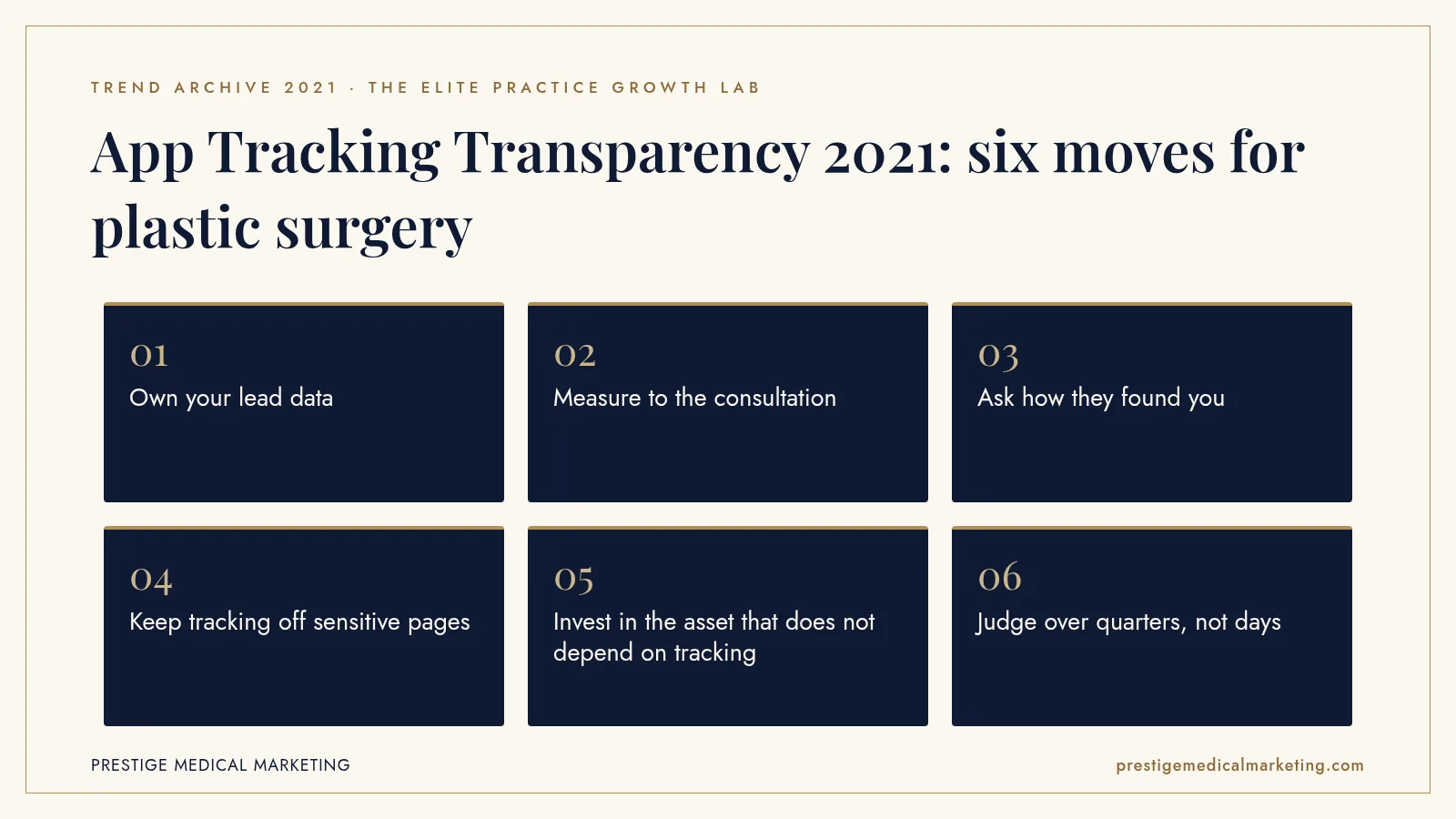
1. Own your lead data
Every consultation request should land in a system the practice controls, with its source, date and status recorded. Platform dashboards are a second opinion, not the ledger.
2. Measure to the consultation
A form fill is not a patient. Track whether each inquiry booked a consultation, attended it and scheduled a procedure, then compare cohorts by channel and month.
3. Ask how they found you
A short, consistent question at intake, recorded accurately, often explains more than any pixel. Patients remember the surgeon’s Instagram, a friend’s referral or a search result.
4. Keep tracking off sensitive pages
Review which third-party scripts run on procedure pages, forms and patient portals. Tracking that is not needed should not be there, and anything that is there should be reviewed for privacy and HIPAA risk.
5. Invest in the asset that does not depend on tracking
A website, galleries and educational content that persuade on their own keep working regardless of how ads are measured.
6. Judge over quarters, not days
Surgical decisions take time. Evaluate campaigns on consultation and procedure trends over a quarter, not on a single week of platform-reported conversions.

Creative and offers after the change
When targeting and measurement became less precise, the creative itself had to do more of the work. An ad that clearly said who the surgeon was, what the practice specialized in and what a consultation involved tended to attract better-fit inquiries than a generic promotion. The ad was effectively doing some of the qualifying that the algorithm could no longer do as well.
Plastic surgery advertising also has to stay accurate. Before-and-after images used with consent, realistic descriptions of recovery and clear statements that results vary are part of advertising responsibly. Discount-led creative, by contrast, tends to attract price shoppers and does little to build a premium practice’s reputation.
A strong consultation offer is usually about clarity rather than price: what happens at the visit, who the patient will meet, how long it takes and whether there is a consultation fee that is credited toward surgery. Clear expectations attract patients who are ready for a serious conversation.
The website does more of the persuading
With weaker retargeting, a practice had fewer chances to remind a visitor to come back. That made the first visit to the website more important. Procedure pages that answer real questions, galleries that are easy to browse on a phone, surgeon bios with accurate credentials and a consultation request form that takes a minute rather than five all help a visitor act the first time.
Speed and simplicity matter on mobile, where most social traffic arrives. A heavy page with autoplay video and a long form loses people who would have booked on a cleaner page. Every friction point that might once have been patched by a retargeting ad now simply costs consultations.
Follow-up matters too. A practice that responds to a consultation request within minutes, by a knowledgeable coordinator, turns more of its existing inquiries into consultations. That improvement shows up in the practice’s own numbers regardless of what any ad platform reports.
A note on privacy and trust
Apple framed App Tracking Transparency as a privacy feature, and many users treated it that way. Prospective surgical patients are often private about their plans. A practice that collects only what it needs, explains how it uses information and keeps tracking away from sensitive pages is aligned with how its patients already think.
That alignment also reduces risk. As later federal guidance made clear, health care websites that share sensitive information with third parties can create real regulatory exposure. The habits that make a practice resilient to tracking changes are the same habits that keep it on the right side of privacy expectations.
A simple measurement setup
A practical setup for a plastic surgery practice does not require sophisticated software. Each consultation request, whether it arrives by form, phone call, text or direct message, is logged in one place with its date, source and the procedure of interest. The coordinator updates the record when a consultation is booked, attended and converted to a surgery date. Once a month, the practice compares those counts with spend and effort by channel.
That simple ledger answers questions no platform dashboard can. It shows whether Instagram inquiries convert to surgery at a similar rate to search inquiries, how long the typical decision takes for each procedure and which months bring the strongest demand. It also makes conversations with any agency more honest, because everyone is looking at the same numbers.
Where a practice uses server-side or conversion API integrations to send events back to ad platforms, it should do so carefully, sending the minimum necessary and never sensitive health details. The goal is better aggregate signals for the platform, not a richer profile of each prospective patient.
What 2021 does not tell us
Apple did not publish the share of users who declined tracking, and estimates from analytics firms varied widely depending on method and app category. We do not have reliable public data on how plastic surgery advertisers as a group were affected, and results differed from practice to practice. What 2021 does show clearly is the direction: platforms would know less about individual users, and advertisers who measured their own outcomes would be better placed than those who relied on platform reporting alone.
The premium practice advantage
A premium surgical practice has what holds up when tracking gets weaker: a respected surgeon, real results and a consultation experience patients talk about. The work is measuring honestly and presenting that clearly. See our plastic surgery services, our booking engine, our full services, who we help and how we approach Google Maps and AI search visibility. Our team works from Austin with practices nationwide.
The bottom line
Apple’s App Tracking Transparency, released with iOS 14.5 in April 2021, made social ad reporting less complete. For plastic surgery practices, the lasting lesson was to own their lead data, measure all the way to booked consultations and procedures, and build websites and creative that persuade without relying on tracking.
Check if your market is open. We take one practice per specialty per market. Request a market check or call (716) 400-0084.
Frequently asked questions
When did App Tracking Transparency take effect?
Apple released iOS 14.5 on April 26, 2021. From that release, apps had to ask users for permission before tracking their activity across apps and websites owned by other companies.
What exactly does App Tracking Transparency require?
Apple says apps must get the user's permission before tracking their data across apps or websites owned by other companies for advertising, or sharing that data with data brokers.
How did Meta respond?
Meta introduced Aggregated Event Measurement for web events from iOS devices, which limited the number of conversion events an advertiser could prioritize and changed how and when conversions were reported.
Why did plastic surgery practices notice it?
Many practices relied on Facebook and Instagram ads to generate consultation requests and judged campaigns by the conversions the platform reported. After the change, reported results became less complete, especially from iPhone users.
Did App Tracking Transparency stop ads from working?
No. Ads still reached people and still produced inquiries. What changed was the precision of the platform's own reporting and targeting, which made independent tracking of real leads more important.
What should a practice measure instead?
Track inquiries, consultations booked, consultations attended and procedures scheduled in your own systems, and compare them to ad spend by channel over time rather than relying only on platform-reported conversions.