
Google's Search Status Dashboard lists the May 2022 core update starting on May 25, 2022 and the September 2022 core update starting on September 12, 2022, each rolling out over roughly two weeks. They sat among ten ranking updates Google announced that year, including helpful content, product reviews and spam updates. Google says core updates have no specific fix. For plastic surgery practices, the lesson was to build expert, procedure-specific content and a trustworthy site rather than chase each update.
For a plastic surgery practice, organic search is often the most valuable channel it does not pay for by the click. Someone researching a rhinoplasty, breast augmentation, abdominoplasty or facelift will read extensively, compare surgeons and return several times before requesting a consultation. Ranking on those searches can mean a steady stream of well-informed prospective patients.
That makes Google’s broad core updates consequential. In 2022, Google ran two of them, in May and September, alongside eight other announced ranking updates. Some practices saw procedure pages move sharply. Many could not tell which update had moved them, because several overlapped.
This retrospective covers what Google actually announced in 2022 and what it means for a plastic surgery practice today. For later chapters, see FAQ rich results restricted in 2023, site reputation abuse in 2024 and the 2025 core updates.
What actually happened in 2022
May 25: the May 2022 core update. Google’s Search Status Dashboard lists the May 2022 core update starting on May 25, 2022, with a rollout of about 15 days.
September 12: the September 2022 core update. The dashboard lists a second broad core update starting on September 12, 2022, rolling out over about 14 days. It began only days after the first helpful content update finished.
A crowded calendar. In total the dashboard lists ten ranking updates for 2022: the desktop page experience update in February, product reviews updates in March, July and September, the two core updates, helpful content updates in August and December, a spam update in October and a link spam update in December.
Google’s guidance on core updates. Google’s documentation on core updates describes them as significant, broad changes designed to ensure Google delivers helpful and reliable results. It says pages that drop are not being penalized, that there may be nothing specific to fix, and that improvements may be recognized over time, sometimes not until another core update.
The self-assessment questions. The documentation points site owners to questions about content quality, expertise and presentation: does the content provide original information, a substantial and complete description of the topic, and insight beyond the obvious? Is it written by an expert or enthusiast who demonstrably knows the topic?
Why it mattered for plastic surgery
Plastic surgery content sits at the intersection of two things Google treats carefully: health topics, where it applies higher standards, and high-value commercial searches, where competition is intense. A procedure page that ranks well can be worth a great deal. That attracted aggressive tactics across the specialty, from mass-produced procedure pages to purchased links and heavily templated city pages.
Broad core updates reassess the whole picture. They are not aimed at a specific tactic, which is why Google says there may be no specific fix. Pages built on substance, with board-certified surgeons explaining procedures in depth, real photography and honest discussion of risk and recovery, tended to be better positioned than pages built mainly to target keywords.
The overlapping timeline mattered too. Between late August and late September 2022, the helpful content update, the September core update and a product reviews update rolled out in close succession. A practice that saw a change in that window could not reliably attribute it to one update, which made reactive fixes risky.
What typical agencies did
Core updates generate a predictable cycle. Rankings move, agencies publish theories, and clients are sold a fix. In 2022, common reactions included rewriting title tags across a site, adding word count to procedure pages, building more links or launching a new batch of location pages. Some of these changes were harmless. Some made things worse by adding more of what core updates tend to reassess.
Few agencies took Google’s guidance at face value: there may be nothing specific to fix, and the best response is to make content more helpful and reliable over time. That answer is less satisfying to sell, but it matched how core updates work.
A calmer approach compared performance across several weeks after each rollout finished, looked at which pages moved and why, and invested in the pages that mattered most to consultations.
What it means for a plastic surgery practice today
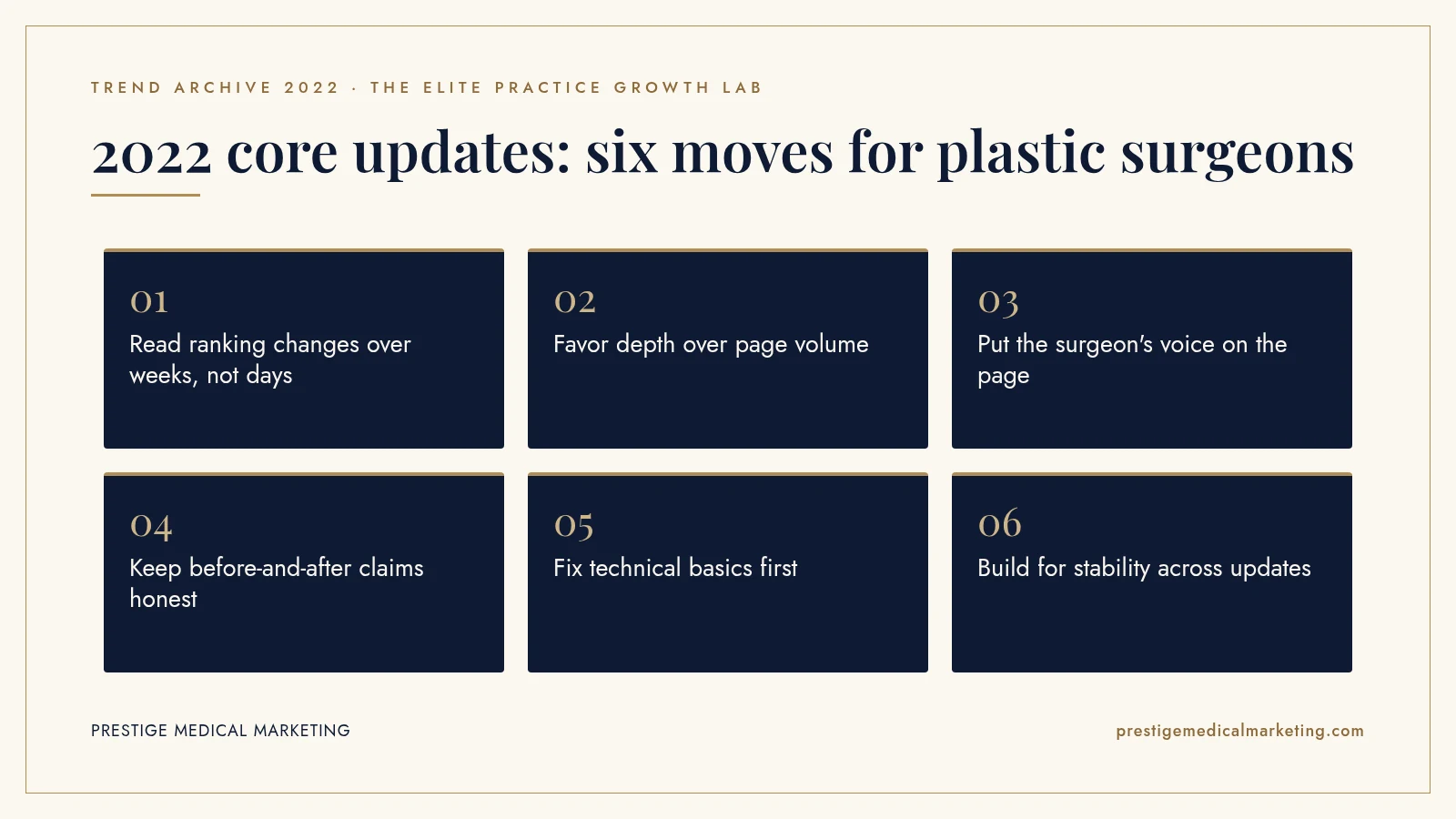
Core updates continue several times a year. These steps make a practice’s site resilient to them.
1. Build depth on core procedures
Your most important procedure pages should be the best explanation a prospective patient can find: candidacy, technique options, the consultation, recovery and risks, written or reviewed by your surgeons.
2. Show the surgeon’s expertise
Feature accurate board certification, training and experience, with a real bio linked from every procedure page.
3. Use real, consented photography
Before-and-after galleries with consent and consistent presentation show experience in a way text cannot.
4. Retire thin and duplicate pages
Merge near-identical procedure variants and remove city pages that exist only to rank. Redirect where appropriate.
5. Measure after rollouts finish
Wait for an update to complete, then compare several weeks before and after. Avoid reacting mid-rollout.
6. Keep shortcuts out
Avoid purchased links and mass-produced content. They create risk under spam policies and add nothing under core updates.

Reading a ranking change correctly
Not every drop after a core update is a problem. Google’s guidance notes that another page may simply be judged more relevant for a query. If an informational article falls behind a medical reference site for a definitional query, that may not matter to consultations at all. What matters is whether the searches that lead to consultations have changed.
A useful review separates pages into groups: core procedure pages, informational articles, location pages and everything else. It looks at Search Console data across a comparable period, before and after the rollout, and focuses on clicks and consultation requests rather than average position alone. It also checks for technical issues that coincide with an update, because a site migration or broken template can look like an algorithm problem.
Seasonality complicates the picture. Interest in some procedures shifts through the year, so a fair comparison looks at the same weeks in a previous year where data allows. A dip that matches last year’s pattern is not an update problem, and treating it as one wastes time and money.
Why depth beats volume in surgery
Prospective surgical patients are making a serious decision. They want to understand techniques, incision options, anesthesia, recovery timelines, risks, revision considerations and costs. A single thorough page that addresses these questions honestly serves them better than ten thin pages each targeting a slightly different keyword.
Depth does not mean length for its own sake. It means completeness and clarity: answering the questions a surgeon hears at consultations, in the order patients ask them, with accurate medical detail and an honest tone. It also means being clear about what varies between patients and what can only be determined in person.
Depth also means keeping pages current. Techniques evolve, devices change and a practice’s own approach develops over time. A procedure page reviewed and updated by the surgeon on a regular schedule stays accurate, and the review date gives readers a visible sign that someone is responsible for it.
The role of the surgeon’s voice
Google’s questions ask whether content is written by an expert who demonstrably knows the topic. In plastic surgery, the most credible voice is the surgeon’s. Pages that reflect how a specific surgeon approaches a procedure, why they prefer certain techniques for certain patients and what they tell patients about recovery carry a perspective no generic page can match.
That does not require the surgeon to write every word. It requires the surgeon’s thinking to shape the content and their review to approve it. Interviews, recorded consultations explained in plain language and the surgeon’s own answers to frequent questions are good raw material.
The other 2022 updates, briefly
The core updates did not arrive alone, and understanding the rest of the calendar helps explain why 2022 felt so unsettled. The desktop page experience update, which began rolling out on February 22, brought page experience signals such as Core Web Vitals to desktop ranking. The three product reviews updates focused on review content, such as articles comparing products, rather than on practice service pages, though a practice that published product roundups could have been touched by them.
The August and December helpful content updates introduced and then expanded a site-wide signal against content created mainly for search engines, with the December update extending the system beyond English to all languages. The October spam update and the December link spam update targeted manipulative practices, with the December update using Google’s AI-based spam-prevention system, SpamBrain, to detect sites buying links and sites used to pass outgoing links.
For a plastic surgery practice, the combined message of the year was consistent. Every update pointed toward original, expert content and away from manufactured signals. A practice did not need to master each update individually to benefit; it needed a site that aligned with the direction they all shared.
Stability across updates
Practices whose sites were built on substance in 2022 generally faced each subsequent core update with less anxiety, because there was less to reassess. That is the practical value of following Google’s guidance even when it feels vague: it describes a site that tends to hold up across many updates rather than one optimized for the last one.
It also frees attention for work that drives consultations directly, such as faster response to inquiries, a smoother booking process and a stronger Google Business Profile.
Those channels compound with organic search. A patient who finds a strong procedure page, then sees consistent reviews and a responsive front desk, is far more likely to book than one who finds a strong page and then waits two days for a reply. Rankings bring the visit, but the rest of the practice converts it.
What 2022 does not tell us
Google does not publish which sites core updates affected or why. We do not have reliable public data on how plastic surgery sites as a group performed in the May or September 2022 core updates, and the overlapping updates that year make attribution uncertain. What 2022 does show is how often Google now changes rankings and what it consistently says about responding.
The premium practice advantage
A premium plastic surgery practice has what core updates reward: expert surgeons, real results and a clear point of view. The work is presenting that with depth and honesty. See our plastic surgery services, our full services, who we help, our approach to custom websites and how we approach Google Maps and AI search visibility. Our team works from Austin with practices nationwide.
The bottom line
Google ran broad core updates in May and September 2022 inside a year of ten ranking updates. For plastic surgery practices, the durable response was expert, procedure-specific content and a trustworthy site, measured calmly after each rollout.
Check if your market is open. We take one practice per specialty per market. Request a market check or call (716) 400-0084.
Frequently asked questions
When were Google's 2022 core updates?
Google's Search Status Dashboard lists the May 2022 core update starting on May 25, 2022 and the September 2022 core update starting on September 12, 2022.
How many ranking updates did Google announce in 2022?
The dashboard lists ten ranking updates for 2022, including two core updates, two helpful content updates, three product reviews updates, a spam update, a link spam update and the desktop page experience update.
What is a core update?
Google describes core updates as significant, broad changes to its search algorithms and systems, designed to make sure it is delivering helpful and reliable results overall.
Is a drop after a core update a penalty?
Google says pages that drop after a core update are not being penalized for violating a policy. Other content may simply be assessed as more relevant or helpful.
Is there a specific fix for a core update drop?
Google says there may be no specific action to take. It points site owners to its guidance on creating helpful, reliable, people-first content.
Why do core updates matter to plastic surgery practices?
Procedure searches are high-value and competitive, and the topics are health-related, where Google applies higher standards. Small ranking shifts can affect consultation volume.