
On August 8, 2023, Google announced it would show FAQ rich results only for well-known, authoritative government and health websites, and would limit How-To rich results to desktop. In September 2023, How-To rich results were removed from desktop as well. Google said sites did not need to remove FAQ markup and that the change did not affect ranking. For plastic surgery practices, it ended an easy way to take up extra space in search results, but FAQs still help patients.
If you searched for a plastic surgery procedure before August 2023, you probably saw it: a practice’s listing followed by a neat stack of expandable questions. How long is recovery? Am I a good candidate? How much does it cost? Each question was a dropdown, and together they pushed competitors further down the page.
Those were FAQ rich results, powered by FAQ structured data, and for several years they were one of the easiest visibility wins in search. Plenty of plastic surgery sites added FAQ markup to nearly every page, sometimes with a dozen questions apiece, specifically to claim more space in Google results.
In August 2023, Google largely ended that. This retrospective covers what changed and what it means for a plastic surgery practice today. For what came next, see our coverage of site reputation abuse in 2024 and the 2025 core updates.
What actually happened in 2023
August 8: the announcement. Google’s John Mueller announced changes to FAQ and How-To rich results. Google said it was reducing the visibility of these results to provide a cleaner and more consistent search experience.
FAQ results limited. Going forward, FAQ rich results would only be shown for well-known, authoritative government and health websites. For all other sites, they would no longer be shown regularly. Google noted that sites could still be eligible to be shown automatically depending on the query.
How-To results limited, then retired. How-To rich results were limited to desktop at first. Google later updated the same announcement: as of September 13, 2023, How-To rich results would no longer be shown on desktop either, and the How-To documentation was deprecated.
No need to remove markup. Google said sites did not need to proactively remove FAQ structured data. It explained that structured data that is not being used does not cause problems for Search, but also has no visible effect.
Not a ranking change. Google was explicit that the change would not affect ranking. Pages would continue to be ranked as before; they would just appear without the FAQ display.
Search Console followed. Google said FAQ search appearance, rich result reports and Rich Results Test support would be updated, with the How-To reports later removed.
Why it mattered for plastic surgery practices
Plastic surgery is one of the most competitive local search categories. Procedure pages for breast augmentation, rhinoplasty, facelifts, tummy tucks and body contouring compete against other practices, national directories, publishers and large aggregators. Every pixel of visible space in the results matters.
FAQ rich results gave practices a way to take more of that space without ranking higher. A listing with four expandable questions could be twice the height of a standard result. Some practices saw it as one of the few levers they could pull quickly, and agencies sold FAQ schema as a dependable visibility boost.
The August change removed that lever for almost all private practices. Even a highly respected plastic surgery practice is not, in Google’s terms, a well-known authoritative government or health website. Overnight, competitors returned to roughly equal visual footing, and the advantage shifted back to the fundamentals: rankings, titles, descriptions, reviews and local presence.
What typical agencies did
Some agencies did not notice for months and kept adding FAQ markup to client sites, reporting it as an SEO deliverable. Others panicked and stripped structured data out entirely, which Google had said was unnecessary.
A few went further in the wrong direction, stuffing pages with even more questions in the hope of being treated as authoritative, or adding unrelated questions just to target keywords. None of that brought the rich results back. The better response was to keep accurate FAQs where they genuinely helped patients and to redirect effort toward work that still moved results.
What it means for a plastic surgery practice today
FAQ rich results are no longer a lever for private practices. These steps focus on what still works.
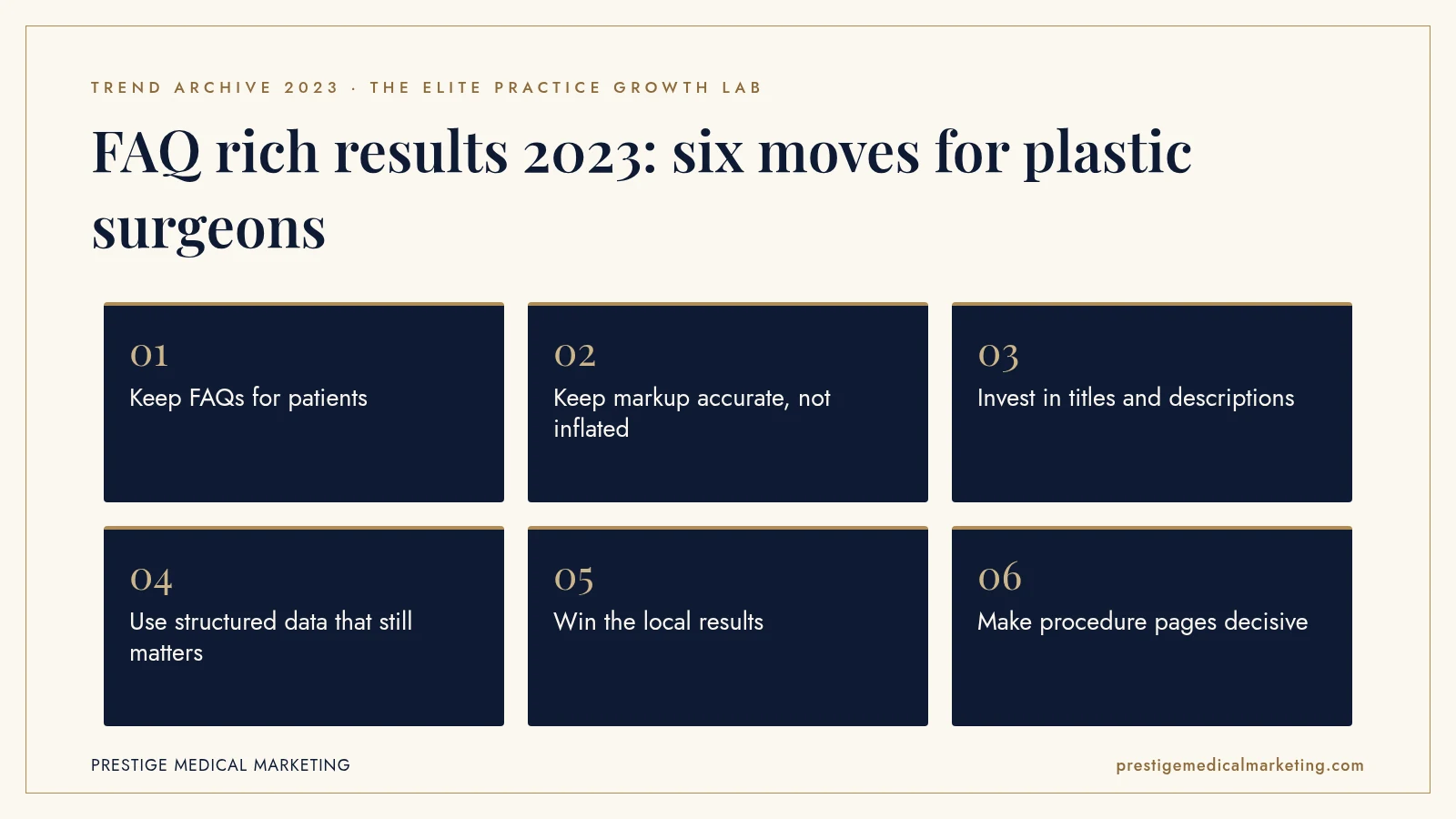
1. Keep FAQs for patients
Answer the questions patients actually ask in consultations, in plain language, on the pages where they matter. The value is in helping a patient decide with confidence, not in a search results display. Good FAQs also reduce repetitive phone questions for your team.
2. Keep markup accurate, not inflated
If you use FAQ structured data, make sure it matches the visible page exactly and reflects real questions. There is no reason to add more. Remove questions that exist only to target keywords.
3. Invest in titles and descriptions
With fewer enhanced displays, the title and description carry more weight in earning the click. Write them for patients, with the procedure, location and a clear reason to choose you. Test whether each title would make sense read aloud to a prospective patient.
4. Use structured data that still matters
Accurate organization, local business, physician and breadcrumb markup helps search engines understand the practice and its surgeons. Validate it after every site change, because redesigns and plugin updates often break markup quietly.
5. Win the local results
For procedure searches with local intent, the map results and Google Business Profile often matter more than any rich result. Keep categories, services, photos and reviews current, and respond to reviews thoughtfully and within privacy limits.
6. Make procedure pages decisive
Show surgeon credentials, consultation details, recovery expectations, financing options and a clear way to book. A patient who clicks should find everything needed to take the next step.

Writing FAQs that patients actually use
The end of FAQ rich results was a useful moment to rethink what an FAQ is for. Many plastic surgery FAQs had drifted into keyword lists dressed as questions: “What is the best breast augmentation in [city]?” or “Why choose us for rhinoplasty?” Those questions were written for search engines, not patients.
Patients ask different things. How long until I can return to work? When can I exercise? What happens at the consultation? Do I need to stop certain medications beforehand? How do I know if I am a good candidate? What does financing look like? Will I need someone to drive me home? Those are the questions that build confidence, and they are the ones worth answering carefully.
Answers should be accurate, specific to how your practice works and honest about variation. Recovery differs by patient and procedure; say so. Costs vary by case; explain what drives the range and how a consultation clarifies it. Avoid implying guaranteed results. Our plastic surgery SEO guide covers how to structure procedure pages around those questions.
The authoritative health site line
Google did not publish a list of which health websites count as well-known and authoritative. In practice, the description points to large, established health information sources and government health agencies. A private plastic surgery practice, however reputable, should assume it does not fall into that group.
That distinction matters beyond FAQ results. It reflects a broader pattern in how Google treats health information: established, widely trusted sources get more latitude, while everyone else has to earn trust page by page. For a practice, that means credentials, accurate information, clear authorship and a consistent reputation across the web are not optional extras. They are how trust gets established.
Where FAQ content still earns visibility
Losing the rich result did not make FAQ content worthless for visibility. Clear question-and-answer content can still help a page rank for the specific questions patients search. It can also be the kind of concise, well-structured content that AI answers draw on, a trend that accelerated after Google began testing AI answers in 2023. Our 2023 SGE retrospective covers that shift.
FAQ content also does work after the click. A patient comparing two practices may read every answer on a procedure page before deciding which practice to call. Thoughtful answers about recovery, safety, revision policies and what the consultation involves make that decision easier.
The lesson about search tactics
The FAQ change was a small event with a large lesson. Any tactic that wins visibility through a search engine feature, rather than through being the best answer, is borrowed. Google can change the feature, limit who qualifies or remove it entirely, and the advantage disappears overnight.
Plastic surgery marketing has seen this pattern repeatedly. Review stars in organic results, certain local pack formats, How-To results and FAQ results all changed or disappeared over time. Practices that built their visibility on those features had to keep chasing the next one. Practices that built it on surgeon reputation, genuinely useful procedure content and a strong local presence were affected far less.
That does not mean ignoring search features. It means treating them as a bonus on top of fundamentals rather than a substitute for them. A practice with excellent procedure pages, a well-reviewed Google Business Profile and a fast booking path will benefit from whatever features Google offers next, without depending on any of them.
Measuring the change honestly
Practices that tracked click-through rates on procedure pages may have seen changes after August 2023. Some of that came from losing FAQ displays; some came from other changes happening in the same period, including several core updates. Attributing any single movement to the FAQ change alone is difficult.
The more useful measure was always downstream: consultation requests, calls and booked appointments from organic search. If those held steady while rich results disappeared, the practice’s fundamentals were sound. If they fell, the FAQ change was likely only part of the story. Practices in that position usually found the larger causes elsewhere: weaker titles than competitors, thin procedure pages, slow mobile performance, unanswered calls or a Google Business Profile that had fallen behind. Those are fixable problems, and fixing them pays off whatever Google does with its results page next.
What 2023 does not tell us
Google did not publish data on how the change affected click-through rates, and it did not define exactly which sites qualified as authoritative health websites. We do not have reliable public data on how plastic surgery practices as a group were affected. What 2023 does show is Google’s stated reasoning, a cleaner and more consistent results page, and its confirmation that rankings were not affected. It also shows how quickly a widely sold tactic can stop working when it depends on a feature a search engine controls.
The premium practice advantage
Premium plastic surgery practices win on what no markup can fake: surgeon reputation, patient experience and clear, confident communication. See our plastic surgery services, our full services, who we help and our approach to Google Maps and AI search visibility. Our team works from Austin with practices nationwide.
The bottom line
Google’s 2023 FAQ change ended an easy visibility trick for plastic surgery practices. It did not end the value of answering patient questions well. Practices that kept their FAQs honest and invested in fundamentals lost little that mattered.
Check if your market is open. We take one practice per specialty per market. Request a market check or call (716) 400-0084.
Frequently asked questions
What did Google change about FAQ rich results in 2023?
On August 8, 2023, Google said FAQ rich results would only be shown for well-known, authoritative government and health websites. For other sites, FAQ rich results would no longer regularly appear.
What happened to How-To rich results?
Google first limited How-To rich results to desktop, then in September 2023 said they would no longer be shown on desktop either, effectively retiring them.
Should a plastic surgery practice remove FAQ schema?
Google said there was no need to proactively remove the markup. Structured data that is not used does not cause problems for Search, though it should still be accurate and match the visible content.
Did the change affect rankings?
Google said the change was not a ranking change. Pages would rank as before, without the extra FAQ display in results.
Are FAQs still worth having on a plastic surgery website?
Yes. Clear, honest answers to common patient questions about candidacy, recovery, cost and consultations help patients decide and can support visibility in other search features and AI answers.
What should a practice do instead?
Focus on strong titles and descriptions, useful pages, accurate structured data for the practice and providers, a well-maintained Google Business Profile and fast, clear booking paths.