
Google announced the Search Generative Experience (SGE) on May 10, 2023 as an opt-in experiment in Search Labs for English-language users in the US. It placed an AI-powered snapshot with links above some search results and offered a conversational follow-up mode. In November 2023, Google expanded it to more than 120 new countries and territories. SGE later became AI Overviews. For dermatology practices, it signaled that being cited as a trusted source would matter alongside ranking.
Most dermatology practices did not notice Google’s Search Generative Experience when it arrived in 2023. It was an opt-in experiment, hidden inside something called Search Labs, used by a fraction of searchers. It was easy to file under “interesting, not urgent.”
In hindsight, it was the clearest preview Google had ever given of where search was going. SGE put an AI-written answer above the traditional results, cited a handful of sources, and invited the searcher to keep asking questions without leaving the page. A year later, that experiment became AI Overviews and reached far more people.
This retrospective covers what Google launched in 2023 and what it means for a dermatology practice today. For what came next, see our coverage of the 2024 AI Overviews launch and Google’s AI Mode in 2025.
What actually happened in 2023
May 10: SGE announced. At Google I/O, Google’s head of Search, Elizabeth Reid, introduced the Search Generative Experience as an early experiment. It was available through Search Labs, Google’s opt-in testing program, on Chrome desktop and the Google app, in English, for users in the US.
The AI-powered snapshot. For some queries, SGE displayed an AI-generated overview of key information near the top of the page, with links to sources so people could dig deeper. Google said the goal was to help people understand a topic faster and uncover new viewpoints.
A conversational mode. Searchers could tap to ask follow-up questions, and the context carried over from question to question. That was a meaningful change from the one-query-at-a-time model of traditional search.
Ads kept their place. Google said search ads would continue to appear in dedicated ad slots throughout the page, labeled as sponsored, and that advertisers would have opportunities to reach customers within the new experience.
Guardrails for sensitive topics. Google said it had trained SGE to hold a higher bar for certain queries where information quality is critical, and that it would not show the snapshot for every query. It acknowledged the technology had known limitations and described SGE as a starting point that would improve with feedback.
Visual search was already huge. In the same announcement, Google noted that people were already using Google Lens for 12 billion visual searches a month. For a specialty as visual as dermatology, that mattered: people were already photographing skin concerns and products and asking Google what they were looking at.
November 8: international expansion. Google expanded generative AI in Search to more than 120 new countries and territories, adding support for Spanish, Portuguese, Korean and Indonesian.
Why it mattered for dermatology practices
Dermatology search has always been heavy with questions. What causes adult acne? Is this mole worth checking? What is the difference between a chemical peel and a laser treatment? How long does a filler last? These are exactly the queries where an AI snapshot can summarize an answer before a searcher ever reaches a practice website.
That raised a hard question in 2023: if Google answers the question, why would anyone click? The honest answer was that some would not. Searchers who only wanted a definition might be satisfied by the snapshot. But searchers deciding where to get care would still need what an AI summary cannot provide: a trusted local clinician, real availability and a clear path to book.
SGE also changed what it meant to be visible. Being one of the sources cited inside the snapshot became a new kind of placement, alongside ranking in the blue links and appearing in the local map results.
What typical agencies did
Most agencies ignored SGE in 2023 because it was opt-in and hard to measure. Some made confident predictions in both directions, either that organic search was finished or that nothing would change. Few changed how they built content.
A smaller number used 2023 to prepare: cleaning up structure, strengthening expert review and making sure the practice’s facts were consistent wherever an AI system might look. Those practices were better positioned when AI Overviews arrived in 2024.
The difference was not a secret technique. It was ordinary discipline applied early: fewer generic articles, more pages written or reviewed by named dermatologists, accurate business information everywhere and a clear record of what the practice actually offered. That work pays off whether a patient finds the practice through a blue link, a map listing or an AI snapshot.
What it means for a dermatology practice today
AI answers are now a normal part of search. These steps help a dermatology practice stay visible and chosen.
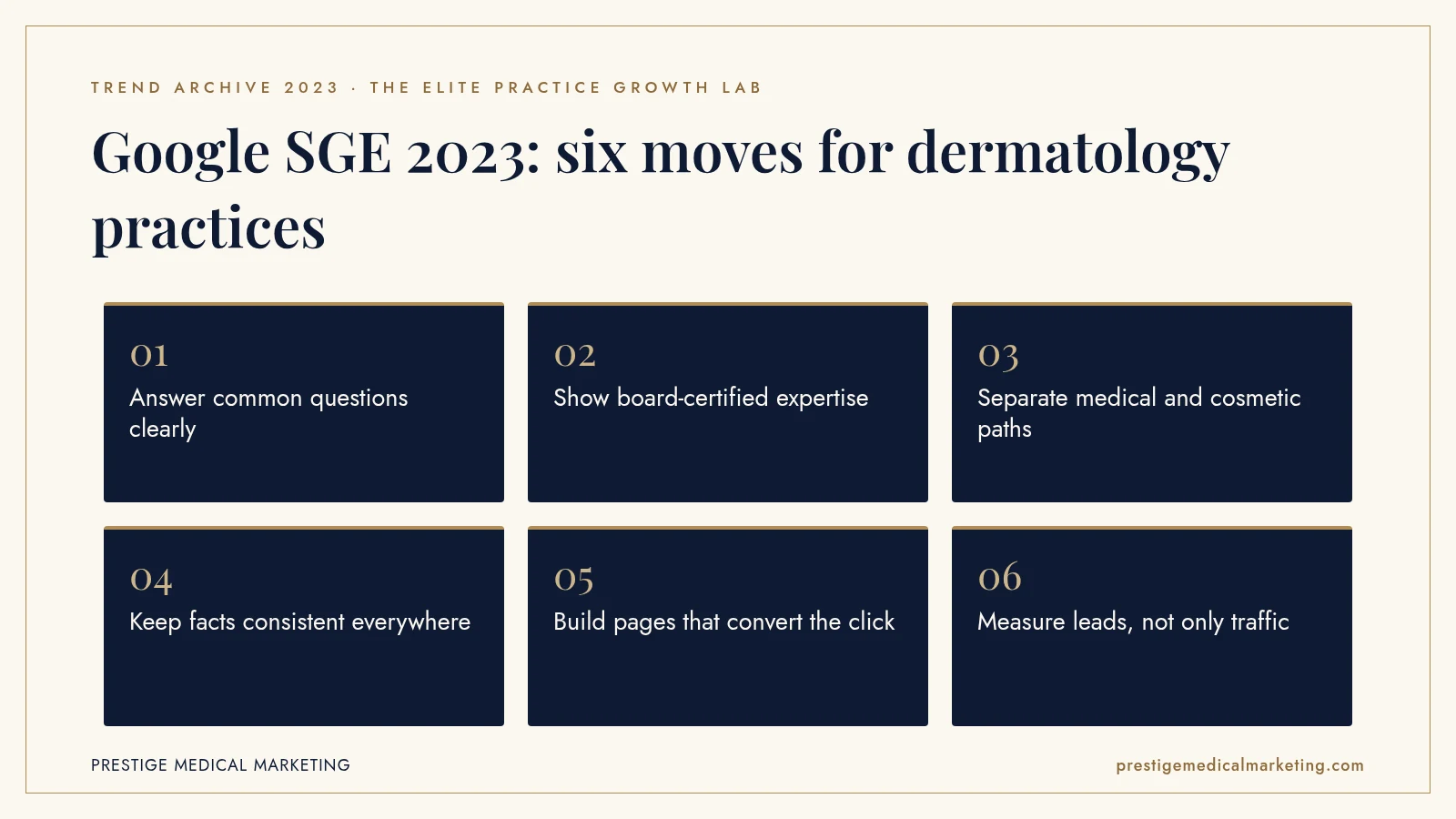
1. Answer common questions clearly
Lead each topic page with a direct, accurate answer in plain language, then go deeper. Clear structure helps both patients and AI systems understand the page. Use descriptive headings and short sections rather than one long block of text.
2. Show board-certified expertise
Credit the dermatologist who wrote or reviewed each page, with accurate credentials. Medical topics get a higher bar for reliability, and named expertise is one of the clearest signals a page can carry.
3. Separate medical and cosmetic paths
A patient worried about a changing mole and a patient researching laser resurfacing need different pages, different language and different booking options. Mixing them confuses patients and search systems alike.
4. Keep facts consistent everywhere
Name, address, phone, hours, services and providers should match across your site, Google Business Profile and major directories.
5. Build pages that convert the click
Searchers who click through after an AI answer are often further along. Show availability, pricing guidance where appropriate and a fast way to book.
6. Measure leads, not only traffic
Track calls, form submissions and booked consultations by source. Traffic alone can fall while qualified demand holds steady, and the reverse can also happen.

From ten blue links to a cited answer
The traditional search results page rewarded a fairly simple goal: rank as high as possible for as many relevant queries as possible. SGE introduced a second goal: be the source an AI system trusts enough to cite. Those goals overlap, but they are not identical.
Content that tends to work well in AI answers is specific, well organized and clearly attributable. A page that defines a condition, explains the main treatment options, notes when to see a dermatologist and credits a qualified author is easy to understand and easy to cite. A page that buries the answer under promotional copy is not.
Dermatology practices also have an advantage generic health publishers lack: local relevance. A searcher asking about treatment options often wants care nearby. Practices with strong local signals, a well-maintained Google Business Profile and consistent reviews are positioned for the moment the question turns from “what is this?” to “who should I see?”
How dermatology searches split
It helps to sort dermatology searches into three rough groups. The first is purely informational: what a condition is, what an ingredient does, how a procedure works. These are the searches AI answers summarize most easily, and the ones where clicks became least predictable after 2023.
The second is evaluative: comparing treatments, understanding costs, judging whether a concern needs a dermatologist at all. AI answers can help here, but searchers often want more depth, and they look for sources they trust. Strong, expert-reviewed pages can still earn that visit and the citation.
The third is transactional and local: a dermatologist near me, a specific treatment in a specific city, a named practice. These searches lead to appointments, and they are shaped by the map results, the Google Business Profile, reviews and the practice website. A practice that wins this third group consistently is in a strong position regardless of what happens to the first.
The trust question in medical search
Google was explicit in 2023 that SGE held some topics to a higher standard. Health information is the clearest example. A wrong answer about a skin lesion is not a minor inconvenience, which is why AI systems lean on sources that look credible and well reviewed.
For a dermatology practice, that is an argument for restraint and accuracy. Avoid overstated claims about results. Say clearly what a treatment can and cannot do, who is a good candidate and what recovery typically involves. Note when something needs an in-person evaluation. That kind of honest content is more useful to patients, and it is the kind of content an AI system can safely summarize.
It also protects the practice. Overstated marketing claims create regulatory and reputational risk that no amount of visibility is worth. Our dermatology practice marketing guide covers how to balance persuasive and accurate.
Where the click still wins
AI snapshots are good at summarizing general information. They are less useful for the decisions that actually fill a dermatology schedule. Which practice has a provider I trust? How soon can I be seen? Does this practice handle both medical and cosmetic concerns? What will my consultation involve?
Those are local, personal and practical questions, and they are best answered on the practice’s own pages, its Google Business Profile and its reviews. In 2023, SGE made it clear that informational traffic would become less reliable. It also made it clear that high-intent decisions would still happen with practices that make choosing them fast, clear and easy.
That shifts where the work goes. Fewer resources go into broad, generic articles. More go into service pages, provider pages, location pages and the booking experience, the places where a patient moves from research to action. It also means treating provider bios, before-and-after policies, consultation details and real office photos as core content rather than afterthoughts, because those are the details a patient checks right before deciding to call.
What 2023 does not tell us
SGE was opt-in, and Google did not publish data on how many people used it or how it affected clicks for any category, including dermatology. Early observations from that period were based on limited samples. We cannot say from 2023 alone how much traffic AI answers took from practice websites. What 2023 does show is the format Google chose, the emphasis on cited sources and the extra care for health topics, all of which carried forward into AI Overviews and AI Mode.
The premium practice advantage
A premium dermatology practice has real expertise, a distinct patient experience and a reputation worth citing. Making that clear to patients and AI systems is the work. See our dermatology services, our full services, who we help and our approach to Google Maps and AI search visibility. Our team works from Austin with practices nationwide.
The bottom line
SGE was an experiment in 2023, but it showed exactly where search was headed: AI answers first, cited sources and fewer casual clicks. Dermatology practices that respond with clear, expert, locally relevant content and an easy path to book stay visible and chosen.
Check if your market is open. We take one practice per specialty per market. Request a market check or call (716) 400-0084.
Frequently asked questions
What was Google SGE?
SGE, the Search Generative Experience, was an experimental Google Search feature announced on May 10, 2023. It showed an AI-generated snapshot with links to sources above some results and let users ask follow-up questions.
Who could use SGE in 2023?
At launch, it was available through Search Labs on Chrome desktop and the Google app for English-language users in the US who opted in. In November 2023, Google expanded it to more than 120 new countries and territories.
Is SGE the same as AI Overviews?
SGE was the experiment. Google launched AI Overviews broadly in the US in May 2024, building on what it learned from SGE.
Did SGE show ads?
Google said ads would continue to appear in dedicated ad slots throughout the page, clearly labeled, including within the new experience.
Why should dermatology practices care about SGE now?
Many dermatology searches are informational questions that AI answers can summarize. Practices that are clear, credible sources are more likely to be cited, and searchers who click through tend to be further along in their decision.
Can a practice control whether it appears in AI answers?
Not directly. Practices can make accurate, well-structured, expert-reviewed content and keep their business information consistent, which supports visibility in both traditional and AI search results.