
Google rolled out AI Overviews to everyone in the U.S. on May 14, 2024, saying it would reach over a billion people by the end of the year. After viral mistakes, Google published an explanation on May 30, 2024 and made more than a dozen technical changes, including limits on satire and user-generated content and additional safeguards for health topics. For practices, it marked the moment search began answering patients before they clicked.
For most of Google’s history, a search for a health question returned a list of links. You picked one, read it and maybe called the practice behind it. In May 2024, that changed for hundreds of millions of people in a single week.
Google rolled out AI Overviews across the United States, placing an AI-generated answer above the links. Two weeks later, the company was publicly explaining why some of those answers had told people to put glue on pizza. Both moments shaped how patients now find medical practices.
This retrospective covers the launch, the stumble, the fixes Google made for health topics, and what it all means for a practice’s visibility today.
What actually happened in 2024
May 14: the launch. At its I/O developer conference, Google announced that AI Overviews, which had been tested as the Search Generative Experience, were rolling out to everyone in the U.S. that week. Google said that meant hundreds of millions of users, and that it expected to bring AI Overviews to over a billion people by the end of the year.
The click claim. In the same announcement, Google said that the links included in AI Overviews get more clicks than if the page had appeared as a traditional web listing for that query. It positioned AI Overviews as a starting point that would send people to a wider range of websites.
The stumble. Within days, screenshots of strange AI Overviews spread across social media. Some were real and some were fabricated. The real errors included suggestions to add glue to pizza sauce and to eat rocks, drawn from satire and forum posts.
May 30: the explanation. Google’s head of Search, Liz Reid, published “AI Overviews: About last week.” She said many viral examples were fake, but acknowledged real problems, often on rare queries with little reliable information, which Google called data voids. Google said it had made more than a dozen technical improvements, including better detection of nonsensical queries, limits on satire and humor content, fewer uses of user-generated content where it could offer misleading advice, and strengthened protections for health topics.
Why it mattered for medical practices
Health questions are among the most common searches, and they are exactly where an AI answer at the top of the page changes behavior most. A patient asking what recovery looks like after a procedure, how a treatment works, or whether a symptom is serious could now get a summarized answer before seeing a single practice website.
That created two shifts at once. First, some informational clicks were likely to disappear because the question was answered on the results page. Second, the pages Google chose to cite inside the answer gained a new kind of visibility. Being the source behind the answer became its own goal.
The May 30 fixes mattered especially for health. Google said it had strengthened guardrails on health-related queries. That pointed to something practices should welcome: on medical topics, Google wanted to lean harder on reliable sources and less on forums and jokes. A practice with careful, clinician-reviewed pages was the kind of source those guardrails were meant to favor.
The viral errors also taught patients something. Many people learned in 2024 that an AI answer can be wrong. For a medical decision, that skepticism sends them looking for a real clinician they can trust, which is where a practice’s own website, profile and reviews come back into the picture.
What typical agencies did
The typical response in 2024 was one of two extremes. Some agencies dismissed AI Overviews as a fad that would be rolled back after the embarrassing errors. Google did not roll it back. It expanded it.
Others went into panic mode and sold “AI optimization” packages without a clear idea of what they were optimizing. Many of those packages were the same keyword articles with a new label, which was the very kind of generic content Google was trying to cite less.
Very few agencies explained the practical middle: AI Overviews draw from pages Google already trusts, so the work is making your pages the clearest, most accurate answer on the topics you treat, and making sure Google understands exactly who your practice is.
What it means for a practice today
AI answers are now a standard part of search. The goal is to be the source those answers rely on, and to be the practice a patient chooses after reading them. Here is how we approach it.
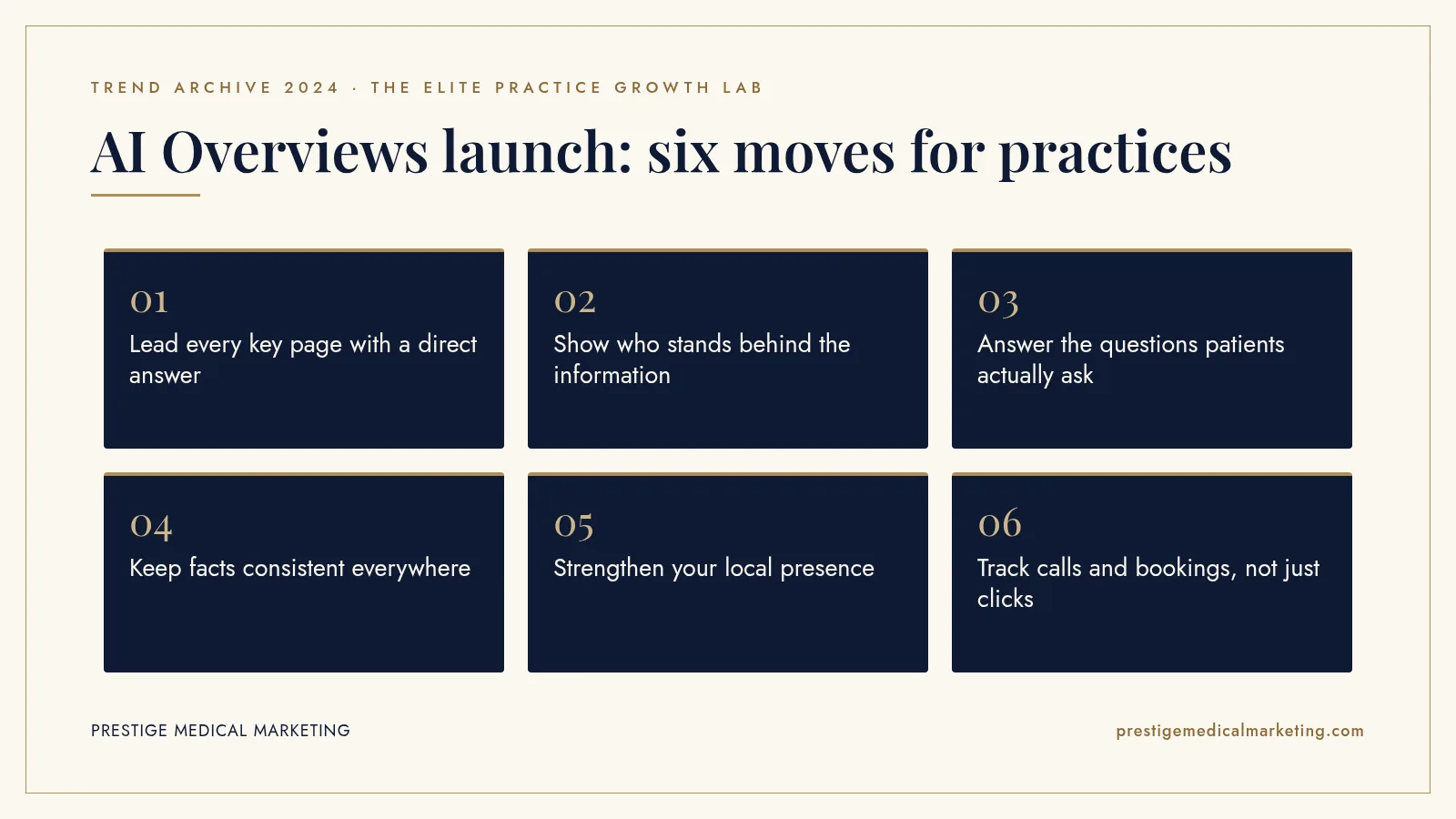
1. Lead every key page with a direct answer
Open each service page with two or three plain sentences that answer the main question a patient asks. That is the passage an AI system is most likely to understand and cite.
2. Show who stands behind the information
Name the clinician, their credentials and their role. Add a reviewed-by line and a date on health content. On medical topics, visible expertise is part of reliability.
3. Answer the questions patients actually ask
Use your front desk’s real call log. Questions about cost ranges, recovery, candidacy and what happens at the first visit make better content than keyword lists.
4. Keep facts consistent everywhere
Your name, address, phone, hours and services should match across your website, Google Business Profile and major listings. AI systems trust consistent information.
5. Strengthen your local presence
For “near me” decisions, your profile, reviews and photos still drive the choice. See our approach to Google Maps and AI search visibility.
6. Track calls and bookings, not just clicks
If AI answers reduce informational clicks but you still book well, that is not a loss. Measure what pays the bills.

Data voids and why your expertise fills them
One of the most useful ideas in Google’s May 30 explanation was the data void: a question so rare, or so poorly covered, that there is little reliable content to draw from. Google said many of the strange answers came from queries like that, where the system reached for satire or a forum comment because nothing better existed.
Medicine is full of data voids at the local and specialty level. How does a particular treatment work at your practice? What does the first visit actually involve? Who is a poor candidate, and what do you recommend instead? What should a patient expect in week two of recovery? Generic health websites rarely answer these questions well because they do not know your practice.
When you publish clear, honest answers to the questions only your clinicians can answer, you are filling a void that search and AI systems have to fill somehow. That makes your page a natural candidate to be cited, and it gives the patient a reason to choose you after reading the answer.
What patients learned in 2024
It is worth remembering how the public experienced AI Overviews in their first weeks. The launch was big news. The errors were bigger news. Many patients came away with a reasonable conclusion: AI can summarize, but it can also be confidently wrong.
That conclusion helps practices. A patient who reads an AI summary about a treatment still wants to know who will actually provide it, whether that person is qualified and what other patients say. The summary starts the research. Your website, profile and reviews finish it. Practices that understood this kept investing in trust signals rather than chasing every new feature.
It also means your pages should be written for a patient who has already read a summary. Skip the generic definition they just saw, and go straight to what is specific to your practice: your approach, your clinicians, your process and how to book. That is the content a summary cannot replace.
How to check your own visibility in AI answers
You do not need special software to get a first read on how AI answers treat your practice. Search the questions your patients ask most, in plain language, the way they would type them on a phone. Note whether an AI answer appears, which sources it cites, and whether any of them are yours or a competitor’s.
Then search your practice name and your main services with your city. Look at whether the information about you is accurate, whether your profile appears, and whether reviews show up. Errors here usually trace back to inconsistent listings or thin pages, both of which are fixable.
Repeat the exercise every few months. AI answers change as Google updates its systems and as new content appears. A simple, repeated check gives you a baseline that a monthly ranking report never will.
What a practice cannot control, and what it can
A practice cannot decide whether an AI answer appears for a given search, which sources Google picks, or how the summary is worded. Those are Google’s decisions, and they change often. Spending energy trying to force a specific answer is usually wasted.
A practice can control the quality and clarity of its own information. It can make sure its services are described accurately, its clinicians are named with their credentials, its location details are consistent and its patients leave genuine reviews. It can answer real patient questions better than anyone else in its market. Those are the inputs every search and AI system depends on, and none of them go out of date when a feature changes.
Think of it as the difference between chasing a placement and earning a reputation. Placements come and go with every product update. A reputation for clear, accurate, expert information keeps paying off across Google, AI assistants and word of mouth alike.
What 2024 does not tell us
Google did not release data on how AI Overviews affected clicks to medical websites specifically, and studies by outside firms measured different samples with different results. We do not know exactly how Google selects sources for a given answer, or how its health guardrails work in detail. We also cannot say how often AI Overviews appear for any one practice’s local searches. What 2024 does show is that Google committed to AI answers at the top of Search and chose to make health answers more cautious, not less.
The premium practice advantage
AI Overviews reward clear, credible sources. A premium practice has clinicians with real expertise, a distinctive approach and a reputation built on outcomes. Those are the inputs AI answers need and the reasons a patient chooses one practice over another after reading them.
We cover this further in how to get your practice recommended by AI. Our services connect pages, profiles and tracking, and our specialties span aesthetics, wellness and specialty medicine. Our team works from Austin with practices nationwide.
The bottom line
May 2024 put AI-written answers at the top of Google for hundreds of millions of people, and the stumble that followed pushed Google toward more careful health answers. For practices, the opportunity is to be the trustworthy source behind those answers and the obvious choice after them.
Check if your market is open. We take one practice per specialty per market. Request a market check or call (716) 400-0084.
Put this playbook to work: see how it applies to med spa marketing.
Frequently asked questions
When did AI Overviews launch in the U.S.?
Google announced at its I/O event on May 14, 2024 that AI Overviews were rolling out to everyone in the U.S. that week, reaching hundreds of millions of users, with plans to reach over a billion people by the end of 2024.
What went wrong after the launch?
Some AI Overviews gave odd or wrong answers that spread widely online, including suggestions to add glue to pizza and to eat rocks. Google said many viral screenshots were fake, but acknowledged real errors, often tied to satirical content, forum posts or rare questions with little good information available.
What did Google change for health topics?
In its May 30, 2024 update, Google said it had made more than a dozen technical improvements, including better detection of nonsensical queries, limits on satire and humor content, fewer uses of user-generated content where it could mislead, and strengthened guardrails for health-related queries.
Do AI Overviews send traffic to websites?
Google said in May 2024 that links included in AI Overviews get more clicks than if the page had appeared as a traditional web listing for that query. Google did not publish overall traffic data, and independent studies have reached different conclusions about clicks.
Can a medical practice appear in AI Overviews?
Yes, as a cited source. Google draws on pages it already ranks and trusts. Clear, accurate, well-organized pages written with real clinical expertise give a practice the best chance of being cited.
Should practices block Google from using their content in AI Overviews?
For most practices, no. Being cited in an answer can put your name in front of patients at the moment they are researching. Blocking can also limit how your pages appear in regular results. Discuss tradeoffs with your web team before changing any settings.