
Google's Search Console reports clicks and impressions from AI features such as AI Overviews and AI Mode within the Web search type of the Performance report. On November 20, 2025, Google announced a branded queries filter that automatically separates branded from non-branded searches, rolling out gradually to eligible sites. For practice owners, non-branded performance is the clearest sign that SEO is reaching new patients, since branded searches mostly come from people who already know the practice.
Most practice owners have seen an SEO report that looks great. Clicks are up. Impressions are up. Rankings are up. But the phone does not seem to ring more, and new patient numbers barely move. Something clearly does not add up.
Often, the explanation is simple. Many of those clicks come from people searching for the practice by name. They already knew you. They would have found you anyway. SEO did not bring them.
In 2025, Google gave every website owner an easier way to see that difference. This retrospective explains what changed in Search Console and how practice owners can use it to judge their marketing honestly.
What actually happened in 2025
AI features in the data. As AI Overviews expanded and AI Mode launched in the US in May 2025, website owners wanted to know how those features affected traffic. Google’s documentation on AI features and your website says sites appearing in AI features such as AI Overviews and AI Mode are included in overall search traffic in Search Console, reported in the Performance report within the Web search type. They are not broken out as a separate report.
The branded queries filter. On November 20, 2025, Google announced a branded queries filter for the Search Console Performance report. It automatically separates branded queries, those that include your brand name, variations and misspellings, or refer to your unique products or services, from non-branded queries. Google said the classification is determined by an internal, AI-assisted system rather than keyword rules, and that it has no effect on ranking. It also added an Insights card showing the split of clicks between branded and non-branded traffic.
Query groups. The branded filter followed a launch the previous month that Google described as Query groups, another way to analyze performance by type of query in the same report. Together, the two changes moved Search Console from a list of keywords toward a view of what kinds of searches bring people to a site, which is much closer to how practice owners think about patients.
Availability. Google said the filter would roll out gradually, and only for top-level properties with sufficient query and impression volume. The post was later updated to say it was available to all eligible sites. Google also noted that some queries may occasionally be misidentified.
Why this mattered for private practices
Google’s own announcement explains the core idea: branded queries typically lead to higher-ranking pages and higher click-through rates, while non-branded queries show how new users find your content without initially intending to visit your site.
For a practice, that distinction is everything. A patient searching your practice name is usually already sold, often because of a referral, a review, an ad or a previous visit. A patient searching “medical weight loss near me” or “best dermatologist for acne scars” is still choosing. That second group is where SEO earns its keep.
Before 2025, separating the two required setting up custom filters and knowing every variation of your name. Many owners never did it. Many agencies never offered it. Now the split is a few clicks away for eligible sites.
What typical agencies did
Many SEO reports show total clicks and impressions. If branded searches are growing, perhaps because the practice got more referrals, ran ads or opened a new location, the total grows too, and the SEO report takes credit.
Some agencies also highlight rankings for long lists of keywords, many of which get little search volume or bring few patients. Others report “traffic” that includes visits from people looking for jobs or from outside the service area.
We report differently. We separate branded from non-branded performance, focus on the queries that bring new patients and connect search data to booked consultations. If non-branded visibility is not growing, we want to know first, and so should you. Our patient quality blueprint explains why we care more about who arrives than how many.
What it means for a practice today
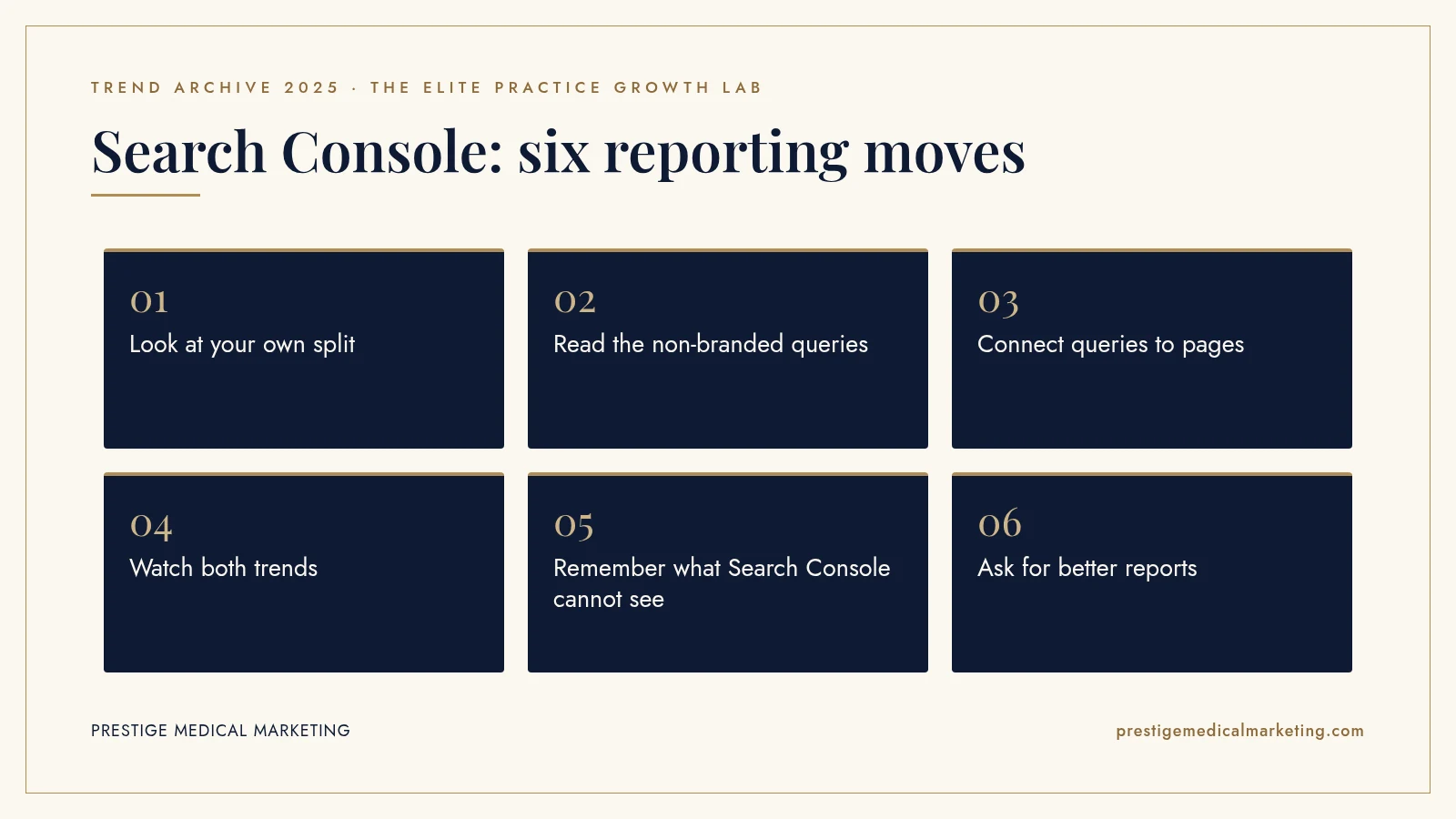
1. Look at your own split
Open Search Console, go to the Performance report and apply the branded filter if it is available for your property. Note how many of your clicks are branded versus non-branded, and how each has changed over the past year.
2. Read the non-branded queries
Look at the top non-branded queries. Are they services you offer, in places you serve? Do they reflect the patients you want? A practice that ranks mainly for informational questions from far away may have traffic but few patients.
3. Connect queries to pages
See which pages non-branded searchers land on. Strong service pages, such as a specific treatment or condition page, should appear. If they do not, those pages may need work.
4. Watch both trends
Branded growth is good news too. It usually reflects reputation, referrals and broader marketing. But it is a different story from SEO growth. Track both and know which is which.
5. Remember what Search Console cannot see
Search Console covers Google Search, including its AI features. It does not show how often ChatGPT or other assistants mention you, or how patients find you through maps and reviews outside of these reports. Combine it with booking data and simple questions to new patients, such as “How did you hear about us?”
6. Ask for better reports
If you work with an SEO provider, ask for non-branded performance specifically. Our predictability and scaling guide covers what a useful marketing report includes.

AI Mode and the click problem
Because AI Mode and AI Overviews are counted within Web results, a practice may see impressions rise while clicks fall, as more searches are answered on the results page. Our retrospective on how AI Overviews affected med spa clicks covers that pattern.
That makes the branded split even more useful. If non-branded impressions are stable or growing but clicks are falling, AI features may be answering more questions directly. The response is not to panic. It is to make sure your practice is the one cited and recommended, with strong reviews, accurate profiles and pages that answer specific questions well. Our guide on getting recommended by AI explains how.
Common misreadings to avoid
“Our traffic doubled, so SEO is working.” Check the split first. If most of the growth is branded, it may reflect referrals, reviews, ads, press or a new location rather than SEO.
“Clicks fell, so SEO is failing.” Not necessarily. If impressions are steady and AI features are answering more questions on the results page, clicks can fall even when visibility holds. Look at bookings and calls before drawing any conclusions.
“We rank number one for 200 keywords.” Rankings matter only for searches real patients make, in places you serve, for services you want to sell. Ten strong non-branded queries can be worth more than two hundred obscure ones.
“Branded traffic is not real growth.” It is real growth, just a different kind. A growing number of people searching your name is a sign of reputation and word of mouth. It deserves its own attention: make sure your profile, reviews and website give those searchers a great first impression and an easy way to book.
Using branded data to protect your reputation
The branded view has another use. Look at the queries people pair with your name. Searches like “[practice name] reviews,” “[practice name] prices” or “[practice name] complaints” tell you what people want to know before they book. Make sure your website answers those questions clearly and that your review profiles are healthy. Our guide on reputation and premium pricing covers how reputation supports the prices premium practices charge.
What good non-branded growth looks like
For a typical private practice, healthy non-branded growth tends to show up in specific ways: more impressions and clicks for service-plus-location searches, such as “Botox [your city]” or “testosterone therapy near me”; growing visibility for condition and treatment questions related to your services; and steady increases in organic bookings from patients who say they found you by searching.
It is usually not a sudden spike. It is steady progress across many specific queries, built by better pages, a stronger Google Business Profile, more reviews and accurate information everywhere patients look.
Practice type examples
Dermatology. Branded traffic often reflects existing patients booking follow-ups. Non-branded growth for cosmetic treatments shows whether the practice is attracting new aesthetic patients. See our dermatology marketing.
Men’s health. Many patients search discreetly with non-branded terms. Non-branded visibility is the main way new patients find these clinics. See our men’s health marketing.
Functional medicine. Patients often research conditions and approaches before choosing a provider, so non-branded informational queries may matter more than in other fields, provided they lead to booked consultations. See our functional medicine marketing.
A five-minute monthly review
You do not need to be an analyst to use this. Once a month, open Search Console and check four things. First, non-branded clicks compared with the same month last year. Second, the top ten non-branded queries, and whether they match services you want to grow. Third, the pages those queries lead to. Fourth, any sudden drops, which can signal technical problems or Google updates. Write the numbers in a simple spreadsheet next to your new patient count. Over a few months, the relationship between non-branded search and real bookings will become clear, and you will be able to tell quickly whether any marketing investment is moving the number that matters.
What 2025 does not tell us
The branded filter is not available for every property, and Google acknowledges some queries may be misclassified. We do not have reliable public data on how branded and non-branded traffic typically split for private practices, and the right balance varies by specialty, age of practice and market. Search Console does not cover AI assistants outside Google. Use it as one important view, alongside booking data and patient feedback.
The premium practice advantage
Typical agencies report the biggest numbers they can find. Premium practices ask harder questions: how many new patients found us, how, and what did they book? The branded filter made one of those questions much easier to answer. Practices that use it hold their marketing accountable, and invest in what actually grows the business.
That is how we report for practices across every specialty we serve, with search, maps and AI visibility handled through our maps and AI search service. Our team works from Austin with practices nationwide.
The bottom line
In 2025, Search Console counted AI Overviews and AI Mode traffic inside Web results, and on November 20 Google announced a branded queries filter that separates searches for your name from everything else. For practice owners, non-branded performance is the clearest view of whether SEO is reaching new patients. Check your own split, read the non-branded queries and ask for reports that connect search to bookings.
Check if your market is open. We take one practice per specialty per market. Request a market check or call (716) 400-0084.
Frequently asked questions
What is the Search Console branded queries filter?
Announced on November 20, 2025, it is a filter in the Search Console Performance report that automatically separates queries that include your brand, or refer to your unique products or services, from all other queries. It uses an AI-assisted system rather than keyword rules.
Why does the branded versus non-branded split matter for a practice?
Branded searches usually come from people who already know your practice, often from referrals, reviews or past visits. Non-branded searches, like "dermatologist near me," show how new patients find you. SEO's job is mainly to grow non-branded visibility.
Does Search Console show AI Mode traffic?
Google says sites appearing in AI features such as AI Overviews and AI Mode are included in overall search traffic in Search Console, reported in the Performance report within the Web search type. They are counted as part of the totals rather than broken out separately.
Who can use the branded filter?
Google said it was available only for top-level properties, not URL path or subdomain properties, and only for sites with sufficient query and impression volume. Google later noted it became available to all eligible sites.
Can the branded filter be wrong?
Google says that because brand classification is dynamic and contextual, some queries may occasionally be misidentified. Use it as a guide and spot-check the queries in each group yourself.
What should I ask my SEO provider?
Ask for non-branded clicks and impressions over time, the top non-branded queries, which pages they lead to and how many new patient bookings came from organic search. Total traffic alone can hide a lack of real growth.