
In 2025, Google's AI Overviews reached more than 2 billion monthly users, and Pew Research found people clicked a result in 8% of visits with an AI summary versus 15% without one. For med spas, the click that used to land on a treatment page often never happened. The fix is to become the source the summary trusts, and to win the map pack and the phone call that still follow.
For years, the med spa marketing game had one simple shape. Someone typed a treatment question into Google. Ten blue links came back. The best-optimized treatment page got the click, the click became a consult, and the consult became a patient who came back every three or four months.
In 2025, Google broke that shape. It started answering the question itself, right at the top of the page, and a big share of people stopped there. Nobody at Google called it “taking your click.” But if you owned a med spa and watched your Search Console numbers that year, that is what it looked like.
This is a retrospective on what actually happened, what the public data shows, and what it means for a med spa owner today. Every number below links to its source. No guesses dressed up as facts.
What actually happened in 2025
AI Overviews were not new in 2025. Google launched them in the U.S. in 2024. What changed in 2025 was scale and placement. Three moments matter.
May 20, 2025: Google I/O. Google said AI Overviews had passed 1.5 billion monthly users across more than 200 countries and territories, and that in big markets like the U.S. and India, AI Overviews were driving more than a 10% increase in usage for the kinds of queries that show them. The same day it rolled out AI Mode, a full conversational search experience, to everyone in the U.S.
July 22, 2025: Pew Research. Pew published the cleanest independent look at behavior. It tracked the real browsing of 900 U.S. adults in March 2025. When a search showed an AI summary, users clicked a traditional result in 8% of visits, compared with 15% when no summary appeared. They clicked a link inside the summary itself in just 1% of visits. And they were more likely to end their browsing session entirely after a page with a summary, 26% of the time versus 16%.
July 23, 2025: Alphabet earnings. One day later, Google said AI Overviews had reached more than 2 billion monthly users, and AI Mode had passed 100 million monthly active users in the U.S. and India.
Add the industry data and the pattern holds. Ahrefs compared 300,000 keywords from March 2024 to March 2025 and found that the presence of an AI Overview correlated with a 34.5% lower click-through rate for the top-ranking page. That is a correlation study, not a controlled experiment, and Ahrefs says so. But it lines up with what Pew saw from the user side.
Why med spas felt it more than most
Med spa search has a particular structure. A large share of it is research. People want to know how long Botox lasts, whether filler migrates, what microneedling feels like, how many laser sessions they need, what a fair price range is. These are exactly the questions an AI summary answers well, in three tidy paragraphs, without a click.
For a decade, those research questions were the top of the med spa funnel. Agencies sold “content marketing” as a volume game: publish four articles a month on treatment basics, rank for the question, capture the reader, retarget them, book the consult. In 2025, the first step of that funnel started to evaporate. The reader got the answer and never arrived.
Three things made it sharper for aesthetics than for, say, a plumber.
The questions are generic. “How long does Botox last” has a broadly agreed answer. When every med spa article says the same thing, the summary can say it once, and nobody needs to click.
Trust is the real decision. Patients choose a med spa on the injector, the results and the feel of the place. An AI summary can explain a treatment. It cannot show your before-and-afters, your provider’s credentials or how your front desk treats people. That is where the click still has value, and where most sites were weakest.
Booking intent is local. When someone is ready to book, they search a treatment near them, and Google answers with the map pack and business listings. The research click shrank. The booking moment moved to the map and the phone.
What most agencies did, and why it failed
Here is what we watched typical agencies do in 2025. They kept the content calendar running. Four posts a month, the same treatment explainers, now often written by AI tools in a fraction of the time. Then they sent a monthly report with rankings and “impressions are up” in green.
Impressions were up. That was the problem. Google was showing those pages more often inside results that people no longer needed to click. A report built on rankings and impressions looked healthy while booked consults from organic search went nowhere.
The other common move was panic: rebuilding the whole website, or dumping budget into paid social to replace the lost traffic. Neither addressed the actual shift, which was that the answer had moved, and the practice needed to be part of it.
We take the opposite view. Clicks were always a stand-in. What a med spa owner cares about is booked consults from high-value patients who come back. In 2025 the path to those consults changed shape, so the work had to change shape with it.
What it means for a med spa owner today
The lesson of 2025 is not “SEO is dead.” It is that there are now three places a patient can meet your practice before they ever call, and you need to win all three.
The answer. The AI summary or the AI Mode response. You want your pages to be the ones it cites, and your practice to be the one it names when someone asks for a recommendation. Our guide on how to get your practice recommended by AI goes deeper on this.
The map. When intent turns to booking, the map pack and your Google Business Profile do the selling. That profile needs every treatment, real photos, steady reviews and answers to common questions. Our med spa Google Business Profile playbook covers it step by step.
The conversation. Whoever answers the phone or the web form first usually wins the patient. Fewer clicks means each inquiry is worth more, so a slow callback costs more than it used to. We wrote about the hard numbers behind that in what missed calls cost medical practices.

The 2025 lesson, turned into a playbook
If we were walking into a med spa today and the organic numbers looked like 2025 hit them, this is the order we would work in.
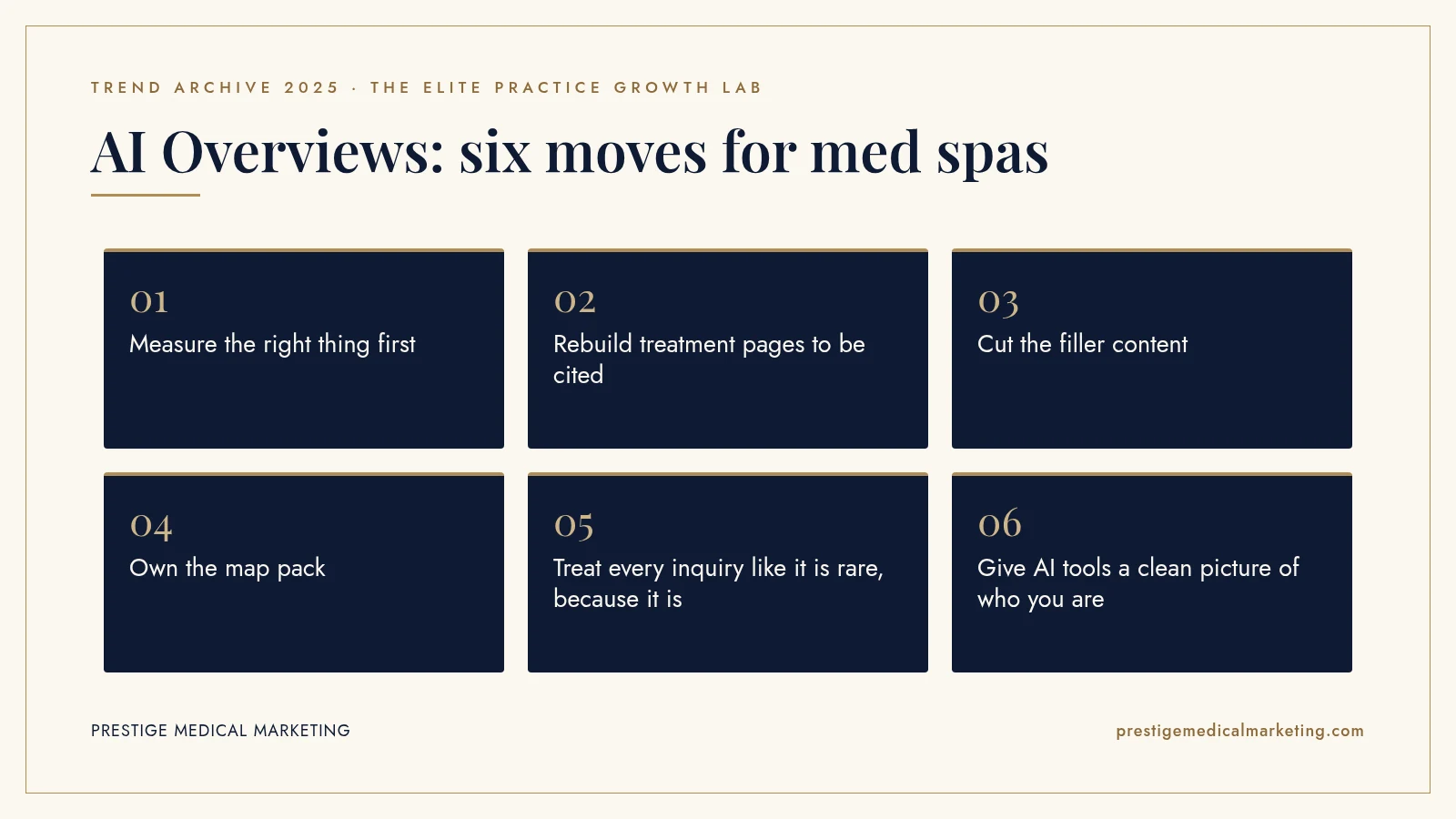
1. Measure the right thing first
Pull twelve months of Search Console data for your treatment pages. Split question-style queries from booking-style queries. Then match organic sessions to booked consults through your booking system or call tracking. If you only measure rankings, you will keep paying for work that looks good and books nothing.
2. Rebuild treatment pages to be cited
Every treatment page should open with a direct, two or three sentence answer to the main question. Follow it with what your practice does differently: who performs the treatment, their training, how you assess candidates, what results realistically look like, downtime and risk in plain language, and real before-and-after photos with consent. Google’s own guidance on helpful, people-first content rewards exactly this kind of first-hand experience.
3. Cut the filler content
Fifty thin articles that repeat each other do not help you in an AI world. Merge them into fewer, stronger pages. One great page on lip filler beats eight weak ones on lip filler variations.
4. Own the map pack
Build your Google Business Profile like a second website: every treatment listed, categories right, fresh photos of your real space and team, honest reviews requested after every visit, and questions answered. For a deeper walkthrough of med spa search overall, see our med spa SEO guide.
5. Treat every inquiry like it is rare, because it is
With fewer clicks, each call and form is worth more. Answer in seconds, follow up the same day, and track it to a booked consult. This is where most practices lose more patients than they ever lost to AI Overviews.
6. Give AI tools a clean picture of who you are
Consistent name, address and phone everywhere. Clear provider bios. A clean, crawlable site with structured data. Third-party mentions in places that matter locally. AI systems summarize what they can find and trust. Make the facts about your practice easy to find and hard to misread.
What the 2025 data does not prove
Honesty matters here, because a lot of agencies used these studies to sell fear. Pew measured all kinds of searches, not med spa searches. Ahrefs measured a correlation across a large keyword set, not your market. Google’s user numbers count anyone who saw an AI Overview, not people who chose a provider because of one.
So none of this tells you exactly how much your practice lost, or whether it lost anything at all. Some med spas with strong brands and busy map listings saw little change. Others that leaned on generic articles saw organic sessions fall while impressions climbed. The only way to know which one you are is to look at your own Search Console and booking data side by side.
What the data does prove is direction. More people got answers without clicking, and Google kept expanding the feature that made that possible. Planning as if that trend will reverse is the riskier bet.
Why this is a premium-practice advantage, not a threat
Here is the part most agencies miss. AI Overviews hurt generic content the most. Generic content was always the weapon of the cheapest competitors: the discount injector with a content mill, the franchise with templated pages.
When the summary handles the generic questions, what is left to win is trust, proof and experience. That is home ground for a premium med spa with skilled providers, real results and a front desk that knows how to treat people. The 2025 shift took away a cheap shortcut. It did not take away the advantages that actually make a patient choose you.
This is how we build med spa marketing at Prestige: from our team in Austin, for practices nationwide, one practice per specialty per market. We aim at the answer, the map and the conversation, and we report on booked consults, not impressions. If you want to see how the full system fits together, start with the Prestige System for medical practice marketing, or read our full med spa marketing guide.
The bottom line
2025 was the year the med spa click got smaller. Google answered more questions itself, people clicked less when it did, and the practices still measuring success by rankings did not notice until consults slowed.
The owners who came out ahead did three things. They measured booked consults instead of traffic. They rebuilt their treatment pages to be the source worth citing. And they treated the map pack and the phone as the main event, because that is where the booking actually happens now.
Check if your market is open. We take one practice per specialty per market. Request a market check or call (716) 400-0084.
Put this playbook to work: see how it applies to plastic surgery marketing and dermatology practice marketing.
Frequently asked questions
Did AI Overviews really reduce clicks to med spa websites in 2025?
The public data points that way. Pew Research tracked 900 U.S. adults in March 2025 and found link clicks happened in 8% of visits that showed an AI summary, compared with 15% when no summary appeared. Ahrefs found AI Overviews correlated with a 34.5% lower click-through rate for the top result. Neither study is med spa specific, so check your own Search Console data before you draw conclusions.
Which med spa searches trigger AI Overviews?
Informational questions are the most likely: how long Botox lasts, filler versus biostimulators, laser downtime, cost ranges. Searches with clear local booking intent, like a treatment plus "near me," still lean on the map pack and business listings. Search your own top treatments in a private window and note which ones show a summary.
Can a med spa get cited inside an AI Overview?
Yes. Google shows links alongside its summaries, and those links come from pages that answer the question clearly and credibly. A treatment page with a direct answer near the top, named provider credentials, honest risk and downtime information and a clean structure gives Google something worth citing.
Should a med spa stop writing educational content because of AI Overviews?
No. Write fewer, better pages. Generic articles that restate what every site says lose the most. Pages built on your providers' real experience, your actual treatment process and your pricing approach are harder for a summary to replace and more likely to be cited.
Is SEO still worth paying for if AI answers take the clicks?
Yes, if the work is aimed at the right targets: the Google Business Profile, treatment pages that earn citations, reviews and fast follow-up on every inquiry. SEO sold as a monthly rankings report was already weak before 2025. It is weaker now.
How do I see AI Overview impact in my own data?
Compare impressions and clicks for your treatment pages in Google Search Console, year over year. Rising impressions with flat or falling clicks on question-style queries is the usual pattern. Pair that with call tracking and booking data so you judge the business result, not just the traffic.