
A missed call costs a practice the lifetime value of the patient who would have booked, plus the marketing spend that made the phone ring. Estimate it with your own numbers: missed calls per month, times the share that were new patients, times your booking rate, times average patient value. Fix it with coverage, fast callbacks and tracking.
Your marketing works. The phone rings. Then it rings out. It’s one of the most expensive moments in a practice, and one of the least visible, because nobody records the patient who never got through.
Where practices get this wrong, and how we do it instead
They assume callers will leave a voicemail. We assume they won’t.
New patients rarely wait. They call the next practice on the map. We treat every unanswered call as a lost patient until someone reaches them.
They blame the front desk. We fix the system.
Your front desk is checking patients in, taking payments and answering questions at the same time. Missed calls are usually a coverage problem, not a people problem. We map when calls are missed and add coverage where it is needed.
They buy more leads. We stop the leak first.
More ad spend into a phone line that goes to voicemail just costs more. We fix answering, callbacks and follow-up before we scale campaigns.
They guess. We measure.
We use your own call data, not industry averages, to show what missed calls cost and how many patients were recovered. No invented numbers.
They hide behind contracts. We earn the work monthly.
Month-to-month terms and one practice per specialty per market. Our monthly ROI reporting shows every call, callback and booking by source.

Check if your market is open. We partner with one practice per specialty per market. Request a market check or call (716) 400-0084.
Why missed calls hurt more than they seem
A new patient searching for an elective treatment often has a short list of practices. If you don’t answer, the next one might. Many won’t leave a voicemail. You’ve paid to attract them and lost them at the final step.
The damage compounds. A missed new patient is not one lost visit. It is the treatment plan, the follow-up visits, the referrals they would have sent and the review they would have written. For elective and cash-pay practices, a single new patient can be worth far more than the first appointment suggests.
Estimate your own cost
Skip industry averages and use your own numbers:
- Missed calls per month (from your phone system or call tracking).
- Share that were likely new patients (check a sample).
- Your booking rate for new-patient calls that are answered.
- Average value of a new patient over their first year (or lifetime).
Multiply them together. Even with conservative assumptions, most practices find the result worth fixing quickly. Run the math twice: once with first-visit value only, and once with first-year value. The gap between those two numbers shows how much a missed call really costs.
When calls get missed
Check your missed calls by hour and day. Common gaps: before opening, lunch, late afternoon when the front desk is checking patients out, evenings and weekends. Those are your priorities. Look at Mondays and the days after holidays, too, when call volume often spikes. A practice that answers every call on a quiet Thursday can still miss a third of them on a busy Monday morning.
How to stop missing calls
- Cover the gaps: overflow staff, an answering service, or a 24/7 AI receptionist that answers questions and books appointments.
- Call back fast: return every missed call within minutes, not hours.
- Text back automatically: an instant “sorry we missed you, can we help?” message recovers many callers.
- Script the first call: warm, helpful and focused on booking a consult.
- Track it: review missed and recovered calls weekly.
The missed-call fix, step by step
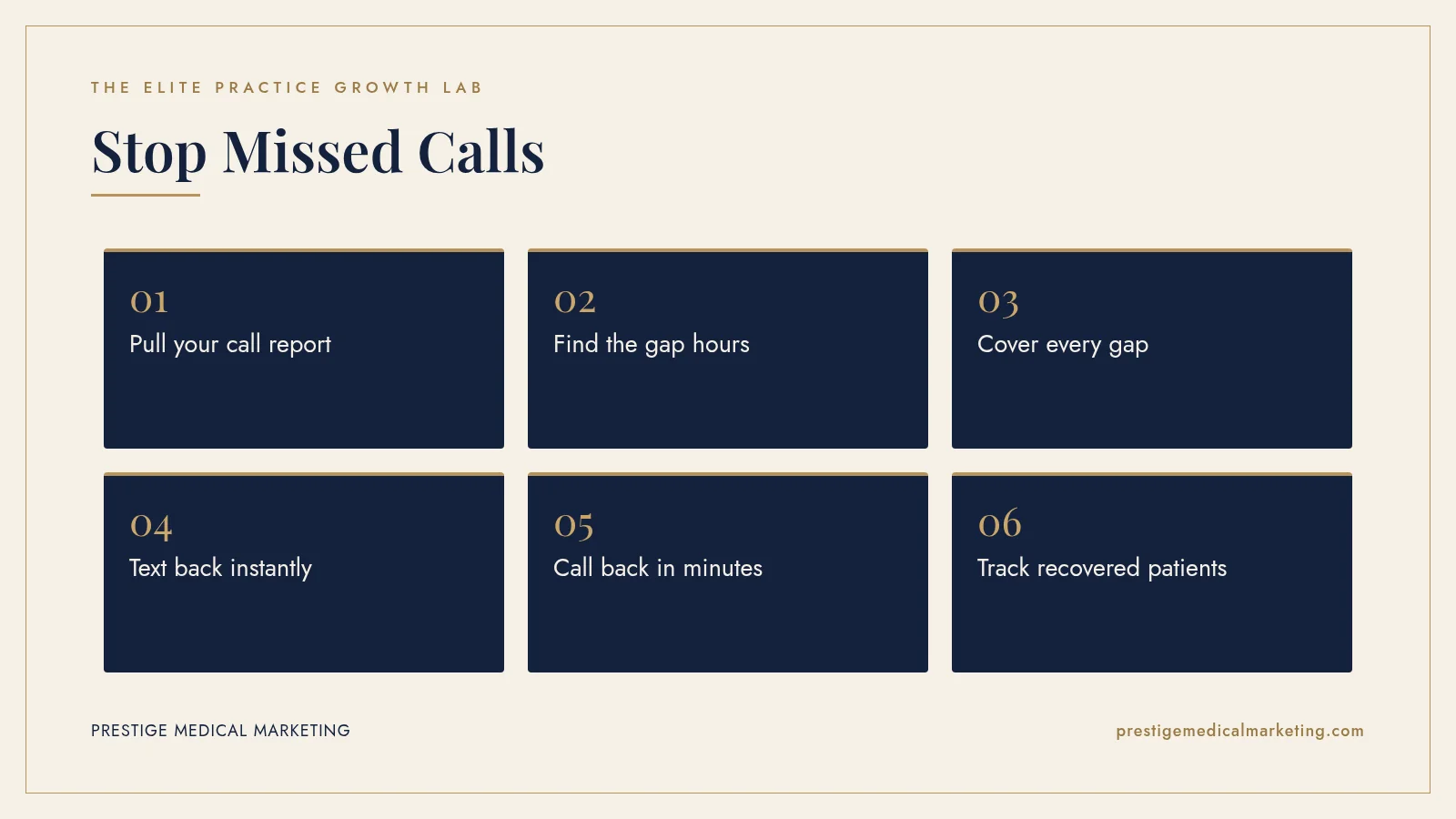
Step 1: Pull your call report
Export the last ninety days of calls from your phone system or call tracking. You need every call, whether it was answered, abandoned or sent to voicemail, plus the time of day.
Step 2: Find the gap hours
Sort missed calls by hour and weekday. Most practices see the same clusters: the first hour of the day, lunch, late afternoon checkouts, evenings and weekends.
Step 3: Cover every gap
Match coverage to the gaps. Stagger front desk lunches, add an overflow line that rings a second team member, use an answering service or a 24/7 AI receptionist trained on your services, hours and booking rules.
Step 4: Text back instantly
Set up an automatic text to every missed caller within a minute: who you are, an apology for missing them and a direct link to book or a promise of a quick callback.
Step 5: Call back in minutes
Assign one person per shift to work the missed-call list. Call back within minutes, try again later the same day and once more the next morning.
Step 6: Track recovered patients
Mark every recovered caller who books. Review missed, recovered and booked calls weekly, and share the numbers with the team so everyone sees the progress.
Make answering part of the marketing system
Ads and SEO shouldn’t be judged on clicks alone. When every call is answered and tracked to a booking, you finally see what your marketing produces. That’s why call handling is part of our patient acquisition system, not an afterthought.
After-hours options compared
- Voicemail only: cheapest and least effective. Many new patients hang up.
- Answering service: a live person takes a message. Better, but the patient still waits for a callback to book.
- On-call staff: works for small practices, but burns people out over time.
- AI receptionist: answers instantly, handles common questions and books into your schedule, then hands clinical questions to your team. Set it up carefully and review its conversations regularly.
The right answer is often a mix: live staff during the day, an AI receptionist or service for overflow and after hours, and a fast callback routine for everything else.
Scripts for callbacks and text-backs
Keep messages short, warm and focused on the next step. A simple text-back: “Hi, this is the team at [practice]. Sorry we missed your call. You can book here [link], or reply and we’ll call you right back.” A simple callback opener: “Hi, this is [name] from [practice], returning your call. How can I help today?” Then listen, answer clearly and offer two specific appointment times.
Missed forms and messages count too
Phone calls are only part of the picture. Website forms, booking requests, Google Business Profile messages and social media inboxes all bring in new patients, and all of them can go unanswered. Route every channel into one place, set a response-time target for each and assign an owner per shift. A form that waits until tomorrow morning is a missed call in slow motion.
Train the team, then trust them
Good coverage still depends on people. Give your front desk a short guide for new-patient calls: how to greet, what to ask, how to handle price questions and how to offer two specific appointment times. Role-play the hard calls once a month. Celebrate recovered bookings in team meetings, so answering every call becomes part of the culture rather than a rule.
Privacy and compliance
Calls, texts and AI tools all handle patient information. Make sure every vendor that touches protected health information will sign a business associate agreement where required, and follow the HIPAA Privacy Rule. Keep text-backs free of health details, and train staff and tools to move clinical questions to the right person.
A worked example (use your own numbers)
To show how the math works, here is a purely hypothetical practice. Replace every figure with your own:
- Missed calls per month: A
- Share that are likely new patients: B
- Booking rate when those calls are answered: C
- Average first-year value of a new patient: D
Estimated monthly revenue at risk = A × B × C × D. Then compare it with the cost of better coverage. For most practices, even a modest number of recovered patients pays for the fix.
Don’t forget the marketing cost
Each missed call also wastes the marketing spend that produced it. When you calculate return on ad spend, include missed calls, or your campaigns will look weaker than they really are. Many practices cut a campaign that was working, when the real problem was the phone line behind it.
What to track every week
- Total calls, answered calls and missed calls by hour
- Average time to call back a missed caller
- Missed callers reached, and how many booked
- New patients booked from phone calls, by marketing source
- Revenue from those patients over time
When missed calls drop and recovered bookings rise, your marketing return rises with them, without spending another dollar on ads.
The bottom line
Missed calls are a silent leak in your marketing budget. Work out what they cost using your own numbers, cover the gaps, call back fast and track everything. Then watch the same marketing budget produce more patients.
Want help finding the leaks? Check if your market is open or call (716) 400-0084. Read our guide to fixing lead leakage, too. We help plastic surgery, med spa and other private practices answer every opportunity. We’re based in Austin, Texas, and work with practices nationwide.
Put this playbook to work: see how it applies to an AI receptionist for your practice and fast patient follow-up and booking.
Frequently asked questions
How can I estimate what missed calls cost my practice?
Multiply missed calls per month by the share that were likely new patients, then by your usual booking rate, then by your average patient value. Use your own call reports and records rather than industry averages.
Do patients leave voicemails?
Many do not, especially new patients choosing between several practices. Assume an unanswered call may be a lost patient unless you call back quickly.
Is an AI receptionist safe for a medical practice?
It can be, when it is set up for scheduling and common questions, hands clinical matters to staff, and follows your privacy and compliance requirements.
What is the fastest fix for missed calls?
Look at when calls are missed, usually lunch, early morning and after hours, and add coverage for those windows first.
What is a good answer rate for a medical practice?
Aim to answer nearly every call live during business hours and to reach every missed caller quickly. Track your own answer rate weekly and work on the hours where it drops.
Should missed callers get an automatic text?
Yes, in most practices. An instant, friendly text with a booking link recovers many callers who would not leave a voicemail. Keep it free of any health details.
How fast should a practice return a missed call?
Within minutes whenever possible. The longer a new patient waits, the more likely they are to book with another practice.