
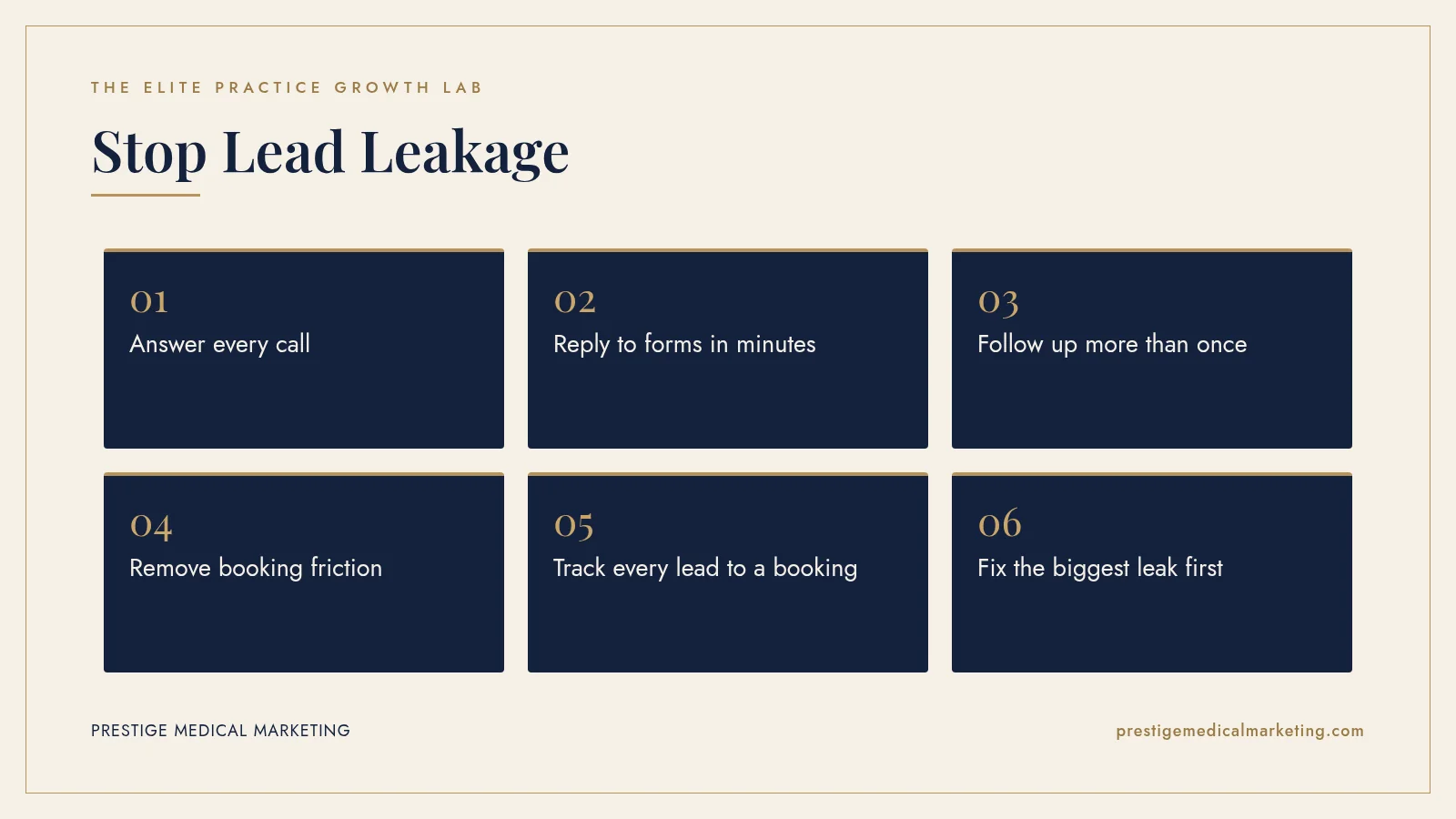
Lead leakage happens when patients you already paid to attract never get booked: calls go to voicemail, web forms wait hours for a reply, and nobody follows up after the first attempt. Fix it by answering every call (including after hours), responding to forms within minutes, following up several times, and tracking every lead to a booked appointment.
You spend real money on SEO and ads to make the phone ring. Then it rings during a procedure, at lunch, or at 7:40pm, and nobody answers. The patient calls the next practice on the list. You paid for that lead and got nothing.
That’s lead leakage, and it’s one of the most common and fixable problems we see.
The math behind wasted ad spend
Most marketing reports stop at cost per lead. That number hides the leak. If a campaign produces 100 calls and forms and your team books 30 of them, every lost lead raises the true cost of each patient you do book. Raise bookings to 45 from the same 100 leads and your cost per booked patient drops by a third without spending another dollar. That is why we treat answering and follow-up as part of marketing, not an afterthought. Run the numbers for your own practice: take last month’s ad spend, divide by booked new patients, then picture that number if you booked half the leads you lost.
Where most practices get this wrong, and how we do it instead
They buy more leads. We fix the leak first.
Pouring more ad spend into a leaky process makes the leak bigger. We measure how many leads become appointments before we scale any campaign.
They report clicks. We report booked patients.
Impressions and clicks feel like progress. Our monthly ROI reporting follows every call and form to the appointment and revenue it produced.
They blame the front desk. We give the front desk a system.
Your team is busy with patients in front of them. We add coverage for overflow and after hours, clear scripts and automatic follow-up so nothing depends on memory.
They lock you in. We earn it monthly.
Month-to-month terms and one practice per specialty per market.

Check if your market is open. Request a market check or call (716) 400-0084.
Where patients leak out
- Unanswered calls: busy front desks, lunch breaks, evenings and weekends.
- Slow replies: web forms that sit in an inbox until the next morning.
- One-and-done follow-up: a single voicemail, then nothing.
- Friction: “we’ll call you back to schedule” instead of booking on the spot.
- No tracking: nobody knows which leads were lost, so nothing changes.
Why speed matters so much
Patients researching an elective treatment often contact more than one practice. The first practice to answer helpfully and offer a time usually wins. Waiting until tomorrow means competing with practices that already booked them.
Step 1: Answer every call
Look at your missed-call report by hour. You’ll likely see clusters: early morning, lunch, after 5pm. Cover them with overflow staff, an answering service, or a 24/7 AI receptionist that can answer common questions and book appointments, then hand clinical questions to your team.
Prestige builds this into our patient acquisition system so after-hours calls don’t vanish.
Step 2: Reply to forms in minutes
Set up instant confirmation by text and email, then a real human or AI follow-up within minutes. Offer specific times rather than “let us know when works”.
Step 3: Follow up more than once
People get busy. A short sequence of friendly touches (a call, a text, an email over a few days) recovers many patients who were interested but distracted. Keep it helpful, not pushy. Our guide to what missed calls really cost includes simple call and text scripts you can adapt.
Step 4: Remove booking friction
Let patients book a consult online or on the first call. Every extra step (“we’ll check and get back to you”) is a chance to lose them. The same goes for your website: a clear booking button on every page matters, as our guide to a low-maintenance website explains.
Step 5: Track every lead to a booking
Connect calls and forms to their source and to the appointment they produced. That’s how you see which campaigns bring patients who actually book, and what each booked patient is worth. It’s the basis of our monthly marketing ROI number.
What a great first call sounds like
Technology helps, but the conversation still matters. A strong first call:
- Answers warmly and quickly, using the caller’s name once they share it.
- Asks what prompted the call and listens before quoting prices.
- Explains the next step (usually a consultation) and what happens there.
- Offers two specific times rather than an open-ended “when works for you?”
- Confirms by text with directions, parking and what to bring.
Train for the “how much?” question
Price questions are normal. Give an honest range where you can, explain what affects the cost, and position the consultation as the way to get an accurate plan. That keeps qualified patients moving forward without feeling dodged.
Step 6: Fix the biggest leak first
You cannot fix everything at once, and you do not need to. Pull one month of data and find the stage where the most patients drop out. If half your calls go unanswered, start there. If calls are answered but few book, work on the conversation. If forms wait hours, fix response time. Solve one leak, measure for a full month, then move to the next one on the list.
Run a secret shopper test
The fastest way to see your leaks is to experience them. Ask a friend to call your practice at three different times: mid-morning, lunch and just after closing. Have them fill out your web form on a Friday evening and send a message through your website chat or social profile. Then write down what happened:
- How many rings before someone answered, or did it go to voicemail?
- Was the greeting warm and clear?
- Did the caller get a specific appointment time?
- How long until anyone replied to the form or message?
- How many follow-ups happened if they did not book?
Repeat the test every quarter and after any staffing change. Most owners are surprised by at least one answer. That surprise is where the quick wins are.
Match the landing page to the ad
Leakage starts before the phone rings. A patient who clicks an ad for a specific treatment and lands on your homepage has to hunt for what they wanted. Send each campaign to a page about that treatment, with the phone number, booking button and a short form above the fold. Use call tracking numbers so you know which ad produced each call. Keep the offer and wording on the page consistent with the ad that brought them there.
Use a simple CRM or lead tracker
A spreadsheet works to start, but a CRM built for practices does it better. Every lead should have a source, a status (new, contacted, booked, lost), a next follow-up date and a reason if they did not book. Review it weekly with whoever handles new patient calls, and celebrate the wins as well as the misses. The “lost” reasons tell you what to fix: price, timing, no answer, chose another practice or no longer interested. Make sure any system that stores patient information meets your HIPAA obligations, with a signed business associate agreement where required.
Common objections, and honest answers
“We’re too busy to answer every call.”
That is exactly why you need overflow coverage. A busy front desk should focus on the patients in the room, while calls roll to a trained answering service or AI receptionist that can book.
“Follow-up feels pushy.”
Helpful follow-up is a service. A short message that offers a time, answers a question or shares what to expect at a consult is welcome. Stop after a few touches, and always honor requests to stop.
“Our leads are just low quality.”
Sometimes that is true, and better targeting helps. Often the leads were fine and simply waited too long. Track response time next to booking rate and the answer becomes clear.
“We already have an answering service.”
Check what it actually does. If it only takes messages, every caller still waits for a callback, and many book elsewhere in the meantime. Coverage should answer common questions, book appointments into your real schedule and hand anything clinical to your team, with a clear record of every call.
What to measure every week
- Missed call rate: unanswered calls as a share of all calls, by hour.
- Speed to lead: minutes from form submission to first reply.
- Booking rate: new leads that become scheduled appointments.
- Show rate: booked appointments that actually happen.
- Cost per booked patient: marketing spend divided by new patients booked.
The bottom line
Before you spend another dollar on more leads, make sure you’re converting the ones you already have. Answer every call, reply fast, follow up and track it all. It’s often the quickest return a practice can find.
Want to see how many patients you might be losing? Check if your market is open or call (716) 400-0084. We’re based in Austin, Texas, and work with practices nationwide. You can also see how we handle this for plastic surgery practices and dermatology clinics.
Put this playbook to work: see how it applies to an AI receptionist for your practice and fast patient follow-up and booking.
Frequently asked questions
What is lead leakage in a medical practice?
It is any point where an interested patient falls out before booking: unanswered calls, slow replies to web forms, no follow-up, or a confusing booking process.
How fast should we respond to a new web inquiry?
As fast as you can, ideally within minutes. Patients often contact several practices at once, and the first to respond helpfully has a real advantage.
Can an AI receptionist handle patient calls?
Yes, for scheduling, common questions and after-hours coverage. It should hand off to your team for anything clinical and follow your privacy and compliance requirements.
How do I know how many calls we miss?
Use call tracking or your phone system reports to see missed and abandoned calls by hour. Most practices are surprised by the after-hours and lunch-time gaps.
What is a good booking rate for new patient leads?
It varies by specialty and lead source, so compare your own numbers month to month. Track it by source and by staff member, and focus on the stage where the most patients drop out.
Should ads send patients to my homepage?
Usually not. Send each campaign to a page about that specific treatment, with a phone number, booking button and short form near the top.
How many times should we follow up with a new lead?
A few friendly touches over several days, by call, text and email, recovers many interested patients. Stop when they book or ask you to stop.