
Private practices get recommended by ChatGPT, Perplexity and Google AI Overviews by being easy to find, easy to understand and easy to trust. Let AI search crawlers reach your site, publish clear pages that answer patient questions, keep listings consistent everywhere, earn steady honest reviews and get mentioned by credible local and industry sources.
Patients have started asking AI assistants the questions they used to type into a search bar. “Who is the best med spa near me?” “Which plastic surgeon in my city has the best reviews?” “Is there a functional medicine doctor nearby who takes new patients?” The assistant answers with a few names. If yours is not one of them, that patient may never see your website.
What changed in search
Google now shows AI-generated summaries above many results. A 2025 Pew Research Center analysis of U.S. adults’ browsing found that users who saw an AI summary clicked a traditional result in 8% of visits, compared with 15% when no summary appeared. Pew also found that searches phrased as questions produced AI summaries 60% of the time. Patients ask questions. More of their searches end in an AI answer.
Meanwhile, ChatGPT and Perplexity search the web and cite sources in their answers. They do not rank pages the same way Google does, but they rely on many of the same things: pages they can reach, information that is clear and consistent, and sources that look trustworthy.
Where AI search advice goes wrong, and how we do it instead
They sell secret hacks. We fix the fundamentals.
Google’s documentation on AI features and your website states there are no additional requirements to appear in AI Overviews or AI Mode, and no special optimization needed beyond normal SEO best practices. We focus on what actually moves the needle: access, clarity, consistency and trust.
They promise placement. We track it honestly.
No one can guarantee what an AI assistant will say. We improve the signals these tools rely on, then check monthly whether your practice appears for the questions your patients ask.
They pump out thin AI content. We publish pages worth citing.
Assistants cite sources that answer the question clearly and credibly. Mass-produced posts that repeat what every other site says give them no reason to cite you. We write specific, clinician-reviewed pages with real details about your practice.
They ignore your listings. We start there.
For local questions, assistants lean on map listings, directories and reviews. If your hours, address or services differ across sites, assistants have less confidence in any of them. We make every listing match.
They report impressions. We report patients.
Our monthly ROI reporting connects visibility to calls, bookings and revenue. One practice per specialty per market, month-to-month terms.

Check if your market is open. We partner with one practice per specialty per market. Request a market check or call (716) 400-0084.
The plan to get recommended by AI, step by step
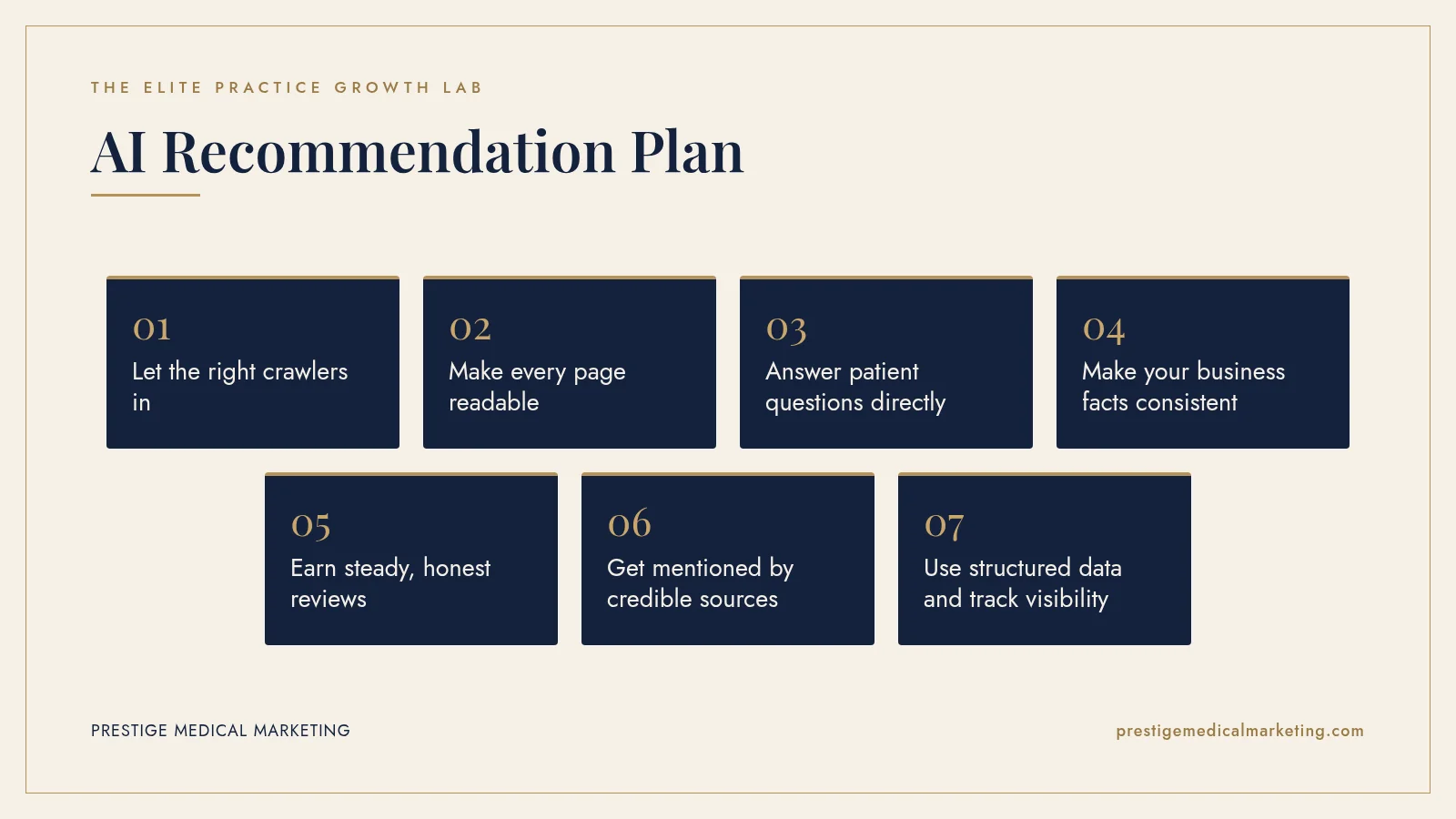
Step 1: Let the right crawlers in
Check your robots.txt and any firewall, security plugin or bot protection. If you want to appear in AI search, allow Googlebot, Bingbot, OpenAI’s search crawler described in its bot documentation and PerplexityBot, described in Perplexity’s crawler guide. Aggressive bot blocking can make your site invisible to these tools without anyone noticing.
Step 2: Make every page readable
Important content should be in plain HTML text, not locked in images, PDFs or scripts that crawlers struggle to read. Fast pages, clean headings, descriptive titles and a clear site structure help every search system understand you.
Step 3: Answer patient questions directly
Each treatment or service page should open with a short, direct answer, then explain who it is for, what to expect, cost ranges, recovery and how to book. Add a short FAQ with the questions patients actually ask your front desk.
Step 4: Make your business facts consistent
Same name, address, phone, hours and services on your website, Google Business Profile, Bing Places, Apple Business Connect, Yelp and the directories in your specialty. Inconsistency creates doubt for people and machines alike. Search for your practice name and old phone numbers to find stray listings from past moves or rebrands, then correct or remove each one. Keep a simple spreadsheet of every listing, its login owner and the date it was last checked.
Step 5: Earn steady, honest reviews
Ask every patient, on every platform that matters in your specialty. Reviews that describe the experience in specific words give assistants language to summarize. Never buy or filter reviews.
Step 6: Get mentioned by credible sources
Local news features, professional associations, community partners, speaking events and specialty directories all create mentions that assistants can find. Earn them by being useful: share expertise, sponsor real community events and contribute to industry discussions.
Step 7: Use structured data and track visibility
Add accurate Organization, LocalBusiness or MedicalBusiness, FAQ and Article markup that matches what is visible on the page. Then test your key patient questions in ChatGPT, Perplexity and Google every month and record whether you appear and which sources are cited.
What AI assistants look for in a practice
- Clear specialization. “We focus on facial plastic surgery” beats “we do it all.”
- Credentials. Named clinicians with training, licenses and affiliations on their bio pages.
- Specific service details. What it is, who it is for, what it costs and what recovery looks like.
- Location clarity. Your address, service area, hours and how to get there.
- Social proof. Steady reviews across platforms, with thoughtful replies.
- Independent mentions. Sources other than your own website that describe your practice.
Mistakes that keep practices out of AI answers
- Blocking crawlers by accident. Security tools often block bots by default.
- Treatment details only in images or PDFs. If a crawler cannot read it, it cannot cite it.
- Vague, generic copy. “Personalized care in a relaxing environment” describes everyone.
- Mismatched listings. Old addresses and phone numbers on directories you forgot existed.
- No reviews outside Google. Assistants often look at several sources.
- Chasing tricks. Hidden text, keyword stuffing and fake reviews risk your regular rankings and your reputation.
Local practices and AI in Maps
For “near me” questions, your Google Business Profile matters as much as your website. Google is adding conversational AI features to Maps, which draw on business details, photos and reviews. Our breakdown of Google’s Ask Maps shift covers what that means for local practices, and our Google Business Profile guide covers the setup step by step.
Do not forget Bing and Apple
Many practices only manage Google. That leaves gaps. Some AI assistants draw on Bing’s index when they search the web, and Apple Maps powers local results on millions of iPhones. Claim and complete your Bing Places and Apple Business Connect listings, verify your site in Bing Webmaster Tools and follow Bing’s webmaster guidelines. It takes an afternoon and widens the set of sources that describe your practice correctly.
Content that earns citations
The pages assistants cite tend to answer one question well. Build a library around the questions your patients ask before they book:
- “How much does [treatment] cost in [city]?”
- “What is recovery like after [procedure]?”
- “How do I choose a [specialty] practice?”
- “[Treatment A] vs. [Treatment B]: which is right for me?”
- “What happens at a first visit?”
Keep each page accurate, reviewed by a clinician, dated and updated. Cite reputable sources for any number. Link each answer to the matching service page and a clear booking option. This is the same work that wins traditional search; read our local dominance blueprint for how it fits the bigger plan.
How to measure AI visibility
AI answers change often, so measure trends, not single results. Build a list of twenty to thirty questions your ideal patients ask. Each month, ask them in ChatGPT, Perplexity and Google from a logged-out browser in your market. Record whether your practice appears, where, and which sources are cited. Watch referral traffic from AI tools in your analytics, and ask new patients how they found you. Over a few months, the pattern shows whether the work is paying off. Share the results with your team, so front desk staff know which questions patients are asking assistants before they call.
What good looks like
In ninety days: crawlers allowed, key pages rewritten with direct answers, listings consistent everywhere, a review system running and a monthly AI visibility check in place. By month six: more of your patient questions answered with your practice named or cited, and a clear link between that visibility and booked consults. See our services overview for how we build it.
Want AI to recommend your practice? Check if your market is open or call (716) 400-0084. We’re based in Austin, Texas, and work with practices nationwide.
Put this playbook to work: see how it applies to Google Maps and AI search visibility, med spa marketing and plastic surgery marketing.
Frequently asked questions
How does ChatGPT decide which practices to recommend?
When ChatGPT searches the web, it draws on pages it can access and sources it finds credible, then summarizes them. Practices with clear, crawlable pages, consistent business details, strong reviews and mentions on trusted sites give it more to work with. No one can pay for placement in those answers.
Do I need special schema or an llms.txt file to appear in Google AI Overviews?
No. Google says there are no additional requirements to appear in AI Overviews or AI Mode beyond normal Search eligibility. Pages must be indexed and eligible to show a snippet. Good structured data still helps Google understand your pages, but it is not a special ticket into AI answers.
Should I block AI crawlers from my website?
If you want to be recommended in AI search, do not block the crawlers those tools use for search, such as OpenAI's OAI-SearchBot and PerplexityBot. You can make separate choices about crawlers used for model training. Check your robots.txt and any firewall or bot protection settings.
Does Google Business Profile affect AI recommendations?
Yes, for local questions. Google's AI features in Search and Maps draw on local business information, and other assistants often cite map listings and directories. A complete, accurate profile with steady reviews is the foundation.
How long does it take to show up in AI answers?
It varies by tool and by how competitive your market is. Fixing crawl access and listings can help within weeks. Building authority through content, reviews and mentions takes months of steady work.
Can an agency guarantee my practice appears in ChatGPT?
No. Anyone who guarantees placement in AI answers is overpromising. An honest agency improves the signals AI tools rely on and tracks whether your practice appears for the questions that matter.
How do I check whether AI tools recommend my practice?
Ask ChatGPT, Perplexity and Google the questions your patients ask, such as "best med spa near me" or "functional medicine doctor in [city]," from a logged-out browser. Record whether you appear and which sources are cited, and repeat monthly.