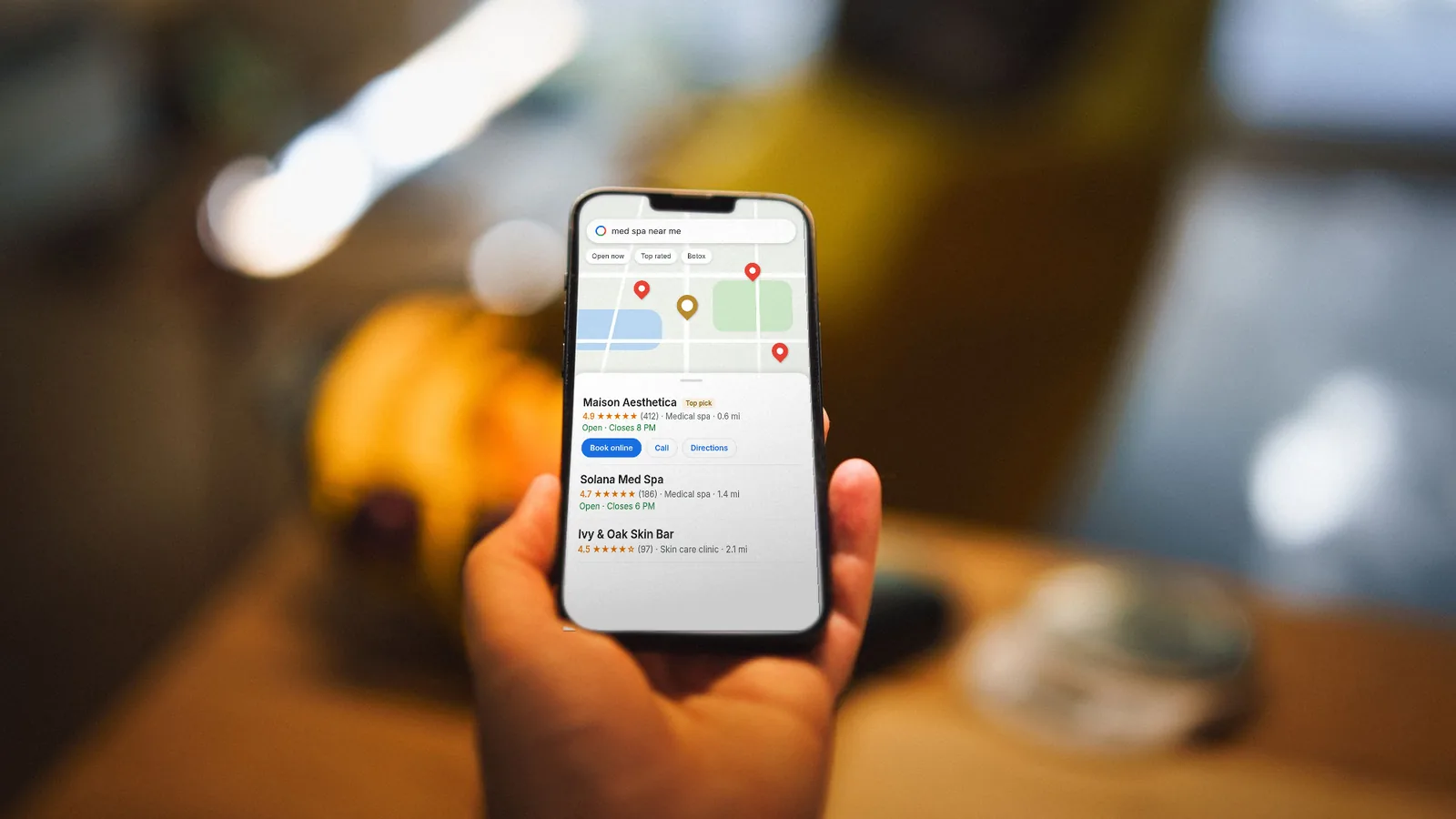
Ask Maps is Google's Gemini-powered, conversational way to search Google Maps, launched in the US in March 2026 and expanded globally in August 2026. Patients ask detailed questions and get a curated answer. Practices that show up have complete, accurate Google profiles, detailed reviews and websites that clearly answer patient questions.
Local search is changing. With Ask Maps, Google lets people ask Maps a full question in plain language and get an AI-generated answer, powered by Gemini. For private practices, that changes what it takes to be found.
Where practices get AI local search wrong, and how we do it instead
They chase a secret formula. We build the fundamentals.
Google has not published how Ask Maps picks results. Anyone selling a guaranteed trick is guessing. We focus on what Google has said matters for local results in its guide to improving local ranking: relevance, distance and prominence, backed by complete and accurate information.
They stuff keywords. We add real detail.
Keyword-stuffed business names and descriptions risk suspension and give the AI nothing useful. We add the details patients ask about: specific services, hours, parking, accessibility, languages and provider experience.
They chase five-star averages. We build specific reviews.
A wall of “Great place!” tells the AI very little. Honest reviews that mention the treatment, the provider and the experience give it rich, trustworthy context.
They treat Maps and the website separately. We connect them.
Your profile and website should tell the same story, with service pages that expand on every service listed in your profile.
They report rankings. We report booked patients.
Our monthly ROI reporting tracks calls, bookings and revenue from Maps and search, month to month, with one practice per specialty per market.

Check if your market is open. We partner with one practice per specialty per market. Request a market check or call (716) 400-0084.
What Ask Maps is
Google announced Ask Maps on March 12, 2026, rolling it out in the US and India on Android and iOS. Instead of typing “med spa near me”, someone can ask something like: “Where can I get a HydraFacial near me that’s open Saturday and has great reviews for sensitive skin?” Maps responds conversationally with places that fit, drawing on what Google knows about each place.
Google says the feature draws on its information about more than 300 million places and reviews from a community of over 500 million contributors. In August 2026, Google expanded Ask Maps to many more countries and added features such as remembering earlier parts of a conversation.
Why it matters for medical practices
Classic local search matched short keywords. Conversational search matches details: specific treatments, hours, accessibility, parking, provider experience, and what reviewers say. If those details aren’t anywhere Google can read them, an AI answer has nothing to match.
That shift rewards practices that have been doing the basics well and exposes those that have not. A thin profile with three categories, a handful of old reviews and a website that lists services without explaining them gives the AI very little to work with. A detailed profile, a steady stream of specific reviews and clear treatment pages give it plenty.
It also changes what patients see before they ever reach your website. A 2025 Pew Research Center analysis found that Google users who saw an AI summary clicked a traditional result in 8% of visits, compared with 15% when no summary appeared. When the answer arrives on the screen, being named in it matters more than ranking below it.
How to show up in Ask Maps answers
Google hasn’t published how Ask Maps chooses results, so be wary of anyone promising guaranteed placement. These fundamentals give the AI the most to work with:
- Complete your Google Business Profile: categories, every service, hours, attributes and photos.
- Earn detailed reviews: reviews that mention specific treatments and experiences give the AI rich, trustworthy context.
- Answer real questions on your website: treatment pages with clear FAQs written the way patients ask.
- Stay consistent: the same name, address, phone and hours everywhere.
- Keep it fresh: update photos, posts and services as things change.
Beyond Maps: AI search everywhere
Patients also ask ChatGPT, Gemini, Perplexity and AI Overviews for recommendations. The same principles apply: clear, structured, accurate information about who you are and what you do. That’s why AI search readiness is part of our Prestige System. For a deeper look at ChatGPT, Perplexity and AI Overviews, read our guide to getting your practice recommended by AI.
What to do this month
- Audit your Google profile for missing services, attributes and photos.
- Write down the ten questions patients ask most, and answer them on your site.
- Start a simple review habit that encourages patients to mention their treatment.
- Try Ask Maps yourself with your patients’ kinds of questions and see who appears.
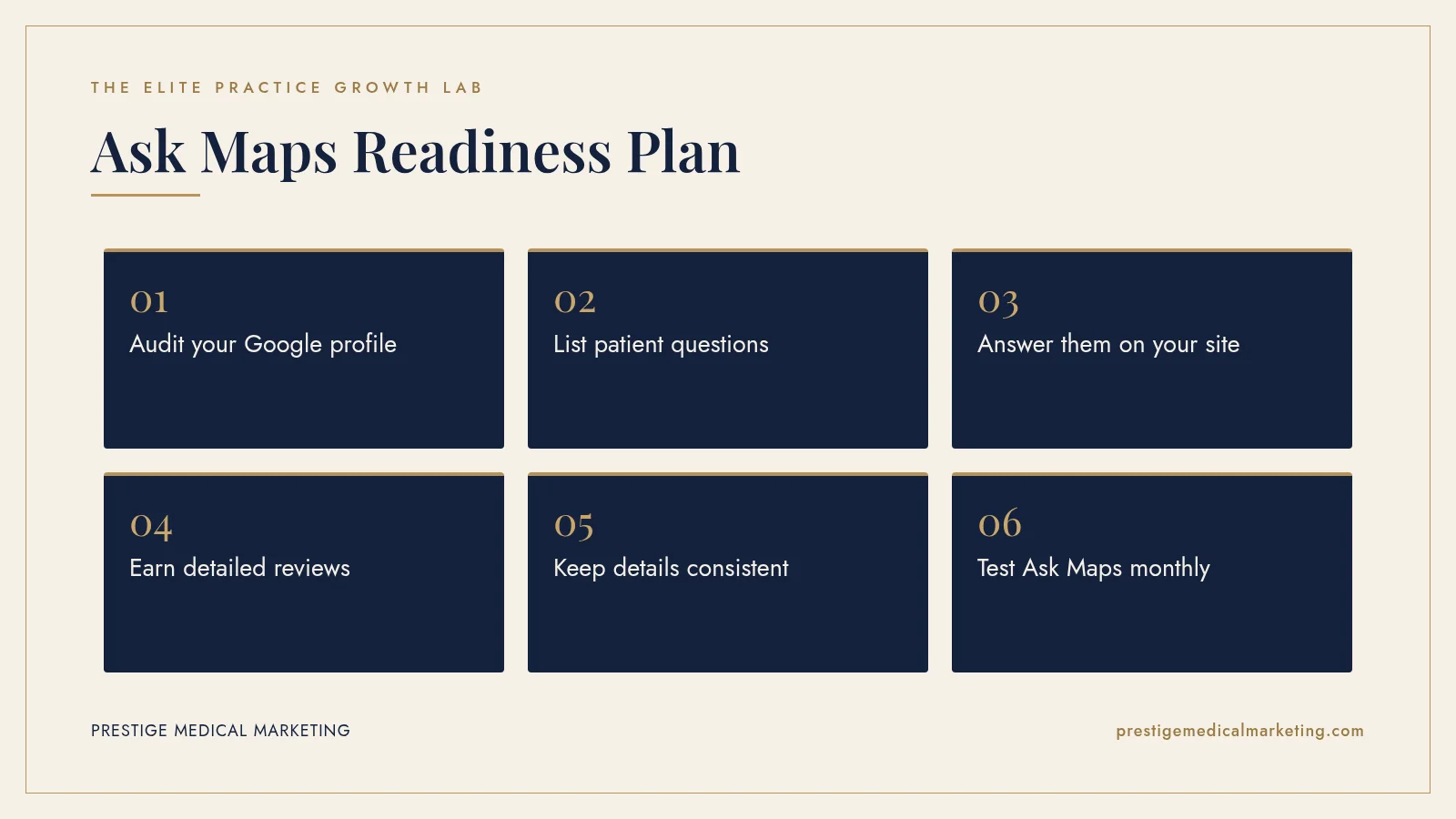
Your Ask Maps readiness plan, step by step
Step 1: Audit your Google profile
Check your primary and secondary categories, every service, hours, holiday hours, attributes, photos and booking link. Fill every field that applies to your practice, and correct anything that is out of date.
Step 2: List the questions patients ask
Ask your front desk for the ten questions they hear most. Add the questions patients ask during consults. These are the questions people now type or speak into Maps.
Step 3: Answer them on your website
Give each core service its own page that answers those questions directly: who it is for, what to expect, cost ranges, recovery, providers and how to book. Add a short FAQ to each page.
Step 4: Earn detailed reviews
Ask every patient for a review, send a direct link by text and encourage them to mention what they came in for. Never offer rewards and never filter who you ask.
Step 5: Keep details consistent everywhere
Match your name, address, phone, hours and services across your website, Google, Apple, Bing, Yelp and specialty directories.
Step 6: Test Ask Maps every month
Ask Maps the questions on your list from a phone in your area, note which practices appear and what details the answer mentions, and close the gaps you find.
Questions patients may ask Ask Maps
Think about the questions your patients ask on the phone. Those are the kinds of questions people can now ask Maps directly:
- “Which dermatologist near me does Mohs surgery and takes new patients?”
- “Med spa near me with experienced injectors for natural-looking lip filler.”
- “Physical therapist near me who specializes in running injuries and has early appointments.”
- “Hormone therapy clinic near me with good reviews from women over 45.”
For each one, ask: does our Google profile, our website or our reviews clearly contain that information? If not, add it, accurately. Don’t claim services, credentials or availability you can’t deliver. Accurate detail wins patients; inflated detail loses them at the front door.
Details that help AI match your practice
- Services: each treatment listed by its common name, with a plain description.
- Attributes: accessibility, parking, appointment types and amenities, where they apply.
- Hours: including evenings, weekends and holiday hours.
- Providers: names, credentials and specialties on your website.
- Photos: recent images of your entrance, reception, rooms and team.
- Reviews: recent, specific and answered.
What this means by practice type
Every specialty gets different questions. Med spas hear about specific treatments, injector experience and natural-looking results. Plastic surgery practices hear about surgeon credentials, consult availability and recovery. Dermatology practices hear about medical and cosmetic services, new-patient availability and insurance. Physical therapy and chiropractic practices hear about conditions, early or late appointments and direct booking. Build your profile and website around the questions your patients actually ask, not a generic checklist.
Mistakes that keep practices out of AI answers
- Missing services. If a treatment is not listed anywhere, the AI cannot match it to a question.
- Old hours. A question like “open Saturday” filters you out if your hours are wrong.
- Generic photos. Real images of your space build trust with patients and confirm details.
- Unanswered reviews. Thoughtful replies show patients and platforms an active, caring practice.
- Overclaiming. Listing services, credentials or availability you cannot deliver leads to bad reviews and lost trust.
How to measure AI local visibility
AI answers change from search to search, so look for trends rather than single results. Keep a list of twenty patient questions, test them monthly in Ask Maps and Google Search, and record whether your practice appears. Watch calls, direction requests and website clicks in your Google Business Profile performance report. Ask new patients how they found you. Over a few months, the pattern shows whether your work is paying off.
The bottom line
Ask Maps rewards practices that are easy for AI to understand and easy for patients to trust. The fundamentals haven’t changed; the bar for detail and accuracy has gone up. Practices that keep their profile complete, earn specific reviews and answer patient questions clearly on their website will be the ones AI keeps recommending as the feature spreads.
Want to know how your practice shows up today? Check if your market is open or call (716) 400-0084. We’re based in Austin, Texas, and work with practices nationwide. We work with med spas, dermatology, plastic surgery and many more private practices.
Sources: Google, “Ask Maps and Immersive Navigation” (March 2026); Google Maps global expansion announcement (Aug 6, 2026).
Put this playbook to work: see how it applies to Google Maps and AI search visibility.
Frequently asked questions
What is Google Ask Maps?
A conversational, AI-powered way to search Google Maps using Gemini. Instead of typing a short keyword, people ask a full question and get a summarized answer with suggested places.
When did Ask Maps launch?
Google announced Ask Maps on March 12, 2026 for users in the US and India on Android and iOS, and expanded it to many more countries in August 2026.
How do I get my practice recommended by Ask Maps?
Google has not published a ranking formula. The best approach is a complete, accurate Google Business Profile, detailed genuine reviews, clear service descriptions, and a website that answers specific patient questions.
Does this replace regular local SEO?
No. It builds on the same foundations. Ask Maps makes depth and accuracy matter even more, because the AI is trying to match specific questions to specific details.
Does Ask Maps use my Google reviews?
Google says Ask Maps draws on its information about places and reviews from its contributor community. Recent, detailed reviews that mention specific treatments give it more to work with.
Can I pay to appear in Ask Maps answers?
Google has not announced paid placement inside Ask Maps answers. Focus on a complete profile, honest reviews and clear website content, and treat any promise of guaranteed placement with caution.
How often should I update my Google profile for Ask Maps?
Review it monthly, update hours before holidays, add new photos regularly and add new services as soon as you offer them.