
To win your local map pack, build a fully optimized Google Business Profile, earn a steady stream of genuine reviews that mention specific treatments, publish a page for each procedure you want more of and answer every inquiry fast. Ranking gets you seen; positioning and follow-up decide whether the patient who finds you is the one you want.
Most private practices don’t have a traffic problem. They have a visibility-in-the-right-place problem. When someone nearby searches “botox near me” or “best dermatologist in [city]”, Google shows a map with a short list of practices. The practice that looks most credible in that list usually gets the call.
This blueprint covers how to earn a top spot there and, just as important, how to make sure the patients who find you are the ones you want.
Where local SEO goes wrong, and how we do it instead
They game the profile. We follow the rules.
Keyword-stuffed names, fake addresses and duplicate listings can work for a few weeks, then get suspended. We build rankings that last, inside Google’s guidelines.
They chase volume. We chase the right patients.
More calls from price shoppers do not grow a premium practice. We position your expertise, so the patients who call are the ones you want to treat.
They buy reviews. We build a habit.
Purchased or incentivized reviews break the rules and fool nobody for long. We set up a simple, honest system to ask every patient.
They stop at rankings. We follow through to bookings.
A top spot is wasted if the phone goes to voicemail. We connect visibility, answering and follow-up into one system.
They lock you in. We earn it monthly.
Month-to-month terms, one practice per specialty per market and monthly ROI reporting on booked patients.

Check if your market is open. We partner with one practice per specialty per market. Request a market check or call (716) 400-0084.
Why the map pack decides who gets the patient
The map pack sits above most organic results on local searches. It shows your rating, review count, photos, hours and a call button, all before anyone visits your website. For many patients, that snapshot is the decision.
That’s why a practice with a beautiful website can still lose to a competitor with a better-tended Google profile. The profile is your first impression now.
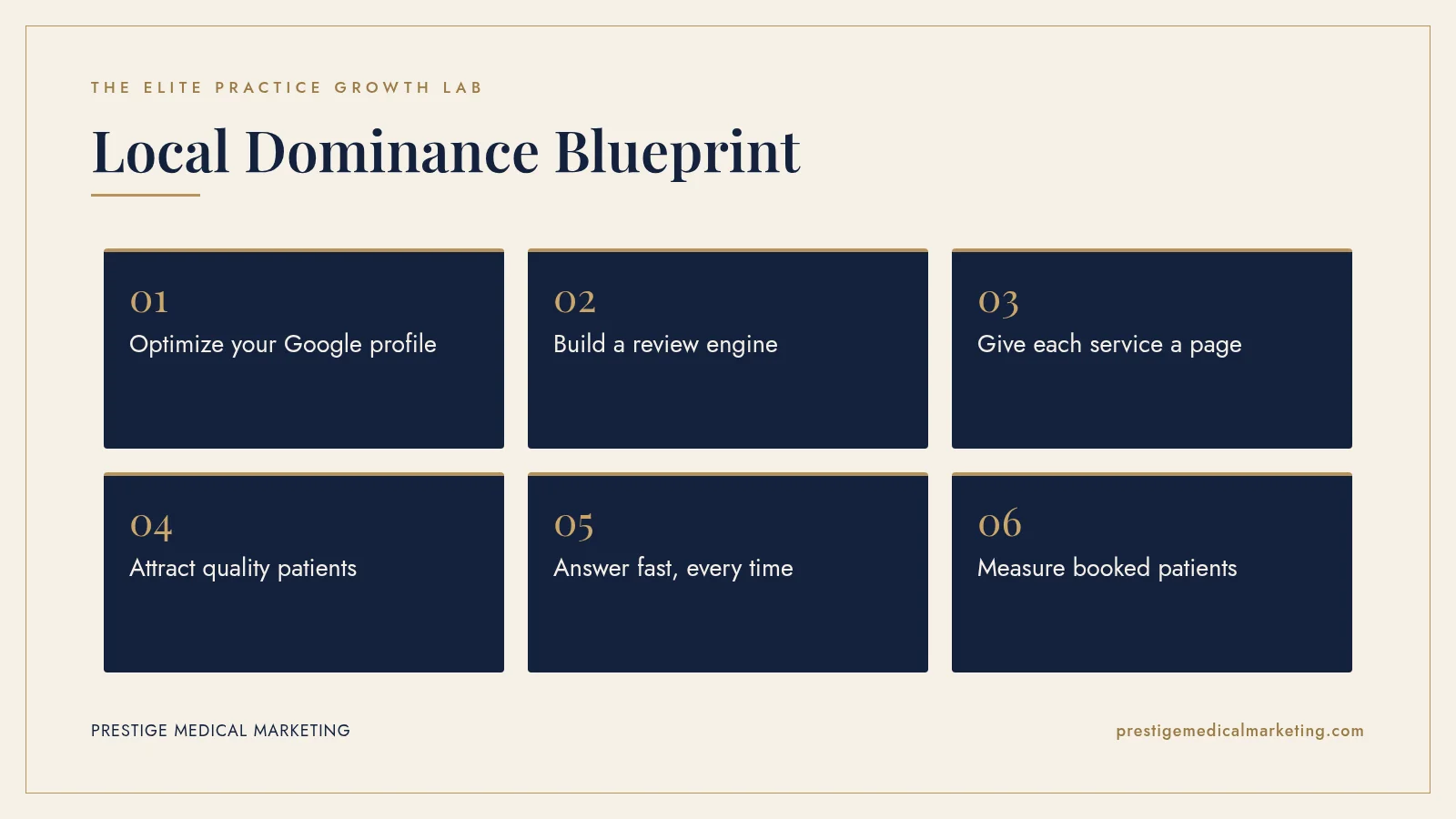
Step 1: Treat your Google Business Profile like a second website
- Primary category: choose the one that matches the service you most want (for example “Medical spa” or “Dermatologist”), then add accurate secondary categories.
- Services: list each treatment with a plain-English description.
- Photos: upload real photos of your space, team and (with consent) results. Refresh them regularly.
- Posts: share updates and answer the questions patients actually ask, in your own words.
- Accuracy: keep name, address, phone and hours identical everywhere online.
Google’s guide to improving local ranking names relevance, distance and prominence as the main factors. A complete, accurate profile improves relevance, and reviews, photos and mentions across the web build prominence. Follow Google’s guidelines for representing your business exactly. A suspended profile disappears from the map. Our Google Business Profile setup guide walks through every field.
Step 2: Build a review engine, not a review campaign
A burst of reviews followed by silence looks odd and fades fast. What works is a simple, repeatable habit: ask every happy patient, make it one tap, and do it while the experience is fresh.
Encourage patients to mention the treatment they had. Reviews that say “my laser resurfacing results were amazing” help you show up for that treatment and reassure the next person considering it. Always respond, especially to criticism, calmly and without sharing protected health information.
Keep it honest. The FTC’s final rule on fake reviews bans fake reviews, incentivized reviews and review suppression. Ask every patient, not only the ones you expect to be happy.
Step 3: Give every high-value service its own page
Google needs a reason to show you for “CoolSculpting” or “rhinoplasty consult”. A single “Services” page with a bullet list isn’t enough. Build a dedicated page for each procedure you want more of, covering who it’s for, what to expect, recovery, and a clear way to book.
Our Prestige System pairs these pages with your Google profile so each one strengthens the other.
Step 4: Attract quality, not just quantity
Ranking is only half the job. If your profile and ads lead with “$9 a unit!”, you will attract people who shop on price and leave for the next deal. Lead with what makes you different instead: credentials, experience, results and how patients feel in your care.
Put it into plain words. “Board-certified dermatologist with fifteen years of laser experience” says more than “premier skin care.” “Consults with the surgeon, not a salesperson” says more than “patient-focused.” Use the same message on your profile, website, ads and front desk script.
That shift alone often changes who calls. It’s the same positioning we use for med spas, plastic surgeons and dermatology practices.
Step 5: Answer fast, every time
A top ranking is wasted if the call goes to voicemail. Patients who search locally often call the next practice on the list if nobody answers. Cover after-hours and busy periods with a receptionist or AI agent that can answer questions and book, and follow up on web forms within minutes, not hours. Our breakdown of what missed calls really cost shows how to put a number on the gap.
Step 6: Measure booked patients, not rankings
Rank trackers are fun to watch, but the real question is simple: how many new patients did local search produce, and what were they worth? Track calls and form fills back to their source and compare new-patient revenue against what you spend. We call that number your marketing ROI.
Your website still matters
The map pack and your website work together. When patients tap through, they should land on a page that matches what they searched, loads fast on a phone and makes booking obvious. Google also reads your site to understand what you offer. Give each service a page, add a clear phone number and booking button to every page, show real photos and credentials and keep your name, address and phone in the footer exactly as they appear on your profile. For practices with several locations, build a page for each location and link each profile to its own page.
Service areas, proximity and expectations
Proximity to the searcher is a major factor, and you cannot move your building. Be realistic: your strongest map visibility will be in the area around your location. Win that area first. Beyond it, earn visibility with strong service pages, regional content and reputation. Never create listings at addresses where you do not see patients; that is a common reason for suspensions.
Common map pack mistakes to avoid
- Keyword-stuffing your business name. Adding “Best Botox Austin” to your name can get your profile suspended. Use your real name.
- Fake or incentivized reviews. They break platform rules and erode trust when patients spot them.
- Ignoring your categories. The wrong primary category can keep you out of the searches that matter most.
- Generic photos only. Patients want to see your real rooms and team. Generic images look flat next to a competitor’s real ones.
- Inconsistent details. Old addresses or phone numbers on directories confuse both Google and patients.
A simple monthly routine
Once a month: add new photos, publish a Google post about a treatment, respond to every review, and check that hours and services are accurate. It takes under an hour and keeps your profile working.
When paid local ads make sense
Organic map rankings take time. Paid local campaigns can fill the gap while you build, especially for a new location or a high-value treatment. Keep them tightly targeted to your real service area, send clicks to matching service pages with online booking and follow each platform’s healthcare advertising rules. Judge them on cost per booked patient. When organic visibility grows, shift budget toward what produces the best patients at the lowest cost.
How long it takes
Profile fixes can show results within weeks. Review momentum, service pages and reputation usually take three to six months to build steady visibility, and competitive specialties take longer. Practices that stop after the first month usually slide back. Consistency beats bursts: a few new reviews every week, fresh photos and posts every month and fast, friendly answers every single day.
How to track your map pack progress
- Visibility: where you appear for your top treatments across your service area, checked monthly.
- Profile actions: calls, website clicks, booking clicks and direction requests from your profile’s performance report.
- Reviews: new reviews per month, average rating and response time.
- Bookings: new patients from local search, tracked from call or form to appointment.
- Revenue: what those patients spend, compared with what you invest.
The bottom line
Local dominance isn’t a trick. It’s a well-kept profile, real reviews, strong service pages, a clear premium position and fast follow-up, done consistently. Do those well and the map pack starts working for you.
Want to know where you stand? Check if your market is open or call (716) 400-0084, and we’ll show you who is winning your map pack today and why. We’re based in Austin, Texas, and work with practices nationwide.
Put this playbook to work: see how it applies to Google Maps and AI search visibility.
Frequently asked questions
How long does it take to rank in the Google map pack?
It depends on your competition, location and starting point. Practices with a strong existing profile can see movement within a few months; competitive metros take longer. Anyone who promises a guaranteed timeline is guessing.
Do reviews really affect map rankings?
Yes. Review count, recency and content are widely understood to be local ranking signals, and they heavily influence which practice a patient chooses once they see the results.
Can I rank in the map pack for a city I am not located in?
Rarely. Proximity to the searcher is a major factor. Your best opportunity is the area around your physical location, plus strong service pages and reviews.
Why do I get lots of calls but few good patients?
Usually it is positioning. If your profile, ads and website lead with discounts, you attract discount shoppers. Lead with expertise, outcomes and experience instead.
Should I put keywords in my Google Business Profile name?
No. Google's guidelines require your real-world business name. Adding keywords can get your profile suspended and is not worth the risk.
How often should I update my Google Business Profile?
Check it weekly for reviews and suggested edits, add photos and posts monthly and update hours before every holiday.
Does my website affect my map pack ranking?
Yes. Google uses information from your website to understand your services and relevance. Clear service pages that match your profile strengthen both.