
The FDA approved Qwo (collagenase clostridium histolyticum-aaes) in July 2020 for moderate to severe cellulite in the buttocks of adult women, and Endo launched it in early 2021 as the first FDA-approved injectable treatment for cellulite. In December 2022, Endo announced it would cease production and sale because of market concerns about the extent and variability of bruising and the potential for prolonged skin discoloration. For med spas, the lesson was to market new treatments with realistic expectations and never build a brand on a single product.
Every few years, the aesthetics industry gets a launch that feels like it might change everything. In 2021, cellulite was the category everyone was talking about. For the first time, there was an FDA-approved injectable designed to treat it, and med spas across the country rushed to add it to their menus.
The product was Qwo, made by Endo. It had been approved by the FDA in July 2020 and reached the market in early 2021. Less than two years later, Endo announced that it would stop making it. The rise and fall of Qwo is one of the clearest case studies in how aesthetic practices should, and should not, market a new treatment.
This retrospective covers what happened, why it mattered to med spas, how agencies handled it and what the lesson means today. For related stories, see our pieces on the 2022 Daxxify approval and the FTC’s 2023 endorsement guides for aesthetic practices.
What actually happened in 2021
The approval. In July 2020, Endo announced FDA approval of Qwo (collagenase clostridium histolyticum-aaes) for the treatment of moderate to severe cellulite in the buttocks of adult women. The company described it as the first FDA-approved injectable treatment for cellulite and said it was thought to work by enzymatically releasing the fibrous bands beneath the skin that contribute to dimpling.
The launch. In its first quarter 2021 results, Endo described the launch of Qwo as an important strategic milestone and said it was encouraged by the product’s initial market reception.
The side effect profile. Endo’s own materials noted that in clinical trials, 84 percent of subjects treated with Qwo experienced injection site bruising, and that the most common adverse reactions were bruising, pain, nodules and itching at the injection site.
What came next. On December 6, 2022, Endo announced that it would cease production and sale of Qwo in light of market concerns about the extent and variability of bruising after initial treatment and the potential for prolonged skin discoloration. The company said it had spent more than a year working to address those concerns.
Why it mattered for med spas
Cellulite is extremely common and has long frustrated people who want smoother skin. A treatment with FDA approval, a clear mechanism and an injectable format fit naturally into the med spa model, which already revolved around injectables and repeat visits. Demand was obvious, and many practices saw Qwo as a way to attract new clients and differentiate themselves.
The challenge was that the product’s real-world experience did not always match the excitement. Bruising was common and could be significant, and some clients were concerned about discoloration. A treatment that is promoted as an easy lunchtime injectable but leaves visible bruising for days creates disappointed clients, even when the outcome is within what the label describes.
When the product was discontinued, practices that had built heavy marketing around it were left with pages, ads and promotions for a treatment they could no longer offer. Those that had presented it as one option among several were barely affected.
What typical agencies did
Many agencies treated the launch as a gold rush. They built campaigns around the novelty, emphasized that this was the first injectable for cellulite and pushed introductory pricing. The messaging often focused on the promise of smoother skin and said little about bruising, downtime or the fact that the approval covered a specific area and population.
Some practices bought large amounts of product and ran aggressive promotions to recover the investment. When clients reported bruising and mixed results, reviews and word of mouth sometimes reflected that disappointment.
The more careful approach was to offer the treatment within a consultation-led process: explain what it could and could not do, describe the likely bruising and recovery honestly, and let clients decide with clear expectations.
What it means for a med spa today
New treatments will keep arriving. These habits help a practice benefit from them without being hurt when they disappoint.
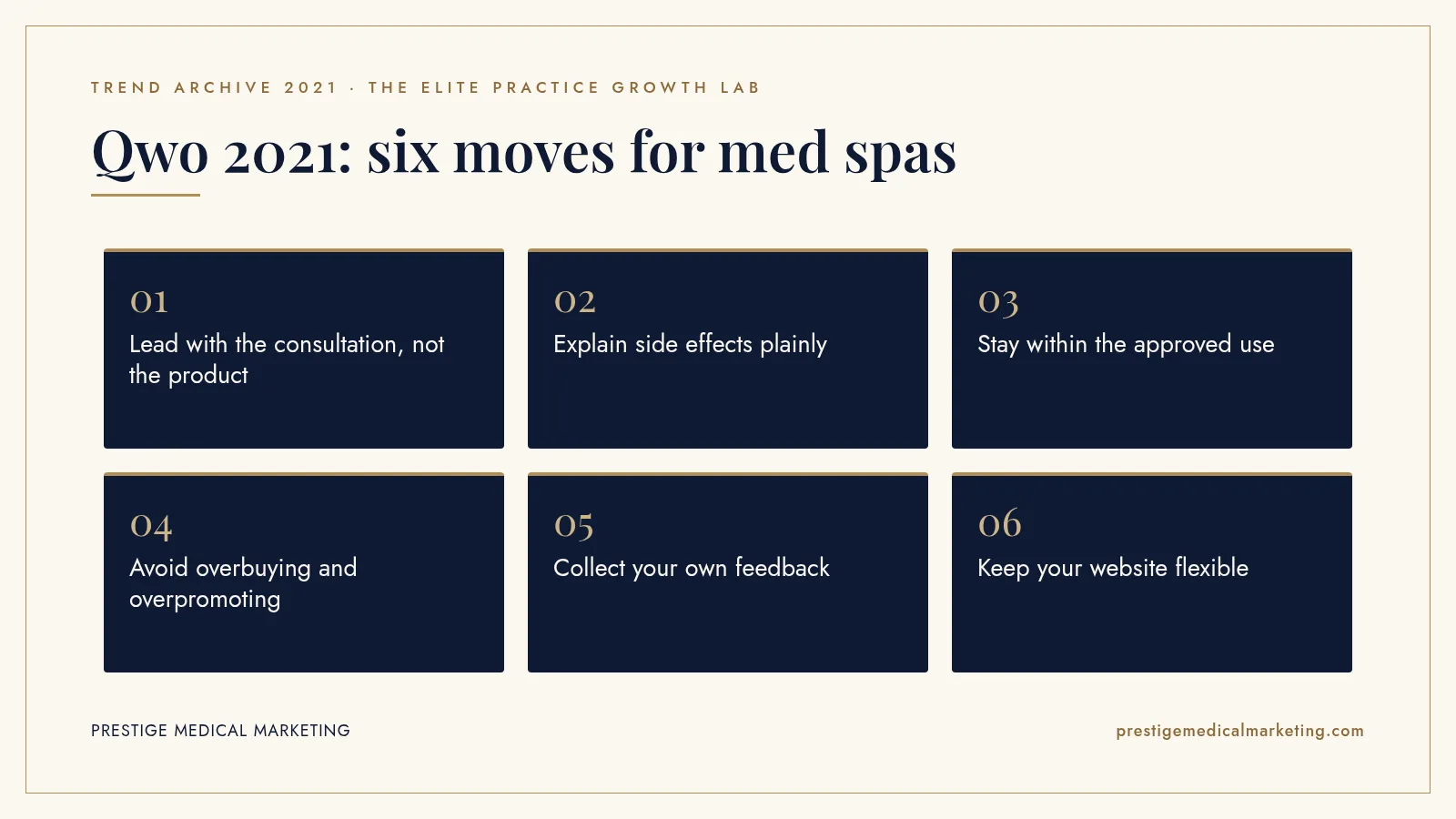
1. Lead with the consultation, not the product
Market the client’s goal and the practice’s expertise. A consultation that matches the right treatment to the right person outlasts any single product.
2. Explain side effects plainly
Describe common side effects and downtime in clear language. Clients who know what to expect are far more satisfied with the same result.
3. Stay within the approved use
Describe new treatments accurately, including who they are approved for, and avoid implying broader results than the evidence supports.
4. Avoid overbuying and overpromoting
Heavy discounting and large inventory commitments create pressure to sell. Pressure rarely produces happy clients.
5. Collect your own feedback
Track client satisfaction, side effects and repeat bookings for each new treatment so decisions rest on the practice’s own experience.
6. Keep your website flexible
Organize treatment pages around concerns and goals so a discontinued product can be removed without breaking the site’s structure.

The novelty trap
New treatments attract attention because they are new. That makes them tempting to market, and it also makes them risky. Early experience in real practices often differs from clinical trials, technique improves over time and side effects that seemed manageable on paper can feel very different to a client looking in the mirror.
A premium practice does not need to be first with every launch. It needs to be trusted. Clients who see a practice offer a new treatment thoughtfully, with honest expectations, are more likely to return for the next one. Clients who feel oversold are more likely to leave a disappointed review.
Writing honest treatment pages
A strong treatment page explains what the treatment is, how it works in plain language, who it is approved for or suited to, what a session involves, what side effects are common, what recovery looks like and how results vary. It introduces the clinicians who perform it and invites the reader to a consultation.
That structure serves clients well, and it also serves the practice when the market changes. If a treatment is discontinued, the page can be updated to explain alternatives rather than simply disappearing.
Before-and-after content and expectations
Cellulite results are especially sensitive to lighting, posture and angle. Before-and-after images that are not taken under consistent conditions can exaggerate improvement. Practices should use consented, consistent photography, avoid heavy editing and explain that individual results vary. That standard protects clients and the practice’s reputation.
Testimonials need similar care. A client’s genuine experience is valuable, but it should not be presented as typical if it is not, and any incentive the client received should be disclosed.
Pricing new treatments responsibly
Launch pricing can be useful, but steep discounts on a new treatment send a mixed message. They suggest the practice needs to push the product rather than recommend it. A clearer approach is to price new treatments in line with the practice’s positioning, explain what is included and offer a consultation that helps the client decide whether it is right for them.
When a treatment involves meaningful side effects or downtime, the consultation fee and follow-up visits should be part of the conversation from the start. Clients appreciate knowing the full commitment before they book.
What happens when a product disappears
Discontinuations happen in aesthetics for many reasons: safety signals, commercial decisions, supply problems or changing regulations. A practice should have a simple plan for when it happens. That plan includes updating the website promptly, pausing related ads, contacting clients who were mid-treatment and offering alternatives where appropriate.
Handled well, a discontinuation can strengthen trust. Clients see that the practice communicates honestly and puts their care ahead of selling a particular product.
Building a brand that outlasts products
The med spas that weather product cycles best are the ones known for their people and their judgment. Clients come for a particular injector, a reputation for natural results or a consultation experience that feels unhurried and honest. Those strengths transfer from one treatment to the next.
Marketing should reflect that. Content about the team, their training and their approach, combined with education about client goals, builds a brand that does not need any single product to succeed.
Training the front desk on new treatments
When a new treatment launches, the first conversations often happen on the phone or in direct messages rather than in the treatment room. Coordinators need accurate, simple answers about what the treatment is, who it suits, what side effects are common, how many sessions are typically involved and what it costs. Without that preparation, a coordinator may repeat the excitement of the advertising rather than the reality of the treatment.
A short internal guide, reviewed by the medical director, keeps those answers consistent. It should also explain when to route a question to a clinician, such as when someone asks whether the treatment is safe for them specifically. That keeps the practice accurate and protects clients from making decisions based on incomplete information.
Listening to early clients
The first clients to try a new treatment are a practice’s best source of information. A brief follow-up call or message a few days after treatment, asking about bruising, discomfort and how the client feels about the experience, gives the practice an early read on how the treatment is landing. It also shows the client that the practice cares about the outcome, not only the sale.
Those early conversations should shape marketing. If clients consistently say recovery took longer than expected, the treatment page and consultation script should say so. Marketing that reflects real client experience earns trust in a way that launch messaging rarely does. Accuracy always comes first.
What 2021 does not tell us
Public sources do not tell us how many med spas offered Qwo, how many clients were treated or how satisfaction compared across practices and injectors. Experience in individual practices varied, and some clinicians reported good outcomes with careful technique and patient selection. What the arc from launch to discontinuation does show clearly is the risk of building marketing around a single new product and the value of setting realistic expectations from the start.
The premium practice advantage
A premium med spa’s real advantage is trust: skilled clinicians, honest consultations and a reputation for natural results. The work is presenting that clearly and letting new treatments add to it rather than define it. See our med spa services, our reputation and premium pricing work, our custom websites, our full services and who we help. Our team works from Austin with practices nationwide.
The bottom line
Qwo launched in early 2021 as the first FDA-approved injectable for cellulite and was discontinued in December 2022 amid concerns about bruising and discoloration. For med spas, the lasting lesson was to market new treatments honestly, keep the consultation at the center and build a brand around expertise rather than any single product.
Check if your market is open. We take one practice per specialty per market. Request a market check or call (716) 400-0084.
Frequently asked questions
What was Qwo?
Qwo was collagenase clostridium histolyticum-aaes, an injectable approved by the FDA in July 2020 for the treatment of moderate to severe cellulite in the buttocks of adult women.
When did Qwo launch?
Endo reported the launch in the first quarter of 2021, describing Qwo as the first and only FDA-approved injectable treatment for cellulite at the time.
Why was Qwo discontinued?
In December 2022, Endo said it would cease production and sale because of market concerns about the extent and variability of bruising after initial treatment and the potential for prolonged skin discoloration.
How common was bruising?
Endo reported that in clinical trials, 84 percent of subjects treated with Qwo experienced injection site bruising.
What did the Qwo story teach med spas?
It showed the risk of building heavy marketing around a single new product and the importance of setting realistic expectations about side effects and downtime.
How should a med spa market a new treatment today?
Present it as one option within a broader consultation, explain realistic results and side effects clearly, collect client feedback and avoid overpromising.