
On June 29, 2023, the FTC finalized updated Endorsement Guides, last revised in 2009. They added a principle against procuring, suppressing or editing consumer reviews to distort perception, addressed incentivized and employee reviews, defined "clear and conspicuous" disclosure and clarified that tags and virtual influencers can be endorsements. On June 30, 2023, the FTC proposed a rule banning fake reviews, finalized in 2024. For aesthetic practices, 2023 made honest review collection and clear influencer disclosures essential.
Aesthetic practices run on social proof. Patients considering injectables, lasers, body contouring or surgery look at reviews, watch influencer content and study testimonials before they book. In 2023, the Federal Trade Commission rewrote the guidance governing all of it.
On June 29, 2023, the FTC finalized its first update to the Endorsement Guides since 2009. The next day, it proposed a rule to ban fake reviews and related practices. Together, they set the standard for how med spas and aesthetic practices collect reviews, work with influencers and use testimonials.
This retrospective covers what changed in 2023 and what it means for aesthetic marketing today. It connects directly to our coverage of the FTC’s final fake review rule in 2024, the consumer review rule in 2025 and Google’s 2023 reviews updates.
What actually happened in 2023
June 29: revised Endorsement Guides. The FTC announced it had finalized updated Endorsement Guides, which advise businesses on practices that may be unfair or deceptive. The guides had last been revised in 2009. The Commission vote was 3-0.
The key changes. The FTC listed six revisions: a new principle on procuring, suppressing, boosting, organizing, publishing, upvoting, downvoting or editing consumer reviews to distort what consumers think; guidance on incentivized reviews, employee reviews and fake negative reviews of competitors; a definition of “clear and conspicuous,” noting a platform’s built-in disclosure tool might not be adequate; a broader definition of endorsements covering fake reviews, virtual influencers and social media tags; clearer liability for advertisers, endorsers and intermediaries; and special concern for child-directed advertising.
Updated FAQs. The FTC also updated its guidance document, “FTC’s Endorsement Guides: What People are Asking,” adding 40 questions, including specific guidance for influencers on disclosing material connections and more on online reviews.
June 30: proposed fake review rule. The FTC proposed a rule prohibiting fake reviews and testimonials, review hijacking, incentives conditioned on positive or negative sentiment, undisclosed insider reviews, company-controlled “independent” review sites, illegal review suppression and fake social media indicators. The FTC noted that generative AI was likely to make fake reviews easier to write.
Why it mattered for aesthetic practices
Few categories rely on endorsements as heavily as aesthetics. Med spas often give influencers complimentary treatments in exchange for content. Many run review campaigns with incentives attached. Staff post enthusiastic content about their own clinics online. Before-and-after testimonials fill websites and social feeds. Each of those is an endorsement in the FTC’s eyes, and each carries its own set of expectations about honesty and disclosure.
The 2023 guidance touched every one of those practices. Influencer partnerships needed clear disclosure of material connections, and a platform’s built-in “paid partnership” label might not be enough by itself. Review programs needed to avoid conditioning incentives on positive sentiment and avoid filtering who was asked. Employee enthusiasm needed to be disclosed or kept out of reviews entirely. And testimonials needed to reflect real experiences, without implying that exceptional results were typical.
The proposed rule raised the stakes further. The FTC explained that case-by-case enforcement without civil penalty authority might not deter clearly deceptive practices. A final rule would allow penalties, and that rule arrived in 2024.
What typical agencies did
Many agencies running aesthetic social programs kept doing what they had always done: influencer trades with a hashtag or no disclosure at all, review drives offering discounts for five-star reviews and staff accounts posting glowing comments. Some had no idea the guides had changed. Others knew but assumed small local businesses were unlikely to draw attention, a bet that looks weaker once a rule allows civil penalties and competitors can report deceptive practices.
The better response was a compliance refresh across every channel: influencer agreements with disclosure requirements, review requests sent to every patient with no sentiment conditions, clear policies for staff, and testimonial review before anything went live.
What it means for an aesthetic practice today
The 2023 guidance, and the 2024 rule that followed, define how endorsements should work. These steps keep a practice on the right side of it.
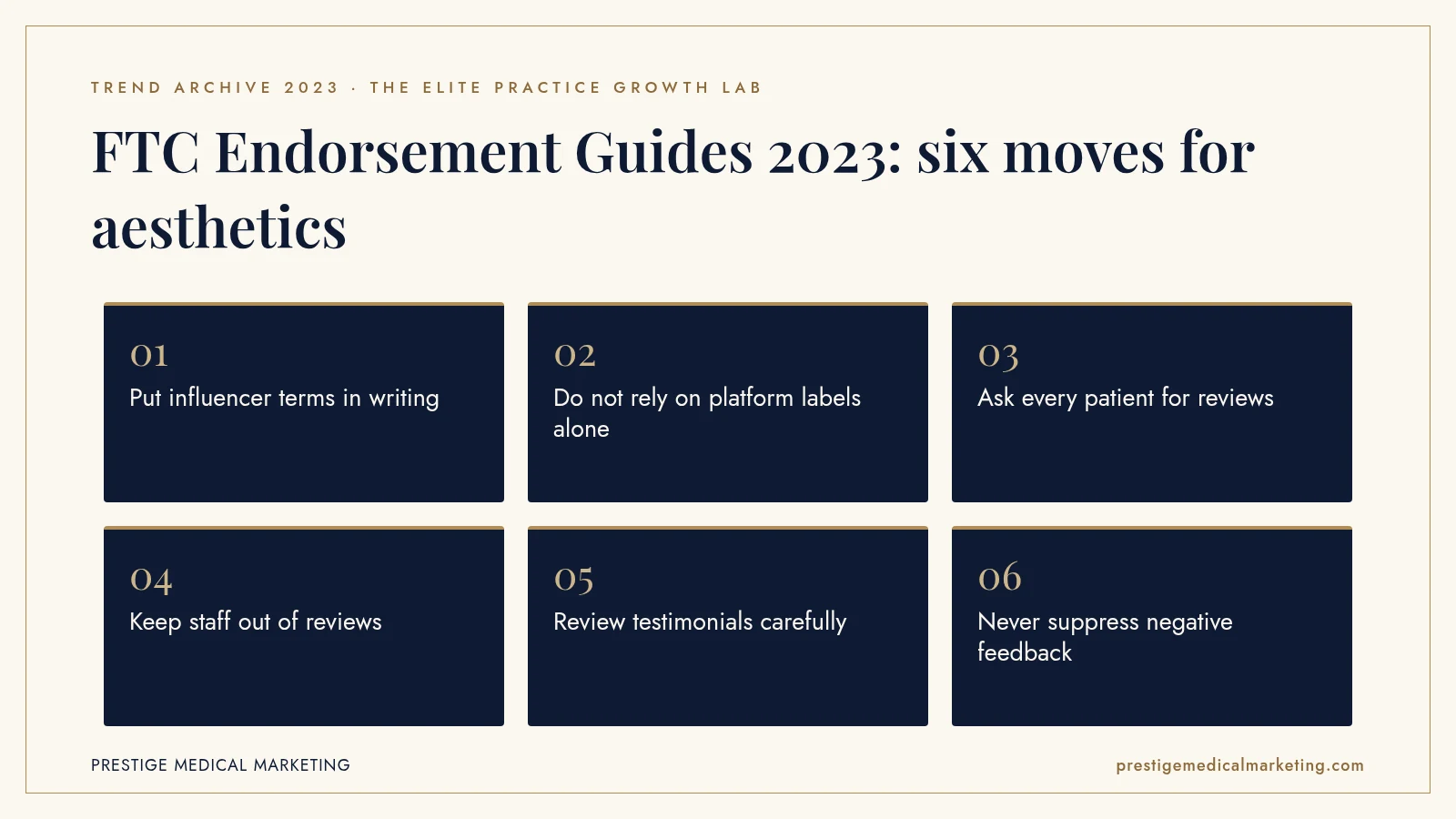
1. Put influencer terms in writing
Every influencer or creator partnership should have a written agreement requiring clear, conspicuous disclosure of free treatments, payment or discounts in every post, in words people will notice and understand. Keep signed copies on file.
2. Do not rely on platform labels alone
The FTC said built-in disclosure tools might not be adequate. Ask creators to disclose plainly in the content itself, such as at the start of a video and in the caption.
3. Ask every patient for reviews
Send review requests to all patients, not only those likely to be happy, and never tie any incentive to positive sentiment. Automating the request makes consistency easier.
4. Keep staff out of reviews
Staff should not review their own practice. If they share content about where they work, the relationship should be obvious. Put the policy in the employee handbook so new hires know it from day one.
5. Review testimonials carefully
Use only real patient testimonials with documented permission. Avoid implying exceptional results are typical, and add clear context when individual results vary.
6. Never suppress negative feedback
Respond professionally to criticism. Do not threaten, pressure or filter reviewers to remove honest negative reviews. A calm reply often reassures future patients more than a perfect rating does.

Influencers and creators in aesthetics
Influencer marketing is especially common in aesthetics because treatments are visual and personal. A creator documenting a lip filler or laser session can reach thousands of potential patients. That reach is exactly why disclosure matters, and why the 2023 guidance paid so much attention to social media. Followers trust creators, and they deserve to know when a creator received a free treatment or payment.
The 2023 guides clarified that advertisers, not only influencers, can bear responsibility for inadequate disclosures. A med spa that provides complimentary treatments should monitor whether creators disclose properly and act if they do not. The updated FAQs gave FTC staff views on that kind of brand monitoring.
Disclosure also needs to fit the format. A disclosure buried in a long caption, hidden among hashtags or shown briefly in a video may not be clear and conspicuous. Simple language such as “I received this treatment free from the clinic” placed where people will see it is safer than abbreviations or vague tags.
Testimonials and typical results
Aesthetic testimonials often describe dramatic changes. That can be powerful, but it carries risk if the result is not typical. The FTC’s long-standing position in its Endorsement Guides is that testimonials about results may convey that the results are representative unless clearly qualified, and that advertisers need evidence for what their testimonials convey.
For a med spa, that means choosing testimonials that reflect realistic outcomes, explaining that results vary and avoiding testimonials that make claims the practice could not substantiate itself, such as permanent results, no downtime or guaranteed outcomes. Before-and-after photos deserve the same care, and they should be genuine, unretouched in ways that misrepresent the result and shared with patient consent.
Building review volume the right way
Honest review programs work well. The most effective approach is simple: ask every patient, shortly after a visit, with a direct link and a short thank-you. No conditions, no discounts tied to star ratings and no screening of who receives the request.
Practices that do this consistently often build strong review profiles over time because most patients of a good practice have good experiences. The reviews that result are more credible to prospective patients, more defensible under FTC guidance and more durable when platforms remove suspicious reviews. Our guide to reputation and premium pricing explains why that credibility supports higher-value treatments.
Staff, owners and the insider problem
Aesthetic practices often have enthusiastic teams who want to help. That enthusiasm is valuable on social media, where staff can share their work and the practice culture. It becomes a problem in reviews, where a staff member’s five-star review looks like an independent patient experience.
The 2023 guidance addressed employee reviews directly, and the proposed rule targeted undisclosed reviews by officers and managers, along with certain solicitations of reviews from employees and relatives. The safest policy is clear: owners, managers and staff do not review their own practice, and they do not ask friends and family to do so.
Company-controlled review sites and comparisons
The proposed rule also addressed businesses that create or control a website claiming to offer independent opinions about a category that includes their own products or services. For aesthetics, that matters more than it might seem. Some practices and groups have run “best med spas in the city” pages, comparison sites or directories that quietly favor themselves.
The safer approach is transparency. If a practice publishes comparison content, it should be clearly presented as the practice’s own perspective, on its own website, with no pretense of independence. That approach also aligns with Google’s reviews system, which rewards first-hand expertise rather than disguised promotion.
A simple compliance checklist
For most aesthetic practices, the 2023 guidance can be reduced to a short checklist reviewed every quarter. Are all influencer and creator partnerships documented, with disclosure requirements, and are creators actually disclosing? Are review requests sent to every patient, without sentiment conditions or filtering? Do staff and owners stay out of reviews? Are testimonials genuine, permissioned and representative, with clear context when results vary? Are negative reviews handled with professional responses rather than pressure?
Add a final question: would the practice be comfortable if a regulator, a journalist or a skeptical patient read every endorsement it has published? If the answer is yes, the practice is in a strong position. If not, the fix is usually straightforward and far cheaper than the alternative.
Practices should also have qualified legal counsel review influencer agreements and review programs, since state laws and platform policies add further requirements.
What 2023 does not tell us
The FTC did not publish data on how many aesthetic practices changed their influencer or review practices in response to the 2023 guidance. We also have no reliable figures on enforcement specific to med spas from that year. What 2023 does show is the documented content of the revised guides, the updated FAQs and the proposed rule that followed.
The premium practice advantage
Premium aesthetic practices have no need to manufacture social proof. Their patients’ genuine experiences, shared honestly and consistently, are the strongest marketing they have. See our med spa services, our full services, who we help and our approach to Google Maps and AI search visibility. Our team works from Austin with practices nationwide.
The bottom line
The FTC’s 2023 Endorsement Guides and proposed fake review rule reset the standard for aesthetic marketing. Practices that disclose clearly, ask every patient and let real experiences speak are both compliant and more persuasive.
Check if your market is open. We take one practice per specialty per market. Request a market check or call (716) 400-0084.
Frequently asked questions
What did the FTC change in its 2023 Endorsement Guides?
The FTC added a principle on procuring, suppressing or editing reviews to distort perception, addressed incentivized and employee reviews, defined clear and conspicuous disclosure and expanded the definition of endorsements.
When were the Endorsement Guides last updated before 2023?
The FTC said the guides were last revised in 2009. The companion FAQ document was last revised in 2017.
Do med spa influencer posts need disclosures?
Yes, when there is a material connection, such as free treatments, payment or discounts. The FTC also said a platform's built-in disclosure tool might not be adequate on its own.
Can a med spa offer incentives for reviews?
The FTC's proposed 2023 rule targeted incentives conditioned on a particular sentiment. Practices should avoid any incentive tied to positive reviews and get legal advice on any review program.
Can staff review their own practice?
The 2023 guides addressed employee reviews, and the proposed rule targeted undisclosed reviews by officers and managers. Staff should not post reviews of their own practice without clear disclosure, and generally should not post them at all.
What happened to the proposed fake review rule?
The FTC finalized its rule on consumer reviews and testimonials in 2024, giving the agency the ability to seek civil penalties for violations.