
Google ran two reviews updates in 2023: the April 2023 reviews update, which started April 12, and the November 2023 reviews update, which started November 8. Earlier updates had been labeled product reviews updates; by April the name was simply reviews update, and Google's documentation now says the system covers reviews of services and businesses. The reviews system evaluates first-party review content, such as treatment comparisons, not patient reviews posted by users. For med spas, it rewarded genuine expertise in comparison content.
Med spas live and die by reviews, but the word means two very different things in Google’s world. There are patient reviews, the star ratings and comments people leave on a Google Business Profile. And there is review content, the pages a business publishes to compare, rank or recommend things: Botox versus Dysport, the best laser for sun damage, the top skincare products for after a peel.
In 2023, Google made two significant changes to how it evaluates the second kind. Its product reviews system became simply the reviews system and expanded to cover services and businesses, not only products. A second update followed in November. For med spas that had published thin comparison pages to capture search traffic, the bar went up.
This retrospective covers what changed in 2023, how it differs from patient reviews and what it means for a med spa today. For the regulatory side of reviews, see our coverage of the FTC fake review rule in 2024 and the FTC’s 2023 endorsement guides.
What actually happened in 2023
February 21: the last product reviews update. Google’s Search Status Dashboard lists a February 2023 product reviews update, part of a series that had run since 2021 focused on product review content.
April 12: the reviews update. Less than two months later, the dashboard lists an April 2023 reviews update, running about 13 days. The word “product” was gone. Google’s reviews system documentation now describes reviews about products, media, and services and businesses such as restaurants or fashion brands.
What it evaluates. Google says the reviews system is designed to evaluate articles, pages or similar first-party standalone content written to provide a recommendation, give an opinion or provide analysis. It aims to reward reviews that share in-depth research rather than thin content that simply summarizes a list of things.
What it does not evaluate. Google states that the system does not evaluate third-party reviews, such as those posted by users in the reviews section of a product or services page. Patient reviews are outside its scope.
Page level, sometimes site level. Google says the system primarily evaluates review content page by page. For sites with a substantial amount of review content, any content within the site might be evaluated.
November 8: another round. The dashboard lists a November 2023 reviews update, running about 29 days and overlapping with the November core update. Google’s documentation now says the reviews system is improved at a regular and ongoing pace.
Why it mattered for med spas
Many med spa websites carried a lot of review-style content by 2023. Comparison pages pitted neurotoxin brands against each other, ranked fillers, compared laser platforms or recommended skincare products. Some were genuinely helpful, written by injectors and providers with real experience who explained how they actually make choices for patients in the treatment room. Many were thin, generic and nearly identical to pages on hundreds of other sites.
The April expansion meant those pages were now squarely in scope for a system built to reward first-hand expertise and penalize summaries. A page comparing two neurotoxins that offered nothing beyond the manufacturers’ marketing language was exactly the kind of content the system was designed to demote.
There was also a less obvious risk. Because the system can evaluate a site more broadly when it has substantial review content, a med spa with dozens of thin comparison pages could, in principle, see effects beyond those pages.
What typical agencies did
Most agencies did not distinguish between the reviews system and patient reviews at all. When clients asked about the “reviews update,” many responded by pushing harder for Google Business Profile reviews, which was useful for local visibility but unrelated to the Search update.
Others kept publishing comparison content at volume, often generated from manufacturer materials or other sites. The better response was to look at every review-style page on the site and ask whether it reflected real hands-on experience from the practice’s own providers.
What it means for a med spa today
The reviews system is now continuously updated. These steps help a med spa’s review content and patient reviews both work in its favor.
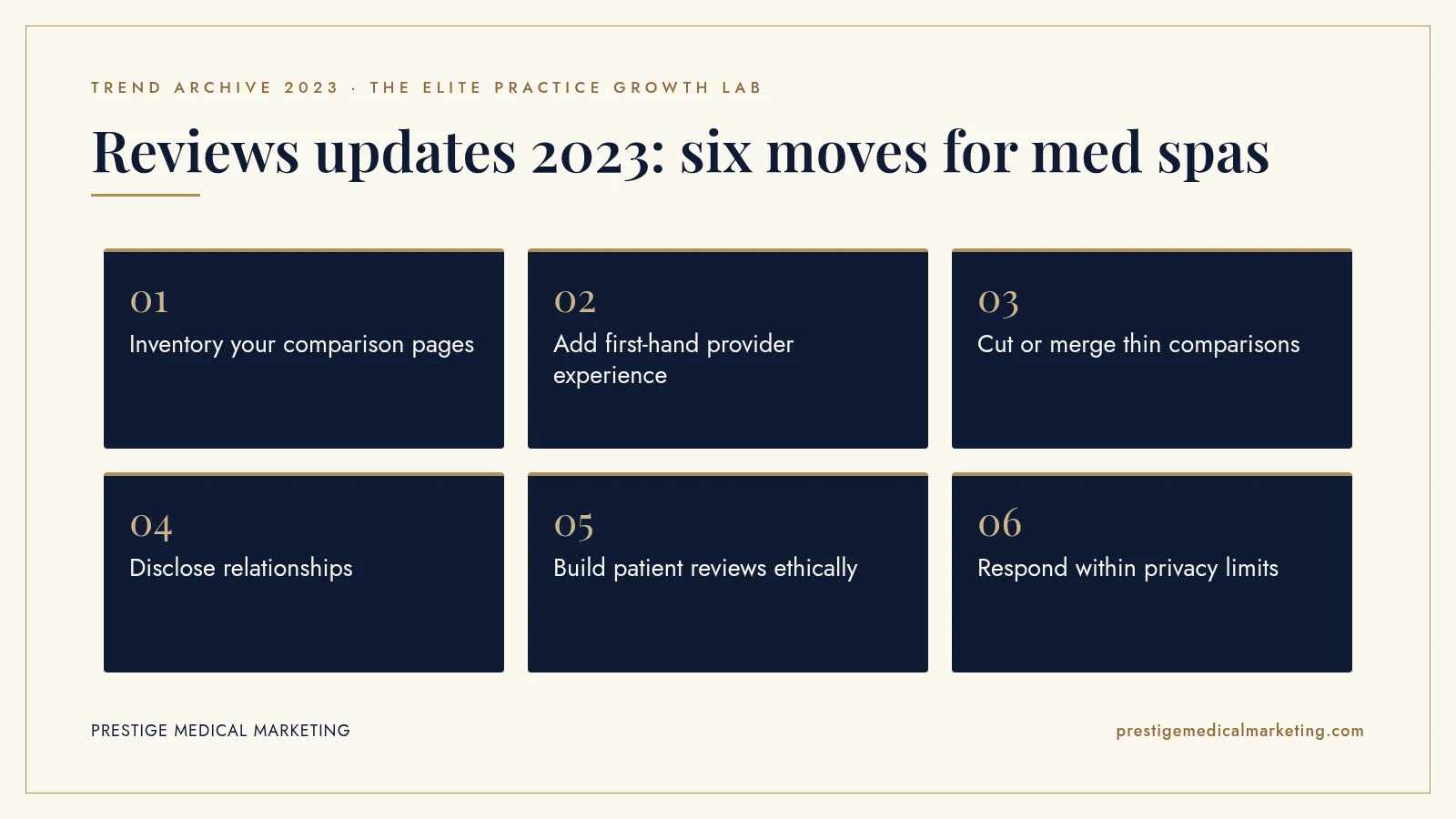
1. Inventory your comparison pages
List every page that compares, ranks or recommends treatments, devices or products. Those are the pages the reviews system evaluates. Many sites are surprised by how many they have, especially after years of content added by different agencies.
2. Add first-hand provider experience
Have the injectors and providers who perform the treatments explain how they choose between options, what patients notice and what tradeoffs matter. That is what generic pages cannot copy, and it is what Google’s guidance asks review content to show.
3. Cut or merge thin comparisons
If a comparison page adds nothing beyond manufacturer claims, improve it substantially or retire it. Fewer, better pages reduce site-wide risk and give patients a clearer path through your site.
4. Disclose relationships
If you sell the products you recommend, earn rewards from a manufacturer program or have other brand relationships, say so clearly. It builds trust and aligns with FTC endorsement guidance.
5. Build patient reviews ethically
Ask every patient for an honest review, without incentives tied to positive sentiment and without filtering who gets asked. Make the request simple and consistent.
6. Respond within privacy limits
Reply to patient reviews professionally without confirming that anyone is a patient or discussing treatment details. Thank reviewers, invite unhappy reviewers to contact the practice directly and keep every reply short, warm and general.

Two kinds of reviews, two systems
The clearest takeaway from 2023 is that med spas need to manage two separate review systems. The first is the reviews system in Google Search, which judges the quality of the review content a med spa publishes on its own site. The second is local search, where patient reviews on the Google Business Profile influence visibility in maps and local results.
Google’s Business Profile help center explains that prominence is one of the main local ranking factors, and that more reviews and positive ratings can help a business’s local ranking. That is a different mechanism from the reviews system, and it rewards a steady flow of genuine patient feedback.
A strong med spa does both well: publishes comparison content that reflects real provider expertise, and earns a consistent stream of honest patient reviews. Our med spa Google Business Profile guide covers the local side in detail.
What good comparison content looks like
Google’s guidance on writing high-quality reviews asks whether content shows evidence of first-hand experience, explains what sets options apart and discusses benefits and drawbacks based on real research. For a med spa, that translates directly into how providers actually work.
A strong neurotoxin comparison page might explain how your injectors think about onset, spread, patient history and preferences, without claiming one brand is universally better. A strong laser comparison might explain which concerns and skin types each platform suits in your providers’ experience, what downtime looks like and why you offer the devices you do. It should note that individual results vary and that a consultation determines the right option.
That kind of content is useful to patients, defensible from a regulatory standpoint and difficult for competitors to replicate. It also tends to convert, because it demonstrates expertise right at the moment a patient is deciding, often before they have contacted any practice.
Where patient reviews fit in the FTC picture
2023 was also a big year for review regulation. In June, the Federal Trade Commission updated its Endorsement Guides, addressing procuring, suppressing and incentivizing reviews. That guidance applies to how med spas collect and display patient reviews, and it set the stage for the FTC’s 2024 rule banning fake reviews.
The practical rules are straightforward. Ask every patient for feedback, not just the happy ones. Do not offer incentives conditioned on positive reviews. Do not write, buy or trade reviews, and do not have staff post them. Do not suppress negative reviews through filtering or pressure. Be careful with testimonials on your own site and in ads, which must reflect real experiences and avoid implying typical results that are not typical.
Building a review engine that lasts
The med spas with the strongest review profiles usually do not rely on bursts of requests. They build a steady, simple process into the patient experience: a review request sent a few days after a visit, an easy link and a genuine thank-you. Over months, that creates a consistent flow of recent reviews that reflects the actual patient experience.
Consistency matters to prospective patients too. A profile with a steady stream of recent reviews signals an active, trusted practice. A profile with a cluster of reviews from two years ago and nothing since raises questions. Our guide to reputation and premium pricing explains why that consistency supports higher-value treatments.
Measuring what changed
A med spa trying to understand the effect of the reviews updates should look at its comparison and recommendation pages as a group in Google Search Console. Compare impressions and clicks for those pages across the weeks around April 12 and November 8, 2023, and against the rest of the site. If the comparison pages moved differently from service pages, the reviews system is a plausible factor.
Be careful with conclusions. The November reviews update overlapped with the November core update, and seasonal demand for aesthetic treatments shifts across the year. A drop in late 2023 could reflect any of those factors, or a competitor improving its content.
The most useful measurement is forward-looking. Once comparison pages are improved with genuine provider expertise, track whether they earn more impressions, longer engagement and more consultation requests over the following months. That tells you whether the content is working for patients, which is what the reviews system is trying to measure in the first place.
What 2023 does not tell us
Google did not publish which sites or pages the 2023 reviews updates affected, and the November update overlapped with a core update, making attribution difficult. We do not have reliable public data on how med spa sites specifically fared. What 2023 does show is Google’s documented scope for the system, including its explicit exclusion of user-posted reviews.
The premium practice advantage
Premium med spas have providers with real expertise and patients who are glad to talk about their experience. The work is capturing both honestly. See our med spa services, our full services, who we help and our approach to Google Maps and AI search visibility. Our team works from Austin with practices nationwide.
The bottom line
Google’s 2023 reviews updates raised the bar for comparison content on med spa sites, while patient reviews remained a separate, local signal. Med spas that publish genuine provider expertise and earn honest patient feedback win on both fronts.
Check if your market is open. We take one practice per specialty per market. Request a market check or call (716) 400-0084.
Frequently asked questions
What were Google's 2023 reviews updates?
Google's Search Status Dashboard lists an April 2023 reviews update starting April 12 and a November 2023 reviews update starting November 8. A February 2023 update was still called a product reviews update.
Does the reviews system evaluate patient reviews on Google?
No. Google says the reviews system evaluates first-party standalone content written to give a recommendation, opinion or analysis. It does not evaluate third-party reviews, such as those posted by users.
What kind of med spa content does the reviews system evaluate?
Pages written to review or compare things, such as treatment comparisons, product recommendations or ranked lists of options, can fall under the reviews system.
Do patient reviews still matter for local search?
Yes. Google's Business Profile help center says more reviews and positive ratings can help a business's local ranking. That is a separate system from the reviews system in Search.
Can one weak review page affect a whole site?
Google says the system primarily evaluates content at the page level, but for sites with a substantial amount of review content, content across the site may be evaluated.
Does Google still announce reviews updates?
Google's documentation now says the reviews system is improved at a regular and ongoing pace, and later reviews system changes were not announced as named updates the way the 2023 ones were.