Google announced the helpful content update on August 18, 2022 and began rolling it out on August 25, 2022 for English searches, finishing in early September. It introduced a site-wide signal: sites with relatively high amounts of unhelpful, search-engine-first content could see their whole site perform less well. For med spas, it rewarded specific, experienced, client-first treatment pages over generic copy written to capture keywords.
By 2022, a typical med spa website followed a familiar recipe. A page for every injectable, every laser and every body treatment, each written to a keyword and often borrowed in spirit from the device maker’s brochure. A few city pages swapped a neighborhood name into the same copy. A steady drip of short posts about “summer skin” or “the best time for filler” kept the site looking active. It was cheap, it was fast, and for a while it worked well enough.
In August 2022, Google introduced a signal designed to make that recipe less reliable. The helpful content update was not just another core update. It added a new, site-wide way for Google to judge whether a site’s content was made for people or made for search engines, and it made the answer matter for every page on the domain.
This retrospective covers what Google actually announced and shipped in 2022, why it landed hard in aesthetics, and what a med spa should do with the lesson today. For the next chapter of the same story, read our look at the September 2023 helpful content update, and for where it ended up, the March 2024 core update.
What actually happened in 2022
August 18: the announcement. Google published “More content by people, for people in Search”, explaining that it would roll out a series of improvements to better connect people with original, helpful content. The same day, Google Search Central published guidance for creators on what the new helpful content update meant.
A site-wide signal. The most important detail was structural. Google said any content on sites determined to have relatively high amounts of unhelpful content overall was less likely to perform well in Search, assuming there was other content elsewhere on the web that was better to display. In plain terms, a large volume of weak pages could weigh down the strong pages on the same site.
August 25: the rollout. Google’s Search Status Dashboard lists the helpful content update as starting on August 25, 2022 and completing in September. Google said it applied first to English-language searches globally, with other languages to follow.
Self-assessment questions. Google’s guidance listed questions for site owners. Does the site have a primary purpose or focus? Does the content demonstrate first-hand expertise and depth of knowledge? Will a reader leave feeling they learned enough to achieve their goal? On the other side: is the content made mainly to attract search visits, does it summarize what others say without adding value, and does it promise answers it cannot deliver?
Recovery would be slow. Google said the classifier ran continuously and that sites removing unhelpful content could see the signal lift, but that this could take months as the system confirmed the change held over time.
A busy season. A core update followed in September 2022, which made it hard for many site owners to separate one update’s effect from the other’s.
Why it mattered for med spas
Aesthetics is a category where search-first content became the default. Treatment pages for neuromodulators, fillers, microneedling, chemical peels and laser resurfacing tended to read alike across thousands of sites. Vendors sold the same page templates to practices in different cities. Device makers supplied descriptive copy that many med spas pasted in directly. The result was a web full of pages that said the same thing in the same order.
That pattern sits close to what Google’s questions describe as search-engine-first: content on many topics chosen because they seem to draw traffic, summarizing what others say, with little first-hand insight. A med spa with sixty such pages and five genuinely useful ones was exactly the kind of site a site-wide signal could affect.
There was also a trust dimension. Aesthetic treatments are elective, often paid out of pocket, and chosen carefully. Clients want to know who will treat them, what the experience is like and what results are realistic. Pages that answered those questions served clients. Pages that defined a treatment in generic terms and ended with a booking button did not.
What typical agencies did
Many agencies reacted in one of two ways. Some kept publishing at the same pace, assuming the update was aimed at content farms and affiliate sites rather than local practices. Others overcorrected, deleting large sections of a client’s site in a single afternoon without checking which pages earned visits, links or bookings.
A few rewrote every page with a new set of keywords, which changed the words but not the substance. Google’s guidance was clear that the question was whether content helped a person achieve a goal, not whether it used particular phrasing.
The better approach took longer. It meant reviewing each page on its merits, keeping and improving what served clients, consolidating duplicates and retiring what served no one, then giving the system time to notice.
What it means for a med spa today
The helpful content system now lives inside core ranking, so these principles are simply how an aesthetic practice earns organic visibility.
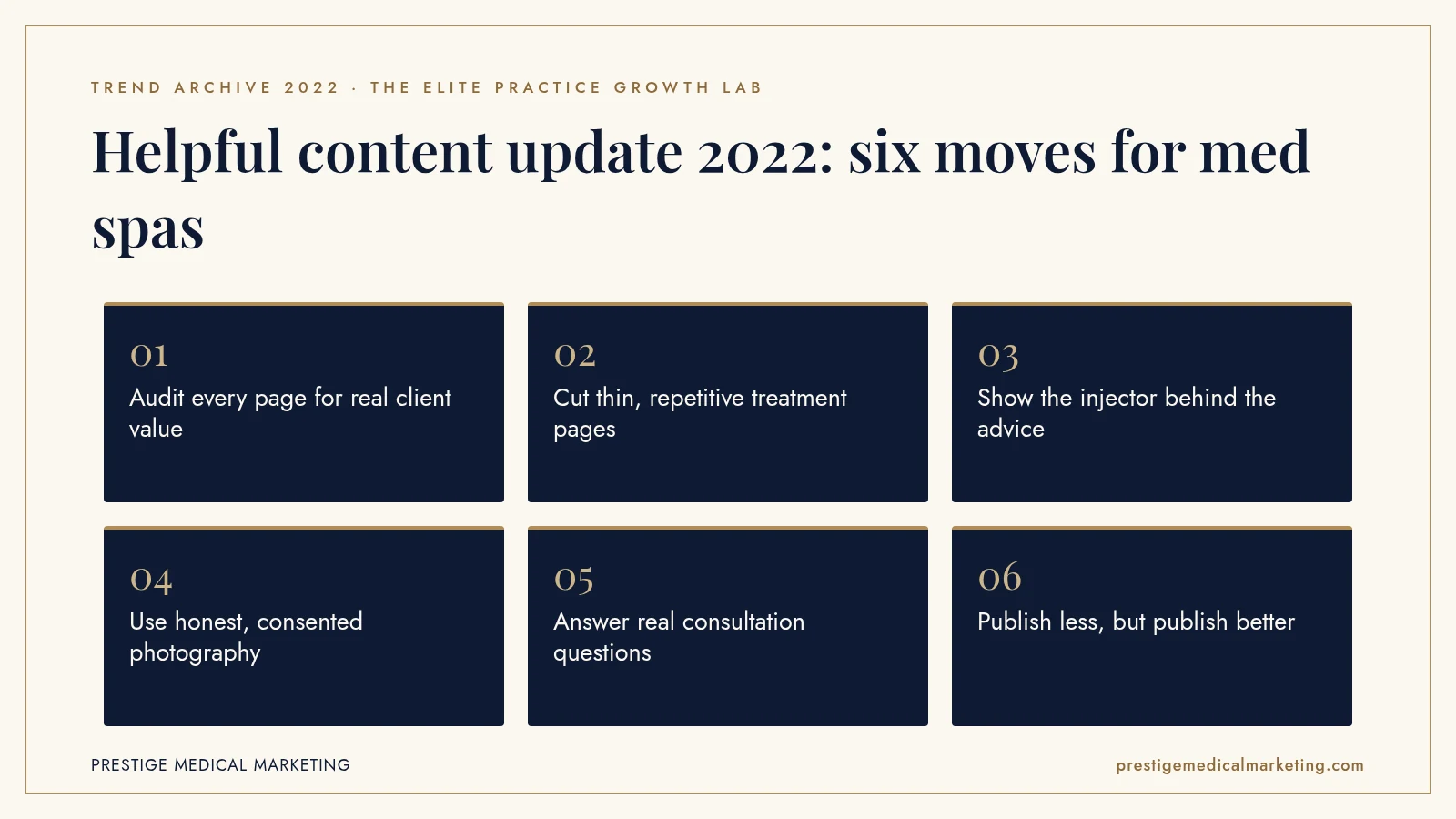
1. Inventory every page
List each URL with its traffic, links and conversions. Pages with none of the three, and no unique information, are candidates to improve, merge or retire.
2. Rewrite treatment pages from the chair
Explain how your injectors and providers actually approach each treatment: the consultation, who is a good candidate, what a visit involves and what recovery commonly looks like.
3. Name the providers
Show who performs treatments and who reviewed the content, with accurate credentials. First-hand expertise was one of Google’s first questions.
4. Retire borrowed copy
Replace manufacturer descriptions and vendor templates with language that reflects your practice. Link to official product information where it helps rather than copying it.
5. Merge thin location pages
Keep a location page only where you have an office, and fill it with real details: parking, hours, the team there and how to book.
6. Give recovery time
Make durable improvements, then measure over months rather than days. Google said the signal could take months to lift.

What client-first content looks like in aesthetics
Google’s guidance asked a simple question: after reading the page, would someone feel they learned enough to achieve their goal? For a prospective med spa client, the goal is usually a decision. Is this treatment right for me? Is this the place I trust to do it? What will it cost, how long will it take and what happens afterward?
A client-first treatment page answers those questions plainly. It explains who tends to be a good candidate and who is better served by another option or a referral. It describes the consultation and the visit itself. It sets realistic expectations about results and downtime without promising outcomes. It is transparent about pricing structure, whether by unit, syringe, session or package. And it makes booking a consultation easy from a phone.
Compare that with a page that defines microneedling in three paragraphs, lists benefits copied from a device brochure and ends with a generic call to action. The first helps a client decide. The second could live on any site in the country, which is precisely why it adds so little.
Photography, proof and honesty
Aesthetic practices have an advantage most categories lack: the work is visible. Real before-and-after photography, shown with consent and consistent lighting, demonstrates experience far better than adjectives. So do accurate provider bios, clear explanations of training and a candid description of what a treatment can and cannot do.
Honesty matters as much as proof. Pages that overstate results, imply guarantees or use unverifiable claims undermine trust with clients and can create advertising and regulatory risk. A strong page tells clients what is typical and what varies from person to person, and invites them to a consultation to find out what applies to them.
Off the page, the same signals reinforce each other. A Google Business Profile with real photos of the space, reviews that mention providers by name and consistent information across the web all tell the same story the website tells.
Fewer pages, stronger site
One of the clearest lessons of 2022 is that a smaller site can be the stronger site. Under a site-wide signal, a med spa with twenty excellent pages is better positioned than one with two hundred thin ones, because the thin pages are not neutral. They contribute to how the whole site is judged.
Consolidation is often the highest-value work. Four near-identical pages about different brand names of neuromodulator can become one strong page that explains the category honestly, with brand-specific details where they matter. A dozen interchangeable city pages can become a few real location pages and a clear service-area explanation. Redirects preserve whatever value the old URLs earned.
A smaller site is also easier to keep accurate. Pricing, staff, hours and treatment menus change. A practice can keep twenty pages current. It cannot realistically maintain two hundred, which is how outdated and contradictory information creeps in.
The content calendar question
Many med spas had committed to publishing a fixed number of posts per month, regardless of whether there was anything worth saying. The helpful content update made that cadence a liability when it produced filler. A better calendar is driven by real client questions: what people ask at consultations, what they misunderstand, what has genuinely changed in the field.
Two well-researched, provider-reviewed articles a quarter that answer real questions can do more than four thin posts a month. Quality, not frequency, was the variable Google said it was measuring.
A practical way to build that calendar is to ask the front desk and the providers to log the questions they hear most often for a month. The list that comes back is usually more specific and more useful than any keyword tool, and every answer written from it is content no competitor can copy, because it reflects how this particular practice works.
What 2022 does not tell us
Google did not publish which sites the helpful content update affected or by how much, and the September 2022 core update that followed muddied attribution. We do not have reliable public data on how med spa sites as a group fared. Results varied from site to site. What 2022 does show is the direction Google stated in writing, and that direction has held through every update since, including the 2024 change that folded the system into core ranking.
The premium practice advantage
A premium med spa already has what Google’s questions reward: experienced providers, a distinct approach and real client outcomes. The work is translating that into pages that help clients decide. See our med spa services, our full services, who we help and how we approach Google Maps and AI search visibility. Our team works from Austin with practices nationwide.
The bottom line
The August 2022 helpful content update introduced a site-wide signal against search-first content. For med spas, the lesson was to trade templated volume for fewer, better pages written from real provider experience, and to give improvements time to register.
Check if your market is open. We take one practice per specialty per market. Request a market check or call (716) 400-0084.
Frequently asked questions
When did the August 2022 helpful content update roll out?
Google announced it on August 18, 2022. Google's Search Status Dashboard shows the rollout starting on August 25, 2022 and completing in September 2022.
What was new about it?
It introduced a site-wide signal. Google said content on sites with relatively high amounts of unhelpful content overall was less likely to perform well, not only the unhelpful pages themselves.
Which searches did it affect first?
Google said the first rollout applied to English-language searches globally, with plans to expand to other languages later.
Why did med spa websites feel it?
Many med spa sites used near-identical treatment pages, often supplied by vendors or device makers, plus thin location pages. That is the kind of search-first content the guidance described.
Is the helpful content system still a separate update?
No. Google later folded the helpful content system into its core ranking systems in March 2024, so its principles now apply through core ranking.
What is the fastest fix for an affected site?
There is no instant fix. Google said recovery could take months because the classifier needs to see that unhelpful content has been removed or improved over time.