
Google's March 2024 core update began March 5, 2024, alongside three new spam policies: scaled content abuse, expired domain abuse and site reputation abuse. Google said it expected 40% less low-quality, unoriginal content in Search, and after the rollout finished on April 19 it reported a 45% reduction. For medical practices, the lesson was clear: a website wins on original, expert, patient-first pages, not on volume.
Ask a practice owner what happened to their website traffic in the spring of 2024 and you will often get a shrug. Calls slowed. The agency said it was seasonal. Months later, the traffic still had not come back.
For a lot of medical practices, what actually happened was the Google March 2024 core update. It was one of the most significant ranking changes Google had made in years, and it arrived together with three new spam policies aimed at exactly the kind of content many practice websites were full of.
This retrospective covers what Google actually announced, what changed, and what it means for building a practice website today.
What actually happened in 2024
The announcement. On March 5, 2024, Google published an announcement describing changes to “reduce low-quality, unoriginal results” in Search. Google said that, combined with earlier efforts, it expected the changes to reduce low-quality, unoriginal content in Search by 40%.
The developer details. The same day, Google Search Central explained that the March 2024 core update was more complex than usual, involved changes to multiple core systems, and would take up to a month to roll out. Google also said it had folded the helpful content system into its core ranking systems.
Three new spam policies. Google introduced scaled content abuse, expired domain abuse and site reputation abuse. Scaled content abuse covered producing many pages primarily to manipulate rankings, regardless of whether they were made with automation, by people or both. Site reputation abuse enforcement was given a two-month runway and began in May.
The result. Search Engine Land reported that the rollout finished on April 19, 2024, about 45 days after it began. Google later said the update had produced a 45% reduction in low-quality, unoriginal content in search results, beating its original 40% target.
Why practice websites felt it
Medical practice websites have a long history of filler. Pages for every service in every nearby town. Articles written to hit a keyword rather than answer a patient. Procedure descriptions copied from a template and lightly reworded across hundreds of practices. Many agencies built websites this way because it was cheap and, for a while, it worked.
The March 2024 changes were aimed at exactly that pattern. Google’s language was about unoriginal content and pages made for search engines instead of people. When a practice website had forty location pages that said the same thing with a different town name, or a library of generic health articles nobody on staff had reviewed, it was more exposed than a site with fewer, deeper pages.
The folding of the helpful content system into core ranking mattered too. Before March 2024, helpfulness was assessed by a separate system. After it, helpfulness became part of how Google evaluated pages in every core update. There was no longer a single named system to recover from. Quality became the whole game.
Health topics raise the stakes further. Google holds pages that can affect someone’s health or money to a higher standard, and a practice website is almost entirely made of those pages. A thin page about hormone therapy or a surgical procedure is not just a weak page. It is a weak page on a topic where Google wants strong evidence of expertise.
What typical agencies did
The common response in 2024 was to wait. Agencies told clients rankings fluctuate during core updates, which is true, and that things would settle, which was not always true. When traffic did not return, some agencies did what they had always done: published more articles, built more city pages and bought more links.
That was the opposite of what Google had just announced. Scaled content abuse explicitly covered mass-producing pages to manipulate rankings. A practice whose agency answered a quality update by adding more low-value pages was moving deeper into the category Google said it wanted to show less.
The other common move was the technical audit. Fix some broken links, compress some images, tune some title tags and call it recovery. Technical hygiene matters, but it does not change whether a page is the most helpful answer. A fast, clean, unoriginal page is still unoriginal.
What it means for a practice today
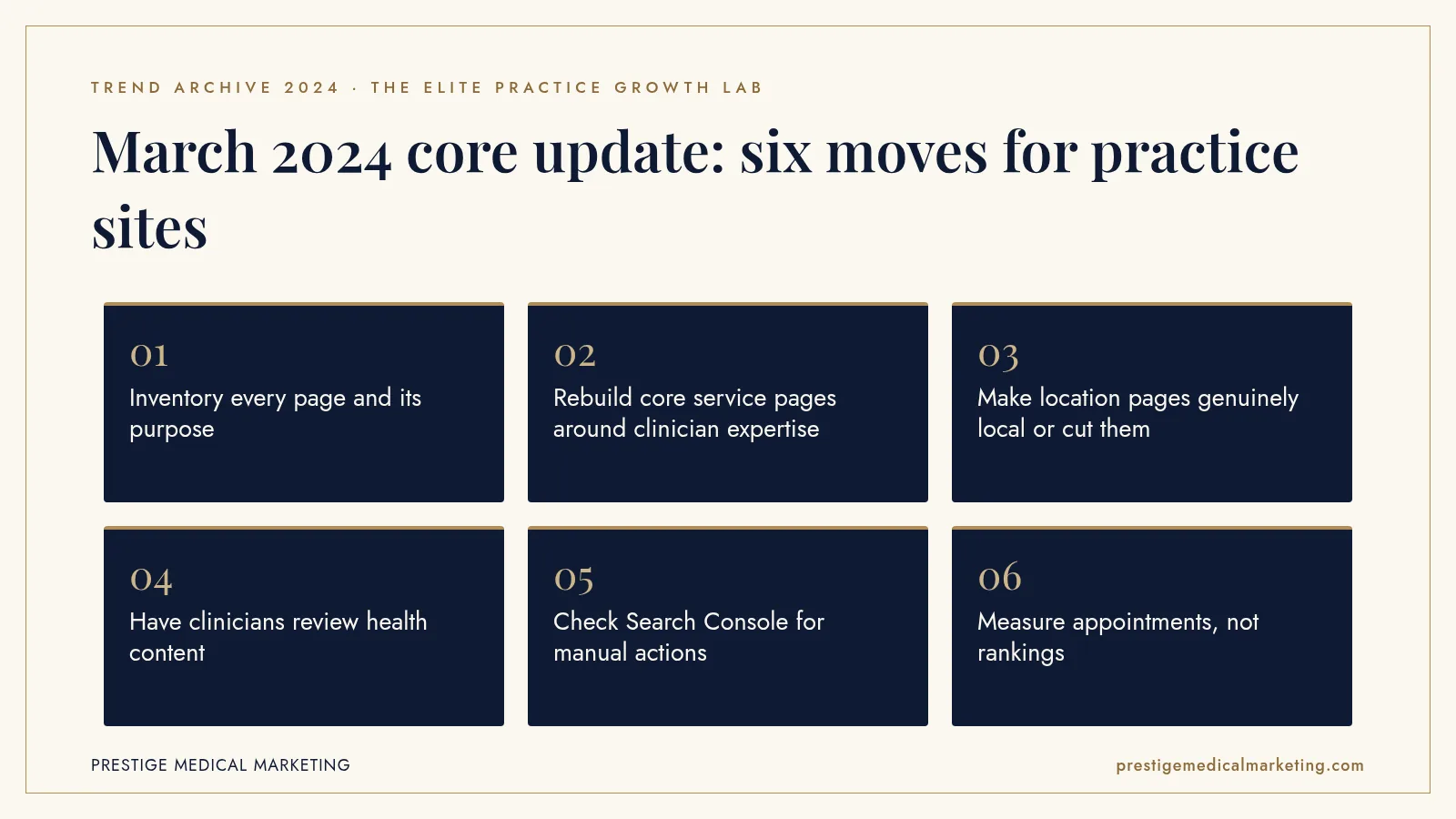
The March 2024 update set the direction for everything Google has done since. A practice website today should be built as if every page will be judged on whether a real clinician would stand behind it. Here is how we approach it.
1. Inventory every page and its purpose
List every URL on the site and ask one question: does a patient need this page? Pages that exist only to target a keyword, duplicate another page or serve a town you do not actually draw patients from are candidates to merge or remove.
2. Rebuild core service pages around clinician expertise
Each core service deserves one strong page with a direct answer at the top, the clinician who provides it and their credentials, who is a good candidate, what to expect, honest risks and the next step. That is the structure behind a medical practice website that converts.
3. Make location pages genuinely local or cut them
A location page should describe a real office: address, parking, hours, the team there, directions and services offered at that site. If you cannot write that page, you probably should not have it.
4. Have clinicians review health content
Every article on a health topic should be reviewed by someone qualified, with a visible reviewer and a date. Fewer reviewed articles beat a large library of unreviewed ones.
5. Check Search Console for manual actions
Algorithmic drops and manual actions are different problems. Search Console’s manual actions report tells you whether a person at Google has flagged the site for a spam policy violation.
6. Measure appointments, not rankings
Track calls, form submissions and booked appointments by page. A ranking report cannot tell you whether a page is earning patients. Your booking data can.

How the 2024 update changed the playbook
Before March 2024, many practice websites were planned like a numbers game. More pages meant more chances to rank. More articles meant more keywords. The update made that thinking risky, because volume without value was now the specific thing Google said it was reducing.
The better model is a smaller site where every page earns its place. A practice that offers ten services needs ten excellent service pages, a strong home page, a real about page with the clinicians, clear location information, and a modest set of genuinely useful articles. That is often fewer pages than an agency template would produce, and it is far easier to keep accurate.
That model also helps beyond Google. AI search tools and assistants look for clear, consistent answers about a business. A tight, accurate website gives them a cleaner picture of what your practice does. We cover that side in how to get your practice recommended by AI.
A note on AI-written content
The March 2024 policies arrived as generative AI tools were making it trivially easy to produce pages. Google’s position was careful: the scaled content abuse policy targeted the purpose and the scale, not the tool. Content made primarily to manipulate rankings was the problem, however it was produced.
For a practice, that means AI can help draft, organize and edit, but it cannot supply the thing Google and patients want most: the judgment of the clinician. A page that reads like it could belong to any practice is the page most likely to struggle. A page that reflects how your clinicians actually treat patients is hard to copy.
Signs your website still carries 2024-era filler
Many practices never rebuilt after 2024. They simply absorbed the loss and moved budget elsewhere. If you are not sure whether your site was built on the old playbook, a few patterns are easy to spot without any special tools.
Near-identical location pages. Open two of your town or neighborhood pages side by side. If the only differences are the place names, those pages are doing little for patients and may be dragging down how the whole site is perceived.
Articles nobody on staff remembers approving. If your site has dozens of health articles and your clinicians could not tell you who wrote them or when they were last checked, that content is a liability on medical topics.
Service pages that never mention a clinician. A page about a treatment that never says who performs it, what their training is, or how your practice approaches it reads like a brochure that could belong to anyone.
Keyword-shaped headings. Headings that repeat the same phrase with small variations are a sign the page was written for a ranking tool rather than for a patient trying to make a decision.
Traffic that fell in spring 2024 and stayed down. Open Search Console, set the date range to cover early 2024, and look at clicks by page. A step down in March or April that never recovered is worth a closer look, especially on informational pages.
None of these patterns proves a site was hit by the March 2024 update specifically. Together, they describe the kind of website the update was designed to show less often, and the kind of website that keeps struggling through later updates too. The good news is that each of them can be fixed with editorial work, not technical wizardry.
What 2024 does not tell us
Google did not publish which sites or industries lost the most visibility, and third-party tools only estimate traffic. The 45% figure describes Google’s own measurement of low-quality content in results, not traffic changes for any particular practice. We also cannot say how much of any single site’s decline came from this update versus other updates later in 2024. What the year does show is the direction Google committed to, and it has not reversed it.
The premium practice advantage
The March 2024 update was bad news for practices that bought volume. It was good news for practices with real expertise, because it raised the value of the one thing a template cannot produce.
A premium practice has clinicians with real training, a distinctive approach and real patient outcomes. Putting that on the page is not just good marketing. Since March 2024, it is how Google decides who deserves to rank. See our services and who we help, and how we connect websites to Google Maps and AI search visibility. Our team works from Austin with practices nationwide.
The bottom line
The March 2024 core update and its spam policies drew a line between websites built for search engines and websites built for patients. Google said it cut low-quality, unoriginal content in results by 45%. The practices that held up were the ones whose pages a clinician would be proud of.
If your site still carries the filler of an older playbook, the fix is not more pages. It is better ones.
Check if your market is open. We take one practice per specialty per market. Request a market check or call (716) 400-0084.
Frequently asked questions
When did the March 2024 core update happen?
Google announced it on March 5, 2024. It was more complex than a typical core update and took weeks to finish. Search Engine Land reported the rollout completed on April 19, 2024, and Google said on April 26 that it had reduced low-quality, unoriginal content in results by 45%.
What were the three new spam policies in March 2024?
Google added scaled content abuse (mass-producing pages mainly to manipulate rankings, however they are made), expired domain abuse (buying old domains to rank low-value content on their reputation), and site reputation abuse (third-party pages published on a host site to exploit its ranking signals).
Did the March 2024 update target medical websites?
No. It was a broad update to how Google assesses quality across all sites. Medical practices felt it because many practice websites carried large amounts of templated or thin content, which was exactly what the update was designed to show less often.
What happened to the helpful content system?
Google said in March 2024 that it had folded the helpful content system into its core ranking systems. Helpfulness stopped being judged by one separate system and became part of how Google ranks pages generally.
Is AI-written content a spam violation?
Not by itself. Google's scaled content abuse policy covers mass-produced pages made primarily to manipulate rankings, whether they are made by automation, humans or both. The method matters less than the purpose and the value to the reader.
What should a practice do if its site lost traffic in 2024 and never recovered?
Audit the pages that lost visibility, remove or merge thin and duplicate pages, rebuild your core service pages around real clinician expertise, and check for any manual actions in Search Console. Then measure booked appointments, not just rankings, as the site improves.