
Google's September 2023 helpful content update began rolling out on September 14, 2023 and finished about two weeks later. Google described it as an improved classifier for its helpful content system, and it updated its documentation to warn against faking freshness, to note that hosted third-party content can affect site-wide signals, and to say helpful content is created for people rather than necessarily written by people. For chiropractors, it rewarded specific, experienced, patient-first pages over mass-produced condition content.
For years, a common playbook for chiropractic websites was volume. Publish a page for every condition, every symptom and every nearby town, keep them short, and let the sheer number of pages do the ranking work. Plenty of practices were sold a site with a hundred near-identical pages and a promise that more pages meant more patients.
September 2023 was a reminder of how fragile that playbook is. Google rolled out an improved version of its helpful content classifier and quietly rewrote parts of the guidance that explains what it rewards. The direction was unmistakable: content made for patients first, by people who demonstrably know the subject, beats content made to fill a search results page.
This retrospective covers what Google actually did in September 2023 and what it means for a chiropractic practice today. For the later chapters of the same story, see our look at the March 2024 core update, when Google folded the helpful content system into core ranking.
What actually happened in 2023
September 14: the rollout. Google’s Search Status Dashboard lists the September 2023 helpful content update as starting on September 14, 2023 and running for roughly 13 days. Google described it as rolling out with an improved classifier.
The documentation changed with it. As Search Engine Journal documented, Google revised its helpful content guidance at the same time. It added a section warning that third-party content hosted on a site or its subdomains may be included in site-wide signals. It added questions about changing the date of pages to make them seem fresh when the content had not substantially changed, and about adding or removing large amounts of content mainly to seem fresh.
“Written by people” became “created for people.” Google’s earlier description of the system referred to helpful content written by people, for people. The revised wording dropped “written by people.” That change aligned with the February 2023 guidance on AI-generated content, which said Google focuses on the quality of content rather than how it is produced.
Expert review got explicit credit. Google’s self-assessment question on expertise was updated to ask whether content is written or reviewed by an expert or enthusiast who demonstrably knows the topic well.
A busy autumn. The update did not happen in isolation. The same dashboard shows an August 2023 core update, an October 2023 spam update, an October 2023 core update and a November 2023 core update. For many sites, it was hard to separate one update’s effect from another’s.
What came next. Google’s ranking systems guide now lists the helpful content system as retired because, in March 2024, it became part of the core ranking systems. The ideas did not go away. They became part of how everything is ranked.
Why it mattered for chiropractic practices
Chiropractic is a category where search-first content was especially common. Condition pages for sciatica, neck pain, headaches, whiplash and dozens of other topics were often templated, lightly reworded and repeated across practices that bought from the same vendors. Location pages followed the same pattern, swapping a town name into an otherwise identical page.
That kind of content describes almost exactly what Google’s guidance calls search-engine-first: pages produced mainly to attract search visits, summarizing what others say without adding much value, on topics chosen because they seemed to have traffic rather than because the practice had something to say.
The update also arrived at a moment when generative AI made that kind of content nearly free to produce. Google’s message, in both the February guidance and the September changes, was consistent. Automation is not the problem. Unhelpful content is, however it is made.
What typical agencies did
Many agencies responded to the autumn of 2023 by producing more. More condition pages, more location pages, more posts, often generated faster than ever. Some quietly changed publish dates on old pages so they looked recent, which is precisely what the revised guidance named.
Others responded with mass deletion, removing hundreds of pages at once in the hope of a quick recovery. Google’s updated questions warned against that too, when it is done mainly to seem fresh rather than to serve readers.
The better response was slower and more deliberate. Review each page against a simple question: would a patient deciding whether to book with this practice find it genuinely useful? Keep and improve what passes. Consolidate or retire what does not.
What it means for a chiropractic practice today
The helpful content system is now part of core ranking, so these steps are simply how a chiropractic site earns visibility.
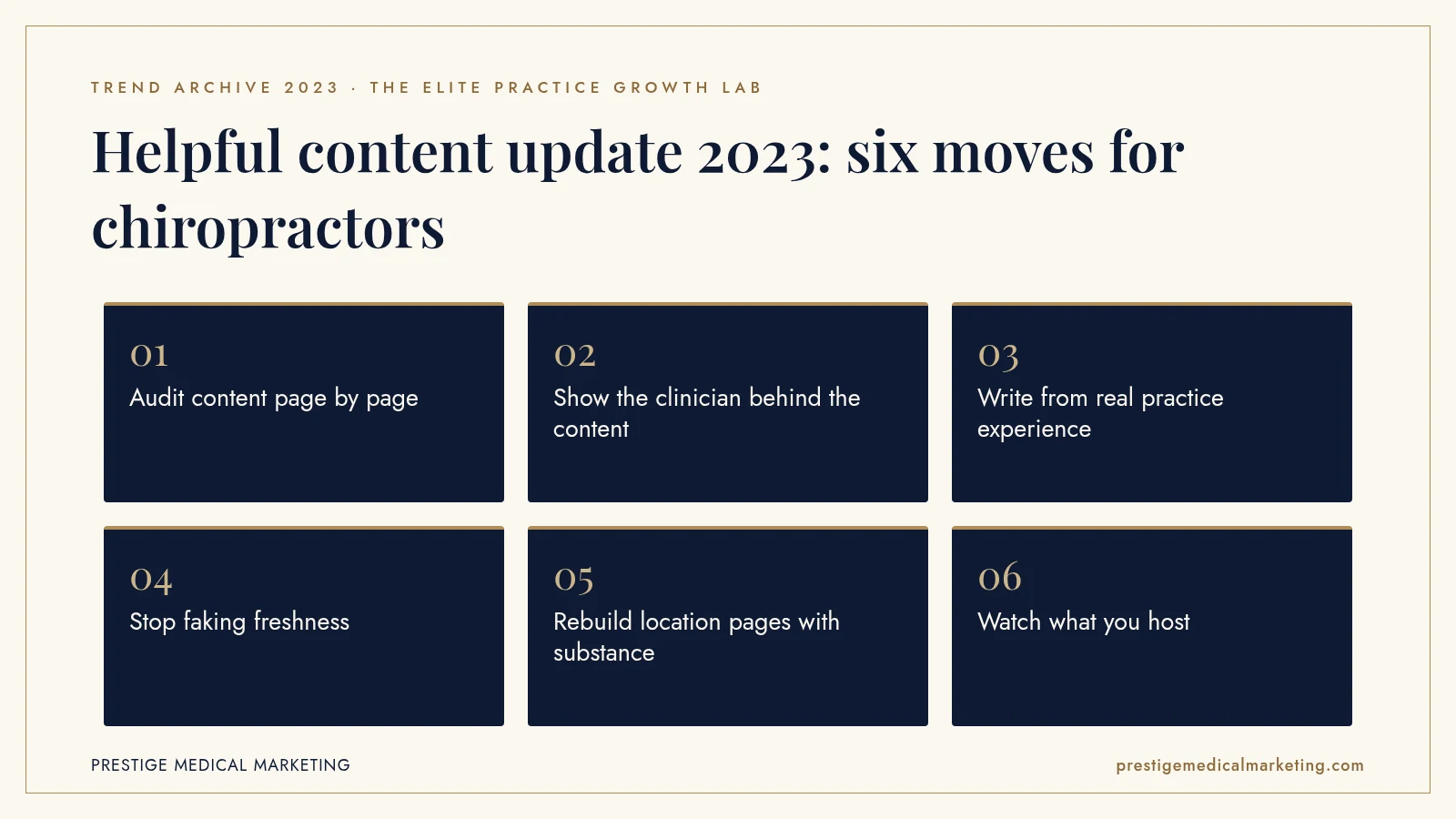
1. Audit content page by page
List every page and ask who it serves. Pages with no visits, no links and no unique information are candidates to improve, merge or retire, judged one at a time.
2. Show the clinician behind the content
Add accurate bylines or reviewer credits from the chiropractors who know the topic. Google’s expertise question now explicitly includes content reviewed by an expert.
3. Write from real practice experience
Explain how your practice actually evaluates and treats a concern, what a first visit involves and when you refer out. That detail is what generic pages cannot copy.
4. Stop faking freshness
Change a page’s date only when the content changes substantially. Note meaningful updates honestly.
5. Rebuild location pages with substance
A location page should describe that office: parking, hours, the team, the services offered there and how to book. Swapped town names add nothing.
6. Watch what you host
Remove or noindex third-party content on your domain that you do not supervise, such as directory widgets or syndicated articles unrelated to your care.

What “people-first” looks like on a chiropractic site
Google’s guidance gives a useful test: after reading the page, would someone feel they learned enough to achieve their goal? For a prospective chiropractic patient, the goal is usually practical. Can this practice help with my problem, what will happen at my first visit, how much will it cost, and can I get in soon?
A people-first page answers those questions directly. It explains which concerns the practice commonly sees and which it refers elsewhere. It describes the evaluation process and what patients can expect over a course of care, without promising outcomes. It is clear about insurance, cash pricing or packages. It makes booking easy from a phone.
That is very different from a 600-word page that defines sciatica, lists generic causes copied from a dozen other sites and ends with a call to action. The first helps a patient decide. The second helps no one, and Google’s systems have become steadily better at telling the two apart.
It also helps to think about the moment a patient lands on the page. Many are in pain, searching on a phone, often in the evening. A page that loads quickly, states plainly whether the practice can help, shows real availability and offers a one-tap call or booking option serves that person. A long, generic essay with the phone number buried at the bottom does not, however well it is optimized for keywords. People-first content and a well-built booking path are the same project.
Experience is the moat
Around the same time, Google had added an extra E to its quality framework, describing experience alongside expertise, authoritativeness and trustworthiness. For local healthcare practices, experience is a natural advantage. A chiropractor who has seen thousands of patients with low back pain can say things a content farm cannot.
Turn that experience into content without crossing into patient privacy. Describe common patterns you see, typical questions patients ask on a first visit, how you think about when imaging or a referral is appropriate, and what recovery commonly involves for different people. Patient stories belong only with documented consent and accurate representation.
Experience also shows up off the page. Reviews that mention a clinician by name, photos of the actual office and team, and a consistent Google Business Profile all reinforce that a real practice with real people stands behind the site. Our chiropractic marketing guide covers how those pieces fit together.
Fewer pages, better pages
One lesson from 2023 is that a smaller site is not a weaker site. A chiropractic practice with twenty genuinely useful pages, each written or reviewed by a clinician, can outperform a practice with two hundred thin pages. The thin pages do not just fail to rank. Under a system that uses site-wide signals, they can drag down the pages that deserve to rank.
Consolidation is often the most valuable work. Five near-duplicate pages about neck pain become one strong page that covers the topic properly. Ten interchangeable town pages become a handful of real location pages plus a clear service-area explanation. Redirects preserve whatever value the old URLs had.
This also makes the site easier to maintain. A practice can realistically keep twenty pages accurate and current. It cannot do that for two hundred, which is how outdated information, broken links and inconsistent pricing creep in.
Where AI fits now
Google’s 2023 guidance made clear that AI assistance is not banned. Using automation primarily to manipulate rankings is a spam policy violation; using it as a tool in a careful process is not. For a chiropractic practice, a reasonable approach is to let AI help with structure, drafts and editing, while the substance, the clinical judgment and the final review come from a licensed clinician who knows the practice.
The test is the same either way. If the finished page reflects real expertise and helps a patient decide, it can do well. If it reads like every other page on the topic, it will not, no matter who or what wrote it.
What 2023 does not tell us
Google does not publish which sites were affected by a specific update or by how much, and the overlapping updates of autumn 2023 make clean attribution difficult. We do not have reliable public data on how chiropractic sites as a group fared. Some sites hit in 2023 recovered later and some did not. What 2023 does show is the direction Google stated in its own documentation, and that direction has held through every core update since, including the update that absorbed the system in 2024.
The premium practice advantage
A premium practice already has what Google’s guidance asks for: experienced clinicians, a distinct approach and real patient relationships. The work is getting that onto the page clearly. See our chiropractic services, our full services, who we help and how we approach Google Maps and AI search visibility. Our team works from Austin with practices nationwide.
The bottom line
The September 2023 helpful content update rewarded content made for patients by people who know the subject. For chiropractic practices, the lesson was to trade volume for substance: fewer, better pages that reflect real clinical experience and make booking easy.
Check if your market is open. We take one practice per specialty per market. Request a market check or call (716) 400-0084.
Frequently asked questions
When did the September 2023 helpful content update happen?
Google's Search Status Dashboard lists the September 2023 helpful content update as starting on September 14, 2023 and running for about 13 days.
What did Google change in its guidance?
Google added a section on hosted third-party content, added questions about changing page dates to look fresh, added "or reviewed" to its expertise question, and changed "written by people" to "created for people" in describing helpful content.
Is the helpful content system still separate?
No. Google says the helpful content system was incorporated into its core ranking systems in March 2024. The principles behind it still apply.
Why did chiropractic sites feel this update?
Many chiropractic sites relied on large libraries of near-identical condition pages and location pages written mainly for search. That is the type of content the helpful content guidance describes as search-engine-first.
Should a chiropractor delete old content?
Not automatically. Google's guidance warns against adding or removing large amounts of content just to look fresh. Review pages individually, improve useful ones, consolidate duplicates and retire pages that serve no patient need.
Does using AI to draft content cause a penalty?
Google's guidance focuses on whether content is helpful, not how it is produced. Using automation mainly to manipulate rankings violates its spam policies. Expert review and genuine practice experience are what make content useful.