
At Fortune's Brainstorm Tech conference in July 2022, Google senior vice president Prabhakar Raghavan said that in Google's studies, almost 40% of young people looking for a place for lunch went to TikTok or Instagram instead of Google Maps or Search. Google later said the figure came from internal research on US users aged 18 to 24. For chiropractic practices, it signaled that patients, especially younger ones, increasingly discover local providers through short video and social platforms as well as search.
For most of the 2010s, local discovery for a chiropractic practice ran through one main route. Someone with back pain, a stiff neck or a sports injury searched on Google, scanned the map results, read a few reviews and called or booked. Search engine optimization and a strong Google Business Profile were the core of being found.
In July 2022, a senior Google executive publicly acknowledged that this route was no longer the only one for younger people. Speaking at a conference, he said that in Google’s own research, almost 40% of young people looking for a place to eat went to TikTok or Instagram rather than Google Maps or Search. The comment was about restaurants, not healthcare, but it said something important about how discovery was changing.
This retrospective covers what was actually said in 2022 and what it means for a chiropractic practice today. For related chapters, see Apple Business Connect in 2023, the Google search documents leak in 2024 and the day TikTok went dark in 2025.
What actually happened in 2022
July 12: Brainstorm Tech. At Fortune’s Brainstorm Tech conference, Prabhakar Raghavan, the Google senior vice president who oversaw Knowledge and Information products including Search and Maps, discussed how younger people find information. TechCrunch reported his comment that in Google’s studies, something like almost 40% of young people, when looking for a place for lunch, did not go to Google Maps or Search but to TikTok or Instagram.
The source of the figure. Google later clarified that the statistic came from internal research on US users aged 18 to 24. It was not a measure of all users or of healthcare searches.
A broader point about discovery. Fortune’s coverage framed the remarks as Google acknowledging that younger users approach information differently, often expecting visual, immersive results rather than typing keywords.
Why Google said it. The comment came as Google faced questions about competition, and it has been read in that light. It was nonetheless an unusually direct acknowledgment from inside Google that other apps were competing for some discovery moments.
What it did not say. The remark did not claim that Google search was shrinking overall, and it said nothing specific about medical care.
Why it mattered for chiropractors
Chiropractic sits in an interesting place on the discovery spectrum. Some patients search urgently after an injury or a painful morning and want the nearest well-reviewed practice. Others choose more deliberately, comparing approaches, philosophies and personalities over weeks. That second group, particularly younger patients interested in mobility, sports performance and wellness, is exactly the audience that discovers through short video.
Chiropractic content also suits video. Demonstrations of posture habits, mobility exercises, explanations of what happens at a first visit and introductions to the team are visual and easy to understand in a short format. Practices that already did this well found that patients sometimes arrived having watched them for months.
At the same time, the format carries risk. Short video rewards dramatic content, and chiropractic social media has a reputation for exaggerated adjustment videos and overstated health claims. A practice that chases that style can damage trust with the patients it most wants and create professional and regulatory exposure.
What typical agencies did
The 40% figure spread quickly through marketing circles, often without its context. Some agencies presented it as evidence that Google was finished and pushed practices to move budgets wholesale into social video. Others ignored social altogether and continued to treat search as the only channel that mattered.
Neither reading was accurate. The figure described a specific age group looking for lunch. It was a sign of changing habits, not a measurement of how patients choose a chiropractor.
The useful conclusion was more measured. Discovery was becoming multi-platform, and a patient might first encounter a practice on social media but still verify it through Google, reviews and the website before booking.
What it means for a chiropractic practice today
Search remains central, but discovery is broader. These steps help a practice show up consistently wherever patients look.
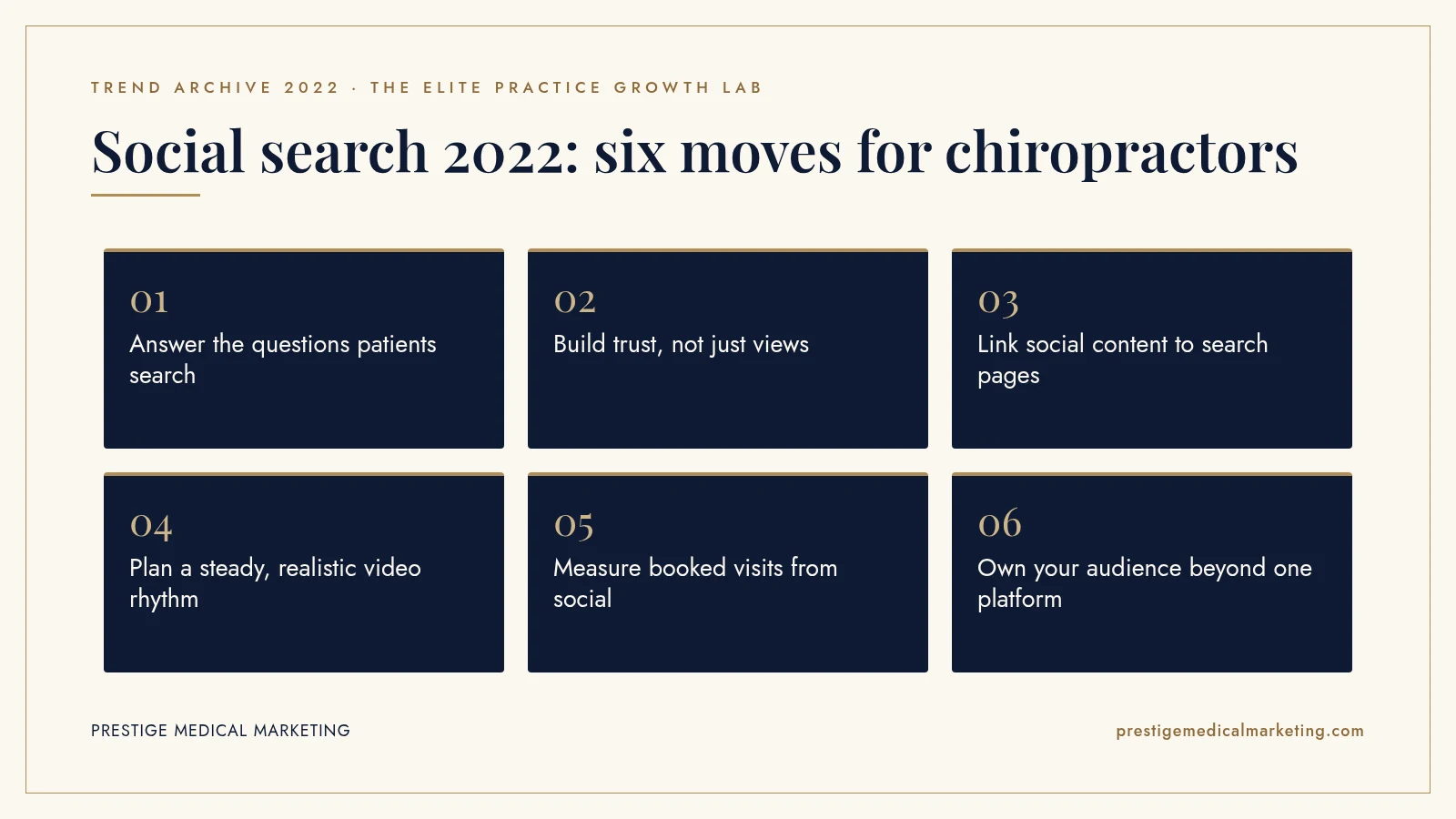
1. Keep your Google Business Profile excellent
Accurate hours, categories, services, real photos and a steady flow of genuine reviews remain the foundation, because social discovery usually ends with a Google check.
2. Publish educational video with restraint
Short videos explaining a first visit, simple mobility habits or common questions can build familiarity. Keep claims accurate and professional.
3. Show the people
Introduce your chiropractors and team. Familiarity with the people is a large part of why social discovery builds trust.
4. Make the bridge to booking easy
Link your profiles to a fast mobile page with clear booking and contact options.
5. Keep information consistent
Names, addresses, hours and services should match across social profiles, Google, Apple Maps and your website.
6. Measure the whole journey
Ask new patients how they found you and track profile visits, calls and bookings rather than views alone.

Content that builds trust, not just views
The most effective chiropractic content on social platforms tends to be useful rather than sensational. Explaining what a first appointment involves reduces anxiety for people who have never visited a chiropractor. Simple guidance on desk posture, lifting technique or warm-up habits, presented as general education rather than treatment, shows expertise without overstating anything. Introductions to the team and a look at the practice environment help people feel they know where they are going.
Content to avoid is equally clear. Exaggerated adjustment sounds and reactions, claims that chiropractic cures conditions it does not, and before-and-after framing that implies guaranteed results may attract views but undermine credibility with thoughtful patients and can create regulatory exposure. Patient privacy also matters: filming patients requires their informed consent, and care should be taken with any identifiable health information.
Platform rules add another layer. Social platforms restrict certain health claims in advertising and can limit the reach of content they consider misleading. Content that stays educational, accurate and modest in its claims is far less likely to run into those limits.
Search and social work together
A useful way to think about 2022’s shift is that social platforms often create awareness while search confirms the decision. Someone sees a chiropractor’s video, becomes curious, then searches the practice name to read reviews, check location and book. If the Google Business Profile is incomplete or the reviews are thin, the awareness created on social may never become an appointment.
That is why branded search is worth watching. Growth in searches for the practice name is often a sign that social and word-of-mouth efforts are working, even if the social platforms themselves show modest direct clicks.
The reverse journey happens too. A patient who finds a practice through search may look it up on Instagram before booking to get a feel for the team and the space. An account that is active, professional and consistent with the website reinforces that first impression; an abandoned account with a last post from years ago can quietly undercut it.
A practical video plan
Most practices do not need a large production budget to use short video well. They need a simple, repeatable plan. A good starting library might include a short welcome from each chiropractor, a walk-through of what happens at a first visit, answers to the five questions the front desk hears most often, a look at the treatment rooms and a few general education pieces on everyday habits such as desk setup or lifting. Each can be filmed on a modern phone in good light with clear audio.
Planning content in batches helps too. Filming several pieces in one session each month, with a clinician present to check accuracy on the spot, keeps the effort manageable for a busy practice and avoids the pattern of enthusiastic posting followed by months of silence.
Consistency matters more than volume. One thoughtful video a week, reviewed by a clinician before posting, builds a body of work that new patients can browse. Captions help, since many people watch without sound, and they make the content accessible. The same videos can live on the practice website, the Google Business Profile and other platforms, which spreads the effort across every place patients look.
A short internal checklist before posting keeps quality steady: is every statement accurate, is any patient shown with documented consent, does the video avoid promising outcomes, and does it point clearly to the next step?
Measuring what social actually does
Views are the easiest number to see and the least useful on their own. A video can reach many people outside a practice’s service area who will never book. The more meaningful measures are local: profile visits, website clicks, calls, booking requests and, most reliably, what new patients say when asked how they first heard about the practice.
Adding a simple “how did you hear about us” question to intake, with social platforms listed as options, gives a practice its own data rather than relying on platform dashboards. Over a few months, that answer shows whether social is creating patients or only attention, and helps decide how much time it deserves.
Platform risk is real
Building on social platforms means building on someone else’s rules. Algorithms change, features appear and disappear, and in some cases access to an entire platform can be disrupted, as TikTok users in the US saw briefly in January 2025. A practice that relied solely on one social platform for new patients would be exposed to those changes.
The safer structure treats social as a valuable discovery channel that feeds owned assets: the website, the Google Business Profile, an email list of existing patients and a strong reputation. Those assets persist regardless of what any one platform does.
What 2022 does not tell us
The 40% figure came from internal Google research on US users aged 18 to 24 looking for places to eat. It does not tell us how patients of any age choose a chiropractor, and we do not have public data that measures that directly. It also does not tell us how discovery habits have shifted since. What 2022 does show is that Google itself recognized discovery was spreading across platforms.
The premium practice advantage
A premium chiropractic practice has a story worth telling: skilled clinicians, a considered approach and patients who value it. The work is telling it consistently across search and social. See our chiropractic services, our chiropractic marketing guide, our full services, who we help and how we approach Google Maps and AI search visibility. Our team works from Austin with practices nationwide.
The bottom line
In July 2022, a Google executive acknowledged that many young people looked for places to eat on TikTok and Instagram. For chiropractors, it signaled that discovery was spreading across platforms, and that search, social and reputation had to work together.
Check if your market is open. We take one practice per specialty per market. Request a market check or call (716) 400-0084.
Frequently asked questions
What did Google say about TikTok and Instagram in 2022?
At Fortune's Brainstorm Tech conference in July 2022, Google's Prabhakar Raghavan said that in Google's studies, almost 40% of young people looking for a lunch spot used TikTok or Instagram rather than Google Maps or Search.
Who was in that 40% figure?
Google said the statistic came from internal research on US users aged 18 to 24. It was about looking for places to eat, not about healthcare.
Did this mean Google search was declining?
No. Google still handled a vast volume of searches. The comment acknowledged that younger people were using other apps for some kinds of discovery.
Does the figure apply to chiropractic patients?
Not directly. There is no public data from that research on healthcare. It is a signal about discovery habits, not a measure of how people choose a chiropractor.
Should a chiropractic practice be on TikTok?
Only if it can publish accurate, useful content consistently and within professional and platform rules. Short educational videos can support discovery, but they complement search rather than replace it.
What matters most if patients find you on social first?
Consistency. Patients who discover you on social media usually check Google, reviews and your website before booking, so all of them need to tell the same story.