
In late May 2024, leaked internal Google Search API documentation was published and analyzed by industry figures, including Rand Fishkin of SparkToro and Mike King of iPullRank. Google confirmed to The Verge that the documents were authentic but cautioned against drawing conclusions from out-of-context, outdated or incomplete information. The documents listed many attributes Google could store, but did not show how they were weighted. For chiropractic practices, the practical lesson was to keep investing in real patient engagement, a strong brand and a useful website.
Search engine optimization has always involved some guesswork. Google publishes guidance and talks about its systems in general terms, but it does not publish its ranking formula. For years, practitioners pieced together how search worked from tests, patents, interviews and experience.
In May 2024, they got something unusual: thousands of pages of internal Google Search API documentation. Industry analysts published breakdowns within days, Google confirmed the documents were authentic, and the SEO world spent weeks debating what they meant.
For chiropractic practices, which compete in crowded local markets and often receive aggressive pitches from SEO vendors, the leak was a useful moment to separate signal from noise. This retrospective covers what happened, why it mattered and what a chiropractor should do with it today. For our broader approach, see chiropractic marketing.
What actually happened in 2024
The publication. On May 27, 2024, Rand Fishkin of SparkToro published an account of the leaked documentation he had received from a source. Mike King of iPullRank published a detailed technical analysis of the documents.
What the documents were. The material appeared to be internal reference documentation for a Google Search API, listing thousands of attributes across many modules. It described kinds of data Google’s systems could store, such as information about pages, sites, links, freshness and user interactions.
Google’s response. On May 29, 2024, Google confirmed to The Verge that the documents were authentic. A Google spokesperson cautioned against making inaccurate assumptions about Search based on out-of-context, outdated or incomplete information.
What it did not show. The documents did not show how attributes were weighted, which ones were active in ranking at any given time, or how they combined. They were a list of ingredients, not a recipe.
The context. The leak arrived during a year of major change in search, including the March 2024 core update and the launch of AI Overviews. It also followed testimony in the U.S. government’s antitrust case against Google, where Google witnesses discussed the use of some user interaction data.
Why it mattered for chiropractic practices
Chiropractic is one of the most competitive local search categories. Many towns have several practices within a few miles of each other, and many practices are pitched by vendors promising first-page rankings. The leak gave some of those vendors new material. Within weeks, pitches appeared promising to exploit newly revealed ranking factors.
For a practice owner, that created confusion. Was the old advice wrong? Should the practice chase clicks, domain authority or some other attribute from the documents? The honest answer was that the leak mostly confirmed what careful practitioners already believed: Google pays attention to how people interact with results and sites, and a recognized brand with genuinely useful pages has an advantage.
That matters for chiropractors because many practices had been sold content-heavy strategies that produced dozens of thin pages targeting every possible condition and town. Those pages rarely earned engagement. The leak and the 2024 updates both pointed toward fewer, better pages that patients actually use.
What typical agencies did
Some agencies rushed out reports claiming to know the secret ranking factors. Others repackaged existing services with new language from the documents. A few started offering tactics designed to inflate engagement signals, which is risky and can harm a site.
Many agencies said nothing to clients at all. That was not necessarily wrong, since the leak did not require dramatic changes, but it missed a chance to explain what good SEO actually looks like.
The most useful response was the least dramatic: review the practice’s site and local presence against the fundamentals the leak reinforced, and fix the gaps.
What it means for a chiropractic practice today
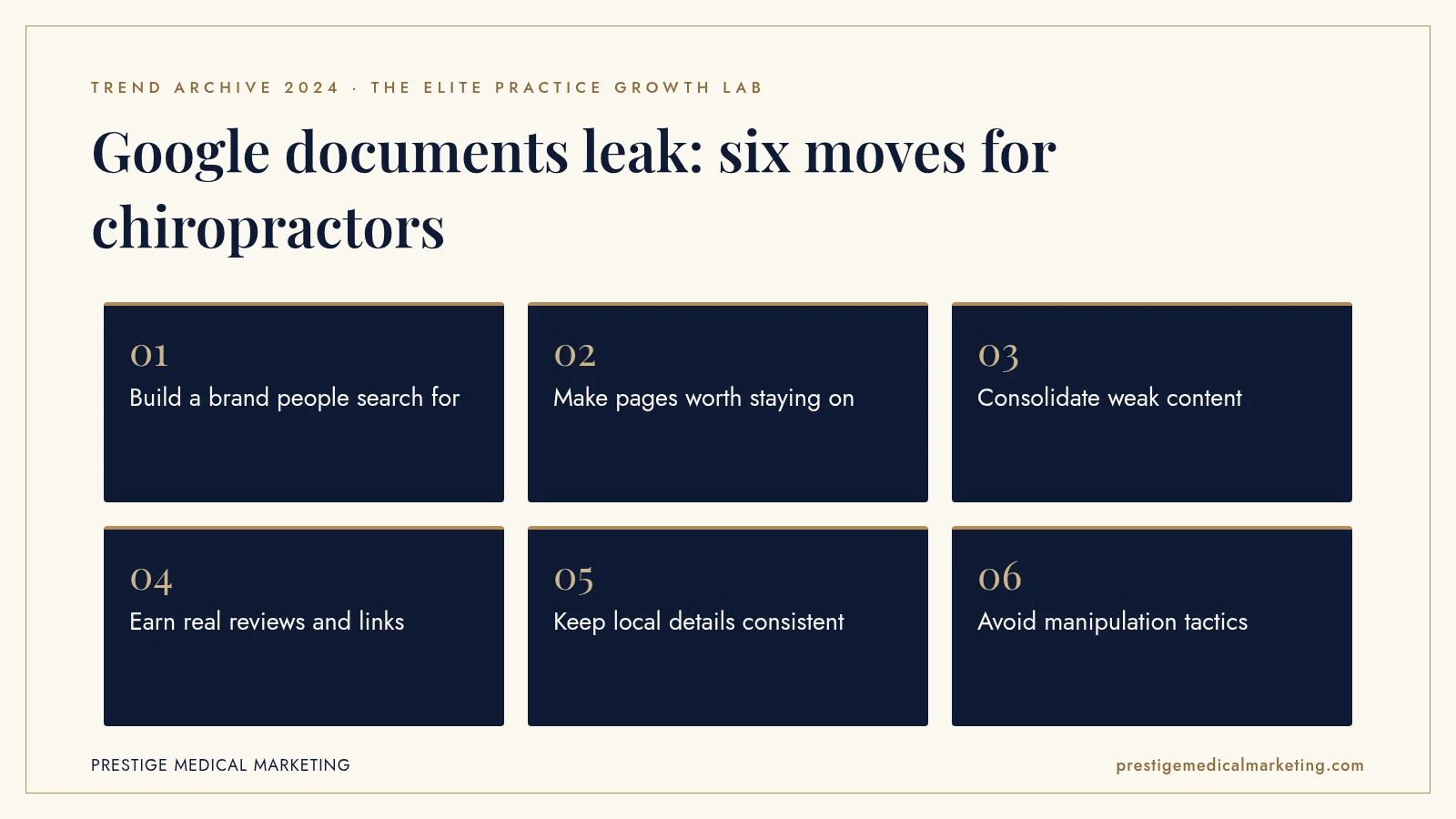
The leak pointed back to fundamentals. Here is how we apply them for chiropractic practices.
1. Build a brand people search for
Patients who search for your practice by name are a strong sign of trust. Community presence, referrals and memorable service create that demand.
2. Make pages worth staying on
Service and condition pages should answer real questions clearly, show who provides care and make the next step obvious. Thin pages give visitors a reason to leave.
3. Consolidate weak content
Merge or remove near-duplicate pages written only to target keywords. A smaller site with stronger pages usually serves patients better.
4. Earn real reviews and links
Ask satisfied patients for honest reviews and build relationships with local organizations, events and health professionals that lead to genuine mentions.
5. Keep local details consistent
Your name, address, phone, hours and services should match across your website, Google Business Profile and directories.
6. Avoid manipulation tactics
Do not buy clicks, fake reviews or link schemes. They violate guidelines and can undo years of legitimate work. See our notes on spam updates for chiropractors.

Reading leaks and rumors responsibly
The 2024 leak was a rare look inside Google, but it came with real limits. Documentation describes what a system can store, not what matters most. Some attributes may have been experiments, deprecated features or data used for purposes other than ranking. Even experienced analysts disagreed about how to interpret many of them.
For practice owners, a good rule is to ask whether a recommendation would make sense even without the leak. Making pages more helpful, earning real reviews and building a known local brand pass that test easily. A tactic that only makes sense if one particular attribute is heavily weighted does not.
That same rule applies to every future rumor, update or vendor pitch. Strategies built on serving patients well tend to hold up as search changes. Strategies built on exploiting a guessed signal tend to break.
Engagement for a local practice
For chiropractors, engagement is not abstract. It is a patient who searches for back pain relief, lands on your page, finds a clear explanation of how you can help, sees your reviews and books. It is a patient who searches for your practice by name because a friend recommended you. It is a returning patient who checks your hours before a visit.
Each of those interactions is a good experience for the patient and, plausibly, a positive signal for search. The work that creates them is practical: fast pages, clear service descriptions, real photos of your clinic and team, easy booking and accurate hours. None of it requires decoding a leaked document.
It also connects directly to revenue. A page that engages visitors is a page that books appointments. Even if search signals were not involved, the work would pay for itself.
What to say when a vendor pitches the leak
If a vendor promises results based on secret ranking factors, ask a few questions. What exactly will they change on your site or profile? How does that change help a patient? What results have they produced for similar practices, and can they show the data? What happens if Google changes direction?
Good partners answer clearly and tie their work to patient outcomes, such as calls, bookings and new patient visits. Vendors who rely on jargon from the leak, refuse to explain their methods or promise guaranteed rankings deserve caution.
The long view on search
Search has changed constantly, and 2024 was an especially busy year. Core updates, new spam policies, AI Overviews and the leak all arrived within months. A chiropractic practice could easily feel that it needed a new strategy every quarter.
The practices that did best were the ones that kept doing the same few things well: serving patients, making their websites clear and fast, keeping their local profiles accurate and asking happy patients for reviews. Those efforts compound. Each good page, each review and each referral adds to a reputation that search systems and patients both recognize.
That long view is also easier to budget for. Instead of reacting to every headline with a new project, a practice can set steady monthly priorities, measure calls and bookings, and adjust based on what patients actually do.
A practical site review after the leak
A useful way to apply the lessons is a simple review of your own site from a patient’s point of view. Search for the main reasons patients come to you, such as low back pain, sciatica, neck pain or sports injuries, and open your page for each. Ask whether the page explains how you help, who provides the care, what a first visit involves and how to book, all within the first screen or two.
Then look at the pages nobody visits. Most practice sites have a long tail of old articles and location pages that receive little traffic and do not help patients. Update the ones that matter, merge the ones that overlap and retire the rest. A cleaner site is easier for patients to navigate and easier for search systems to understand.
Finally, check your Google Business Profile against the site. Services, hours, photos and booking links should tell the same story. Inconsistencies confuse patients and weaken the signals that help a local practice stand out.
Measuring what matters
Rankings are a means, not the goal. The metrics that matter to a chiropractic practice are calls, booked appointments, new patient visits and the share of those patients who continue care. Track them by source where you can, and review them monthly with your front desk lead, who often knows why a week was slow before the reports do. Ask new patients how they found you and record the answer consistently. When a change in search affects your practice, those numbers will show it faster and more honestly than any ranking report.
What 2024 does not tell us
The leaked documents did not reveal how Google weighted any attribute, which features were active at the time or how systems have changed since. Google has continued to update its systems, so even accurate readings from 2024 may be out of date. We do not have reliable data on how many sites changed their strategies because of the leak or what effect those changes had. What 2024 does show is that the fundamentals of being genuinely useful and genuinely known were reinforced, not replaced.
The premium practice advantage
A premium chiropractic practice is known in its community, easy to find and easy to book. That reputation is built through real patient experiences, and it shows up in search because patients seek it out.
That is how we approach chiropractic marketing: Google Maps and AI search visibility built on real reviews, clear pages and consistent local information. See our services and who we help, including chiropractic practices. Our team works from Austin with practices nationwide.
The bottom line
The May 2024 Google Search documents leak was real, confirmed by Google, and widely misread. It showed what kinds of data Google could store, not a formula. For chiropractors, the lesson was to keep building real engagement, a known local brand and genuinely useful pages, and to be skeptical of anyone selling shortcuts.
Check if your market is open. We take one practice per specialty per market. Request a market check or call (716) 400-0084.
Frequently asked questions
What leaked from Google in 2024?
Internal documentation for a Google Search API, describing thousands of attributes and modules, was published in May 2024. It appeared to show many types of data Google's systems could store about pages, sites and links.
Did Google confirm the documents were real?
Yes. Google confirmed to The Verge on May 29, 2024 that the documents were authentic. It also cautioned against making inaccurate assumptions about Search based on out-of-context, outdated or incomplete information.
Did the leak reveal Google's ranking formula?
No. The documents described attributes and data structures, not how much each one mattered or whether it was used in ranking at a given time. Much of the debate came from people reading more into them than they could support.
What did the documents suggest that mattered most?
Analysts focused on references to user interaction data, such as clicks, and to site-level signals. Those references were consistent with testimony in the U.S. antitrust case that Google uses some interaction data. They reinforced that real engagement and brand matter.
Should a chiropractic practice change its SEO because of the leak?
Not dramatically. The leak supported long-standing good practice: be known in your community, make your site genuinely useful, earn real reviews and links, and give searchers a reason to choose and stay on your pages.
Are there SEO tricks that the leak made worth trying?
Trying to manipulate click data or other signals is risky and rarely lasts. Google has systems to detect manipulation, and tactics built on guesses about leaked attributes can backfire.