
The FTC announced its final rule banning fake reviews and testimonials on August 14, 2024. It was published in the Federal Register on August 22 and took effect October 21, 2024. The rule prohibits fake or AI-generated reviews, buying reviews conditioned on positive or negative sentiment, undisclosed insider reviews, company-controlled review sites posing as independent, review suppression through threats, and fake social media indicators. For practices, it made honest review collection a legal requirement, not just good manners.
Reviews are one of the most powerful forces in a medical practice’s marketing. A prospective patient comparing two practices often decides on the strength of what other patients said. That power is exactly why fake reviews became a business, and why regulators spent years warning about them.
In 2024, the warnings became a rule. The Federal Trade Commission finalized a regulation that specifically bans fake reviews, paid sentiment, hidden insider reviews and review suppression, and it attached civil penalties to violations.
This retrospective covers what the FTC finalized in 2024 and what it means for how a practice builds its reputation. We covered the enforcement that followed in our look at the review rule in 2025. This post focuses on the rule itself. It is marketing guidance, not legal advice.
What actually happened in 2024
August 14: the final rule. The FTC announced its final rule banning fake reviews and testimonials. The rule allows the agency to seek civil penalties against knowing violators, which it could not easily do under its earlier guidance alone.
August 22: publication. The rule was published in the Federal Register as the Trade Regulation Rule on the Use of Consumer Reviews and Testimonials.
October 21: effective date. The rule took effect on October 21, 2024, and is codified at 16 CFR Part 465.
What it covers. The rule addresses six main practices:
- Fake or false reviews and testimonials, including those from people who do not exist or did not have the experience, and those generated by AI.
- Buying reviews with compensation or incentives conditioned on a particular sentiment, positive or negative.
- Insider reviews by company officers, managers, employees or agents, and certain relatives, without clear disclosure of the relationship.
- Company-controlled review websites that claim to provide independent opinions.
- Review suppression, such as using unfounded legal threats, intimidation or false accusations to remove or prevent negative reviews, or misrepresenting that displayed reviews represent all or most reviews.
- Selling or buying fake social media indicators, such as followers or views, to misrepresent influence.
Why it matters so much for practices
For a premium practice, reputation is pricing power. Patients pay more for providers they trust, and reviews are often where that trust starts. That makes reviews a tempting place to cut corners, and it makes the consequences of cutting corners more serious.
Several common shortcuts in medical marketing land squarely inside the rule. Agencies that post reviews on a practice’s behalf. Staff members who leave five-star reviews without disclosure. Gift cards offered only to patients who promise a positive review. A “testimonials” page full of glowing quotes that cannot be traced to real patients. A practice that threatens legal action over an honest but negative review.
Healthcare adds another layer. Practices must protect patient privacy when responding to reviews, and many of the public reply mistakes practices make involve confirming that a reviewer was a patient or discussing their treatment. The FTC rule did not change those obligations, but it raised the stakes on the reputation side of the equation.
What typical agencies did
Before 2024, some reputation vendors openly sold review packages: a set number of reviews per month, written by people who had never visited the practice. Others sold “review management” that quietly filtered unhappy patients away from public review sites while sending happy ones straight to Google.
After the rule was announced, the most blatant sellers changed their language more than their methods. Some shifted to incentive programs, contests and “loyalty rewards” tied to reviews. Others kept the same review funnels and hoped no one would look closely.
The better approach was never complicated. Ask every patient for honest feedback, make it easy to leave a review, respond professionally, and let the reputation reflect the actual patient experience. That approach was compliant before the rule and it remained compliant after it.
What it means for a practice today
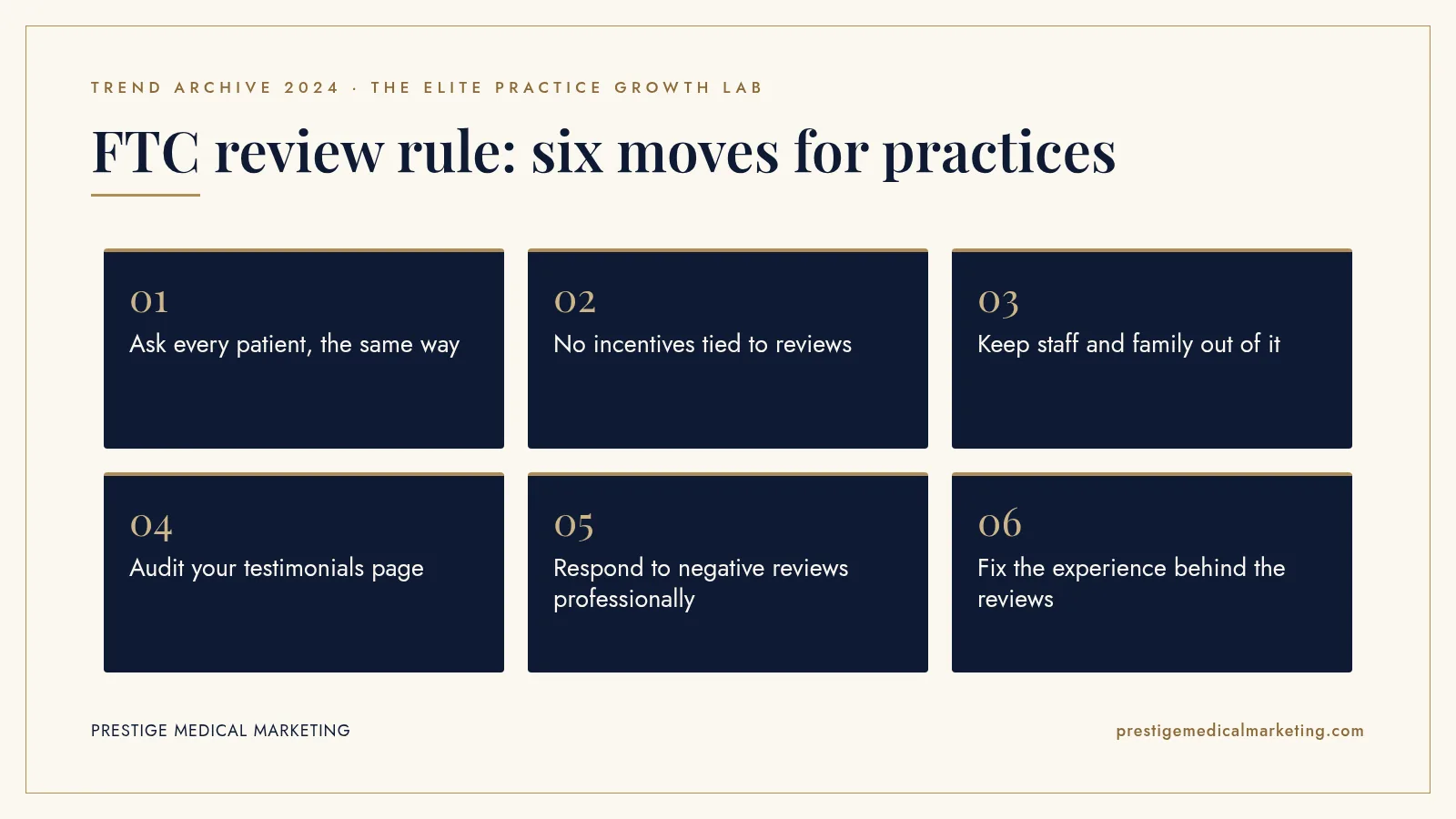
Treat your review program as a patient experience system, not a marketing trick. This is marketing guidance, not legal advice; have counsel review your practices.
1. Ask every patient, the same way
Build a review request into follow-up for every patient, without filtering by satisfaction. Consistency is both compliant and effective.
2. No incentives tied to reviews
Do not offer discounts, gifts or entries for reviews. The FTC rule bans incentives conditioned on sentiment, and Google’s policies prohibit incentivized reviews altogether.
3. Keep staff and family out of it
Ask employees, contractors and relatives not to review the practice. Disclosure rules exist, but abstaining is simpler and cleaner.
4. Audit your testimonials page
Every testimonial on your website should be from a real patient, accurately quoted, with documented consent. Remove anything you cannot verify.
5. Respond to negative reviews professionally
Never threaten reviewers. Reply briefly, without confirming patient status or discussing care, and invite the person to contact the office directly.
6. Fix the experience behind the reviews
Recurring complaints about wait times, billing or phone access are operational signals. Fixing them improves reviews more than any request script.

Google’s rules sit on top of the FTC’s
The FTC rule is not the only rulebook. Google’s own policies for reviews on Maps and Business Profiles prohibit fake engagement, incentivized reviews and conflicts of interest, and they say businesses should not discourage negative reviews or selectively ask only happy customers. Google can remove reviews and place restrictions on profiles that break its policies.
That means a practice can stay within the FTC rule and still lose reviews or visibility by breaking platform policies. The simplest path is to meet the stricter standard: ask everyone, offer nothing in return, and never write or commission a review.
A strong Google Business Profile depends on this. Reviews are one of the most visible parts of your profile, and patients read them closely. Our Google Business Profile guide covers how reviews fit with photos, services and posts.
Reputation as a pricing strategy
It is worth stepping back from compliance to the business case. A practice with a large volume of recent, detailed, genuine reviews can justify premium pricing in a way that a practice with a handful of generic five-star ratings cannot. Patients read the details: the clinician’s name, how they felt during the visit, what the results were, how the staff treated them.
Genuine reviews contain that detail naturally. Fake reviews rarely do, and patients have become good at spotting them. A reputation built honestly is both safer and more persuasive.
That is why we connect review systems to reputation and premium pricing rather than treating reviews as a vanity metric. The goal is not a perfect star rating. It is a body of patient stories that makes your price feel like the obvious choice.
What a compliant review request looks like
A good request is short, consistent and neutral. It goes to every patient after a visit, by text or email. It thanks them, asks them to share their experience, and links directly to your review profile. It does not ask only for positive feedback, does not mention any reward, and does not route unhappy patients somewhere else.
Inside the practice, the request should be automated wherever possible so it does not depend on a staff member deciding who seems happy enough to ask. Automation removes the temptation to filter and makes the program steady month after month.
Track the results simply: requests sent, reviews received and average rating over time. If ratings dip, look at the comments for operational issues before changing anything about the request itself.
Testimonials beyond review sites
The rule’s title covers reviews and testimonials, and practices often forget the second word. Testimonials appear in many places beyond Google: the practice website, social media posts, video clips, email newsletters, printed brochures and ads.
Each of those deserves the same discipline. The person quoted should be a real patient who actually had the experience described. The quote should reflect what they said, not a polished rewrite that changes the meaning. Consent should be documented, especially for anything that reveals that someone received care, and doubly so for before-and-after photos.
Social proof on social media is part of this too. The rule covers buying fake followers or views to misrepresent influence. A practice that buys followers to look more established is now doing something the FTC has specifically named. Real engagement from real patients and prospects is slower to build, but it is the only kind worth having.
Influencer and creator partnerships sit nearby as well. When a creator receives free treatment or payment in exchange for content, the FTC’s endorsement guidance expects that relationship to be clearly disclosed. Make disclosure a written requirement in every partnership, and check the published posts to confirm the disclosure actually appears where viewers will see it, not buried in a long list of hashtags.
Questions to ask any reputation vendor
Reputation software can be valuable. It automates requests, gathers reviews into one place and helps teams respond quickly. The question is how it gets results. Before signing with a vendor, ask:
Does every patient receive the same request? If the system sends unhappy patients to a private form and happy ones to Google, that is the kind of selective solicitation Google’s policies prohibit.
Does anyone ever write, edit or post reviews for us? The only acceptable answer is no.
Are incentives part of the program? If yes, walk away or remove them.
How do you handle negative reviews? A good vendor helps you respond professionally. A bad one promises to make negative reviews disappear.
Can we export our data if we leave? Your review history and request records belong to your practice. Make sure you keep them.
A vendor that answers these questions clearly is a partner. A vendor that dodges them is a liability with your name on it.
What 2024 does not tell us
The rule took effect late in 2024, so the year itself did not show how aggressively the FTC would enforce it or how courts would interpret specific provisions. We do not have reliable public data on how many medical practices used review services that would now violate the rule. State laws and platform policies continue to add their own requirements. What 2024 does show is that fake reviews moved from a reputational risk to a regulatory one.
The premium practice advantage
A premium practice should welcome the rule. If your patient experience is genuinely excellent, honest reviews will show it. The rule makes it harder for competitors to buy a reputation they did not earn.
See our services and who we help, and how reviews support Google Maps and AI search visibility. Our team works from Austin with practices nationwide.
The bottom line
In 2024 the FTC made the rules on reviews explicit: no fakes, no paid sentiment, no hidden insiders, no suppression. For practices, the winning strategy did not change. Deliver an experience worth talking about, ask every patient honestly, and let your reputation do the selling.
Check if your market is open. We take one practice per specialty per market. Request a market check or call (716) 400-0084.
Put this playbook to work: see how it applies to med spa marketing.
Frequently asked questions
When did the FTC fake review rule take effect?
The FTC announced the final rule on August 14, 2024. It was published in the Federal Register on August 22, 2024 and took effect on October 21, 2024.
What does the rule prohibit?
It prohibits fake reviews and testimonials, including those attributed to people who do not exist or did not have the experience, and AI-generated fakes. It also covers buying reviews with incentives conditioned on a particular sentiment, undisclosed reviews by insiders, company-controlled review sites claiming independence, suppressing reviews through threats or intimidation, and buying fake social media followers or views.
Can a practice still ask patients for reviews?
Yes. Asking patients for honest reviews is allowed. The problems are faking reviews, paying or rewarding patients only for positive reviews, hiding insider reviews, and suppressing negative ones through threats or false accusations.
Can staff or family members leave reviews?
The rule targets reviews by officers, managers, employees or agents, and certain relatives, when the connection is not clearly disclosed and the business knew or should have known. The safest approach is for staff and family not to review your practice at all.
Is offering a discount for a review allowed?
The rule prohibits incentives conditioned, expressly or implicitly, on the review expressing a particular sentiment. Separately, platforms such as Google prohibit offering incentives for reviews. Many practices avoid review incentives entirely to stay clear of both.
Does the rule replace patient privacy obligations?
No. When responding to reviews, practices must still protect patient privacy. Never confirm someone is a patient or discuss their care in a public reply.