
On January 25, 2022, the FTC announced that Fashion Nova would pay $4.2 million to settle allegations that it suppressed product reviews below four stars from late 2015 until November 2019. The FTC called it its first case involving a company's efforts to conceal negative reviews. It also sent letters to 10 review management companies and issued new review guidance. For med spas, it meant review collection and display must not filter out unhappy clients.
Reviews carry enormous weight in aesthetics. A prospective client choosing where to have a neuromodulator treatment, filler or laser procedure reads reviews carefully, looking for signs of skill, safety, honesty and a comfortable experience. A med spa’s star rating and the stories behind it can decide whether someone books a consultation or keeps scrolling.
That pressure created a market for tools that help businesses manage reviews, and some of those tools made it easy to show only the good ones. In January 2022, the Federal Trade Commission brought its first case against a company for doing exactly that. The company was an online fashion retailer, but the case described a practice any business, including a med spa, could slip into.
This retrospective covers what the FTC actually did in 2022 and what it means for a med spa today. For later chapters, see the Google reviews update in 2023, the FTC fake review rule in 2024 and the consumer review rule in 2025.
What actually happened in 2022
January 25: the settlement. The FTC announced that Fashion Nova would pay $4.2 million and be prohibited from suppressing customer reviews, settling allegations that it blocked negative reviews from appearing on its website.
How the suppression worked. According to the FTC’s complaint, Fashion Nova used a third-party review management interface that automatically posted four- and five-star reviews and held lower-starred reviews for approval. From late 2015 until November 2019, the company never approved or posted hundreds of thousands of those lower-starred reviews.
A first. The FTC said the case was its first involving a company’s efforts to conceal negative customer reviews. Samuel Levine, then Director of the FTC’s Bureau of Consumer Protection, said deceptive review practices “cheat consumers, undercut honest businesses, and pollute online commerce.”
Letters to review management companies. The FTC said it was sending letters to 10 companies offering review management services, putting them on notice that avoiding the collection or publication of negative reviews violates the FTC Act.
New guidance. The FTC also released new guidance for online retailers and review platforms on collecting and publishing customer reviews in ways that do not mislead consumers.
Context. The FTC noted that in October 2021 it had warned more than 700 businesses that they could face civil penalties for using reviews or endorsements in ways found unlawful in earlier cases.
Why it mattered for med spas
Many med spas use software that sends a message after each appointment asking how the visit went. That is reasonable. The problem arises when the software routes responses: clients who tap five stars are sent to Google to post a public review, while clients who tap fewer stars are sent to a private feedback form. This practice, often called review gating, filters negative experiences out of public view.
The Fashion Nova case was about a retailer’s own website, but its principle was clear: collecting reviews in a way that systematically hides negative ones can mislead consumers. The FTC’s letters to review management companies addressed the tools themselves. Google’s own policies already prohibited selectively soliciting positive reviews.
For aesthetic practices, the stakes are high. Clients rely on reviews to judge safety and skill. A rating inflated by gating presents a picture that may not match reality, and a client who books on that basis has been misled.
What typical agencies did
Many reputation tools and agencies continued offering gating features after 2022, sometimes renamed as “feedback routing” or “smart review requests.” Some agencies advised clients to keep using them on the grounds that the case involved a retailer’s website rather than Google reviews.
That missed both the principle and the platform rules. Google’s review policies prohibit discouraging or selectively soliciting reviews, and the FTC’s direction was unmistakable. In 2024, the FTC finalized a rule addressing fake reviews and review suppression.
The safer approach was to remove gating entirely and invite every client to review in the same way.
What it means for a med spa today
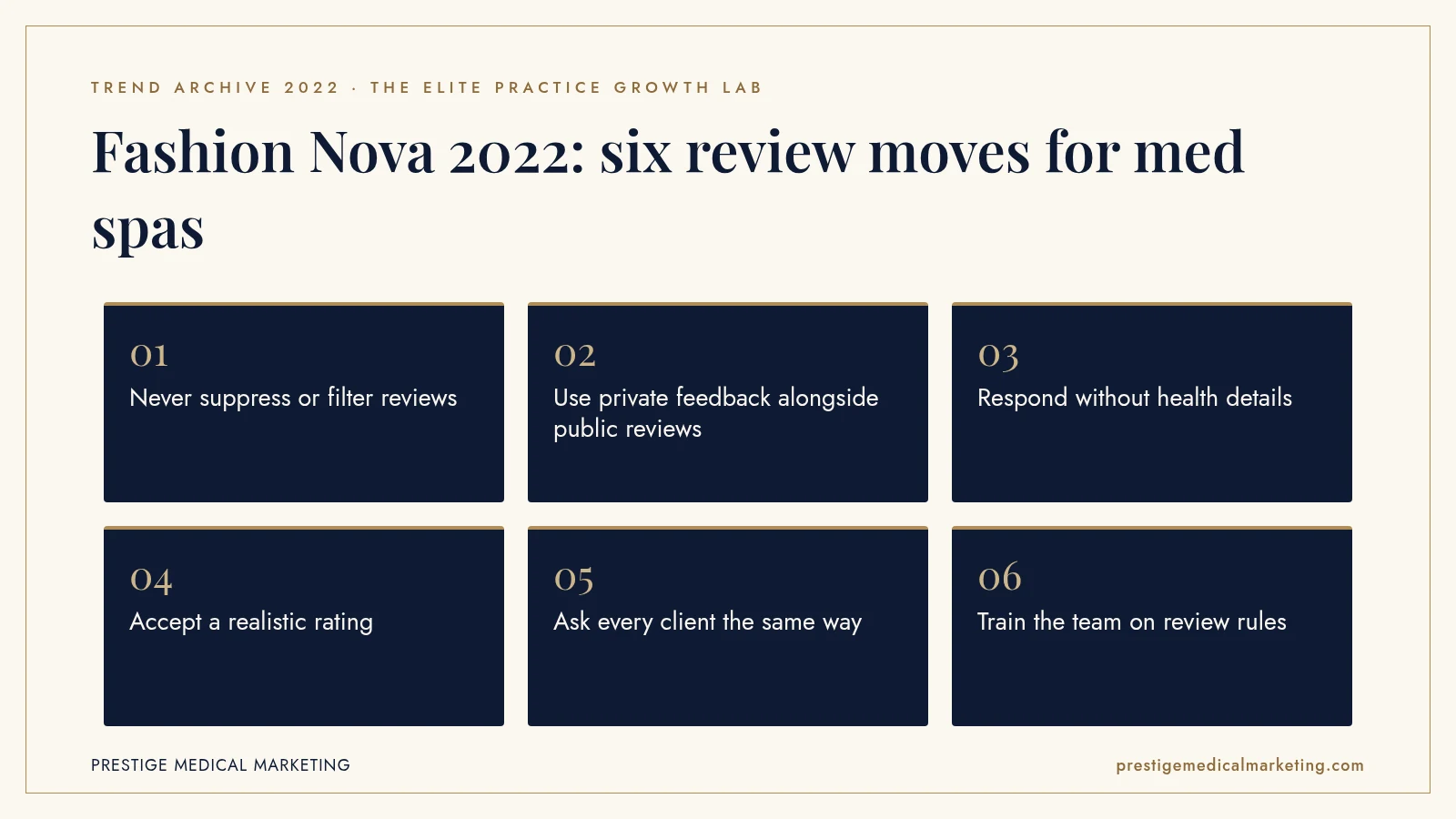
Review rules have only grown stricter since 2022. These steps keep a med spa’s reputation honest and resilient.
1. Turn off review gating
Audit your review software. Every client should receive the same invitation to leave a public review, whatever their rating.
2. Never condition incentives on positive reviews
Do not offer discounts, credits or gifts for reviews, and never for positive ones.
3. Show reviews honestly on your website
If you display reviews, do not hide negative ones or edit them to change their meaning.
4. Respond to every review professionally
Thank positive reviewers and address concerns calmly, without revealing any health information.
5. Fix the causes of complaints
Use private feedback to improve the experience, not to keep complaints off the internet.
6. Ask your vendors directly
Confirm in writing that your reputation tools do not filter, suppress or route reviews by sentiment.

Private feedback and public reviews can coexist
Collecting private feedback is not wrong. Many med spas benefit from asking clients about their experience, wait times, comfort and results, and using that information to improve. The problem is using private feedback as a filter that decides who gets invited to post publicly.
A clean approach separates the two. Every client gets an invitation to leave a public review on the platforms the practice uses. Separately, the practice may ask for private feedback to improve its service. Neither depends on the other. A client unhappy with a result can still post a public review, and the practice can still learn from private comments.
The timing and tone of invitations matter as well. A short, courteous message a day or two after a visit, with a direct link and no pressure, is more respectful than repeated reminders. Clients who feel pressured tend not to respond, and those who do may write something less useful than an unprompted reflection.
Responding without revealing health information
Med spas face a particular challenge when responding to reviews. A client may describe their treatment in detail, but the practice must not confirm that the person is a client or discuss their care in public. Privacy rules for health information apply to many medical aesthetic practices, and disclosing patient information in a public reply can violate them.
A safe response thanks the reviewer, acknowledges the concern in general terms and invites them to contact the practice directly. It never confirms treatment, mentions specifics or argues about details publicly.
Prepared templates help staff respond quickly and safely. A short set of approved responses for positive reviews, general complaints and concerns about results can be adapted to each situation, with any review that involves a serious complaint escalated to a practice leader before replying.
A realistic rating is a credible rating
Prospective clients are sophisticated readers of reviews. A practice with hundreds of perfect reviews and no criticism at all can seem less believable than one with a strong average and a few thoughtfully handled complaints. Honest reviews, including the occasional critical one, signal authenticity.
The way a practice responds to criticism often matters more than the criticism itself. A calm, respectful response that invites a conversation shows professionalism. A defensive or dismissive response does the opposite.
Building review volume the right way
The most reliable way to earn strong reviews is to deliver a consistently excellent experience and ask every client to share their view. Simple, timely requests after appointments, a direct link to the review platform and a front desk that mentions it naturally all help. Volume built this way is durable, because it reflects real client experience rather than filtering.
Consistency across platforms also matters. Google, Yelp and specialty review sites may each have their own rules, and the practice should follow all of them. Some platforms discourage soliciting reviews at all; others allow neutral requests.
Monitoring completes the picture. Checking each platform weekly for new reviews, reporting anything that appears fake or violates platform rules through the proper channels, and tracking themes in what clients say over time turns reviews from a scoreboard into a useful source of insight about the practice itself.
When a review seems unfair
Every practice eventually receives a review that feels unfair: a complaint about a result that was discussed at length beforehand, a criticism of a policy the client agreed to, or a review that seems to describe a different business entirely. The temptation is to have it removed or buried. The right approach depends on what the review actually is.
If a review violates a platform’s rules, for example because it is spam, contains hateful content, describes a different business or comes from someone who was never a client, the practice can report it through the platform’s own process. Platforms decide; the practice does not. Reporting reviews simply because they are negative is not appropriate and rarely succeeds.
If the review reflects a genuine experience the practice sees differently, the best response is a calm public reply and a private conversation. Sometimes that conversation resolves the concern and the client updates the review voluntarily. Sometimes it does not, and the reply stands as evidence of how the practice handles disagreement. Either outcome is better than an argument in public, and far better than any attempt to suppress what the client said.
Training the team
Review policies only work if everyone follows them. Front desk staff, providers and managers should understand what they can and cannot say when asking for reviews. A provider who tells a client to “only leave a review if you loved it” is gating in conversation, even if the software is clean. A staff member who offers a discount in exchange for a review creates the same problem.
A short written policy, reviewed with the team once or twice a year, keeps practices aligned. It should cover how reviews are requested, who responds, what responses must never include and how to escalate a serious complaint.
What 2022 does not tell us
The Fashion Nova case involved product reviews on a retailer’s website, not reviews of medical services on third-party platforms. It does not tell us how regulators would treat any specific med spa practice, and we have no public data on how common gating was among aesthetic practices in 2022. What it does show is the FTC’s stated position that hiding negative reviews can be deceptive.
The premium practice advantage
A premium med spa does not need to hide reviews; it earns strong ones through skill and service. See our med spa services, our full services, who we help and how we approach Google Maps and AI search visibility. Our team works from Austin with practices nationwide.
The bottom line
In January 2022, the FTC brought its first case over hiding negative reviews, with a $4.2 million settlement. For med spas, the lesson was to invite every client equally, display reviews honestly and respond without revealing health information.
Check if your market is open. We take one practice per specialty per market. Request a market check or call (716) 400-0084.
Frequently asked questions
What did the FTC allege against Fashion Nova?
The FTC alleged Fashion Nova used a review management interface that automatically posted four- and five-star reviews while holding lower-starred reviews for approval, and from late 2015 until November 2019 never approved hundreds of thousands of them.
How much did Fashion Nova pay?
Under the proposed settlement announced on January 25, 2022, Fashion Nova agreed to pay $4.2 million for harm consumers incurred.
Why was the case significant?
The FTC said it was its first case involving a company's efforts to conceal negative customer reviews.
What else did the FTC do that day?
It sent letters to 10 companies offering review management services, warning that avoiding the collection or publication of negative reviews violates the FTC Act, and released new guidance on collecting and publishing reviews.
What is review gating?
Review gating means asking clients how they feel first, then inviting only happy clients to post public reviews. It filters out negative experiences and creates a misleading picture.
How should a med spa ask for reviews?
Invite every client in the same way, without screening by satisfaction, and never offer incentives conditioned on positive reviews.