
Google launched About This Result on February 1, 2021 for US English searches on desktop, mobile web and the Google app on Android. It showed a Wikipedia description of a site when available, or other context such as when Google first indexed the site, and whether the connection used HTTPS. On July 22, 2021, Google expanded it to show relevance factors such as matching keywords, related terms, links and local relevance, plus search tips. For practices, it underlined that credibility signals are visible to patients before they click.
Patients have always checked out a practice before booking. They ask friends, read reviews and look at the website. In 2021, Google added a small tool that made part of that process happen directly on the search results page. Next to most results, a menu icon opened a panel that told searchers about the website before they clicked.
It was a modest feature, and many practice owners never noticed it. But it said something important about where search was heading. Google wanted people to evaluate sources, particularly for health information, and it was willing to show context that helped them do so.
This retrospective covers what Google actually launched in 2021, why it mattered for private medical practices and what building credibility looks like today. For related chapters, see our look at Google’s 2023 reviews update, the FTC fake review rule in 2024 and site reputation abuse in 2024.
What actually happened in 2021
February 1: the launch. Google introduced a quick way to learn more about search results. Next to most results, searchers could tap a menu icon to learn more about the result and where the information came from. When available, the panel showed a description of the website from Wikipedia. If no Wikipedia description existed, Google showed other context that might be available, such as when Google first indexed the site.
Security and features. The panel also showed whether the connection to the site was secure based on its use of HTTPS. For search features such as local business listings, it described how Google sourced that information from websites or from businesses themselves.
Health in mind. Google noted that context about an unfamiliar site could provide peace of mind, especially when looking for something important like health or financial information. The feature launched for English-language results in the US on desktop, mobile web and the Google app on Android.
July 22: the expansion. Google announced it would show more about how results were connected to a search. The About This Result panel began showing factors such as matching keywords, related terms, links from other pages using similar words and local relevance based on language and location. It also offered search tips to help people refine their queries.
Why it mattered for private practices
A national health publisher or a large hospital system often has a Wikipedia entry and a long history. A private practice usually does not. When a patient opened the About This Result panel for a practice website, the context might be limited to when Google first indexed the site and whether it used HTTPS.
That made the basics more visible. A practice website without HTTPS would be marked as not secure. A newly launched domain would show a recent first-indexed date. Neither was a disaster on its own, but both reinforced how much credibility rests on fundamentals that a practice controls.
The July expansion added another lesson. By showing that results were connected to a search by matching keywords, related terms, links and local relevance, Google was explaining in plain language some of the factors it uses. For practices, those factors pointed to clear, relevant content, a reputation that earns links and mentions, and accurate local information.
What typical agencies did
Most agencies ignored the feature, and some practices never knew it existed. A few agencies responded by trying to create Wikipedia pages for clients, which usually failed because Wikipedia requires notability supported by independent reliable sources, and promotional articles are removed.
Others focused narrowly on the technical items, such as ensuring HTTPS, without addressing the broader question the feature raised: does this practice look credible to a cautious patient?
The better approach treated About This Result as a prompt to review the practice’s whole presence: website security and quality, consistent business information, real clinician credentials, genuine reviews and earned mentions from credible local and professional sources.
What it means for a private practice today
Search has added more ways to evaluate sources since 2021. These habits build credibility that holds up.
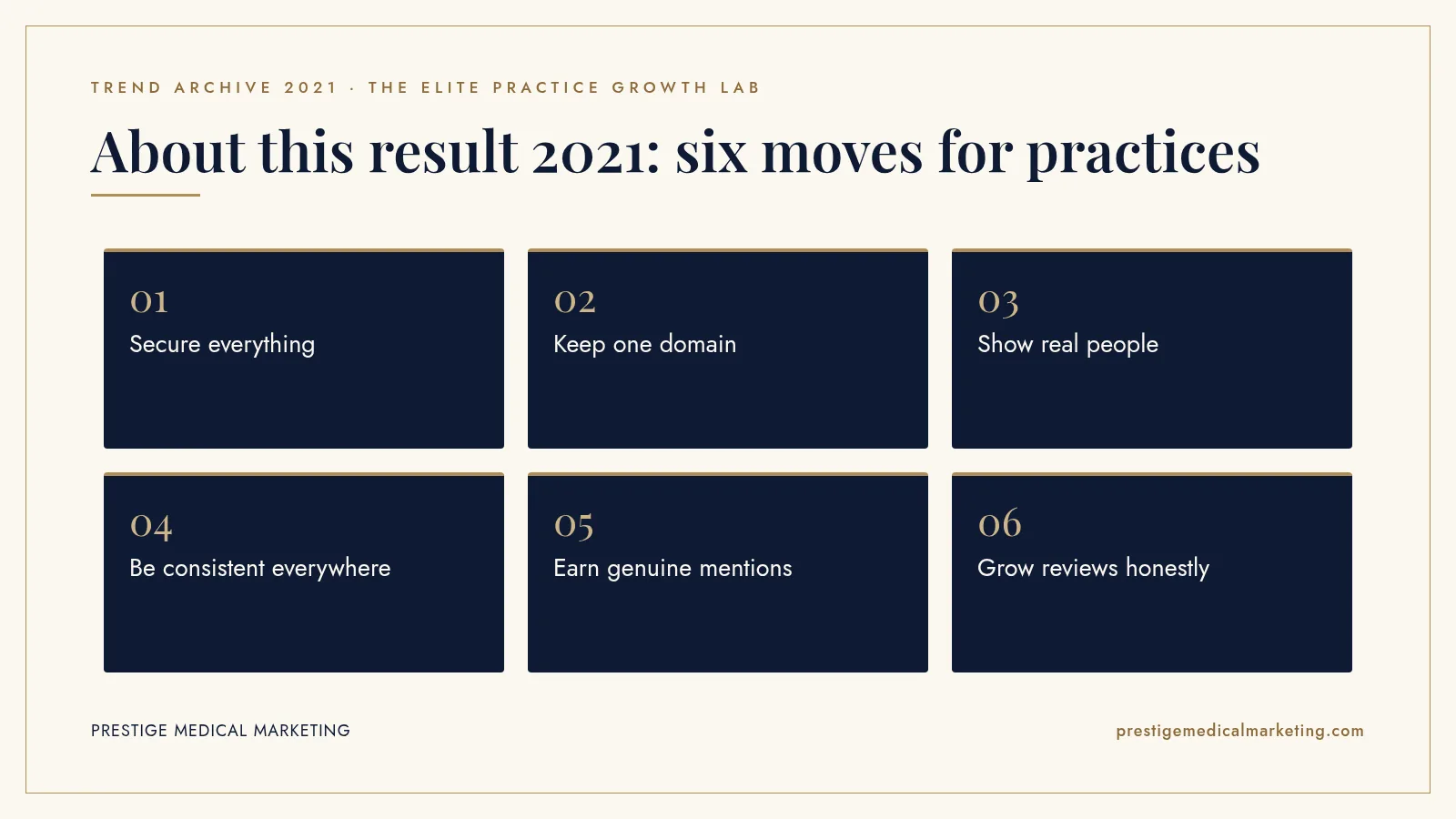
1. Secure everything
Use HTTPS across the site, keep certificates current and make sure forms and booking tools are secure as well.
2. Keep one domain
Avoid frequent domain changes or many microsites. A stable, established domain carries history that a new one cannot.
3. Show real people
Clinician bios with accurate credentials, licenses, training and professional affiliations help patients judge expertise.
4. Be consistent everywhere
Name, address, phone, hours and services should match across your website, Google Business Profile and directories.
5. Earn genuine mentions
Local news coverage, professional association listings, speaking engagements and community involvement create credible references.
6. Grow reviews honestly
Invite every patient consistently, never offer incentives for positive reviews and respond professionally without revealing patient information.

Credibility patients can see
About This Result reflected a broader truth: patients judge a practice on signals they can see quickly. A clean, secure website with clear information about the clinicians and services sends one message. A cluttered site with broken links, outdated information and generic, impersonal imagery sends another.
The same applies to the Google Business Profile, which often appears before the website. Accurate categories, current hours, real photographs of the practice and team, and thoughtful responses to reviews all help a patient form a positive first impression. Inconsistencies, such as different phone numbers on different sites, can create doubt.
For practices that offer aesthetic, elective or wellness services, credibility is part of the premium. Patients choosing a provider for something they will pay for directly want reassurance that they are in expert hands. Every visible signal either supports that reassurance or undermines it.
Wikipedia is not the goal
It can be tempting to view the Wikipedia description as a prize. For most private practices, it is not realistic and not necessary. Wikipedia’s standards for notability are strict, and attempts to create promotional articles are generally removed. A practice’s energy is better spent on things it can influence honestly.
Those include publishing accurate, helpful information on its own website, building relationships that lead to genuine media coverage or professional recognition and making it easy for satisfied patients to share their experiences. Over time, those efforts create a body of evidence that the practice is real, established and respected.
Health information and responsibility
Google’s mention of health information was not a passing detail. Health searches carry real consequences, and search engines have long applied higher standards to them. A practice that publishes medical information takes on responsibility for its accuracy.
That means clinician review of medical content, careful language about outcomes, clear distinctions between established and emerging treatments and prompt updates when guidance changes. It also means avoiding the temptation to publish large volumes of thin content for search visibility. Content that a patient might rely on should be content the practice is proud to stand behind.
The About page deserves real investment
Many practice websites treat the About page as an afterthought, with a short paragraph and a handful of generic phrases. Yet it is often where a careful patient goes to decide whether a practice is legitimate and trustworthy. A strong About page explains who founded the practice, who provides care, what training and licensing they hold, how long the practice has served its community and what it believes about patient care. It should be specific, current and written in a voice that sounds like the practice itself.
Provider pages that answer real questions
Patients want to know who will treat them. Each provider page should list credentials accurately, describe areas of focus, explain the provider’s approach and show a professional, current photo. Linking those pages from service pages helps patients connect expertise to the treatment they are researching. It also gives search engines clear, consistent information about who stands behind the practice’s content.
Consistency across the web
Search tools that describe a source draw on what the wider web says about it. If a practice’s name, address, phone number and description differ between its website, its Business Profile, directories and social profiles, the picture becomes confusing for patients and machines alike. A periodic audit that brings every listing into line is simple work that strengthens how the practice appears wherever someone looks it up.
Policies that signal professionalism
Clear privacy, cancellation, financial and accessibility policies tell patients that a practice is organized and accountable. They also answer practical questions before a patient has to ask. Policies should be easy to find, written in plain language and reviewed with qualified advisors so they match how the practice actually operates. When policies change, the website should change the same week, so patients never read rules that no longer apply or rely on outdated details.
Earned mentions over manufactured ones
Being mentioned by respected local organizations, professional associations or reputable publications helps build a practice’s reputation in a durable way. Those mentions come from genuine contributions, such as community education, expert commentary or meaningful partnerships. Paid placements on low-quality sites that exist only to sell links do little for credibility and can carry risk.
Reviews as part of the picture
When patients look up a practice, reviews are usually part of what they find. A steady flow of genuine reviews, collected ethically and answered professionally within privacy rules, shows that real people have chosen the practice and that the practice listens. It never involves fake, paid or filtered reviews, which damage trust and carry legal risk. See our pieces on Google’s 2023 reviews update and the FTC’s 2024 fake review rule, and our work on reputation and premium pricing. Over time, this record becomes one of the most persuasive descriptions of a practice that anyone can find.
What 2021 does not tell us
Google did not publish how often searchers used About This Result or whether it influenced which sites they visited. We do not have data on how it affected private practices specifically. What 2021 does show is Google’s intent to help people evaluate sources, particularly for health, and its willingness to explain in plain terms the factors that connect results to searches.
The premium practice advantage
A premium practice already has what cautious patients look for: real expertise, a respected team and patients willing to say so. The work is making that credibility visible and consistent everywhere. See our approach to reputation and premium pricing, our custom websites, our full services, who we help and how we approach Google Maps and AI search visibility. Our team works from Austin with practices nationwide.
The bottom line
Google launched About This Result in February 2021 and expanded it in July to explain why results appeared. For private practices, the lasting lesson was that credibility is judged before the first click, and that secure websites, consistent information, real credentials and genuine reviews are what patients and search engines can see.
Check if your market is open. We take one practice per specialty per market. Request a market check or call (716) 400-0084.
Frequently asked questions
When did About This Result launch?
Google introduced it on February 1, 2021 for English-language results in the US, on desktop, mobile web and the Google app on Android.
What did it show?
A description of the website from Wikipedia when available, or other context such as when Google first indexed the site, along with whether the connection was secure through HTTPS.
How did it change in July 2021?
On July 22, 2021, Google added information about factors that connected a result to the query, including matching keywords, related terms, links and local relevance, plus tips to refine searches.
Why did Google build it?
Google said it wanted to help people make more informed decisions about which sites to visit, especially when looking for something important like health or financial information.
Why does it matter for medical practices?
Most private practices do not have Wikipedia entries, so searchers may see more limited context. That puts more weight on what a practice controls: a secure, credible website, accurate business information and genuine reviews.
What should a practice do today?
Use HTTPS, keep business information consistent across the web, show real clinicians with credentials, earn genuine reviews and build a reputation that other credible sources reflect.