
The FTC's Consumer Review Rule, in effect since October 2024, bans fake reviews and testimonials, reviews conditioned on positive or negative sentiment, undisclosed insider reviews, deceptive company-controlled review sites, review suppression and fake social media indicators. On December 22, 2025, FTC staff warned 10 companies of potential violations, noting civil penalties of up to $53,088 per violation. Practices should ask every patient for honest reviews, never tie incentives to positive ones and never hide negative ones.
For aesthetic and private practices, reviews are not a marketing extra. They are often the deciding factor. A prospective patient comparing two injectors, two plastic surgeons or two longevity clinics will read reviews before almost anything else. That makes reviews one of the most valuable assets a practice owns, and one of the most tempting to manipulate.
In 2025, the federal rule against fake reviews moved from announcement to enforcement. The FTC sent its first public round of warning letters under the Consumer Review Rule, and the penalties it named were large enough to get any owner’s attention.
This retrospective covers what the rule says, what changed in 2025 and how a practice should build reviews the right way.
What actually happened
The rule. In August 2024, the FTC announced a final rule banning fake reviews and testimonials. It took effect on October 21, 2024. For the first time, the FTC had a rule specifically targeting review practices, which allows it to seek civil penalties for violations.
December 2025: warnings go out. On December 22, 2025, FTC staff sent letters to 10 companies warning them of potential violations. The FTC said the letters were based on consumer complaints and information provided by the companies, and were not formal determinations of violations. But they warned that violations could lead to a federal lawsuit and civil penalties of up to $53,088 per violation.
What the rule covers. According to the FTC, the rule prohibits reviews and testimonials that misrepresent whether the reviewer’s experience was positive or negative or whether the reviewer used the product or service at all. It prohibits conditioning compensation or other incentives on a reviewer expressing a particular sentiment. It prohibits failing to disclose reviews written by company insiders or their immediate relatives. It also covers company-controlled review websites, suppressing certain reviews and misusing indicators of social media influence such as follower or view counts.
Why practices should pay attention
Most practice owners would never write fake reviews themselves. But many common review tactics in the aesthetic and wellness world sit close to the lines the rule draws.
Review gating. Some review tools send a satisfaction survey first, then only invite happy patients to post publicly, while routing unhappy ones to a private form. That pattern raises questions under the rule’s review suppression and misrepresentation provisions, and it violates Google’s own policies.
Incentives. Offering a discount, gift card or entry into a drawing for a five-star review is clearly a problem. Even incentives for any review can violate platform policies.
Insider reviews. Staff, owners, friends and family reviewing the practice, or providers reviewing each other, are common and risky.
Purchased or agency-written reviews. Any vendor that offers to “generate” reviews or post them on your behalf is a serious risk.
Inflated social proof. Bought followers or views fall under the rule’s provisions on social media indicators.
The penalty figure matters because review violations can stack. A single program that produced hundreds of problematic reviews could, in theory, involve many violations. The FTC has not published penalties against a medical practice under the rule as of this writing, and we are not suggesting any practice faces that exposure. But the downside is far too large to risk.
What typical agencies did
Reputation management has long been one of the murkiest corners of practice marketing. Some vendors sold review gating as a feature. Others offered “review campaigns” with incentives attached, or quietly posted reviews from accounts they controlled. Some promised to remove negative reviews through aggressive flagging or legal threats.
Those tactics were always risky under platform rules. After 2024 and 2025, they carry federal penalty risk as well. A practice that hires a vendor using them can still be responsible for the results.
We take the opposite approach. Our view, laid out in our guide to reputation and premium pricing, is that honest reviews from real patients, gathered consistently, are what support premium prices. Manufactured reviews eventually undermine them.
What it means for a practice today
This is marketing guidance, not legal advice. Have counsel review your review practices.
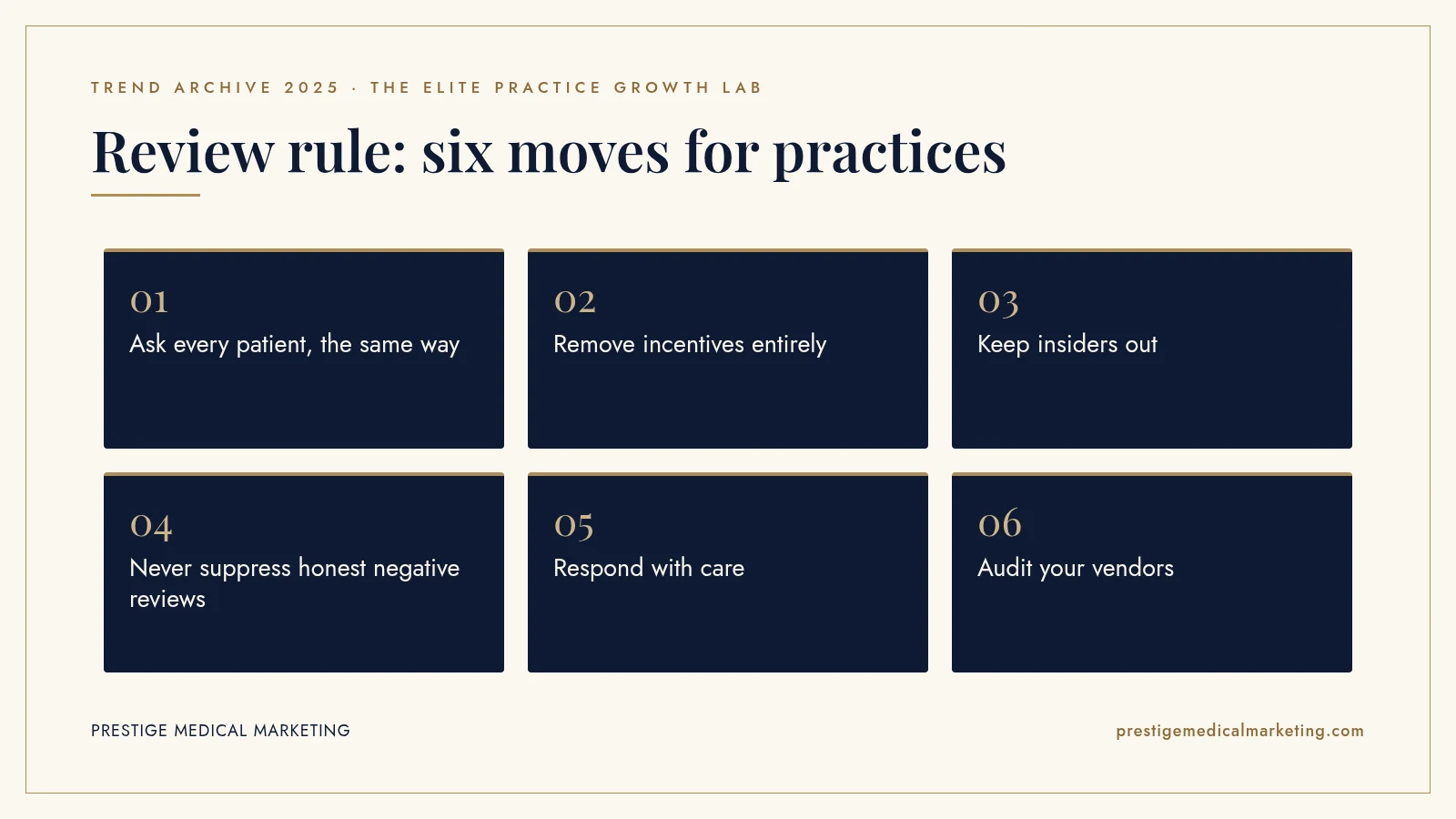
1. Ask every patient, the same way
Build the review request into your normal follow-up for every patient, without filtering by satisfaction. A short text or email after the visit, with a direct link to your Google profile, is enough. Consistency is both the compliant approach and the most effective one.
2. Remove incentives entirely
Do not offer anything in exchange for a review, even a neutral review. The rule focuses on sentiment-based incentives, but Google and other platforms prohibit incentives broadly.
3. Keep insiders out
Staff, owners, family members and business partners should not review the practice. If a team member is also a patient, they still should not post a review.
4. Never suppress honest negative reviews
Do not use legal threats, intimidation or false reports to remove honest reviews. Flag reviews only when they truly violate platform policies, such as spam or reviews from people who were never patients.
5. Respond with care
Respond to reviews, positive and negative, briefly and professionally. Never confirm that someone is a patient or discuss their care, which can create HIPAA issues. Invite unhappy reviewers to contact the practice directly.
6. Audit your vendors
Ask every reputation or marketing vendor exactly how they generate reviews. If the answer involves gating, incentives, posting on your behalf or bought social proof, end it.

Testimonials on your own website and ads
The rule is not only about Google. Testimonials on your website, social media and ads also count. A few principles keep them honest.
Use real patients with permission. Get written consent, especially for anything that might reveal health information or show results. Healthcare privacy laws apply on top of FTC rules.
Do not edit meaning. Shortening a testimonial is fine; changing what it says is not.
Disclose relationships. If a testimonial comes from an employee, a paid influencer or someone who received free treatment, disclose it clearly. The FTC’s endorsement guides apply.
Represent typical experiences fairly. Showing only your most dramatic result as if it were typical can mislead. The FTC’s health products compliance guidance explains how claims and testimonials about health outcomes need support.
Building reviews that hold up
A compliant review system is not slower or weaker. It is usually stronger, because it produces a steady flow of real, detailed reviews that future patients trust. Here is a simple system we recommend.
The moment. Ask at the right time: after a follow-up visit when results are visible, not before the patient has seen any benefit. For aesthetic treatments, that may be two weeks after a visit. For longevity or wellness programs, it may be after the first progress review.
The message. A short, personal note from the provider or the practice: “We would be grateful if you would share your honest experience. It helps others find the right care.” Link directly to the review form.
The reminder. One gentle follow-up if they have not responded. No more.
The response. Reply to every review within a few days, with a thank you or a professional invitation to talk.
The review. Look at themes each month. Reviews that mention wait times, front desk communication or pricing confusion are free operational feedback.
Done consistently, this system builds a review profile that grows month after month and reflects your real strengths. It also feeds AI search: assistants and AI Overviews increasingly summarize reviews when recommending practices. Our guide on getting recommended by AI explains why.
Reviews and AI search
Reviews increasingly matter beyond the review sites themselves. When people ask AI assistants for recommendations, those tools often draw on review content to describe a practice: what patients liked, what they mention most, how the practice handles concerns. A profile full of specific, varied, honest reviews gives AI tools accurate material to work with. A profile padded with short, generic or suspicious reviews does not, and platforms may filter those reviews anyway.
That makes the honest system even more valuable. Detailed reviews that mention specific providers, treatments and experiences are exactly what both people and AI systems look for. Our guide to your Google Business Profile covers how reviews fit with the rest of your local presence.
If you inherited a problem
Many owners discover review issues only after taking over a practice, changing agencies or looking closely for the first time. If you find reviews from staff, family members or accounts a past vendor controlled, or a gating tool still running, act calmly and quickly.
Turn off any gating or incentive programs right away. Stop working with vendors that posted or generated reviews. Ask staff and family to remove reviews they posted. Document what you found and what you changed, and talk with counsel about whether anything else is needed. Then start the honest system described above, so real reviews steadily replace anything questionable.
If a past vendor wrote testimonials for your website or ads, replace them with real, consented patient words or remove them. If your website shows a review widget, make sure it pulls all reviews from the platform rather than a hand-picked set presented as complete.
The goal is not perfection overnight. It is a clear record that your practice found a problem, fixed it and now gathers reviews the right way. That record matters if questions ever come up later.
What 2025 does not tell us
The FTC did not name the 10 companies that received letters, and we do not know whether any were medical practices. We also do not yet know how aggressively the FTC will pursue penalties under the rule, or how courts will interpret its provisions in specific cases. State laws and platform policies add further layers. What 2025 showed is that the FTC is actively watching review practices, using consumer complaints to decide where to look.
The premium practice advantage
Premium practices do not need fake reviews. They need a consistent system that captures the real experiences of satisfied patients, who are usually happy to share them when asked. The result is a review profile that grows steadily, reads authentically and supports premium pricing.
That is part of how we build the Prestige System for aesthetic and private practices: honest review systems, strong Google profiles through our maps and AI search service and fast follow-up for every inquiry. Our team works from Austin with practices nationwide.
The bottom line
The FTC’s Consumer Review Rule took effect in October 2024. In December 2025, the FTC warned 10 companies about potential violations and reminded businesses of civil penalties up to $53,088 per violation. For practices, the safe and effective path is the same: ask every patient for an honest review, offer no incentives, keep insiders out, never suppress honest feedback and audit your vendors. Real reviews, gathered consistently, are worth more than any shortcut.
Check if your market is open. We take one practice per specialty per market. Request a market check or call (716) 400-0084.
Put this playbook to work: see how it applies to med spa marketing.
Frequently asked questions
What is the FTC Consumer Review Rule?
It is a federal rule, announced in August 2024 and in effect since October 21, 2024, that prohibits specific deceptive practices involving reviews and testimonials. It lets the FTC seek civil penalties for violations, which it generally could not do for first-time violations of the FTC Act alone.
What happened with the rule in 2025?
On December 22, 2025, FTC staff sent warning letters to 10 companies about potential violations of the rule. The FTC said the letters were not formal findings of violations, but warned that violations could lead to federal lawsuits and civil penalties of up to $53,088 per violation.
Can my practice offer an incentive for reviews?
The rule prohibits conditioning compensation or other incentives on a reviewer expressing a particular sentiment, positive or negative. Platforms such as Google also have their own policies, and Google prohibits offering incentives for reviews. The safest approach is to ask every patient for an honest review without any incentive.
Can staff or family members leave reviews for the practice?
The rule prohibits failing to disclose reviews written by company insiders or their immediate relatives in certain situations. Platform rules also restrict conflicts of interest. In practice, do not have staff, owners or their families review your practice.
Is it legal to only ask happy patients for reviews?
The FTC rule addresses review suppression and misrepresentations about reviews, and Google's policies prohibit selectively soliciting positive reviews. Asking every patient in the same way is both the safest approach and the most credible for future patients.
How should a practice respond to negative reviews?
Respond professionally, briefly and without confirming that the reviewer is a patient or sharing any health information, which could create HIPAA issues. Invite them to contact the practice directly. Never threaten reviewers or use legal threats to remove honest reviews.