
Site reputation abuse is Google's name for publishing third-party pages on a strong host site to exploit that site's ranking signals. Google announced the policy in March 2024, began enforcing it with manual actions in May 2024, and clarified it on November 19, 2024 to say that first-party involvement or oversight does not make it acceptable. For plastic surgeons, the lesson is to build authority on your own website and profiles instead of renting it.
Plenty of plastic surgeons have been pitched the same idea: pay to appear in a “best surgeons” roundup on a well-known website, and ride that website’s search rankings to new patients. The pitch is simple. Their domain is strong, yours is not, so borrow theirs.
In 2024, Google made it clear that borrowing a strong site’s reputation to rank content that does not belong there is a spam problem. It named the tactic site reputation abuse, enforced it against some of the most famous publishers online, and then tightened the rule further in November.
This retrospective covers what happened and why it matters for how a surgeon builds visibility today.
What actually happened in 2024
March: the policy is announced. When Google announced its March 2024 spam policies, site reputation abuse was one of three new categories. Google gave site owners until May 5 to prepare before enforcement began.
May: enforcement starts. Search Engine Land reported that Google began issuing manual actions in early May 2024. Coupon sections and similar third-party content on major news and media websites were removed from search results. Google said algorithmic enforcement would come later.
November: the rule tightens. On November 19, 2024, Google updated the policy. It defined site reputation abuse as “the practice of publishing third-party pages on a site in an attempt to abuse search rankings by taking advantage of the host site’s ranking signals.” It added that no amount of first-party involvement or oversight changes that. A host could not make borrowed content acceptable simply by supervising it.
Freelance and affiliate content stay legal. Google was explicit that using freelancers or publishing affiliate content is not a violation by itself. The problem is the arrangement: outside content placed on a strong site to exploit that site’s reputation. The Verge covered the November update in the context of what the SEO world calls “parasite SEO.”
Why plastic surgeons should care
Most surgeons never ran a coupon section. So why does this matter? Because plastic surgery marketing has long relied on rented authority in other forms.
Think about the paid placements many practices have bought: a sponsored “top surgeons” page on a lifestyle site, a profile on a directory that ranks well for procedure searches, a “featured provider” listing on a review platform, a paid article on a news site’s partner section. Some of these are legitimate advertising. Some are exactly the kind of borrowed-ranking arrangement Google targeted in 2024.
When a surgeon’s visibility depends on another site’s ranking power, two things can go wrong. The host site can lose that ranking power when Google acts, taking your placement down with it. Or the arrangement itself can stop producing traffic as Google gets better at recognizing it. Either way, the surgeon owns nothing.
Plastic surgery is also a high-trust category. A patient choosing a surgeon for a facelift or breast augmentation is making a decision about their body and their money. Google wants to send that patient to sources that genuinely know the subject, which is the surgeon’s own carefully built pages far more often than a sponsored roundup.
What typical agencies did
For years, some agencies sold “authority placements” as a shortcut. A practice paid for a spot on a high-ranking site and the agency reported impressive-looking links and mentions. The reports rarely tracked whether any of those placements produced a consultation.
After the 2024 enforcement, the pitch adapted rather than disappeared. Instead of coupon sections, it became “partner content,” “expert columns” and “featured provider” programs. Some of these are legitimate. The question to ask is whether the placement makes sense for the host site’s real readers, or whether it exists mainly to rank.
The other common pattern was ignoring the policy altogether because it did not seem to apply to a medical practice. That missed the bigger message. Google was signaling that it wanted to rank sources on their own merit, and that is a message every practice website should act on.
What it means for a plastic surgeon today
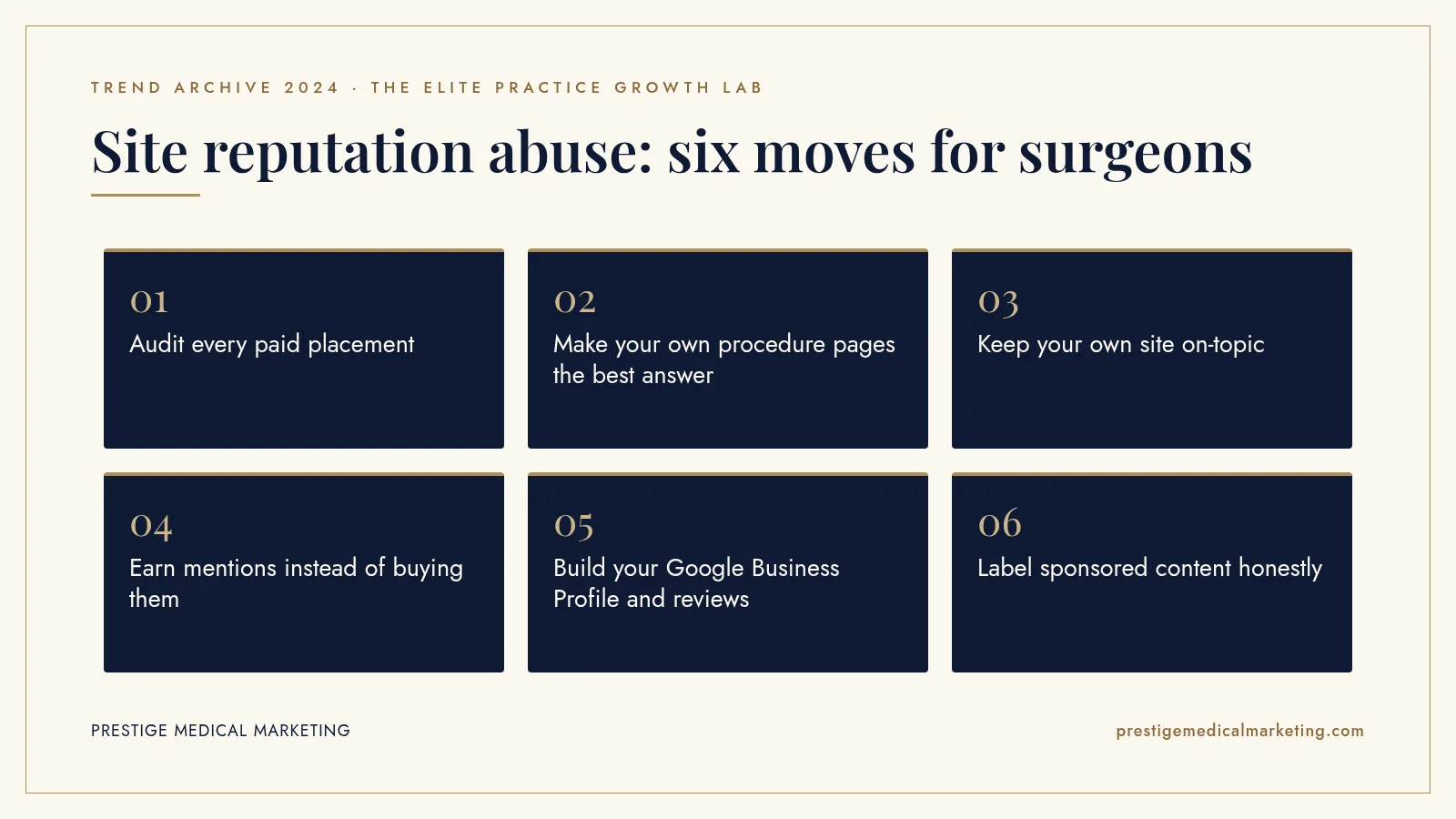
The practical takeaway is to invest in authority you own and earn, and to treat rented visibility as advertising rather than as a foundation. Here is how we would approach it.
1. Audit every paid placement
List every directory, roundup, sponsored article and featured listing you pay for. For each, check whether it still ranks, whether patients mention it, and whether it produces calls or forms. Cut what cannot show results.
2. Make your own procedure pages the best answer
Your website should carry the deepest, most honest page on each procedure you perform: who is a candidate, how your surgeon approaches it, recovery, risks, results and consult steps. Our plastic surgery SEO guide covers the structure.
3. Keep your own site on-topic
Do not host content unrelated to your practice, even if someone offers to pay for it. Everything on your domain should serve your patients.
4. Earn mentions instead of buying them
Professional society listings, hospital affiliations, interviews, speaking engagements and genuine media quotes create credibility that does not depend on someone else’s ranking tactics.
5. Build your Google Business Profile and reviews
For local procedure searches, your profile and reviews often matter as much as your website. A steady flow of genuine reviews is the kind of reputation nobody can rent. See how reputation supports premium pricing.
6. Label sponsored content honestly
If you do pay for placements, treat them as ads, disclose them as required, and judge them on booked consultations.

Rented authority versus owned authority
A useful way to think about 2024 is the difference between renting and owning. A paid placement on a strong site is rented. It works only as long as the host keeps its rankings, keeps your listing, and keeps the arrangement within Google’s rules. You do not control any of those.
Owned authority is slower to build but it compounds. Every strong procedure page, every genuine review, every before-and-after with patient consent, every credible interview adds to a reputation that belongs to your practice. When Google changes its policies, owned authority tends to hold up, because it was built on the things Google says it wants to reward.
This also matters for AI search. Assistants and AI summaries draw on what they can find about a practice across the web. A surgeon with a consistent, credible presence on their own site, their profile and reputable third-party sources gives those systems a clearer picture than a surgeon whose visibility lives on sponsored pages. Our guide on getting your practice recommended by AI goes deeper.
Questions to ask before you pay for any placement
Surgeons still receive offers for featured listings and roundups every week. A few questions separate useful advertising from rented authority that may not last.
Who actually reads this site? If the host’s real audience is not prospective patients in your area, the placement is probably being sold for its search rankings rather than its readers.
Is the placement clearly labeled? Honest advertising is disclosed. If the seller suggests it will look like independent editorial content, that is a warning sign for patients, for regulators and for search engines.
Can they show results in patients, not links? Ask for evidence of calls, forms or consultations from comparable practices. A list of domain metrics is not evidence.
What happens if the host loses rankings? Ask what you keep. In most cases the answer is nothing, which tells you how to value it.
Does it fit the host’s purpose? Google’s November 2024 language focused on third-party content that exploits a host site’s ranking signals. A surgeon profile on a professional society’s site fits that site’s purpose. A paid surgeon roundup on a site with no connection to medicine raises the question Google asked in 2024.
How the year unfolded for a surgeon
It helps to picture 2024 from inside a practice. In early March, the new spam policies were announced alongside a major core update, and many procedure pages across the web moved around for weeks. Most surgeons heard nothing about site reputation abuse at the time. It sounded like a problem for publishers.
In May, the first manual actions landed. Sections of well-known media websites disappeared from search results. For a surgeon who had paid for a placement on a site like that, the change could show up as a listing that simply stopped sending visitors, with no notice from the seller.
Through the summer and fall, sellers adjusted their language, and many surgeons kept renewing placements out of habit. Then in November, Google closed the door that many hosts had been relying on: the idea that supervising outside content made it acceptable. After November 19, a host’s oversight was no longer a defense.
By the end of the year, the message was consistent across every announcement. Google wanted rankings to reflect a site’s own expertise and purpose. That is a standard a surgeon with a strong website can meet directly, without paying anyone for the privilege.
None of this required a surgeon to understand the technical details. It only required noticing where their patients were really coming from, and asking whether that source was something the practice controlled.
The practical lesson for planning is simple. Any marketing line item that depends on another company staying in Google’s good graces deserves a shorter contract, closer tracking and a smaller share of the budget than the assets you own. Your own pages, profile and reviews are the parts of the plan that survive policy changes.
What 2024 does not tell us
Google did not publish a list of every site that received a site reputation abuse manual action, and we have no reliable data on how many medical directories or sponsored placements lost visibility because of the policy. Google also said algorithmic enforcement would follow, without detailing how it works. We cannot say whether any specific placement you paid for was affected. What 2024 does show is that Google is willing to act against even the most famous websites when their content borrows authority it did not earn.
The premium practice advantage
A premium surgeon does not need borrowed authority. Board certification, years of focused experience, real results and patients willing to talk about their outcomes are authority. The 2024 changes made those assets more valuable, because they made the shortcuts less reliable.
That is the foundation of our plastic surgery marketing: procedure pages built around your surgeon, a profile that earns trust, and Google Maps and AI search visibility grounded in your own reputation. See our services and who we help. Our team works from Austin with practices nationwide.
The bottom line
In 2024, Google told the world that famous websites cannot lend their rankings to content that does not belong there. For plastic surgeons, the message is about where to invest. Visibility you rent can disappear with a policy update. Reputation you build on your own pages and profiles stays yours.
Check if your market is open. We take one practice per specialty per market. Request a market check or call (716) 400-0084.
Frequently asked questions
What is site reputation abuse?
Google defines it as publishing third-party pages on a site in an attempt to abuse search rankings by taking advantage of the host site's ranking signals. A common example in 2024 was coupon or product review sections on major news websites that were run by outside companies.
When did Google start enforcing the policy?
Google announced the policy on March 5, 2024 and gave sites two months to prepare. Search Engine Land reported that enforcement began in early May 2024, with manual actions removing affected sections of several well-known sites from search results.
What changed in November 2024?
On November 19, 2024, Google updated the policy to say that no amount of first-party involvement or oversight makes it acceptable to publish third-party content that exploits the host site's ranking signals. Google also said freelance content and affiliate content are not violations on their own.
Does this affect plastic surgeons directly?
Usually indirectly. Most practices are not running third-party sections on their own websites. But many surgeons paid for sponsored placements, list articles and directory pages on other sites that depended on borrowed authority. When Google devalues that kind of content, those placements can lose visibility.
Is guest content on my practice website a problem?
Content written by outside experts is fine when it genuinely serves your patients and fits your site's purpose. The risk is hosting content that exists mainly to rank for unrelated topics using your site's reputation. Keep everything on your site relevant to your practice and your patients.
What should a plastic surgeon invest in instead?
Your own website, your Google Business Profile, a steady flow of genuine reviews, consented before-and-after galleries, and credible earned mentions such as interviews and professional society listings. Those assets build reputation you control.