
Meta announced in November 2021 that it would remove detailed targeting options relating to topics people may perceive as sensitive, such as health causes, sexual orientation, religious practices and political beliefs. The removal began on January 19, 2022, and existing ad sets using affected options could keep delivering until March 17, 2022. For plastic surgery practices, it reduced reliance on interest targeting and made compliant creative, strong offers and careful use of practice data more important.
For plastic surgery practices, social advertising has always been attractive. Facebook and Instagram are visual, the audience is large, and aesthetic procedures lend themselves to images and stories. For years, the platforms also offered detailed targeting by interests and behaviors, allowing advertisers to reach people who had shown interest in topics related to beauty, wellness, fitness and, in some cases, specific health subjects.
In early 2022, Meta narrowed those options significantly. It removed detailed targeting choices that referenced topics people might perceive as sensitive, including health causes. Advertisers who had built campaigns around those interests had to rebuild them, and many found that the old precision was not coming back.
This retrospective covers what Meta actually changed in 2022 and what it means for a plastic surgery practice today. For later chapters, see Meta’s health ad restrictions in 2025 and, for the data side, the Meta Pixel hospital findings of 2022.
What actually happened in 2022
November 9, 2021: the announcement. In “Removing Certain Ad Targeting Options and Expanding Our Ad Controls”, Meta said it would remove detailed targeting options relating to topics people may perceive as sensitive. Its categories included health, race or ethnicity, political affiliation, religion and sexual orientation.
Health examples. Meta cited options referencing causes, organizations or public figures relating to health, with examples such as Lung cancer awareness, World Diabetes Day and Chemotherapy.
January 19, 2022: removal begins. Meta’s developer update said the removal would begin on January 19, 2022, affecting ads created through Ads Manager and the Marketing API.
March 17, 2022: transition ends. Existing ad sets that used affected options could continue delivering until March 17, 2022. After that, advertisers needed to update them.
Meta’s reasoning. Meta said it had heard concerns from experts that targeting options like these could be used in ways that lead to negative experiences for people in underrepresented groups. It acknowledged the change would affect some businesses and nonprofits that used the options for legitimate purposes.
Remaining tools. Advertisers could still target by location, age and other demographics, use interests that were not removed, and use custom and lookalike audiences built from their own data, subject to Meta’s policies.
Why it mattered for plastic surgery
Plastic surgery advertising on social platforms had long relied on audience selection. A practice promoting body contouring, breast procedures or facial rejuvenation might layer interests related to beauty, fitness, wellness and health topics to reach people likely to be receptive. Some health-adjacent interests were affected by the removal, and the broader direction made clear that health-related targeting would be treated cautiously.
The effect was to push practices toward broader audiences and to make the creative itself do the targeting. An ad’s image, message and offer determined who engaged, and Meta’s delivery system learned from that engagement. That favored practices with strong, compliant creative and clear offers.
It also raised the stakes of first-party data. Custom audiences built from email lists or website visitors became more attractive, but for medical practices, those lists can contain protected health information. Using them carelessly could create serious privacy problems, as later findings about tracking on health websites made clear.
What typical agencies did
Many agencies scrambled to find replacement interests that approximated the removed ones, building long lists of loosely related topics in the hope of recreating the old precision. Some uploaded patient lists to build custom audiences without considering the privacy implications. Others concluded social ads no longer worked for medical practices and stopped altogether.
Each reaction had problems. Proxy interests often delivered poorly. Uploading patient data without proper review risked privacy violations. Abandoning social entirely ignored the value of awareness among people who later search for a practice by name.
The better path was to accept broader targeting, invest in creative and landing pages, and handle any first-party data under a clear privacy review. That approach took longer to show results, but it built campaigns that did not depend on options a platform could remove at any time, and it kept the practice on the right side of rules that were clearly tightening.
What it means for a plastic surgery practice today
Meta’s health ad rules have tightened further since 2022. These steps keep social advertising effective and safe.
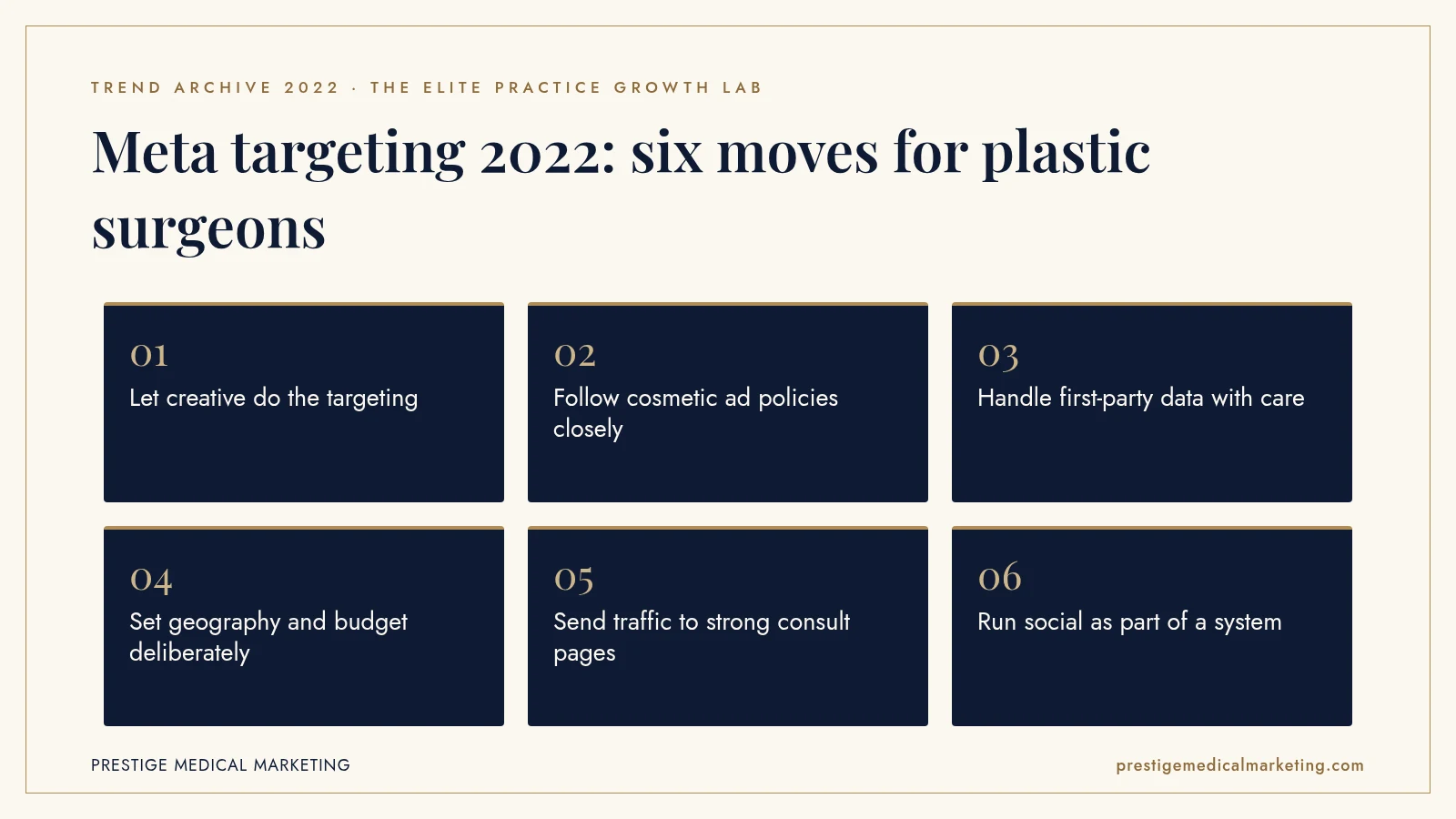
1. Let creative define the audience
Use clear, compliant imagery and messaging that speaks to the people you want to reach. Strong creative attracts the right engagement.
2. Follow platform health policies
Review Meta’s advertising standards for health and cosmetic procedures before launching, including rules on before-and-after imagery and body image.
3. Treat patient data as sensitive
Do not upload patient lists or share health-related website events with ad platforms without a documented privacy and legal review.
4. Build to a strong landing page
Send traffic to a fast, procedure-specific page with clear credentials and an easy consultation request.
5. Measure consultations, not clicks
Track consultation requests and booked appointments, using privacy-safe methods, to judge campaigns.
6. Use social for awareness too
Some value shows up later as branded searches and referrals. Watch those signals alongside direct results.
Creative is the new targeting
When precise interest targeting disappears, the advertisement itself becomes the filter. An image of a calm, elegant consultation room and a message about a surgeon’s approach to natural-looking results will attract a different audience than a discount banner. The platform’s delivery system learns who responds and shows the ad to more people like them.
That gives premium practices an advantage if they use it. Distinctive photography of the practice, the surgeon speaking about their philosophy, explanations of what a consultation involves and educational content about recovery all attract thoughtful prospective patients. Aggressive discounts and exaggerated promises tend to attract the opposite and can breach platform policies.
Testing still matters. Running a small number of distinct creative concepts, each with a clear angle, shows which messages attract consultation requests rather than casual clicks. Retiring weak concepts quickly and refreshing strong ones before they tire keeps campaigns efficient without chasing every new format the platform introduces.
Platform policies for cosmetic procedures
Meta’s advertising standards include specific rules for health, weight loss and cosmetic procedures, including restrictions on content that implies or attempts to generate negative self-perception and limits on how before-and-after imagery can be used. These rules have changed over time and deserve review before every campaign.
Truth-in-advertising law applies regardless of platform. Claims about results, safety, downtime and pricing must be accurate and substantiated. Testimonials and influencer content must reflect genuine experiences and carry appropriate disclosures. A campaign that performs well but breaks these rules is a liability.
Handling first-party data carefully
As detailed targeting narrowed, many advertisers leaned on custom audiences and pixel-based retargeting. For medical practices, that path requires caution. A list of patients who had a particular procedure, or website events showing someone viewed a procedure page and requested a consultation, can reveal health information. Sharing that with an ad platform raises questions under HIPAA and state privacy laws.
In December 2022, the HHS Office for Civil Rights issued guidance on tracking technologies used by covered entities, and parts of it were later vacated by a federal court in 2024. The legal landscape has shifted, but the practical lesson holds: practices should review exactly what data their sites and ad tools share, and avoid sharing anything that could identify a patient’s health interests without proper safeguards.
Consent-based approaches offer a safer route. Newsletter subscribers who have explicitly agreed to receive marketing, and content that does not reveal a specific procedure, give a practice a way to stay in touch without turning sensitive interests into advertising signals.
Geography and budget after the change
With interest targeting narrower, geography became one of the most dependable levers a practice still controlled. A plastic surgery practice usually knows where its patients come from: a metro area, specific suburbs, perhaps a wider region for certain procedures that people travel for. Setting location targeting to match that reality, rather than a generous radius drawn by default, keeps budget focused on people who can realistically become patients.
Budget structure matters as well. Broader audiences mean the platform needs enough data to learn who responds. A practice spreading a small budget across many procedures and many ad sets may never give any of them enough volume to improve. Concentrating on one or two priority procedures at a time, with a clear offer such as a consultation and a strong landing page, usually produces clearer results and better learning.
Frequency deserves attention too. Prospective surgical patients often take months to decide. Seeing a practice’s thoughtful content repeatedly over that period can build familiarity, but seeing the same ad many times in a week tends to irritate. Rotating creative and capping repetition where possible keeps a campaign welcome rather than intrusive.
Finally, the schedule of reviews should match the pace of change. Monthly reviews of creative, cost per consultation and landing page performance catch problems early without reacting to every daily fluctuation.
Social as part of a system
Social advertising rarely works alone for plastic surgery. Prospective patients typically research extensively, reading procedure pages, reviewing before-and-after galleries and checking reviews before requesting a consultation. A social ad may start that journey, but the website, Google Business Profile and reputation complete it.
That makes it important to measure the whole system. A rise in branded searches, direct visits and consultation requests can reflect social activity that does not show up as a direct click. Asking new patients how they heard about the practice remains one of the most reliable signals available.
It also argues for consistency in how the practice presents itself. The tone of a social ad, the procedure page it leads to and the consultation experience itself should feel like one practice with one point of view. When those pieces match, patients move from curiosity to consultation with fewer doubts along the way.
What 2022 does not tell us
Meta did not publish data on how the targeting removal affected advertiser performance, and we have no public data specific to plastic surgery practices. Results varied with creative, budgets, offers and local markets across the country. What 2022 does show is the direction Meta has taken since: more restrictions on health-related targeting and data, not fewer.
The premium practice advantage
A premium plastic surgery practice has the strongest raw material for creative-led advertising: an accomplished surgeon, refined spaces and real results shared with consent. See our plastic surgery services, our full services, who we help and how we approach Google Maps and AI search visibility. Our team works from Austin with practices nationwide.
The bottom line
From January 19, 2022, Meta removed detailed targeting options tied to sensitive topics, including health causes. For plastic surgery practices, it shifted advertising toward compliant creative, strong landing pages and careful handling of patient data.
Check if your market is open. We take one practice per specialty per market. Request a market check or call (716) 400-0084.
Frequently asked questions
What did Meta remove in 2022?
Detailed targeting options relating to topics people may perceive as sensitive, including health causes, sexual orientation, religious practices and groups, and political beliefs and causes.
When did the change take effect?
Meta said the removal would begin on January 19, 2022. Existing ad sets using affected options could continue delivering until March 17, 2022.
Which health examples did Meta give?
Meta's announcement cited examples such as Lung cancer awareness, World Diabetes Day and Chemotherapy as options referencing health causes.
Could practices still advertise on Facebook and Instagram?
Yes. Advertisers could still use location, age, broader interests that were not removed, custom audiences and lookalike audiences, subject to Meta's policies.
Why did it matter for plastic surgery?
Aesthetic and surgical advertising had often used interest-based targeting, and some cosmetic and health-adjacent interests were affected. Practices had to rely more on creative and on their own audience data.
Can a practice upload patient lists to Meta?
Practices must be very careful. Patient lists can involve protected health information, and sharing them with ad platforms raises privacy and HIPAA questions that need proper review.