
Starting in January 2025, Meta rolled out restrictions on certain categories of health and wellness websites using its business tools. Many affected advertisers could no longer share lower-funnel events such as purchases or leads for optimization, and custom conversions that implied health conditions were limited. For private practices, the fix is privacy-safe tracking, offline conversion measurement from your own booking data, and creative that sells the practice rather than relying on audience targeting.
For years, advertising a private practice on Facebook and Instagram worked like this: install the Meta Pixel, track the people who submitted a form or booked online, and let Meta’s algorithm find more people like them. It was powerful. It was also, in many cases, sending sensitive information about health interests to an ad platform.
In January 2025, Meta started closing that door for a large group of health and wellness advertisers. Campaigns that had relied on lead and purchase optimization lost the signal they ran on. Many practices saw their costs rise and their reporting go dark, often without a clear explanation.
This retrospective covers what changed, why, and how a private practice should advertise and measure on Meta today.
What actually happened in 2025
The announcement. In mid-November 2024, Meta told advertisers and agencies it would “begin rolling out additional restrictions on certain categories of websites that are using Meta’s business tools” starting in January 2025, according to an email reported by Digiday. Meta said it was updating its guidance “to further clarify and help prevent advertisers from sharing sensitive information with us through our Meta Business Tools.”
The effect. Brands and websites flagged in health and wellness categories could no longer use lower-funnel tracking data for conversions. In practice, that meant events like purchases, leads and completed registrations from flagged websites could not be used to optimize campaigns. Some advertisers kept partial capabilities; others lost more. The extent varied by account and by what data the website was sharing.
Custom conversions. Meta’s own help center explains restrictions on certain custom conversions: conversions that suggest sensitive information, including health conditions, can be flagged and blocked from use in new campaigns.
The context. The change did not come from nowhere. Washington’s My Health My Data Act had taken effect in 2024, and its first class action was filed in February 2025, as WilmerHale summarized. Regulators and plaintiffs’ lawyers had been focusing on health data flowing to ad platforms for several years. Meta tightening its own rules fit that pattern.
Why private practices felt it
Many aesthetic, wellness and specialty practices had built their Meta advertising around one tactic: optimize for leads. The pixel recorded every consultation request, and Meta’s algorithm learned which users were most likely to submit one. Without that signal, campaigns had to optimize toward softer events like page views or clicks, which tend to bring cheaper, less qualified traffic.
At the same time, reporting got worse. Practices that had judged their agencies by the cost per lead shown in Ads Manager suddenly had fewer conversions reported, even when real bookings had not changed much. Some cut budgets that were working. Others kept funding campaigns that were not, because they could no longer tell the difference.
The underlying problem was not Meta’s change. It was that many practices had outsourced their measurement to the ad platform. When the platform changed the rules, they lost their view of the business.
What typical agencies did
Some agencies tried to work around the restrictions: renaming events, moving conversion tracking to different domains, or sending the same data through server-side integrations. Those tactics miss the point. If the data is sensitive, moving it through a different pipe does not make it less sensitive, and it can increase legal exposure for the practice.
Others simply reported lower conversion numbers and asked for more budget. Neither approach answered the question a practice owner actually cares about: are these ads producing patients, and at what cost?
We treat platform data as one input, not the scoreboard. The scoreboard lives in your own booking system.
What it means for a practice today
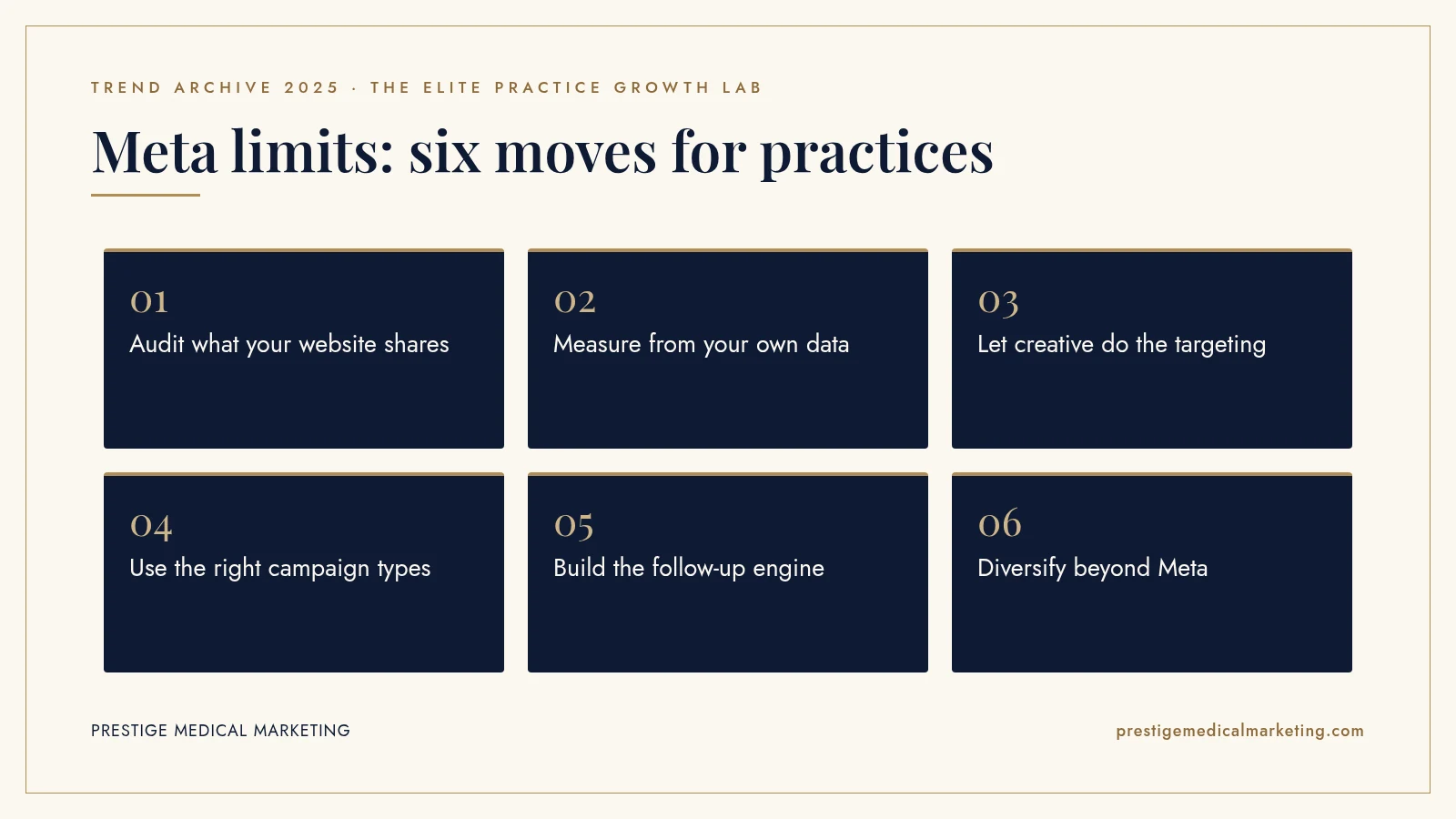
1. Audit what your website shares
Review every tracking tool on your site: pixels, tag managers, chat widgets, booking embeds and form tools. Know what each one collects and where it sends it. Remove tracking from pages and forms that involve health information unless counsel has approved it. Our retrospective on 2025’s tracking and health privacy changes covers this in depth.
2. Measure from your own data
Your scheduling system or CRM knows who booked, who showed up and who became a patient. Record the source of every new patient. Use dedicated booking links or call tracking numbers per campaign where privacy rules allow. Compare month over month. That is the number that tells you whether ads work.
3. Let creative do the targeting
With less data, the ad itself has to find the right person. Specific, high-quality creative attracts the right patient and repels the wrong one: a provider explaining a treatment, a tour of your space, a clear offer for a specific service. Broad audiences with sharp creative often beat narrow audiences with generic creative.
4. Use the right campaign types
Awareness and traffic campaigns that send people to strong treatment pages can still work well. Meta’s on-platform lead forms may be an option for some practices, but they need careful setup to avoid collecting health details. Retargeting based on sensitive page visits is the area to be most cautious about.
5. Build the follow-up engine
When every lead costs more, speed to response matters more. Practices that reply within minutes convert far more of the inquiries they already pay for. Our guide to call handling and lead leakage explains where most practices lose patients after the click.
6. Diversify beyond Meta
Meta can be a strong channel for awareness and demand creation, but it should not be the only one. Search, maps, reviews, referrals and your own list are less exposed to any single platform’s rules. See our playbook on predictability and scaling.

A privacy-safe measurement setup
Here is a measurement setup we recommend for most private practices. It does not depend on sending sensitive data to any ad platform.
On the website: privacy-respecting analytics for traffic and page performance, with no tracking on health intake forms. Clear consent tools where required by state law.
On the booking side: a required source field for every new patient, filled by the patient or the front desk, plus campaign-specific links or numbers where appropriate.
In the monthly review: new consultations by source, consultation-to-patient rate by source, revenue per new patient by source and total marketing spend by channel. That gives you cost per patient, which is the number that matters.
In the ad platform: top-of-funnel and mid-funnel metrics used for creative testing, not for judging overall return.
This setup is simple, it is defensible, and it survives any future platform change. It also makes it much harder for any vendor, including us, to hide behind platform numbers.
Creative that works without the data
When the algorithm has less to learn from, the ad has to do more of the work. For private practices, a few creative patterns tend to hold up well because they speak directly to the right person.
The provider explains. A short video of your provider answering one common question about one treatment. It builds trust, shows expertise and naturally attracts people interested in that treatment.
The space and the experience. A walk through your practice, the consultation room, the details that make a visit feel premium. This attracts clients who value experience over price.
The clear offer. A specific, honest invitation: a consultation for a named service, a seasonal event or a new provider’s availability. Vague brand messages give the algorithm nothing to work with.
The proof. Real reviews, shared with permission, and consented results where your platform rules and state regulations allow. Be careful here: Meta’s advertising policies restrict some before-and-after imagery and health claims, and the FTC’s health guidance applies to every claim you make.
Avoid creative that names or implies a viewer’s health condition, such as “Struggling with your weight?” Meta’s policies restrict ads that assert or imply personal attributes, including health conditions. Speak about the treatment and the outcome, not the viewer’s body.
Test two or three creative ideas at a time, let each run long enough to show results in your booking data, and keep what brings real consultations.
Where Meta still fits for a private practice
None of this means Meta stopped being useful. For aesthetic, wellness and longevity practices, Facebook and Instagram remain strong places to introduce your providers, show your space and stay visible to people in your area. What changed in 2025 is how you judge success there. Treat Meta as a channel that creates demand, and judge it by the consultations and patients that show up in your own records over time, not by the conversions an ad dashboard claims.
What to say to your current agency
If you run Meta ads through an agency, three questions will tell you a lot. First, what data is our website sending to Meta right now, and who reviewed it for health privacy? Second, how many new patients did Meta ads produce last month, according to our own booking data rather than Ads Manager? Third, what changed in our campaigns after January 2025, and what did that do to cost per patient?
A good partner will have clear answers, or will be glad to build the system that produces them. A partner that answers only with platform metrics, or treats privacy as someone else’s problem, is a risk to your practice, not just to your budget.
What 2025 does not tell us
Meta did not publish a full list of affected categories, and the impact varied widely by advertiser. We are not aware of reliable public data on how much ad costs changed for private practices specifically. Some practices may have been unaffected; others lost most of their optimization signal. Check your own Events Manager and your own booking data rather than relying on industry averages.
We also cannot tell you where Meta’s rules will go next. The safe assumption is that platforms will keep tightening what health-related data they accept, and that state laws will keep adding requirements. Build for that direction.
The premium practice advantage
Practices that compete on discounts need cheap, high-volume leads, and they suffer most when targeting gets harder. Premium practices compete on expertise, experience and reputation, which show up in creative, reviews and referrals. Those advantages do not depend on a pixel.
That is why we build the Prestige System for medical practice marketing around assets you own and measurement you control, with fast patient follow-up and booking to make every inquiry count and custom practice websites built with privacy in mind. Our team works from Austin with practices nationwide.
The bottom line
In January 2025, Meta began restricting lower-funnel conversion data for many health and wellness advertisers and tightened rules on custom conversions that imply health conditions. Practices that depended on platform optimization lost their engine. Practices that measured from their own booking data, respected privacy and invested in strong creative kept advertising effectively. That is the model to build on now.
Check if your market is open. We take one practice per specialty per market. Request a market check or call (716) 400-0084.
Put this playbook to work: see how it applies to med spa marketing.
Frequently asked questions
What did Meta change for health advertisers in 2025?
Meta told advertisers in November 2024 that it would begin rolling out additional restrictions on certain categories of websites using its business tools starting in January 2025. Many health and wellness advertisers flagged under those rules lost the ability to share lower-funnel conversion events, such as purchases and leads, from their websites.
Why did Meta make the change?
Meta said it was updating its guidance to help prevent advertisers from sharing sensitive information through Meta Business Tools. The change came amid broader legal pressure on health data, including state laws such as Washington's My Health My Data Act and federal guidance on tracking technologies.
How do I know if my practice's account is restricted?
Meta's Events Manager shows warnings and restrictions on data sources. Check it for your website's data source and any custom conversions that have been flagged. If you believe your site was miscategorized, Meta has described an appeal or review process.
Can my practice still advertise on Facebook and Instagram?
Usually yes. The restrictions mainly affect what data you can send and optimize toward, not whether you can run ads. Practices can still run awareness and traffic campaigns, use Meta's on-platform lead forms where appropriate, and measure results using their own booking data.
Is it safe to put the Meta Pixel on a medical practice website?
It depends on what data it collects and where. Tracking on pages or forms that involve health information can create legal risk under HIPAA and state health privacy laws. Many practices limit pixels to non-sensitive pages and use privacy-safe analytics. Ask healthcare counsel to review your setup.
How should a practice measure Meta ads without lower-funnel tracking?
Measure from your own systems. Track consultations booked and patients started by source in your scheduling or CRM, ask new patients how they found you, use dedicated booking links or phone numbers per campaign, and compare results over time rather than relying on platform attribution alone.