
On October 4, 2021, Facebook said configuration changes on the backbone routers that coordinate network traffic between its data centers interrupted communication and brought its services to a halt across its platforms. It said there was no malicious activity behind the outage. A follow-up explained that a command meant to assess backbone capacity unintentionally took down all backbone connections, a bug in an audit tool failed to stop it and DNS servers became unreachable.
Many practices treat social platforms as their front door. Patients discover them on a feed, send a message and book a consultation without ever visiting a website. On October 4, 2021, that front door closed without warning.
That day, Facebook’s services went offline around the world. For private practices that relied on social messaging to answer questions and schedule appointments, the outage was a sharp reminder of an old principle: build on ground you own.
This retrospective explains what happened, why it mattered to practices, how typical agencies reacted and what it means for a growth system today. For later social chapters, see our pieces on Meta’s 2025 health ad restrictions and Instagram’s 2025 changes for aesthetic practices.
What actually happened in 2021
In a same-day update, Facebook apologized to the people and businesses around the world who depend on it. It said configuration changes on the backbone routers that coordinate network traffic between its data centers caused issues that interrupted communication. That disruption had a cascading effect on how its data centers communicate, bringing its services to a halt.
Facebook stated that there was no malicious activity behind the outage and that its root cause was a faulty configuration change on its end.
The next day, it published more details. During routine maintenance, a command was issued to assess the availability of global backbone capacity. It unintentionally took down all the connections in the backbone network, effectively disconnecting Facebook data centers globally. Facebook said its systems are designed to audit commands like this, but a bug in the audit tool prevented it from stopping the command.
Because the backbone was removed from operation, Facebook’s DNS locations declared themselves unhealthy and withdrew their BGP advertisements. The result was that its DNS servers became unreachable even though they were still operational. Engineers could not reach the data centers through normal means, and the loss of DNS broke many internal tools, so restoring service took time.
Why it mattered for private practices
By 2021, many practices, especially med spas, aesthetic clinics and wellness practices, had come to rely on social messaging. Prospective patients asked about treatments, prices and availability through direct messages. Some practices booked a large share of consultations that way.
When the platforms went offline, those conversations stopped. Patients who wanted to reach a practice had to find another way, and if the practice’s website, phone number or booking link was hard to find, some of those patients simply did not follow through.
Ads stopped running too. Practices that depended on paid social campaigns for their schedule had no alternative traffic source ready. Service was restored the same day, but the outage exposed how fragile a single-channel growth system can be.
What typical agencies did
Many agencies treated the outage as a curiosity. Once the platforms came back, they returned to business as usual without changing anything in their clients’ systems.
Some reacted with alarm, urging practices to abandon social media entirely, which overlooked how valuable those platforms remain for discovery and brand building.
The wiser response was balanced: keep using social platforms, but make sure the practice’s growth does not depend on any single channel it does not control.
What it means for a practice today
Platform outages, policy changes and account issues still happen. The lessons from 2021 apply to every channel a practice rents rather than owns.
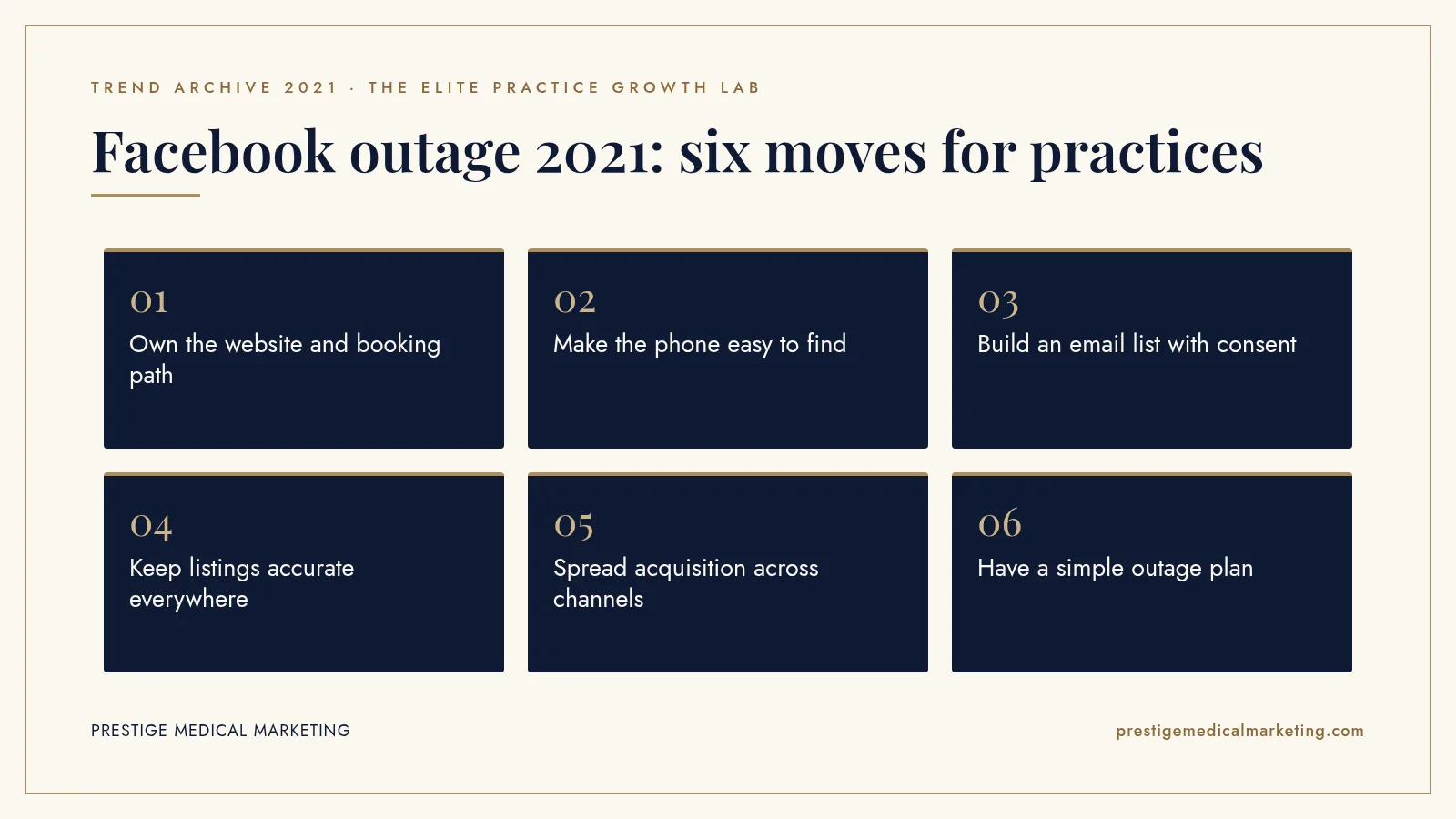
1. Own the website and booking path
A fast, clear website with online booking is the one front door the practice controls. Every channel should lead back to it.
2. Make the phone easy to find
Many patients will call when another channel fails. The number should be prominent everywhere, and someone should answer.
3. Build an email list with consent
An opt-in list lets the practice reach existing patients directly, regardless of what any platform does.
4. Keep listings accurate everywhere
Business Profile, directories and social profiles should all show the same phone number, website and hours.
5. Spread acquisition across channels
Search, maps, referrals, email and social each bring different patients. Balance protects the schedule.
6. Have a simple outage plan
Know who will post updates elsewhere, how messages will be redirected and how staff will handle calls.

Borrowed ground versus owned ground
Social platforms offer reach that few practices could build alone. But a practice does not own its followers, its message history or the rules that govern its account. Those can change because of an outage, an algorithm shift, a policy update or an account restriction. Owned channels, such as the website, the email list, the phone line and the booking system, remain under the practice’s control. A healthy growth system uses borrowed ground for discovery and owned ground for relationships.
The website as the hub
When every social profile, ad and listing points to a strong website, an outage on any one platform matters less. Patients can still learn about services, read about the providers, see policies and book. That only works if the website is fast, mobile-friendly and easy to book from. Our custom websites and booking engine are built to be that hub.
Calls catch what other channels miss
When digital channels fail, the phone becomes the backup. Practices with reliable call handling, including after-hours coverage and quick callbacks, keep converting patients when other paths are down. Practices that let calls go to voicemail lose them. Our work on call handling and lead leakage covers how to measure and fix that gap.
Messaging and privacy
Social messaging is convenient, but it is not always the right place for health details. Practices should be careful about discussing sensitive information through consumer messaging apps and should guide patients toward secure channels for anything clinical. Clear instructions on the website about how to share medical questions safely help patients choose the right channel from the start, and they reduce the volume of sensitive messages arriving through social apps. An outage is a good prompt to review how patient conversations are handled and where they are stored.
Maps and search as steady sources
Search and local results are not immune to change, but they are a different system from social platforms. A practice with a strong Google Business Profile, a well-built website and genuine reviews has a source of patients that keeps working if social feeds go quiet. Our maps and AI search work focuses on building that steady visibility.
Email and SMS with consent
An email list built with clear consent gives a practice a direct line to its existing patients, for appointment reminders, seasonal offers and educational content. Text messaging can serve a similar role when patients have agreed to receive it. Both channels must follow applicable consent and privacy rules, but they belong to the practice in a way that social followers never do.
Measuring channel dependence
A practice cannot manage risk it does not measure. Tracking where new patients come from, by channel and by service, shows how concentrated the schedule is. If one platform drives most consultations, that is a signal to strengthen other sources, not necessarily to pull back from the strong one.
Multi-location practices feel it more
Practices with several locations often run social accounts, ads and messaging for each site. When a platform goes down, every location loses that path at once. Central teams should know which locations depend most on social inquiries and make sure each has a clear phone number, booking link and website page that patients can find without the platform. Consistent location pages and listings make that much easier to manage.
Reviews keep working when feeds go quiet
Patients researching a practice often read reviews on search and maps before they ever look at a social profile. A steady flow of genuine reviews, with professional responses that respect privacy, keeps building trust regardless of what happens on any single platform. Our work on reputation and premium pricing explains why that trust supports premium positioning.
Content worth keeping
Many practices pour their best educational content into social posts and videos that live only on a platform. A more resilient approach publishes that expertise on the practice website too, as service pages, guides and answers to common questions. The content can still be shared socially, but the practice keeps a permanent home for it that supports search visibility and never disappears with an outage or policy change.
Communicating during an outage
When a major platform goes down, patients may wonder whether the practice itself is affected. A short note on the website, an email to patients with upcoming appointments if needed and a clear voicemail message can reassure people and direct them to working channels. Preparing simple templates in advance means the team can respond calmly instead of improvising.
Training the team for channel shifts
Front desk and coordinator teams often handle social messages alongside calls and forms. When one channel stops, the others may suddenly get busier. Cross-training staff, setting clear response expectations for each channel and reviewing call and message volume afterward helps a practice absorb those shifts without losing patients.
Paid campaigns need a backup too
Practices that depend heavily on paid social for new consultations can protect themselves by keeping at least one other paid or organic source active and measured. Search campaigns, local visibility and referral relationships respond to different patient intent, so they are useful counterweights. If one source pauses for any reason, the others keep the schedule moving while the team decides what to do next. Reviewing the mix each quarter keeps that balance deliberate rather than left to chance, and it gives leadership a clear picture of where each new patient actually came from. Resilience is built quietly, long before any platform goes dark for a day. Plan for it now, while everything works.
What 2021 does not tell us
The October 2021 outage shows that even very large platforms can fail, but it does not predict how often outages will happen or how long future ones might last. It also does not tell a practice how to weigh social channels against others for its specific market. Those choices depend on the practice’s patients, services and data. Treat this history as a prompt for resilience planning, not a forecast.
The premium practice advantage
A premium practice builds a growth system that keeps working when any single channel stumbles. Our work is making sure the website, booking, phone and listings form a dependable foundation under every campaign. See our services, med spa marketing, multi-site operators, AI agents and who we help. Our team works from Austin with practices nationwide.
The bottom line
On October 4, 2021, a faulty configuration change took Facebook’s platforms offline worldwide. For private practices, the lasting lesson is resilience: use social platforms for reach, but own the website, booking path, phone line and patient list that keep the schedule full.
Check if your market is open. We take one practice per specialty per market. Request a market check or call (716) 400-0084.
Frequently asked questions
What happened on October 4, 2021?
Facebook's services went offline across its platforms after configuration changes on the backbone routers connecting its data centers interrupted network traffic, according to the company.
Was the outage caused by an attack?
Facebook said there was no malicious activity behind the outage and that its root cause was a faulty configuration change on its end.
What caused the configuration problem?
Facebook said a command issued during routine maintenance to assess global backbone capacity unintentionally took down all backbone connections, and a bug in an audit tool failed to stop it.
Why did DNS matter?
When the backbone went down, Facebook's DNS locations withdrew their BGP advertisements, which made its DNS servers unreachable even though they were still operational.
Why does this matter for private practices?
Practices that relied on social messages for inquiries and bookings temporarily lost that path. The outage showed the value of owned channels such as a website, phone line, email list and booking system.
What should a practice do today?
Make sure patients can always reach the practice and book through channels it controls, keep contact details current everywhere and treat social platforms as valuable but borrowed ground.