
In late July 2022, Instagram paused a full-screen, TikTok-style feed test and temporarily reduced the number of recommended posts in feeds, after criticism from users and creators, including a widely shared Make Instagram Instagram again petition. The BBC reported that Meta wanted to take the time to get changes right. For dermatology practices, it showed that platform formats change quickly, so a durable plan rests on a practice's own website, search presence and patient relationships, with social media in support.
Dermatology is a visual specialty, and social media has become one of the ways patients discover and evaluate practices. Skin education, treatment explanations and a look at the team all translate naturally to Instagram. For many practices, the platform felt like an essential channel.
In 2022, Instagram pushed hard toward full-screen video and recommended content, in a style closer to TikTok. Then, in late July, after a public backlash, it paused part of that shift. Practices that had just reorganized their content around the new direction found the ground moving again.
This retrospective covers what happened in 2022 and what it means for a dermatology practice today. For related dermatology chapters, see the Olumiant alopecia approval of 2022, and for broader social context, the rise of TikTok and Instagram as search tools in 2022 and how Instagram explained ranking in 2023.
What actually happened in 2022
The push to video. Throughout 2022, Instagram increased the share of recommended video content in its app. The BBC reported that the revamp was widely seen as a response to TikTok’s popularity.
The backlash. According to the BBC, users criticized the new display and feeds because they felt they were seeing fewer photos from friends and family. Some creators said photos were receiving lower engagement. A petition to Make Instagram Instagram again was shared by prominent public figures.
The pause. In late July 2022, a Meta spokesperson told the BBC that Instagram was pausing the full-screen test and temporarily decreasing the number of recommendations in feeds, so it could improve the quality of the experience.
Regrouping. Instagram’s head, Adam Mosseri, told The Verge the test version would be phased out within weeks and that the company needed to take a big step back and regroup, as the BBC reported.
Not a full reversal. Instagram said it believed the app needed to evolve. Video and recommendations remained central to the platform’s direction.
Why it mattered for dermatology practices
Many dermatology practices had invested in Instagram as a primary way to reach new patients. In early 2022, the message from the platform seemed clear: make more video. Practices hired video editors, reshaped content calendars and deprioritized photo carousels that had performed well.
The July pause showed how quickly that guidance could shift. It did not mean video was a mistake, but it showed that a practice’s reach on any platform depends on decisions it does not control. A sudden change in feed design or recommendations can alter who sees a practice’s content overnight.
For a medical specialty that depends on trust, the lesson went further. Patients choosing a dermatologist want credible information and a practice they can rely on. Those qualities are built across many touchpoints, not just one app.
What typical agencies did
Some agencies treated each platform announcement as a mandate, pivoting entire content strategies every few months. Practices paid for production that was quickly outdated.
Others measured success only in followers and likes, which made changes in reach look like failures even when new patient inquiries were steady.
The careful approach kept social media in its place: a useful channel for education and trust, built on a strong website, search presence and patient experience, with content formats chosen for patients rather than for the algorithm of the month.
What it means for a dermatology practice today
Social platforms have changed many times since 2022. These principles still apply.
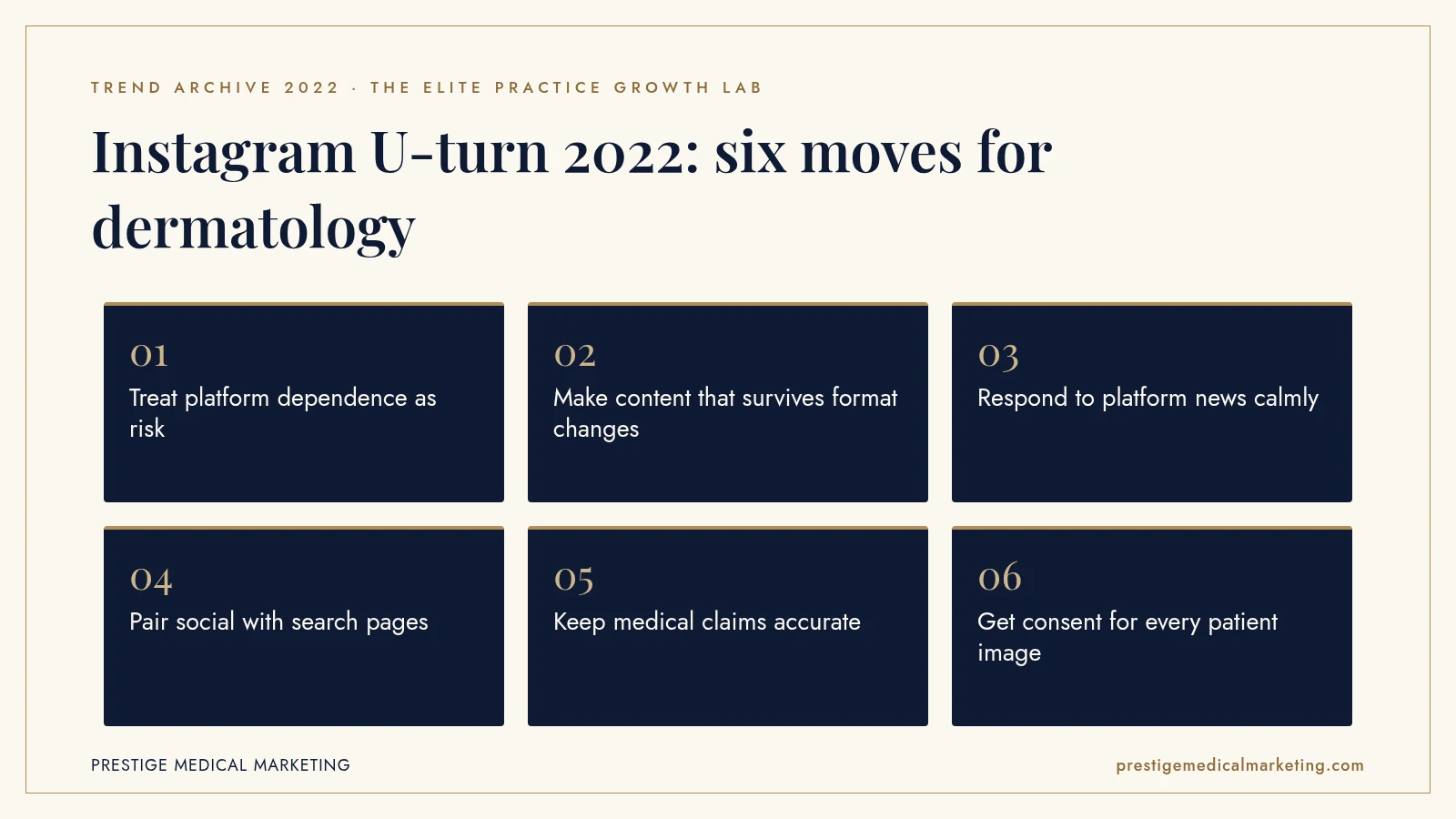
1. Own your foundation
Keep your website and Google Business Profile as the core of patient acquisition.
2. Repurpose wisely
Create educational content once and adapt it across formats and platforms.
3. Measure inquiries
Track consultations and bookings, not only reach and followers.
4. Keep it medical
Make clinical accuracy and dermatologist review the standard for every post.
5. Respect privacy
Use patient images only with documented consent and never reveal identifying details.
6. Expect change
Build a plan that can absorb shifts in format without starting over.

Platform dependence is a business risk
When a large share of new patients arrive through a single platform, that platform’s decisions become the practice’s risk. Feed redesigns, recommendation changes, account restrictions and policy updates can each reduce reach without warning. In 2022, practices saw that happen in both directions within a single year.
Diversifying does not mean being everywhere. It means making sure the foundations patients rely on, the website, the Google Business Profile, reviews and a responsive front desk, are strong enough that social media amplifies them rather than replacing them. A patient who discovers a dermatologist on Instagram almost always checks the website and reviews before booking.
It also means owning the relationship with existing patients. An email list, a patient portal and a good recall system keep the practice connected to people regardless of what any platform decides.
Content that survives format changes
The most durable dermatology content is educational and grounded in clinical expertise. An explanation of how to recognize a changing mole, what to expect at a skin check or how a treatment works remains useful whether it is shown as a short video, a photo carousel or a page on the practice’s website.
Practices can plan content around topics rather than formats. A single topic, reviewed by a dermatologist, can become a website article, a short video, a carousel and an email. If a platform shifts its emphasis, the practice adjusts the format without losing the substance.
That approach also helps search and AI visibility. Educational content on the practice’s own website is indexed and can be cited. Social posts are often harder for search engines to surface reliably over time.
Responding to platform news calmly
Platform announcements arrive constantly, and each one can feel urgent. In 2022, dermatology practices heard that video was essential, then saw Instagram step back from its most aggressive changes within weeks. Reacting to every announcement with a new strategy is expensive and exhausting for a busy team.
A calmer approach starts with a simple question: does this change affect how patients find and choose us? Most of the time, the honest answer is that it affects reach on one channel at the margin. The practice can test the new format with a small amount of content, watch inquiries for a few months and adjust gradually if the results justify it.
That approach also protects the clinical team’s time. Dermatologists are the most valuable voices in a practice’s content, and their time is limited. Spending it on durable education rather than chasing every format shift is a better investment for both the practice and its patients.
Where search fits alongside social
Patients looking for a dermatologist often start with search: a condition, a treatment or a dermatologist near me. The Google Business Profile, reviews and website usually decide whether they call. Social media can reinforce that decision by showing the team’s expertise and personality, but it rarely replaces it.
Linking the two helps. Social profiles should point to the website and booking page, and the website can feature selected educational videos so the effort spent on social content also serves people who never open the app.
Medical accuracy on social media
Dermatology content on social media competes with influencers and unqualified voices. Practices have an opportunity to stand out by being accurate, measured and clear about what requires an in-person evaluation. That credibility matters more to patients than production polish.
Every post should be reviewed for accuracy, avoid promising results and steer people toward evaluation rather than self-diagnosis. Prescription treatments should be discussed carefully and in line with their approved uses. When a trend circulates that is unsafe or misleading, a calm, evidence-based explanation from a dermatologist can be among the most valuable content a practice publishes.
Patient images and consent
Before-and-after images are powerful in dermatology and carry obligations. Patients must give informed, written consent for any use of their images in marketing, and practices should be careful about details that could identify a patient. Images should be honest representations, without misleading editing or lighting changes between photos.
Platform shifts toward video can increase the temptation to feature patients on camera. The same consent standards apply, and many practices find it better to feature clinicians explaining treatments than to rely on patient appearances.
Measuring what matters
Followers and likes are easy to see and easy to misread. A drop in reach after a platform change can feel alarming, but it does not necessarily mean fewer patients. The measures that matter are consultation requests, booked appointments and the quality of patients who arrive.
Practices can track how new patients first heard of them, use dedicated links in social profiles and review booking sources monthly. That data shows whether social media is contributing and helps decide how much to invest, regardless of what any platform is emphasizing at the time.
It also helps to compare channels side by side. If most new skin check appointments come from search and referrals, and social media mainly reinforces trust for patients who found the practice elsewhere, that is useful to know. Social content may still be worth producing, but the budget and expectations should reflect its actual role.
Building a sustainable content rhythm
Dermatologists are busy, and content that depends on constant new filming is hard to sustain. A practical rhythm might involve a short monthly session where a dermatologist records several short explanations, which are then edited into videos, captions and website updates over the following weeks.
That rhythm is resilient to platform changes because it starts with expertise rather than a format. If a platform favors video, the clips are ready. If photos regain ground, the same explanations become carousels. The practice keeps publishing steadily without reinventing its approach every time a platform changes course.
Consistency also matters more than volume. A few accurate, well-produced posts each week, reviewed by a clinician, tend to build more trust than a flood of hurried content chasing the latest format.
What 2022 does not tell us
The July 2022 pause was one moment in a longer evolution. It did not settle how Instagram would balance photos, video and recommendations in later years, or how other platforms would develop. It also did not show that video was unimportant. What it shows is that platform direction can change quickly, and plans built on any single direction are fragile.
The premium practice advantage
A premium dermatology practice earns trust through clinical credibility on every channel it uses. See our dermatology services, our custom websites, our approach to reputation and premium pricing, our full services, who we help and how we approach Google Maps and AI search visibility. Our team works from Austin with practices nationwide.
The bottom line
In July 2022, Instagram paused its TikTok-style test after a public backlash. For dermatology practices, the lesson was to build on owned foundations, plan content by topic rather than format and measure success in patients, not likes.
Check if your market is open. We take one practice per specialty per market. Request a market check or call (716) 400-0084.
Frequently asked questions
What did Instagram change in July 2022?
According to the BBC, Instagram paused a full-screen test and temporarily decreased the number of recommendations in feeds, following backlash against a more video-focused, TikTok-style design.
Why was there a backlash?
The BBC reported that people felt they were seeing fewer photos from friends and family, and that some creators said photos were getting lower engagement.
What was Make Instagram Instagram again?
An online petition shared widely in July 2022, including by prominent public figures, asking Instagram to return to its focus on photos from accounts people follow.
Did Instagram abandon video?
No. Instagram's leadership said it would regroup and continue evolving, while also supporting photos. Video remained a major part of the platform.
What should dermatology practices take from it?
That platforms change direction often, so practices should avoid building their entire patient acquisition on one format or one app.
Where should a dermatology practice focus first?
On its website, Google Business Profile, reviews and patient experience, using social media to support those foundations.