
Google released three broad core updates in 2025: March 13 to 27, June 30 to July 17, and December 11 to 29. None targeted plastic surgery directly, but each one rewarded pages that show real surgeon expertise, honest information and first-hand proof, and each one punished thin, templated and mass-produced content. The lesson for surgeons is to build fewer, deeper procedure pages that only your practice could have written.
If you run a plastic surgery practice, you probably remember at least one morning in 2025 when the phone was quieter than it should have been, and someone on your team pulled up the rankings to find a procedure page had slid off page one.
There is a good chance that morning landed during a Google core update. Google released three of them in 2025. Most practice owners never heard their names. Their agencies often did not explain them. But they reshaped who got found for breast augmentation, tummy tucks, facelifts and every other high-value procedure.
This retrospective covers what actually rolled out, what Google said about it, and what it means for a surgeon who wants to rank today.
What actually happened in 2025
Google’s own Search Status Dashboard records every confirmed ranking update. For 2025, it lists three broad core updates.
The March 2025 core update began March 13 and finished March 27.
The June 2025 core update began June 30 and completed on July 17, a rollout of about 16 days, as Search Engine Land reported.
The December 2025 core update began December 11 and finished December 29, an 18-day rollout.
In between, Google ran an August 2025 spam update that started August 26 and finished in late September. That one targeted spam policy violations, not overall quality.
The context matters too. In January 2025, Google updated its Search Quality Rater Guidelines to tell its human raters that pages where nearly all the main content is AI-generated, copied or paraphrased with little effort or value should get the lowest rating. Raters do not set rankings directly, but their ratings help Google judge whether its systems are working. The message was hard to miss.
What a core update actually is
A core update is not a penalty. Google is direct about this in its documentation on core updates. It describes them as broad changes to its overall ranking systems, designed to surface more helpful and reliable results. If a page drops, Google says it does not mean the page did anything wrong. It means other pages are now judged to be better answers.
That distinction matters for a surgeon. A penalty would have a specific fix. A core update has a general one: be the most helpful and trustworthy result for that search. There is no plugin for that.
Google also points site owners to its helpful, reliable, people-first content guidance and to the idea of experience, expertise, authoritativeness and trust. For a cosmetic surgery page, trust is not a nice extra. Plastic surgery affects health and involves significant money, which puts it squarely in the kind of topic Google says it scrutinizes most.
Why plastic surgery felt every update
Plastic surgery SEO had a dirty secret long before 2025. A lot of practice websites were built from the same templates and filled with the same procedure copy. Change the surgeon’s name and city and the pages were nearly identical. Many were written by agencies that had never been inside an operating room, and some by tools that had never been inside anything.
That approach worked when Google could not tell the difference well. Each core update in 2025 made it a little better at telling the difference. Templated breast augmentation pages, thin “before and after” galleries with no context, and articles answering questions no patient asks were the content most exposed.
At the same time, demand was steady. The American Society of Plastic Surgeons reported nearly 1.6 million cosmetic surgical procedures in 2024, led by liposuction, breast augmentation and tummy tucks. The patients did not disappear. They were being redistributed toward the practices whose pages earned trust.
What typical agencies did after each drop
We saw the same pattern after every update. Rankings fell. The agency blamed “the algorithm,” promised it would bounce back, and kept doing exactly what it had been doing. Sometimes it doubled down: more articles, more backlinks from directories nobody visits, more keyword-stuffed location pages.
Some went further and bought links or spun up dozens of near-duplicate city pages. Those tactics are named directly in Google’s spam policies, including scaled content abuse. A practice that took that route was not just failing to recover. It was building risk.
The average SEO firm sells activity. A core update is a test of whether the activity was ever building anything real.
What it means for a plastic surgeon today
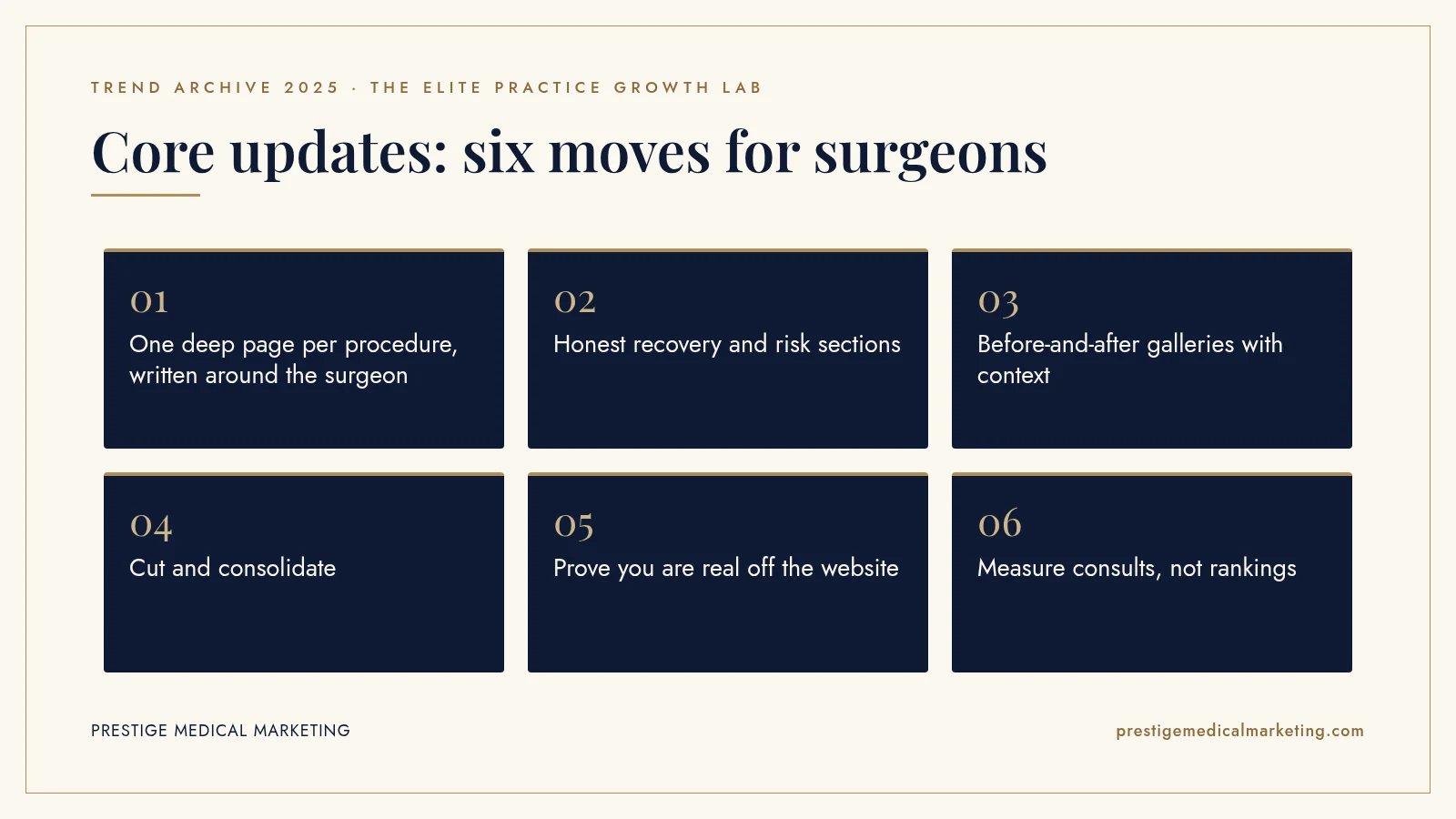
The practical lesson of 2025 is that the surgeon has to be visible inside the content. Not a generic bio at the bottom. The actual judgment, process and proof of the person holding the scalpel. Here is how we would build it.
1. One deep page per procedure, written around the surgeon
Each core procedure needs its own page that opens with a direct answer, then explains who the surgeon is, their board certification, how they approach that procedure, who is a good candidate and who is not. A patient should finish the page knowing how this surgeon thinks. Our plastic surgery SEO guide breaks down the page structure.
2. Honest recovery and risk sections
Pages that skip downtime and complications read like ads. Pages that explain them plainly read like a doctor. The second kind builds trust with both patients and search systems.
3. Before-and-after galleries with context
Consented photos, organized by procedure, with the basics a patient wants: what was done and what the patient’s goal was. Context turns a gallery from decoration into proof.
4. Cut and consolidate
If your site has fifteen thin pages on variations of the same procedure, merge them into one strong page. Delete articles that exist only to target a keyword. Fewer, better pages tend to do better after core updates than a sprawling library of filler.
5. Prove you are real off the website
Consistent business listings, a fully built Google Business Profile, steady reviews, and mentions in credible places. Core updates evaluate pages, but trust is built across the whole footprint.
6. Measure consults, not rankings
Rankings move during every rollout. Track organic inquiries and booked consults by procedure so you can tell a real decline from rollout noise.

How to read a core update in your own data
When the next update lands, avoid two mistakes: panicking in week one, and ignoring it entirely. Rankings often swing up and down during a rollout. Google’s own core update guidance recommends waiting at least a full week after an update completes before analyzing your site, then comparing that week with a week before the rollout began.
Do that comparison in Google Search Console. Look at which pages lost or gained clicks, and on which queries. A loss concentrated on a few procedure pages tells you where to improve. A loss across every page usually points to a sitewide trust or quality issue. Then check whether booked consults actually changed. Sometimes traffic dips on informational pages while consults hold steady, and that calls for patience, not a rebuild.
A 2025 timeline for a surgeon’s calendar
It helps to see the year the way a practice lived it. A surgeon who launched a spring campaign for body contouring in early March would have watched the March core update roll through the middle of it. A practice that redesigned its website in June walked straight into the June update, which ran through most of the first half of July. And the December update landed in the stretch when many practices plan next year’s budget, finishing just before the new year.
That is three windows of ranking turbulence in twelve months, each lasting two to three weeks. For a practice that judged its marketing month to month on rankings, about seven weeks of the year, roughly 52 days by the dashboard’s dates, were spent inside an active core rollout. That alone is a reason to judge marketing on booked consults over a full quarter, not on a single month’s ranking report.
It is also a reason to time big website changes with care. Launching a redesign in the middle of a rollout makes it very hard to tell whether a change in traffic came from your new site or from Google. When you can, ship major changes between updates and keep a dated log of what you changed, so the next analysis has clean before-and-after dates.
What patients want from a procedure page
Strip away the algorithm talk and a core update is Google trying to rank pages the way a careful patient would. So ask what that patient wants when they research a tummy tuck or a breast lift at 11 p.m. on their phone.
They want to know if they are a candidate. They want to know what recovery will mean for their job and their kids. They want a realistic sense of results, not a fantasy. They want to know who will operate and why that person is qualified. They want a sense of cost and financing. And they want to know what happens when they call.
Most procedure pages answer one or two of those questions, wrapped in marketing language. The pages that held up through 2025 answered nearly all of them, plainly, in the surgeon’s own voice. That is not an SEO trick. It is just a better consultation, delivered before the patient ever picks up the phone.
Your website has to carry that consultation well on a small screen, too. Slow pages, pop-ups that block the content and galleries that take forever to load all work against the patient, and against you. If your site was built years ago, a medical practice website that converts is often the foundation the content work needs before anything else pays off.
The premium practice advantage
Here is the upside most surgeons miss. Every core update in 2025 made it harder to fake expertise. That is bad news for template factories and very good news for a surgeon with real credentials, real results and a willingness to put their judgment on the page.
Your competitors’ shortcut got weaker three times in one year. Your real advantages did not. A practice that builds content around its surgeon is building the one thing a core update cannot take away.
This is how we approach plastic surgery marketing: procedure pages built around your surgeon, a Google Business Profile that sells, AI search visibility through Google Maps and AI search visibility work, and tracking to booked consults. Our team works from Austin with practices nationwide, one per specialty per market.
The bottom line
Three core updates in 2025, each one asking the same question: is this page the most helpful and trustworthy answer? For plastic surgery, that means real surgeon expertise, honest information and proof. Practices that built around that held up. Practices that built around templates kept riding the rollercoaster.
If your rankings have been unpredictable, the answer is rarely a technical fix. It is usually that your website does not yet show what makes your surgeon worth choosing.
Check if your market is open. We take one practice per specialty per market. Request a market check or call (716) 400-0084.
Put this playbook to work: see how it applies to the Prestige System for medical practice marketing.
Frequently asked questions
When were Google's core updates in 2025?
Google's Search Status Dashboard lists three broad core updates in 2025. The March 2025 core update ran from March 13 to March 27. The June 2025 core update ran from June 30 to July 17. The December 2025 core update ran from December 11 to December 29.
Did the 2025 core updates target plastic surgery websites?
No. Google says core updates are broad changes to how it assesses content overall, not penalties aimed at an industry. Plastic surgery sites feel them strongly because medical and cosmetic surgery topics affect health and money, and Google holds those pages to a higher standard of trust.
My rankings dropped after a core update. Was I penalized?
Usually not. Google's guidance says a drop after a core update does not mean a page violated a policy. It means other pages were judged more helpful. The fix is improving the content and the proof of expertise, not hunting for a technical trick.
How long does recovery from a core update take?
Google says some improvements can be reflected between updates, but larger shifts often show up when the next core update rolls out. With three core updates in 2025, that meant waiting months in some cases. Plan for steady improvement rather than a quick rebound.
Does AI-written content hurt plastic surgery SEO?
AI use alone is not the problem. Google's January 2025 rater guidelines say pages where almost all main content is copied, paraphrased or AI-generated with little effort or originality should get the lowest quality rating. Procedure pages need your surgeon's real judgment, process and results.
What should a plastic surgery procedure page include now?
A direct answer at the top, who performs the procedure and their board certification, who is and is not a good candidate, what recovery really involves, honest risks, consented before-and-after photos, financing and consult steps. Each page should read like your surgeon wrote it, because ideally they reviewed it.