
Starting January 1, 2021, CMS required each hospital operating in the United States to provide clear, accessible pricing information online in two ways: a comprehensive machine-readable file with all items and services, and a display of shoppable services in a consumer-friendly format. On November 2, 2021, CMS finalized higher penalties starting January 1, 2022: a minimum of $300 per day for hospitals with 30 or fewer beds and $10 per bed per day for larger hospitals, up to $5,500 per day.
Few questions shape a cosmetic surgery decision more than cost, and few questions are handled more awkwardly online. In 2021, the federal government began requiring hospitals to answer that question publicly. Private plastic surgery practices were not the target, but they felt the ripple effects in what patients expected.
The Hospital Price Transparency rule took effect on January 1, 2021. By the end of the year, the Centers for Medicare and Medicaid Services had raised the penalties for hospitals that did not comply, signaling that price clarity was becoming a lasting expectation in American health care.
This retrospective explains what happened in 2021, why it mattered to plastic surgery practices, how typical agencies responded and what it means for how a practice discusses cost today. For related chapters, see our pieces on the 2022 No Surprises Act good faith estimates and Meta’s 2022 detailed targeting removal.
What actually happened in 2021
According to CMS, starting January 1, 2021, each hospital operating in the United States was required to provide clear, accessible pricing information online about the items and services it provides. Hospitals had to do this in two ways: as a comprehensive machine-readable file with all items and services, and in a display of shoppable services in a consumer-friendly format.
Compliance was uneven. On November 2, 2021, CMS announced a final rule that strengthened enforcement. CMS Administrator Chiquita Brooks-LaSure said the agency took seriously concerns from consumers that hospitals were not making clear, accessible pricing information available online, as they had been required to do since January 1, 2021.
Beginning January 1, 2022, CMS set a minimum civil monetary penalty of $300 per day for smaller hospitals with 30 or fewer beds, and a penalty of $10 per bed per day for hospitals with more than 30 beds, not to exceed $5,500 per day. CMS said that for a full calendar year of noncompliance, the minimum total penalty would be $109,500 per hospital and the maximum would be $2,007,500.
The CMS fact sheet added that the machine-readable file had to be accessible to automated searches and direct downloads, closing off some of the ways hospitals had made their files hard to reach.
Why it mattered for plastic surgery practices
Most cosmetic plastic surgery is paid for directly by patients. That makes cost a central part of the decision, and it makes patients active researchers. When hospitals began publishing prices, and when news coverage highlighted which ones were not, the broader message reached consumers: health care prices should be findable.
The hospital rule did not tell private practices what to publish. But it raised the baseline expectation. A prospective patient who could look up hospital prices might reasonably wonder why a surgeon’s website offered no guidance at all on cost. Practices that answered the question thoughtfully stood out. Practices that avoided it entirely risked seeming evasive.
The rule also mattered for practices that perform procedures in hospital settings. Some facility charges became easier for patients to research, which meant practices needed to explain clearly how surgeon, facility and anesthesia fees fit together.
What typical agencies did
Many agencies ignored the topic entirely, advising practices never to discuss price online for fear of losing a consultation. Others went the opposite direction, promoting low headline prices or limited-time discounts that could attract bargain hunters and undercut a premium surgeon’s positioning.
Both approaches missed the point. Patients wanted clarity, not a race to the bottom. The better response was honest guidance on what drives cost, presented with the confidence of a practice that knows its value.
What it means for a plastic surgery practice today
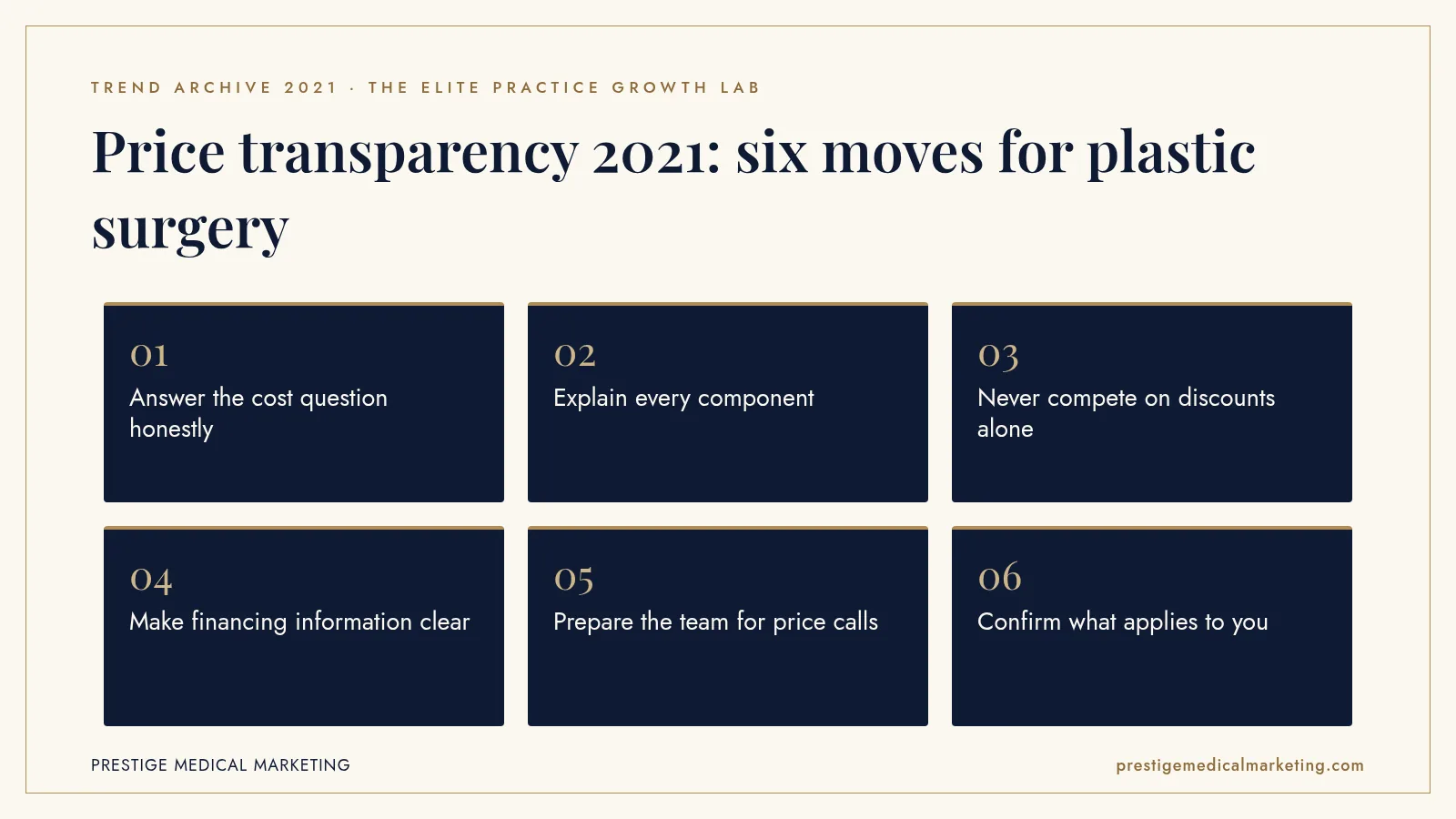
Pricing rules continue to evolve, but the core lessons for communicating cost are clear.
1. Answer the cost question honestly
If a practice shares ranges, explain what they include and what can change them. If it does not share figures, explain why and how a patient gets a personal quote.
2. Explain every component
Surgeon fees, facility fees, anesthesia, garments and follow-up care can all affect the total. Spell out what a quote typically covers.
3. Never compete on discounts alone
Deep discounts can attract the wrong patients and undermine trust in quality. Lead with expertise, safety and results the practice can lawfully show.
4. Make financing information clear
If financing is available, explain it accurately and avoid language that pressures a decision.
5. Prepare the team for price calls
Many patients ask about cost on the first call. A coordinator who can explain ranges and the consultation process kindly converts more of those calls.
6. Confirm what applies to you
Disclosure rules depend on setting, state and payment type. Confirm requirements with qualified advisors.

Self-pay patients and the No Surprises Act
Price transparency did not stop with hospitals. The No Surprises Act, which took effect in 2022, created good faith estimate requirements for uninsured and self-pay patients in many situations. Our piece on the 2022 good faith estimate rules covers that chapter. For plastic surgery practices that serve many self-pay patients, it is another reason to build clear cost communication into every stage of the patient journey, with qualified advice on what applies.
Price clarity as a sign of confidence
Elite practices do not need to hide behind vague language. A clear explanation of what shapes the cost of a procedure, presented alongside the surgeon’s training, the safety of the setting and the care the practice provides, signals confidence. It tells the patient that the practice expects to be judged on value, not on a low number.
That confidence can be expressed in many ways. Some practices share starting ranges. Others explain the factors that change cost and invite patients to a consultation for a personal quote. Either approach can work if it is honest, consistent and easy to find.
The consultation is where value becomes visible
Online cost information starts the conversation, but the consultation is where a patient understands what they are paying for. A thorough assessment, a clear surgical plan, honest discussion of risks and recovery, and an itemized quote all help a patient compare options fairly. Practices that make the consultation experience exceptional rarely need to compete on price. A written summary after the visit, covering the plan, the quote and next steps, helps patients review the decision calmly at home and share it with family.
Website pages that handle cost well
A strong procedure page can include a short section on cost: what affects it, what a quote includes, whether financing is offered and how to get a personal estimate. It should load quickly, read well on a phone and lead naturally to booking a consultation. Our custom websites are built to present that information clearly, and our work on reputation and premium pricing explains how trust supports higher value.
Price questions on the phone
Many patients test a practice by calling to ask about cost. If the answer is evasive or rushed, they move on. If the coordinator explains ranges, what affects them and how the consultation works, the caller is far more likely to book. Training and call review make a measurable difference here. See our work on call handling and lead leakage.
Reviews and perceived value
Patients often judge whether a price is fair by what other patients say about the experience. Genuine reviews that describe care, communication and results help a premium price feel justified. Practices should invite feedback consistently and respond professionally, within privacy rules, rather than relying on discounts to win attention or volume.
Ambulatory surgery and facility choices
Many cosmetic procedures take place in accredited office-based suites or ambulatory surgery centers rather than hospitals. Patients do not always understand the difference, and they may not know how the setting affects cost, safety standards or recovery arrangements. A practice that explains where procedures are performed, how the facility is accredited and how facility fees are included in a quote removes a common source of confusion and helps patients compare offers fairly.
Comparing quotes fairly
Patients who gather several quotes often find that they are not comparing like with like. One quote may include anesthesia, garments and follow-up visits, while another lists only the surgeon fee. Practices can help by providing itemized quotes and by explaining, without criticizing competitors, what their price includes. That clarity shifts the conversation from the lowest number to the most complete and trustworthy plan.
Advertising price responsibly
If a practice mentions price in ads or on social media, the figure must be accurate and must not mislead about what a typical patient will pay. Small print that hides major conditions erodes trust and can raise legal concerns. A safer approach is to promote the consultation, the surgeon’s expertise and the quality of care, and to keep cost details on pages where they can be explained fully.
Consistency across every channel
Cost information should match everywhere a patient might see it: the website, emails, social posts and what the team says on the phone. Inconsistent figures create doubt at the exact moment a patient is deciding whether to trust the practice. A simple internal reference sheet, reviewed regularly, keeps everyone aligned as fees or offerings change.
Financing without pressure
Patient financing can make a procedure more accessible, but it should never be presented as a reason to decide quickly. Explain the options plainly, point patients to the lender’s terms and give them time to consider. A practice that treats financing as a convenience rather than a sales tool protects its reputation and attracts patients who are ready for surgery for the right reasons. Coordinators should be comfortable answering basic questions and should know when to refer patients directly to the financing provider for details about rates and approval.
What 2021 does not tell us
The 2021 hospital rule shows the direction of federal policy and consumer expectations, but it does not tell a private plastic surgery practice exactly what to publish, which state rules apply or how its local patients will respond to pricing information. Those decisions depend on the practice’s setting, market and positioning, and on qualified legal advice. Treat this history as context, not as a compliance guide.
The premium practice advantage
A premium plastic surgery practice wins on expertise, safety and experience, and it can talk about cost with the same confidence. Our work is helping practices present value clearly from the first search to the consultation. See our plastic surgery marketing, booking engine, full services and who we help. Our team works from Austin with practices nationwide.
The bottom line
In 2021, hospitals across the United States had to post prices online, and by year end CMS had raised the penalties for those that did not. For plastic surgery practices, the lasting lesson is that patients expect clarity about cost. Answer the question honestly, explain the components and let expertise carry the value.
Check if your market is open. We take one practice per specialty per market. Request a market check or call (716) 400-0084.
Frequently asked questions
What did the hospital price transparency rule require in 2021?
Starting January 1, 2021, each hospital operating in the United States had to post pricing information online as a comprehensive machine-readable file and as a consumer-friendly display of shoppable services.
Did the rule apply to private plastic surgery practices?
The CMS rule applies to hospitals. A private plastic surgery practice should confirm with qualified advisors which pricing and disclosure rules apply to its own setting, including any facility it uses.
What changed in November 2021?
CMS finalized higher civil monetary penalties starting January 1, 2022: $300 per day minimum for hospitals with 30 or fewer beds and $10 per bed per day for larger hospitals, not to exceed $5,500 per day.
How large could the penalties become?
CMS said a full calendar year of noncompliance could cost a minimum of $109,500 and a maximum of $2,007,500 per hospital.
Why does this matter for plastic surgery marketing?
Cosmetic procedures are often self-pay, and patients increasingly expect clear information about cost. Practices that explain pricing honestly build trust before the consultation.
Should a plastic surgery practice publish exact prices?
That is a business decision. Many practices share starting ranges and explain what affects the final quote, while making clear that an exact price follows a consultation.