
Weight loss clinic marketing works when you sell a physician-led program, not a drug. Build clear pages for medical weight loss and GLP-1 care, keep claims honest and inside FTC, Google and Meta rules, avoid before-and-after hype, win local search with a strong Google Business Profile, and track every inquiry to patients who start and stay.
The CDC reports that 40.3% of U.S. adults had obesity in its most recent national survey. Add the demand created by GLP-1 medications and every weight loss clinic should be busy. Many are not. Patients are buried in telehealth ads, price promises and conflicting information, and the clinics that look like everyone else get lost in that noise.
What changed in weight loss marketing
Three shifts reshaped this market:
- Patients arrive informed and skeptical. They have read about semaglutide and tirzepatide, compared prices and seen headlines about shortages and compounded versions.
- Online sellers compete on price. A local clinic cannot win a price war with a national telehealth company, and should not try.
- Rules tightened. Google, Meta, the FTC and the FDA all have something to say about how you advertise weight loss and prescription medications.
The clinics that grow sell a physician-led program with visible people behind it, and they say so clearly.
Where weight loss marketing goes wrong, and how we do it instead
They sell a shot. We sell a program.
“Semaglutide $199/month” ads attract price shoppers who leave for the next cheaper offer. We market what a clinic does that an online seller cannot: in-person evaluation, labs, provider oversight, nutrition and strength guidance, body composition tracking and a maintenance plan.
They make promises. We make honest claims.
“Lose 30 pounds in 30 days” draws regulators as well as patients. The FTC’s health products compliance guidance expects health claims to be supported by competent and reliable scientific evidence, and results claims to reflect what patients generally achieve. We write copy that is specific about process and honest about outcomes.
They blur compounded and approved. We keep it straight.
The FDA has published concerns about unapproved GLP-1 drugs, including compounded products it does not review for safety, effectiveness or quality. We never present a compounded medication as FDA-approved or as the same as a brand drug. Your compliance advisor signs off on medication language.
They get ad accounts suspended. We build inside policy.
Google’s healthcare and medicines policy limits prescription drug promotion and often requires certification. Meta’s drugs and pharmaceuticals policy adds its own rules, and Meta also restricts weight loss ads that use before-and-after images or imply negative self-image. We plan campaigns around those rules from day one.
They report clicks. We report patients who stay.
Our monthly ROI reporting follows each inquiry to consult, program start, month-three retention and revenue by source. One clinic per market, month-to-month terms.

Check if your market is open. We partner with one weight loss clinic per market. Request a market check or call (716) 400-0084.
The weight loss clinic marketing plan, step by step
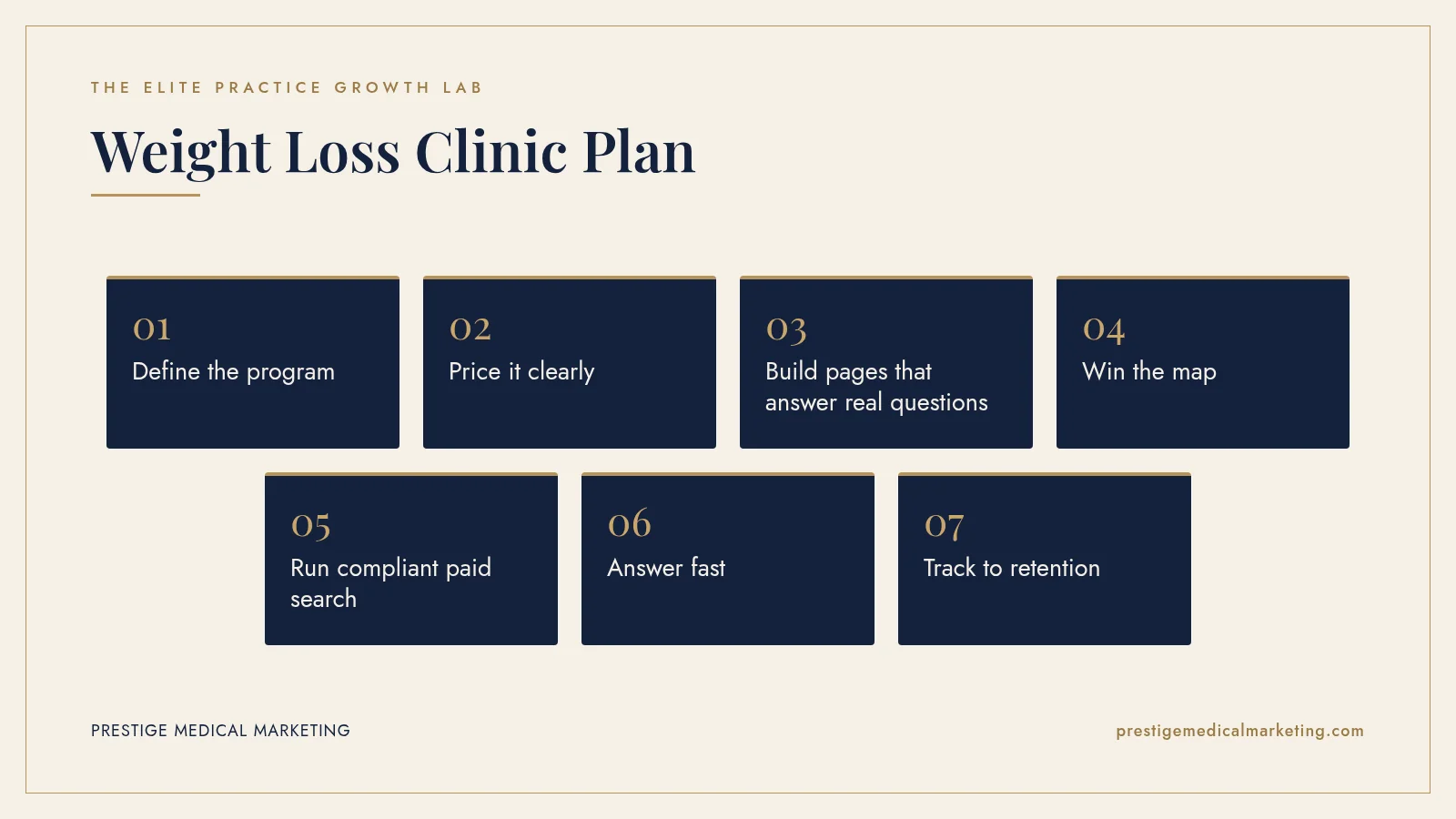
Step 1: Define the program
Write down exactly what a patient gets: the first visit, labs, provider check-in schedule, medication options when appropriate, nutrition and activity support, body composition scans, and what happens after the active phase. If you cannot explain the program in a paragraph, a patient cannot buy it.
Step 2: Price it clearly
Membership tiers or a program fee with a clear list of what is included. State whether medication cost is included. Hidden fees are the fastest way to lose trust and earn bad reviews.
Step 3: Build pages that answer real questions
A medical weight loss page, a GLP-1 program page, a page on how candidacy is decided, a cost page, provider bios and an FAQ. Each page explains the process, risks and monitoring in plain language and ends with a single next step.
Step 4: Win the map
A complete Google Business Profile with accurate categories, every service listed, real photos of your team and clinic, and a booking link. Consistent listings everywhere. Steady reviews from patients at milestone visits.
Step 5: Run compliant paid search
Campaigns around program and consult terms, with landing pages that match the ad and pass policy review. Certification where required. Every claim checked before launch.
Step 6: Answer fast
Weight loss inquiries cool quickly. Respond within minutes, offer online booking and use a 24/7 AI receptionist for after-hours calls. Our guide on what missed calls cost a practice shows how much revenue slips away in the gap.
Step 7: Track to retention
Call tracking and booking tracking tied to your practice software. Measure program starts, month-three and month-six retention, and revenue by source.
Messaging that earns trust
- Lead with medical care. “A physician-led program with labs, check-ins and a plan for after” says more than any discount.
- Talk about health, not just pounds. Energy, strength, blood work and confidence are honest reasons patients start.
- Be specific about the process. What happens at visit one, week two and month three.
- Be honest about outcomes. Results vary. Say so plainly and explain what affects them.
- Show the people. Your providers and coaches are the reason a patient picks you over an app.
Content that ranks and converts
Patients research for weeks before booking. Answer their questions and you become the clinic they trust:
- “How does medical weight loss work?”
- “Who is a candidate for GLP-1 medication?”
- “How much does a medical weight loss program cost?”
- “What happens when you stop a GLP-1?”
- “How to keep muscle while losing weight”
Every article links to the matching program page and ends with a clear next step. This library is also what search engines and AI assistants draw on when they recommend clinics. Our guide on getting recommended by AI explains how.
Retention: the revenue most clinics leave on the table
A patient who stops at month two cost the same to acquire as one who stays a year. Build retention into the marketing plan:
- Milestone check-ins with a provider, not just a refill
- Nutrition and strength guidance that protects lean mass
- A maintenance phase with its own membership
- Simple reminders and easy rescheduling
- Review requests at positive milestones, never gated by sentiment
Retention by source also tells you where to spend. The channel with the cheapest inquiries is rarely the channel with the patients who stay.
Mistakes we fix first
When a weight loss clinic comes to us, the same problems show up again and again:
- One page for everything. Medical weight loss, GLP-1 care, nutrition coaching and body contouring crammed onto a single page that ranks for none of them.
- A price in the headline and nothing behind it. The ad promises a monthly number, the landing page has no program details and the patient leaves.
- Slow follow-up. Web inquiries answered the next afternoon, after the patient already booked with someone else.
- No candidacy explanation. Patients do not know if they qualify, so they do not call. A clear, honest page on who is and is not a candidate fixes that.
- Template design. A generic site with a scale and a tape measure in the banner looks like every other clinic. Real people and a real space look like a practice.
- No maintenance offer. Patients finish the active phase and drift away because nothing tells them what comes next.
Fixing these six things often does more in the first sixty days than any new campaign.
Website essentials for a weight loss clinic
- A homepage that states the program and who it is for in one sentence
- Separate pages for each program and service line
- Candidacy, cost and process pages written in plain language
- Provider and coach bios with real photos
- Booking reachable in two taps on a phone
- Short intake forms, with tracking pixels kept off pages where patients enter health details
Our website efficiency playbook shows how a site should save your front desk time instead of creating more calls.
Questions to ask a weight loss marketing agency
- How do you handle prescription drug and weight loss ad policies? They should name the rules and the certification process.
- How do you write about compounded medications? The right answer starts with “carefully, and with your compliance advisor.”
- What do you report? Consults, program starts and retention by source.
- Do you work with other weight loss clinics in my area? If yes, your strategy is shared.
- What are the terms? Month-to-month keeps the agency accountable.
What good looks like
In ninety days: a clearly defined and priced program, pages that answer real questions, a complete map listing, compliant campaigns and tracking to program starts. By month six: steady consults, stronger retention and a clear picture of which channels bring patients who stay. Learn more on our weight loss practice page and our services overview, or read how we approach predictable growth.
Ready to grow a program patients stay in? Check if your market is open or call (716) 400-0084. We’re based in Austin, Texas, and work with clinics nationwide.
Put this playbook to work: see how it applies to medical weight loss marketing and med spa marketing.
Frequently asked questions
Can a weight loss clinic advertise semaglutide or tirzepatide on Google?
Google restricts ads that promote prescription drugs, and advertisers usually need certification before ads or landing pages name prescription medications. Many clinics run search campaigns around medical weight loss programs, consults and provider expertise instead. Policies change often, so review them before every launch.
Can we advertise compounded GLP-1 medications?
Be careful. The FDA has warned about unapproved and compounded GLP-1 products and does not review compounded drugs for safety or effectiveness. Never present compounded versions as FDA-approved or identical to brand drugs. Have your compliance advisor review all compounded medication language.
Are before-and-after photos allowed in weight loss marketing?
Meta restricts before-and-after imagery and content that implies negative self-perception in weight loss ads. On your own website, results photos need patient consent and honest context about typical outcomes. FTC guidance requires that results claims reflect what patients can generally expect.
What makes a weight loss clinic stand out from online GLP-1 sellers?
In-person medical oversight, lab work, nutrition and lifestyle support, body composition tracking and a provider who knows the patient. Market the program and the people. Price-only competition against online sellers is a race you do not want to win.
How do weight loss clinics keep patients longer?
Clear milestones, regular provider check-ins, nutrition and strength coaching, simple membership pricing and a plan for maintenance after the active phase. Retention is the biggest revenue lever most weight loss clinics have.
Which keywords should a medical weight loss clinic target?
Local, high-intent searches such as "medical weight loss near me," "weight loss doctor [city]," "GLP-1 program [city]" and "semaglutide clinic near me," plus cost and process questions your patients ask before they book.
How long does SEO take for a weight loss clinic?
Map listing and long-tail searches often move within two to three months. Competitive head terms in large metros typically take six months or longer of steady content, reviews and technical work.