
On May 13, 2022, the FDA approved Mounjaro (tirzepatide) to improve blood sugar control in adults with type 2 diabetes, alongside diet and exercise. It is injected once weekly, and FDA based the approval on nine clinical trials of 7,769 patients. Lilly described it as the first GIP and GLP-1 receptor agonist. Weight loss was not an approved indication in 2022; tirzepatide was approved for chronic weight management as Zepbound in 2023. For weight loss clinics, accurate marketing meant respecting that difference.
Few medical approvals have reshaped a specialty’s marketing as quickly as the arrival of a new class of metabolic drugs. For weight loss clinics, 2022 was the year a second major medicine entered the conversation. Semaglutide had already been approved for chronic weight management as Wegovy in 2021. Then, in May 2022, the FDA approved tirzepatide as Mounjaro.
The detail that mattered most for marketing was in the indication. Mounjaro was approved for type 2 diabetes, not weight loss. Public interest in its effect on weight was intense, and many patients asked for it by name. Clinics had to decide how to talk about a drug whose most discussed effect was not, in 2022, an approved use.
This retrospective covers what the FDA approved and what it means for a weight loss clinic today. For the chapters that followed, see the 2022 Wegovy shortage, Zepbound’s approval in 2023, the tirzepatide shortage resolution in 2024 and the FDA’s 2025 drug ad crackdown.
What actually happened in 2022
May 13: approval. According to the FDA’s Drug Trials Snapshot, Mounjaro (tirzepatide) from Eli Lilly was approved to improve blood sugar control in adults with type 2 diabetes when used in addition to diet and exercise.
Once weekly. FDA said Mounjaro is injected once weekly under the skin using a prefilled pen, and may be used alone or with other diabetes medications.
The evidence. FDA said the approval was based on nine clinical trials of 7,769 patients with type 2 diabetes, of whom 5,415 received Mounjaro. Five trials assessed efficacy, comparing Mounjaro with placebo, semaglutide and long-acting insulins.
A new mechanism. Lilly’s announcement described Mounjaro as the first and only GIP and GLP-1 receptor agonist for adults with type 2 diabetes.
Not a weight loss approval. The 2022 indication was limited to blood sugar control in type 2 diabetes. Tirzepatide was approved for chronic weight management, as Zepbound, in November 2023.
Safety. Mounjaro’s labeling includes a boxed warning about the risk of thyroid C-cell tumors, along with other warnings that clinicians must consider.
Why it mattered for weight loss clinics
Patients do not read prescribing information before they search. In 2022, many people heard about tirzepatide from news stories and social media, and they arrived at weight loss clinics asking about it. Clinics faced a practical question: how to meet that interest honestly.
The answer had regulatory, platform and ethical dimensions. Promoting a drug for an unapproved use can create legal exposure. Major ad platforms restrict prescription drug advertising and require certification. And patients deserve accurate information about what a drug is approved for, what the evidence shows and what risks apply.
Clinics that handled this well focused on the medical evaluation and the overall program rather than on a drug name. Clinics that handled it poorly ran ads naming Mounjaro as a weight loss shot, inviting scrutiny and eroding trust.
What typical agencies did
Many agencies built campaigns around the drug’s name, because that is what people searched for. Landing pages promised dramatic results and quick access, sometimes without mentioning the approved indication, the need for a clinical evaluation or the boxed warning.
Some agencies went further, using before-and-after images and testimonials that implied typical outcomes. These approaches sometimes produced short-term leads but carried real risk, and as regulators and platforms increased scrutiny of weight loss drug marketing in later years, many of those campaigns became liabilities.
The careful approach centered the clinic’s medical process: evaluation, individualized treatment plans, monitoring and support. Drug names, if mentioned at all, appeared in balanced educational content reviewed by clinicians and counsel.
What it means for a weight loss clinic today
Approvals, labels and enforcement have changed since 2022. These principles still hold. Confirm specifics with counsel.
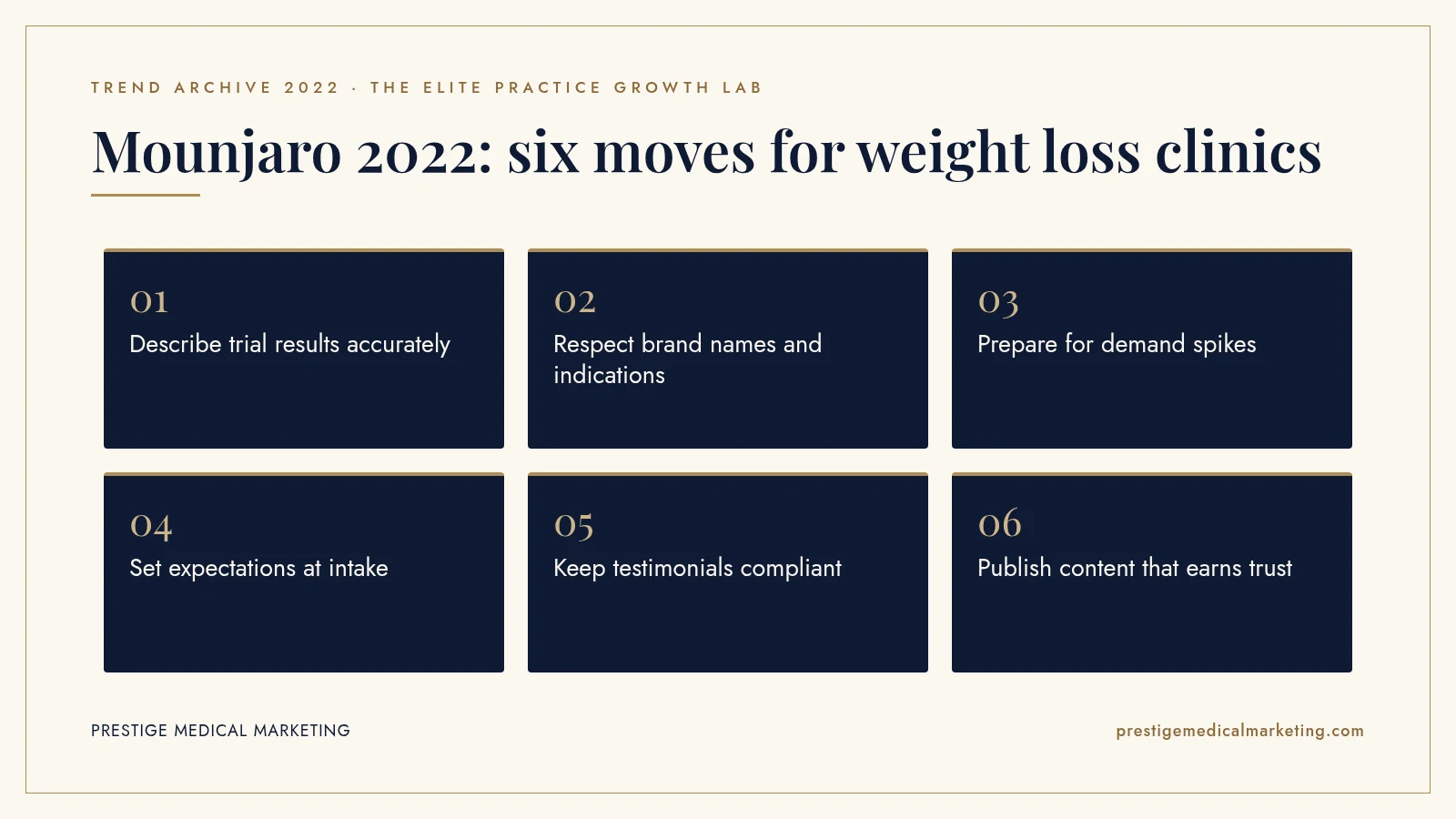
1. Lead with the program
Market the clinic’s evaluation, care plan and support, not a specific drug as a product.
2. Respect approved uses
Do not promote a drug for an indication it was not approved for. Distinguish between brands and their indications.
3. Include safety information
When discussing a medication, provide balanced information about risks, including any boxed warning.
4. Avoid outcome promises
Do not promise specific pounds lost or timelines. Results vary.
5. Follow platform rules
Prescription drug and weight loss ads face strict platform policies. Check before launching.
6. Have clinicians review content
Medical claims should be reviewed by a qualified clinician and, where appropriate, legal counsel.

What the trials compared
One reason tirzepatide attracted attention was the design of its diabetes trials. FDA’s snapshot notes that the efficacy trials compared Mounjaro not only with placebo but with semaglutide and with two long-acting insulins, and that the primary measure was the change in HbA1c, a marker of blood sugar control. Those comparisons gave clinicians a sense of where the new drug fit among existing treatments for diabetes.
Weight changes were also reported in the diabetes trials, as is common for diabetes medicines, and those findings drove much of the public conversation. But a reported effect in a diabetes trial is not the same as an approval for weight management. The trials that supported the later weight management approval enrolled different populations and measured different primary outcomes. For marketing purposes, and for patient safety, the line between what a study observed and what a drug is approved for is the line that matters.
Clinics that explained this distinction in plain language helped patients understand why a medication’s approval matters, and why a clinician’s evaluation is the right starting point rather than a product request.
Brand names and indications
Tirzepatide illustrates why brand names matter. The same molecule was approved as Mounjaro for type 2 diabetes in 2022 and as Zepbound for chronic weight management in 2023. Semaglutide follows the same pattern, approved as Ozempic for type 2 diabetes and Wegovy for chronic weight management. A clinic that uses the diabetes brand name in weight loss advertising is associating a product with a use it was not approved for under that name.
Clinical decisions are separate. Physicians can make individual prescribing decisions based on their judgment and the patient’s needs, within applicable law. But marketing is not individual medical judgment. It is promotion to the public, and it is held to different standards.
For website content, the safest approach is educational and accurate: explaining what each medication is approved for, how a clinic evaluates whether medication is appropriate and what patients should know about benefits and risks.
The demand wave
Interest in metabolic medications grew rapidly through 2022 and beyond. That wave brought many new patients to weight loss clinics, and it also brought competition from telehealth companies, med spas and others entering the space. In a crowded market, clinics were tempted to compete on access and price for a drug rather than on the quality of care.
That strategy is fragile, as later events in the market showed. Drug supply can change, prices can change, and regulators can act. A clinic whose brand is built on a single drug is exposed to each of those changes. A clinic whose brand is built on medical expertise, personalized care and long-term support can adapt as treatments evolve.
Intake that sets expectations
The first conversation with a prospective patient shapes everything that follows. Many people contacted weight loss clinics in 2022 asking for a specific drug by name. A strong intake process respected that interest while redirecting it toward the clinic’s medical approach.
That might mean explaining that a clinician will review the patient’s history, current medications, goals and any conditions that affect treatment options, and that medication may or may not be part of the plan. It means being honest about cost, monitoring requirements and the likelihood of side effects. It also means being clear about what the clinic offers beyond medication, such as nutrition guidance, activity planning and regular follow-up.
Patients who understand this from the start tend to stay longer and have more realistic expectations. Patients who want only a prescription with no evaluation are better served elsewhere, and a clinic that says so protects its reputation.
Reviews and testimonials
Weight loss is a field where testimonials are powerful and risky. A patient’s story of dramatic change can be genuine and still mislead others if it implies that such results are typical. FTC guidance on endorsements, updated in 2023, expects advertisers to avoid implying typical results that are not supported, and platforms limit before-and-after imagery in weight loss ads.
Clinics can still share patient experiences with care: with consent, with context about the full program and without implying a guaranteed outcome. Focusing testimonials on the care experience, such as the attention of the clinical team or the clarity of the plan, is often more persuasive and less risky than focusing on numbers. It also reflects what many patients value most when they recommend a clinic to a friend: being listened to, guided carefully and supported through setbacks.
Content that earns trust
Patients researching metabolic medications are often anxious and overwhelmed by conflicting information online. A clinic that explains the landscape clearly, without hype, stands out. Useful content might cover how the clinic evaluates candidates for medication, what lifestyle support accompanies treatment, how side effects are monitored and what happens if medication is not appropriate.
That kind of content serves search visibility and trust at the same time. It also gives AI assistants and search engines accurate, well-structured information to cite when people ask about weight loss options in a given area.
Clinician authorship strengthens it further. When the physician or nurse practitioner who actually evaluates patients writes or reviews the content, with their credentials and a review date shown, readers can see that the guidance reflects real clinical practice. That transparency matters in a topic where so much online information comes from sellers rather than clinicians.
What 2022 does not tell us
The 2022 approval established what Mounjaro was approved for, not how clinics used it or how patients fared in practice. We do not have reliable public data on how many clinics marketed the drug for weight loss or what consequences followed. Long-term outcomes and later approvals came after 2022. What 2022 does show is that the gap between public interest and approved use was a marketing risk from the start.
The premium practice advantage
A premium weight loss clinic builds its brand on care, not on a drug name. See our weight loss services, our weight loss clinic marketing guide, our full services, who we help and how we approach Google Maps and AI search visibility. Our team works from Austin with practices nationwide.
The bottom line
In May 2022, the FDA approved Mounjaro for type 2 diabetes. For weight loss clinics, the lesson was to respect approved uses, lead with the medical program and build a brand that outlasts any single drug.
Check if your market is open. We take one practice per specialty per market. Request a market check or call (716) 400-0084.
Frequently asked questions
What did the FDA approve in May 2022?
Mounjaro (tirzepatide), a once-weekly injection to improve blood sugar control in adults with type 2 diabetes, used with diet and exercise. The approval date was May 13, 2022.
Was Mounjaro approved for weight loss in 2022?
No. Its 2022 approval was for type 2 diabetes. Tirzepatide was later approved for chronic weight management under the name Zepbound in 2023.
What evidence supported the approval?
FDA's Drug Trials Snapshot says the approval was based on nine clinical trials of 7,769 patients with type 2 diabetes, with five trials used to assess efficacy.
How does tirzepatide work?
Lilly described it as the first and only GIP and GLP-1 receptor agonist at the time of approval, meaning it acts on two hormone pathways involved in blood sugar regulation.
Can a clinic advertise Mounjaro for weight loss?
Clinics should be very careful. Promoting a drug for an unapproved use raises regulatory and platform policy issues. Get qualified legal advice before making any claims.
What should a clinic's website say?
Accurate, balanced information about approved uses, the role of clinical evaluation, and safety, without promising results.