
On September 9, 2025, HHS and FDA announced a crackdown on misleading drug advertising, with thousands of letters to companies and roughly 100 cease-and-desist letters. FDA also issued warning letters to telehealth companies over claims about compounded GLP-1 drugs. For weight loss clinics, the lesson is to market the medical program, never imply a compounded drug is the same as or approved like a branded one, and present risks fairly.
There are moments when a regulator stops sending signals and starts sending letters. For drug advertising, September 9, 2025 was that moment.
That day, HHS and FDA announced what they described as sweeping reforms to rein in misleading drug ads. Thousands of warning letters. Roughly 100 cease-and-desist letters. A promise to use AI tools to watch ads proactively. And, for the first time, warning letters to telehealth companies over how they marketed compounded GLP-1 weight loss drugs.
If your clinic advertises weight loss medications, this is the most important marketing event of 2025 to understand. Here is what happened and how to market responsibly and effectively today.
What actually happened in 2025
In its September 9, 2025 announcement, FDA said it was sending thousands of letters warning pharmaceutical companies to remove misleading ads, and issuing approximately 100 cease-and-desist letters to companies with deceptive ads. It also said it was beginning rulemaking to close what it called the “adequate provision” loophole, created in 1997, which has let broadcast drug ads point viewers elsewhere for full risk information.
The announcement made several points that matter to any practice that promotes a medication:
- FDA said social media and undisclosed paid influencer promotion have blurred the line between editorial content, user-generated media and drug advertising.
- It cited a 2024 review finding that 100% of pharmaceutical social media posts it examined highlighted benefits, while only 33% mentioned potential harms.
- It said warning letters to drug companies had fallen to one in 2023 and zero in 2024, and that it would now “aggressively deploy its available enforcement tools.”
- It said it was already using AI and other tech-enabled tools to monitor and review drug ads.
In the same push, FDA issued warning letters to telehealth companies marketing compounded GLP-1 drugs. Endpoints News reported that FDA said the companies made “false or misleading” claims about compounded GLP-1 obesity drugs, and described it as a first for the agency. Among the claims cited were statements implying that compounded products were the same as FDA-approved brands.
Why this landed hardest on weight loss marketing
The compounded GLP-1 market grew up during the drug shortages of 2023 and 2024. As we covered in our retrospective on the end of the GLP-1 shortages, FDA declared the tirzepatide shortage resolved in December 2024 and the semaglutide shortage resolved in February 2025, with grace periods ending by May 2025.
A lot of weight loss marketing from those years used the same shortcuts: naming famous brands, implying equivalence, promising dramatic results, burying risks and leaning on influencer testimonials. Those are exactly the patterns the September announcement described. Telehealth brands were the most visible targets, but the same language had spread across local clinic ads, med spa promotions and social posts.
The message to the whole category was clear. The era of loose medication marketing was over.
What typical agencies did
Many agencies that ran GLP-1 campaigns treated compliance as the client’s problem. They wrote the ads that converted best, and the ads that converted best often did exactly what FDA objected to: name brands, imply sameness, promise quick results and skip the risks.
When the letters went out, some of those agencies simply paused campaigns. Others swapped a few words and kept going. Very few rebuilt the offer and the message from the ground up.
We see it differently. Compliance is not a brake on marketing. In a regulated category, it is the moat. The clinic that can advertise with confidence, while competitors are pulling ads and rewriting landing pages, wins the patients those competitors are no longer reaching.
What it means for a weight loss clinic today
This is marketing guidance, not legal advice. Every clinic should have healthcare counsel review medication-related advertising. With that said, here is the framework we use.
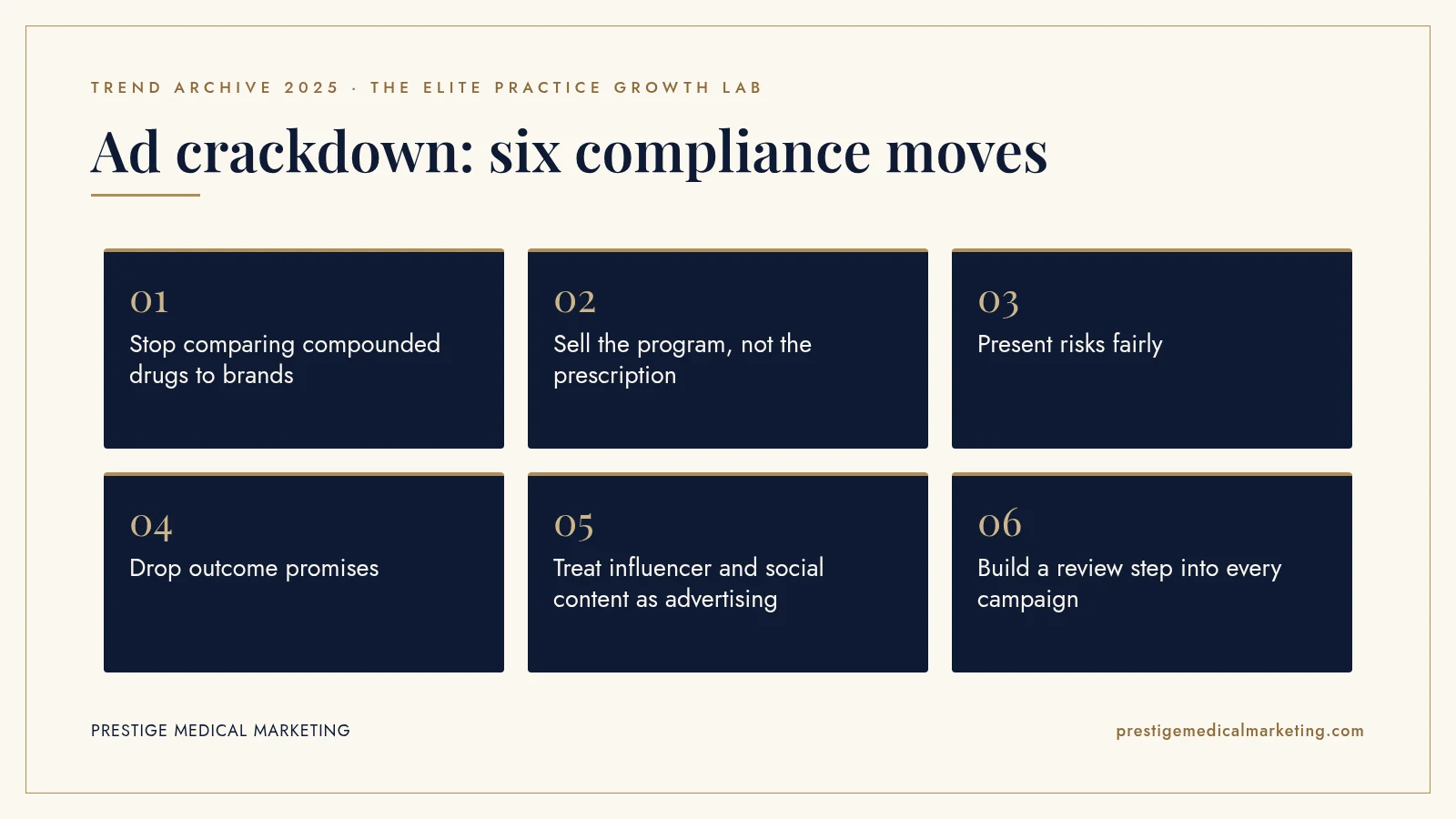
1. Stop comparing compounded drugs to brands
Do not say or imply that a compounded product is the same as, equivalent to or a generic version of a branded medication. Do not use brand names to describe compounded products. Compounded drugs are not FDA-approved, and your marketing should never suggest otherwise.
2. Sell the program, not the prescription
The safest and strongest message is also the most honest one: you offer a medically supervised weight loss program. Evaluation, labs, a plan, medication management when appropriate, nutrition and behavior support, progress tracking and maintenance. Our weight loss clinic marketing guide covers how to present it.
3. Present risks fairly
Fair balance is not just a rule for drug companies. It is how a medical practice earns trust. If you discuss a medication, mention that it is not right for everyone, that side effects are possible, and that a clinician will review whether it is appropriate. Link to a page that explains risks in plain language.
4. Drop outcome promises
“Lose 30 pounds in 30 days” is the kind of line that invites trouble, and it attracts the wrong patients. Talk about the process and the support instead. If you show patient stories, follow testimonial rules, disclose typicality where required and get written consent.
5. Treat influencer and social content as advertising
FDA called out undisclosed paid influencer promotion specifically. If you pay or gift anyone to talk about your services, they must disclose it clearly, and the content must meet the same standards as your own ads. Review it before it posts.
6. Build a review step into every campaign
Create a short checklist for every medication-related ad, landing page, email and post: no brand comparisons for compounded drugs, no approval implications, risks presented, no outcome promises, disclosures in place, counsel sign-off where required. Make it routine, not a scramble.

A before-and-after example
To make this concrete, here is the kind of rewrite we recommend. This is an illustration, not a real ad from any clinic.
Before: “Same active ingredient as the famous brand. Half the price. Lose weight fast. No insurance needed. Start today.”
After: “Physician-led medical weight loss in [your city]. A full evaluation, lab work and a plan built for you, with medication when it is appropriate and real support every month. See if our program is a fit.”
The first version leans on a brand, implies equivalence and promises speed. The second describes what a patient actually gets. It is also harder for a low-cost online seller to copy, because it depends on your clinicians and your process.
The second version also does a better job of filtering. It speaks to patients who want supervision and support, which tends to mean patients who stay longer and refer friends. Price-led copy fills the calendar with people who will leave the moment someone else is cheaper.
Social media is where most clinics slip
Paid ads usually get some review. Social posts often get none. A provider films a quick video, a coordinator writes a caption, a happy patient posts a story and the clinic reshares it. That is where most medication marketing problems actually start, and it is exactly the area FDA singled out in September.
A few habits close most of the gap. Keep a short list of approved phrases for describing your program and any medications, and a list of phrases nobody uses. Route any post that mentions a drug by name through the same review as an ad. Do not reshare patient content that makes claims you could not make yourself. And if you work with creators, put disclosure and review requirements in writing before anything is posted.
None of this slows a good social program down. It just keeps the content focused on what makes your clinic different: your clinicians, your process, your space and the experience patients have with your team.
Talking to patients who saw the headlines
The September news was widely covered, and many patients saw it. Some wondered whether their own treatment was affected. Clinics that handled this well did not wait for questions. They explained, in plain language reviewed by counsel, what their program includes, how medications are sourced and prescribed, and how the clinic decides what is appropriate for each patient.
That kind of proactive communication does two things. It keeps current patients confident, and it gives prospective patients a reason to trust you over a provider who stayed silent. In a category where trust was shaken, clarity is a competitive advantage.
Where else the rules come from
FDA was not the only regulator watching health claims in 2025. The FTC enforces truth-in-advertising law for health services, and its health products compliance guidance explains that health claims need competent and reliable scientific evidence. State medical boards and attorneys general also act on misleading clinic advertising. And the ad platforms set their own rules for healthcare and prescription drug promotion.
The practical takeaway: assume every claim about a medication or a result will be read by someone whose job is to check it. Write accordingly.
What the 2025 record does not show
FDA did not publish a list of every recipient of the thousands of letters, and enforcement priorities can change. We also do not have public data on how many local clinics changed their advertising as a result. What the record does show is the agency’s stated direction: more enforcement, more monitoring, more attention to social media and telehealth. Building your marketing to that standard is simply prudent.
It is also worth separating two questions that often get blurred. Whether a clinic may lawfully offer a particular compounded medication is a legal and pharmacy question. How a clinic describes whatever it offers is a marketing question. You can get the first one right and still get in trouble with the second. Treat them as separate reviews.
One practical step helps here: date your medication-related pages and review them on a schedule, such as every quarter and after any major FDA announcement. A page that was accurate in 2024 may not be accurate now, and an outdated claim is still a claim.
The premium clinic advantage
Here is the upside. A crackdown on misleading ads is bad news for clinics that competed on hype and good news for clinics that compete on care. When the loud, cheap offers go quiet, the patients do not disappear. They look for a provider they can trust.
That is where a premium, physician-led program wins. It is also why we build medical weight loss marketing around the program and the clinicians, not the molecule, with ads that can run with confidence and fast follow-up that books consultations while interest is high. Our team works from Austin with clinics nationwide, one per specialty per market.
The bottom line
On September 9, 2025, FDA announced thousands of letters over misleading drug ads, about 100 cease-and-desist letters and warning letters to telehealth companies over compounded GLP-1 claims. The direction was unmistakable. Weight loss clinics that market an honest medical program, describe medications accurately and present risks fairly are the ones positioned to keep growing.
Check if your market is open. We take one practice per specialty per market. Request a market check or call (716) 400-0084.
Put this playbook to work: see how it applies to the Prestige System for medical practice marketing and med spa marketing.
Frequently asked questions
What did FDA announce on September 9, 2025?
HHS and FDA announced reforms targeting misleading direct-to-consumer drug advertising. FDA said it was sending thousands of letters warning companies to remove misleading ads and about 100 cease-and-desist letters, and that it would begin rulemaking on the "adequate provision" rule that has governed broadcast drug ads since 1997.
Were weight loss clinics and telehealth companies included?
Yes. As part of the effort, FDA issued warning letters to telehealth companies marketing compounded GLP-1 drugs, citing claims it considered false or misleading. Reporting at the time described it as the first time FDA had called out telehealth companies this way over GLP-1 advertising.
What kinds of GLP-1 claims did FDA object to?
Claims that implied compounded products were the same as FDA-approved drugs, such as saying they contain the same active ingredient as a named brand, were among those cited in the letters. Compounded drugs are not FDA-approved, and marketing should never suggest otherwise.
Does FDA regulate ads for a local clinic?
FDA's advertising authority centers on drug manufacturers and distributors, and the letters went to companies marketing drugs, including telehealth platforms. State medical boards, state attorneys general and the FTC also police health advertising. A local clinic should assume someone is reading its ads and review claims with healthcare counsel.
What is fair balance in drug advertising?
It is the requirement that promotional material present a drug's risks along with its benefits, without exaggerating benefits or creating a misleading overall impression. FDA's announcement noted social media posts often highlight benefits while leaving out harms.
How should a clinic advertise weight loss services now?
Lead with the medical program and the clinicians who run it. Describe medications accurately, avoid brand comparisons for compounded products, avoid outcome promises, present risks honestly, and have counsel review medication-related ads before they run.