
On June 4, 2021, the FDA approved Wegovy (semaglutide) 2.4 mg once-weekly injection for chronic weight management in adults with obesity, or with overweight and at least one weight-related condition, in addition to a reduced calorie diet and increased physical activity. The FDA called it the first such approval since 2014. For weight loss clinics, the approval set off strong patient demand, and the lasting lesson was to market a medical program with honest expectations rather than a single drug.
For years, medical weight loss clinics worked with a limited set of tools. Nutrition counseling, exercise guidance, behavior change support and a handful of older medications made up most programs. Patients often came in hopeful and left frustrated by slow progress. Then, in June 2021, a new option arrived that would reshape the field.
On June 4, 2021, the FDA approved Wegovy, a once-weekly injection of semaglutide at 2.4 mg, for chronic weight management. The agency described it as the first drug approved for chronic weight management in adults with general obesity or overweight since 2014. Within months, patient interest in medical weight loss surged in a way few clinics had seen before.
This retrospective covers the approval, why it mattered, how agencies reacted and what weight loss clinics should take from it today. For the chapters that followed, see our pieces on the 2022 Wegovy shortage, the FDA’s 2023 compounded semaglutide warning and the end of the GLP-1 shortage in 2025.
What actually happened in 2021
June 4: the approval. The FDA announced approval of Wegovy for chronic weight management in adults with obesity or overweight with at least one weight-related condition, such as high blood pressure, type 2 diabetes or high cholesterol, for use in addition to a reduced calorie diet and increased physical activity.
Eligibility. The approval covered adults with a BMI of 30 or greater, or 27 or greater with at least one weight-related condition.
Dosing. The FDA said the dose must be increased gradually over 16 to 20 weeks to 2.4 mg once weekly to reduce gastrointestinal side effects.
The evidence. Safety and efficacy were studied in four 68-week trials. More than 2,600 patients received Wegovy and more than 1,500 received placebo. In the largest placebo-controlled trial, which enrolled adults without diabetes, participants who received Wegovy lost an average of 12.4% of their initial body weight compared with those who received placebo.
Safety. The FDA noted a boxed warning about the potential risk of thyroid C-cell tumors and said Wegovy should not be used in patients with a personal or family history of medullary thyroid carcinoma or with Multiple Endocrine Neoplasia syndrome type 2.
Why it mattered for weight loss clinics
The approval changed the conversation. Patients who had given up on weight loss programs began asking whether a new medication could help them. News coverage, social media and word of mouth spread awareness quickly. Search interest in medical weight loss rose, and clinics that had worked quietly for years suddenly had more inquiries than they could handle.
It also changed the competitive landscape. New entrants, including telehealth companies and businesses with little medical weight management experience, began advertising aggressively. Patients faced a crowded and sometimes confusing market.
For established clinics, the challenge was to stand out by doing things properly: careful evaluation, honest expectations, monitoring for side effects and support for the nutrition and lifestyle changes that the approval itself specified.
What typical agencies did
Many agencies treated the approval as a keyword gold rush. They built pages and ads around the drug name, used dramatic before-and-after imagery and implied that results were fast and guaranteed. Some promoted the medication as a standalone solution, ignoring the diet and activity components that were part of the approved use.
That approach created problems: patients with unrealistic expectations, reviews from people who felt misled and growing regulatory attention to weight loss claims.
The better approach treated the medication as one part of a medical program. It explained who might be a candidate, what the evaluation involved, how side effects were managed and how the clinic supported patients over the long term.
What it means for a weight loss clinic today
GLP-1 medications are now central to medical weight management. These habits help clinics market them responsibly.
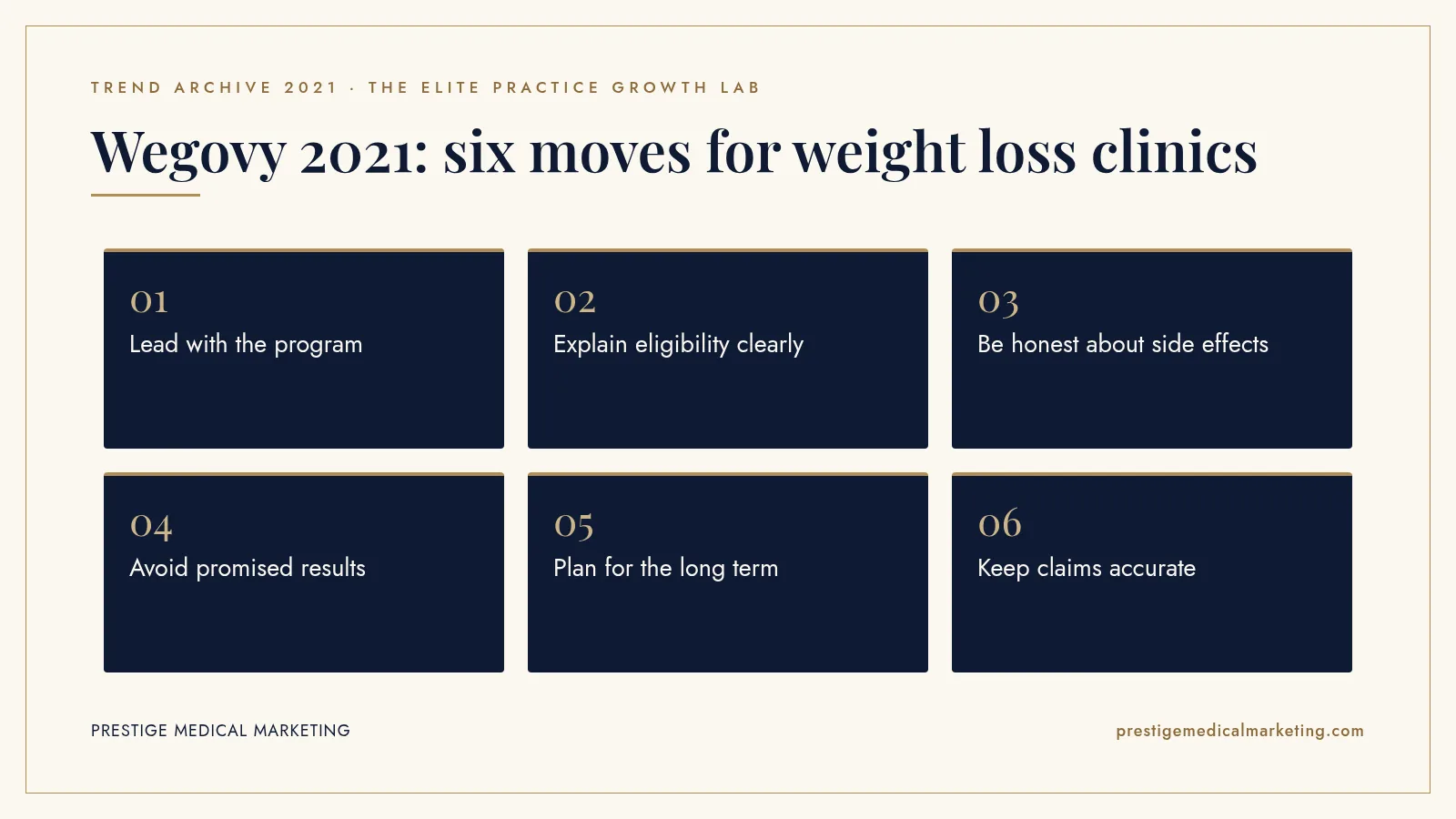
1. Lead with the program
Describe evaluation, monitoring, nutrition and lifestyle support as the core of the service, with medication as one tool.
2. Explain eligibility clearly
Help patients understand that candidacy depends on medical evaluation, not just interest.
3. Be honest about side effects
Discuss common side effects and the importance of gradual dose increases in plain language.
4. Avoid promised results
Do not promise specific amounts of weight loss. Individual results vary.
5. Plan for the long term
Weight management is ongoing. Explain how the clinic supports patients over months and years.
6. Keep claims accurate
Every statement about medications should match official information and be reviewed by a clinician.

The demand surge and the phone line
When interest rose quickly, many clinics discovered that their front desks could not keep up. Calls went unanswered, voicemails piled up and web inquiries waited days for a reply. Patients who had finally worked up the courage to ask for help moved on to whoever answered first. Clinics that added staff, improved call handling and offered online booking captured far more of that interest.
The lesson applies to any surge in demand: marketing creates interest, but operations decide whether that interest becomes care.
Setting expectations before the first visit
Patients who arrived expecting a quick prescription were sometimes disappointed to learn that they needed an evaluation, lab work or a discussion of lifestyle changes. Clear website content about what the first visit involves, what information is needed and how decisions are made reduces that friction. It also attracts patients who are ready for a medical program rather than a shortcut.
Respectful language about weight
Weight is a sensitive subject, and many patients have experienced judgment in healthcare settings. Marketing that uses respectful, non-stigmatizing language, focuses on health and well-being and avoids shaming imagery builds trust. Before-and-after photos, if used at all, should be consented, accurate and accompanied by context that results vary.
Nutrition and lifestyle support as differentiators
The FDA approval specified use alongside a reduced calorie diet and increased physical activity. Clinics that offered real support for those changes, such as dietitian visits, coaching and practical meal planning, provided something a prescription alone could not. That support also helped patients manage side effects and maintain progress, and it gave the clinic a meaningful way to stand apart from businesses focused only on the medication.
Supply, access and cost conversations
Within months of the approval, demand and supply issues became part of the story, and insurance coverage for weight management medications varied widely. Patients wanted to know whether they could get the medication, what it would cost and how long they would need it. Clinics that explained these issues honestly, without making promises about availability or coverage, earned trust during a confusing period.
Regulatory attention to weight loss claims
Weight loss has long been an area of regulatory focus for advertising claims. The surge in GLP-1 marketing brought renewed attention. Clinics should make sure every claim is accurate and substantiated, every testimonial reflects real experience with appropriate disclosures and no advertising suggests guaranteed results. Clinician and compliance review of marketing content is a sensible safeguard.
Building content that lasts
Pages written in mid-2021 quickly became outdated as new medications, indications and guidance emerged. Clinics that built content around the condition and their program, rather than around a single drug name, needed fewer rewrites. A regular clinician review keeps medication information current and signals to patients that the clinic stays informed.
Measuring the right outcomes
During a surge, it is easy to measure success by inquiries alone. A healthier view looks at how many inquiries became evaluations, how many patients began a program and how many stayed engaged over time. Those numbers reflect both marketing quality and patient experience, and they reveal whether the clinic is attracting the right patients.
Telehealth entrants and the local clinic
The approval arrived as telehealth was already well established, and new online programs quickly began offering weight management visits. For local clinics, that meant competing with businesses that could advertise nationally and move patients through brief virtual consultations. Some patients preferred that convenience. Others wanted something more: in-person measurements, lab work reviewed with a clinician they could meet and regular check-ins with a team that knew their history.
Clinics that explained the value of that continuity, without criticizing other models, attracted patients who were looking for a durable relationship rather than a single prescription. Clear descriptions of follow-up schedules, monitoring and access to the care team made the difference tangible.
What happens when patients stop
An honest weight management program addresses an uncomfortable question: what happens when a patient stops treatment. Patients ask it often, and the answer depends on individual circumstances and evolving evidence. Clinics did not need to predict outcomes on their websites, but they could explain that weight management is long term, that any changes to medication should be discussed with the clinician and that the program includes support for maintaining habits over time.
Addressing the question directly builds credibility. Patients notice when a clinic avoids hard topics, and they notice when it answers them calmly and truthfully. That honesty also reduces the disappointment that leads to negative reviews later.
Training staff for medication questions
As interest grew, front desk teams fielded questions they were not trained to answer: whether a caller qualified, how much the medication cost, whether it was available and what side effects to expect. Clinics that gave staff clear, clinician-approved guidance on what they could say, and when to route a question to a clinician, handled those calls with confidence and kept patients moving toward an evaluation instead of leaving them uncertain.
What 2021 does not tell us
The June 2021 approval did not tell us how demand would affect supply, how insurance coverage would develop, how compounded versions would be regulated or how patients would fare over many years in real-world use. Those questions shaped the years that followed. There is no reliable public data on how weight loss clinics as a group were affected in 2021 specifically. What it does show is that a major new treatment can transform patient demand quickly, and that clinics built on careful medical care and honest marketing are best placed to serve that demand well.
The premium practice advantage
A premium weight loss clinic offers careful evaluation, honest guidance and ongoing support. The work is presenting that program clearly and handling demand without losing the personal experience. See our weight loss services, our weight loss clinic marketing guide, our call handling and lead leakage work, our booking engine and our full services. Our team works from Austin with practices nationwide.
The bottom line
The June 2021 approval of Wegovy gave adults with obesity or overweight and a related condition the first new chronic weight management medication since 2014, and it transformed demand for medical weight loss. For clinics, the lasting lesson was to market a complete medical program with honest expectations, respectful language and the operational capacity to respond when patients reach out.
Check if your market is open. We take one practice per specialty per market. Request a market check or call (716) 400-0084.
Put this playbook to work: see how it applies to med spa marketing.
Frequently asked questions
What did the FDA approve in June 2021?
Wegovy (semaglutide) injection 2.4 mg once weekly for chronic weight management in adults with obesity or overweight with at least one weight-related condition, alongside a reduced calorie diet and increased physical activity.
Who was Wegovy approved for?
Adults with a BMI of 30 or greater, or a BMI of 27 or greater with at least one weight-related condition such as high blood pressure, type 2 diabetes or high cholesterol.
How was Wegovy studied?
The FDA said safety and efficacy were studied in four 68-week trials in which more than 2,600 patients received Wegovy and more than 1,500 received placebo.
Does Wegovy carry a boxed warning?
Yes. The FDA said the prescribing information contains a boxed warning about the potential risk of thyroid C-cell tumors.
Why did the approval matter to weight loss clinics?
It created intense patient interest in medical weight management and changed how many people searched for weight loss care.
How should a weight loss clinic market GLP-1 care today?
Lead with medical evaluation, ongoing monitoring and lifestyle support, explain eligibility and side effects honestly and avoid promising specific results.