
On May 30, 2023, the FDA warned about compounded semaglutide, noting reports of adverse events and that some compounders were using salt forms such as semaglutide sodium and semaglutide acetate, which the agency said had not been shown to be safe and effective. On June 20, 2023, CNBC reported that Novo Nordisk had sued spas and clinics over sales of products marketed as semaglutide. For weight loss clinics, 2023 showed that GLP-1 marketing needs accuracy about what is being prescribed and from where.
In 2023, GLP-1 medications became the center of weight loss care and weight loss marketing. Demand for semaglutide, sold as Ozempic for type 2 diabetes and Wegovy for chronic weight management, grew faster than supply. Compounded versions filled the gap, and many clinics, med spas and online programs began advertising them. Search interest, social content and ad spending around the drugs surged, and weight loss marketing changed almost overnight. Clinics that had built steady programs over years suddenly competed with aggressive new entrants.
Two events that year marked the risks. On May 30, the FDA warned about compounded semaglutide. On June 20, CNBC reported that Novo Nordisk had sued spas and clinics. For weight loss clinics, those events set the tone for how GLP-1 care should be described.
This retrospective covers what happened and what it means today. It connects to our coverage of the 2024 tirzepatide shortage resolution, the 2025 end of the GLP-1 shortages and the FDA’s 2025 drug ad crackdown.
What actually happened in 2023
The shortage. Semaglutide appeared on the FDA’s drug shortage list. When a drug is in shortage, compounders may be able to prepare versions if they meet certain requirements of federal law, though the FDA does not review compounded drugs for safety, effectiveness or quality.
May 30: the FDA warning. As CNN reported, the FDA warned that it had received adverse event reports from people using compounded semaglutide and said patients should not use a compounded drug if an approved drug is available.
Salt forms. The FDA said some compounders were using salt forms such as semaglutide sodium and semaglutide acetate, which differ from the approved products. Healio reported the agency was not aware of any basis for compounding with salt forms that would meet federal requirements.
Sourcing advice. The FDA said patients should obtain semaglutide only with a prescription from a licensed provider and only from state-licensed pharmacies or FDA-registered outsourcing facilities.
June 20: the lawsuits. CNBC reported that Novo Nordisk had sued several spas and clinics over sales of products marketed as semaglutide, citing trademark use, consumer confusion and safety concerns. One defendant was advertising a one-week semaglutide program through a deal site.
Why it mattered for weight loss clinics
Weight loss clinics were at the center of the GLP-1 boom. Many built entire programs around semaglutide and advertised heavily. The 2023 events showed three risks that marketing had often glossed over.
First, the source and form of the medication mattered. Patients reasonably assumed “semaglutide” meant the same drug as Ozempic or Wegovy, and the FDA’s warning showed that was not always true. Second, brand names carried legal risk when the product was not the branded drug. Third, deep-discount promotions on deal sites and social media looked like retail, not medical care, and attracted scrutiny.
Clinics that described their programs accurately, explained sourcing and emphasized medical evaluation stood on firmer ground than those advertising cheap shots. They also built a patient base that was more likely to stay when prices, supply and rules changed, as they did repeatedly over the next two years.
What typical agencies did
Many agencies chased the demand. Ads used “Ozempic” and “Wegovy” in headlines for programs that prescribed compounded semaglutide. Landing pages promised specific pounds lost. Promotions emphasized low monthly prices and fast starts, with eligibility and medical evaluation mentioned in fine print, if at all.
The better approach treated GLP-1 marketing as medical marketing: accurate names, clear eligibility, honest expectations and visible clinical oversight. It produced fewer cheap leads, but far more qualified consultations and far less exposure when the rules tightened.
What it means for a weight loss clinic today
The shortage has ended and compounding rules have changed since 2023, but these principles still apply to GLP-1 marketing.
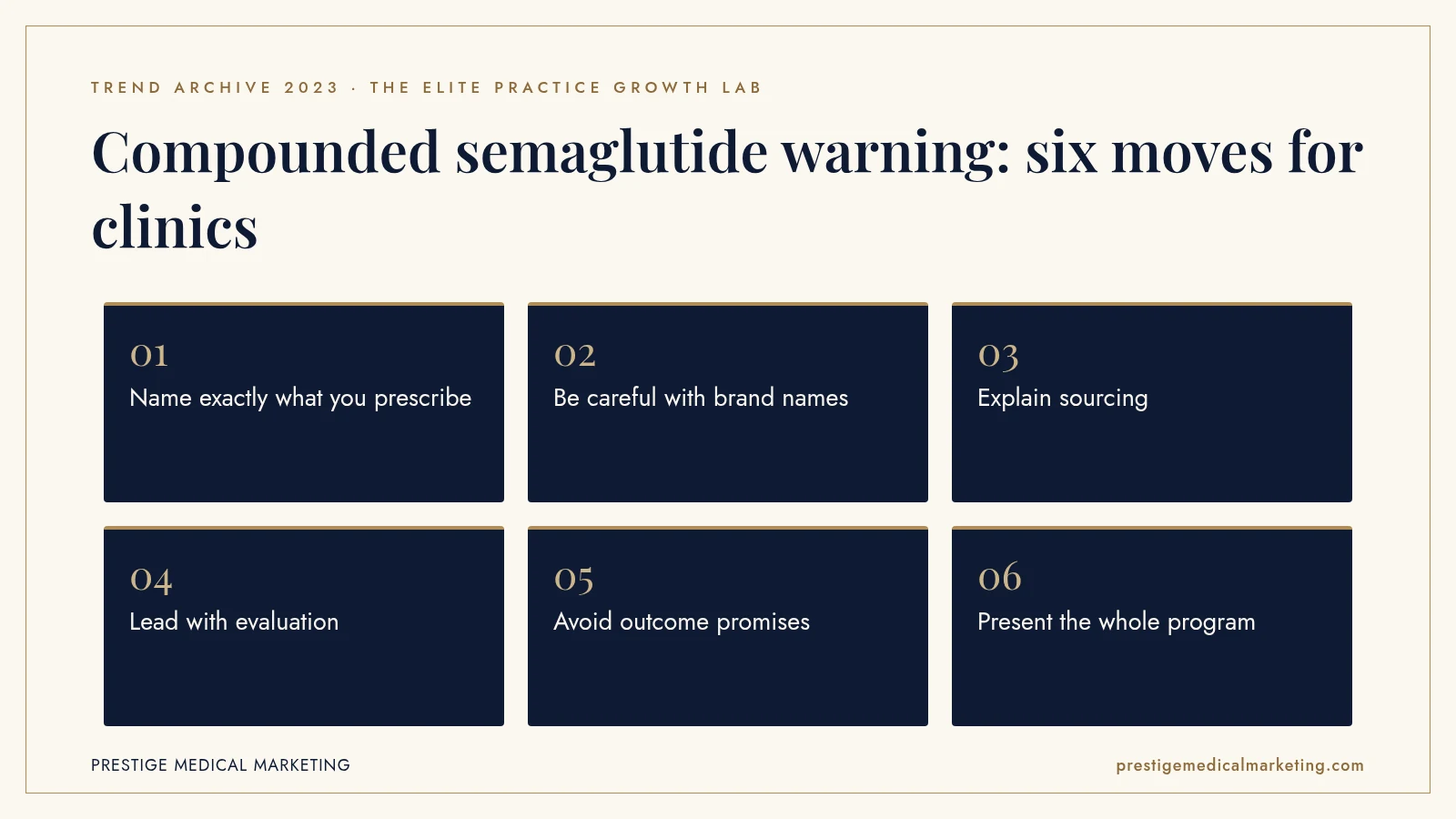
1. Name exactly what you prescribe
Describe the medication accurately, including whether it is an FDA-approved branded product or a compounded preparation, consistent with current law and legal advice. Patients deserve to know what they are receiving before they book.
2. Be careful with brand names
Do not use Ozempic, Wegovy, Mounjaro or Zepbound to describe products that are not those drugs. That applies to ad headlines, keywords in landing page copy, social captions and hashtags.
3. Explain sourcing
Where relevant, explain that medications come from licensed pharmacies, as the FDA advised patients to expect. Patients who read the 2023 headlines often ask, and a clear answer on the website saves time in consultations.
4. Lead with evaluation
Make the medical evaluation and eligibility criteria prominent, not hidden. Saying clearly that not everyone qualifies builds credibility rather than reducing leads.
5. Avoid outcome promises
Do not promise specific weight loss. Results vary, and the approved labeling describes trial averages, not guarantees. Phrases like “lose 30 pounds in 30 days” are the kind of claim that invites trouble.
6. Present the whole program
Describe nutrition, activity, follow-up and monitoring. Medication is one part of care, and showing the rest of the program is what separates a medical practice from a prescription storefront.

Why deep discounts backfire
The 2023 lawsuits included a clinic selling a semaglutide program through a coupon site. Deep discounts may generate leads, but they frame a prescription treatment as a commodity. They attract price shoppers who leave when a cheaper option appears, and they invite attention from regulators and manufacturers.
Premium weight loss clinics compete on medical quality, attention and outcomes measured over time, not on the lowest monthly price. Our guide to reputation and premium pricing explains how to support higher fees with trust signals.
Advertising platform rules
Prescription drug advertising on major platforms comes with restrictions. Google and Meta have policies on prescription drug ads and on certain health and weight loss content, and those policies have changed over time. Clinics should check current rules before launching campaigns and expect some ads to require certification or to be disapproved.
Search and local visibility are often more durable channels. People searching for medical weight loss nearby compare clinics on Google Maps, reviews and websites. We cover that in our weight loss clinic marketing guide.
Content that builds trust
Weight loss patients research carefully. Content that explains how GLP-1 medications work in general terms, who may be eligible, common side effects, what follow-up looks like and how the clinic supports patients beyond medication builds confidence.
Provider credentials and visible clinical involvement matter. Patients want to know a physician or qualified clinician is directing their care, and they want to see who that person is. Honest content also tends to perform better in search and in AI answers, which increasingly favor clear, accurate sources.
Before-and-after photos and testimonials
Weight loss marketing relies heavily on transformation stories. Real patient results can be powerful, but they also carry risk when presented as typical. The FTC’s updated Endorsement Guides, finalized in June 2023, address testimonials that misrepresent typical results, and we cover them in our Endorsement Guides retrospective.
Clinics that use patient stories should get written consent, avoid editing images in misleading ways, avoid implying the results are typical and pair stories with honest information about the range of outcomes. Many practices find that sharing the patient’s experience of the program, rather than only a number on a scale, resonates more and carries less risk.
The med spa overlap
In 2023, many med spas added GLP-1 programs alongside injectables and skin treatments. The CNBC report on Novo Nordisk’s lawsuits named several spas among the defendants. For aesthetic businesses, weight loss medication is a different kind of service: it involves chronic disease management, ongoing monitoring and prescribing decisions that call for careful medical oversight.
Med spas offering GLP-1 care should market it as a medical program, with the supervising clinician visible and the evaluation process clear. Bundling it into aesthetic promotions, such as “summer body” discounts, blurs that line. We explore the aesthetic connection in our 2025 piece on GLP-1s and body contouring.
Side effects belong in the conversation
GLP-1 medications have known side effects, most commonly gastrointestinal ones, and important warnings on their labeling. Marketing that mentions only benefits leaves patients unprepared and erodes trust when side effects appear. It can also run into advertising rules that require balanced information for prescription drug promotion.
A clinic does not need to turn every ad into a label. But the website should address side effects honestly, explain how the clinic monitors patients and manages dose changes, and invite questions. Patients who feel prepared are more likely to stay in a program and to recommend it.
Pricing transparency
Price is one of the first questions weight loss patients ask. Clinics that hide pricing until a consultation frustrate people, while clinics that advertise only a low introductory price create disappointment later. The better approach is to publish clear price ranges or program tiers, explain what is included, such as visits, labs, medication and follow-up, and note what could change the cost. Transparent pricing filters out poor-fit leads and builds trust with the right patients.
Telehealth programs and local clinics
The 2023 boom also brought large online programs that advertised nationally. Local clinics competed by emphasizing what an online program could not easily offer: in-person evaluation, body composition tracking, a consistent clinician and a nearby team. Those advantages remain real, and marketing should state them plainly rather than competing on price alone.
Clinics that offer both in-person and telehealth follow-up should explain how each works, which licenses apply and how prescriptions are handled. Clear explanations reduce confusion and support the clinic’s credibility.
Maintenance and long-term care
Weight management is long term. Marketing that frames GLP-1 treatment as a quick fix sets expectations the clinic cannot meet. Better messaging describes a program that includes medication when appropriate, nutrition guidance, strength and activity support and a plan for what happens after the initial phase.
That framing also supports the business. Patients who understand the long-term nature of care tend to stay longer, and programs built around ongoing support produce steadier revenue than one-time promotions.
What 2023 does not tell us
We do not know how many patients received salt-form products in 2023 or how the lawsuits were ultimately resolved in each case. Compounding rules have also changed since, so 2023 practices are not a guide to current legality. What 2023 does show is the documented FDA warning and the legal risk of brand-name confusion.
The premium practice advantage
Premium weight loss clinics market medical care, not shortcuts. Visit our weight loss marketing service, our services, who we help and our approach to Google Maps and AI search visibility. Our team works from Austin with practices nationwide.
The bottom line
The 2023 semaglutide warning and lawsuits showed that GLP-1 marketing must be accurate about what is prescribed and how. Weight loss clinics that market evaluation, sourcing and full programs build lasting trust.
Check if your market is open. We take one practice per specialty per market. Request a market check or call (716) 400-0084.
Frequently asked questions
What did the FDA warn about in May 2023?
Compounded semaglutide. The FDA said it had received adverse event reports and that some compounders were using salt forms such as semaglutide sodium and semaglutide acetate, which had not been shown to be safe and effective.
Why was compounded semaglutide available at all?
Semaglutide was on the FDA's drug shortage list. When a drug is in shortage, compounders may be able to prepare versions if they meet requirements of federal law.
What did Novo Nordisk do in June 2023?
CNBC reported on June 20, 2023, that Novo Nordisk had sued several spas and clinics over sales of products marketed as semaglutide, citing trademark use and consumer confusion.
Is semaglutide still in shortage?
No. The FDA later determined the semaglutide shortage was resolved, which changed the rules for compounding. We cover that in our 2025 retrospective.
Can a clinic use the names Ozempic or Wegovy in ads?
Using brand names for products that are not the branded drug can create confusion and legal risk. Clinics should get legal advice and describe exactly what they prescribe.
How should weight loss clinics market GLP-1 care now?
Describe the medical program accurately, name what is prescribed and its source, avoid outcome guarantees, explain eligibility and emphasize clinical oversight.