
FDA declared the tirzepatide shortage resolved in December 2024 and the semaglutide shortage resolved on February 21, 2025. Its grace periods for compounders ended between February and May 2025. Clinics that had built their marketing on low-price compounded GLP-1s lost their main message. The durable model is a medically supervised program, marketed on physician oversight, outcomes support and the patient experience, not on a cheaper copy of a branded drug.
For a stretch of 2023 and 2024, medical weight loss marketing could be summarized in one line: “Semaglutide, starting at a low monthly price.” The national shortages of GLP-1 medications opened the door to compounded versions, and a wave of clinics, telehealth brands and med spas built their entire marketing around that door staying open.
In 2025, it closed. FDA declared the shortages over, set deadlines, and the courts declined to stop it. The clinics that had built a real medical program kept going. Many of the clinics that had built a price ad had to find a new reason to exist.
This retrospective covers what happened, on what dates, and what a medical weight loss clinic should market today.
What actually happened, in order
FDA tracked every step on its page titled FDA clarifies policies for compounders as national GLP-1 supply begins to stabilize. Here is the sequence in plain English.
December 19, 2024: tirzepatide. After re-evaluating an earlier decision that had been challenged in court, FDA confirmed the tirzepatide injection shortage was resolved. It gave state-licensed pharmacies until February 18, 2025, and outsourcing facilities until March 19, 2025, before it would act on shortage-dependent compounding.
February 21, 2025: semaglutide. FDA determined the semaglutide injection shortage was resolved. It gave 503A pharmacies until April 22, 2025, and 503B outsourcing facilities until May 22, 2025.
March 5, 2025: the tirzepatide court decision. A federal district court denied a preliminary injunction sought by the Outsourcing Facilities Association, and FDA confirmed that the 503A discretion period for tirzepatide had ended. The 503B date of March 19 stood.
April 24, 2025: the semaglutide court decision. The court denied a similar motion on semaglutide. FDA confirmed that the 503A discretion period had ended, with 503B facilities still held to May 22, 2025.
By late May 2025, the shortage-based grace periods for both major GLP-1 molecules were over. Then, in September 2025, FDA launched a crackdown on deceptive drug advertising that reached telehealth and wellness companies marketing compounded GLP-1s. We cover that in a separate retrospective in this archive.
Why this hit marketing, not just pharmacy
The shortage era created a very specific kind of marketing. The ads looked alike: a molecule name, a monthly price, a “no insurance needed” line, and a fast online intake. Clinics competed on price because the product looked interchangeable.
When the shortages ended, three things broke at once.
The headline offer. Many clinics’ main message depended on compounding rules tied to the shortage. Once the grace periods ended, that message needed legal review at minimum, and for many clinics it had to change entirely.
The trust story. Patients who had paid for low-price compounded medications now heard a confusing mix of news about legal deadlines, pharmacy changes and safety warnings. Clinics that had never explained their medical process had nothing to fall back on.
The economics. A clinic built to sell a low-margin monthly prescription to as many people as possible needs constant new patient volume. When the offer changes, the cost of acquiring each patient goes up, and price-led clinics have the least room to absorb it.
What typical agencies did
Agencies that grew fast on GLP-1 lead generation in 2023 and 2024 mostly kept running the same playbook into 2025: price-led ads, high-volume lead forms and quick-turn landing pages. Some kept implying their clients’ compounded products were equivalent to branded medications, which is exactly the type of claim FDA targeted later in the year.
Few of them helped clients rebuild the offer itself. That is the difference between a lead vendor and a growth partner. A lead vendor buys clicks for whatever you sell. A growth partner helps you sell something that holds up when the rules change.
What it means for a weight loss clinic today
Medical weight loss is a real medical service with real demand. The shortage era just made it look like a commodity. Here is how we would market it now.
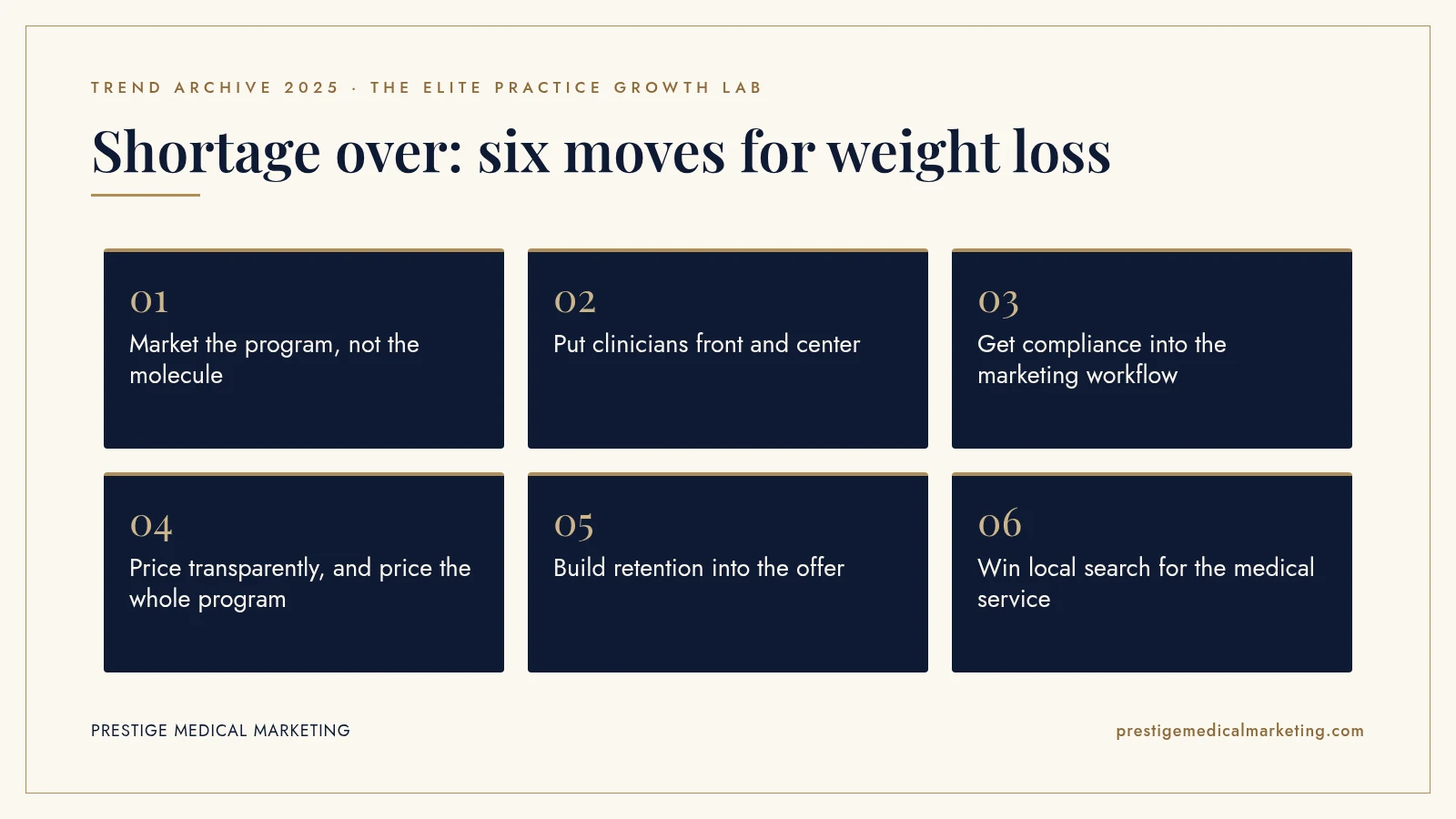
1. Market the program, not the molecule
Your offer is a medically supervised program: an initial physician or clinician evaluation, lab work, an individualized plan, medication management when appropriate, nutrition and behavior support, body composition tracking, side effect management and a plan for maintenance. Each piece is a reason to choose you over a website that mails a vial. Our weight loss clinic marketing guide covers how to build those pages.
2. Put clinicians front and center
Name your medical director and the providers who manage patients. Explain their training. Show your follow-up process. Patients who were burned by fast, faceless programs are looking for exactly this.
3. Get compliance into the marketing workflow
Every ad, landing page and email that mentions medications should be reviewed against FDA rules and platform policies before it runs. Never call a compounded drug FDA-approved or imply it is the same as a branded product. Avoid outcome promises. Clinics that build review into their process can keep marketing confidently while others pause and rewrite.
4. Price transparently, and price the whole program
Patients still compare costs. Give them a clear picture of what the program costs and what is included, rather than leading with a single medication price. A program price that includes visits, labs and coaching is a different conversation than a monthly vial price.
5. Build retention into the offer
Weight loss is a long journey, and maintenance is part of it. Clinics that keep patients engaged after they reach a goal, through maintenance plans, body composition checks and related services, build lifetime value that does not depend on a single drug’s legal status.
6. Win local search for the medical service
Patients search for medical weight loss near them, for a doctor-supervised program, for help with weight and metabolic health. Make sure your Google Business Profile, service pages and reviews describe a medical practice, not a pharmacy storefront.

What a program-led patient journey looks like
To make “market the program” concrete, here is the journey your marketing should describe, step by step. Every step is a chance to show a prospective patient what they get from you that they cannot get from a faceless online pharmacy.
First contact. The patient finds you in search, on the map or through a referral. Your page explains who the program is for, who runs it and what happens next. A real person answers the phone or replies within minutes, not days.
Evaluation. A clinician reviews history, goals, current medications and lab work. The patient leaves with a plan, not just a prescription. If medication is not appropriate, they hear that honestly, and that honesty becomes part of your reputation.
The first ninety days. Regular check-ins, side effect support, nutrition guidance and progress tracking that looks beyond the scale, such as body composition and strength. This is where many low-cost programs go quiet, and where your clinic proves its value.
Maintenance. A clear plan for what happens after the goal. Patients worry about regaining weight. A clinic that has a credible answer to that worry has a reason to keep the relationship going for years.
Write your website, your ads and your intake scripts around that journey. Patients comparing options will see the difference immediately.
What to say to existing patients
Many clinics had a second marketing problem in 2025: patients who were already in a program and confused by the news. They read headlines about shortages ending, legal deadlines and pharmacy changes, and they wondered what it meant for them.
The clinics that handled it well communicated early and plainly. They explained what was changing in their practice, what was not changing, and what options each patient had, after review by counsel and their pharmacy partner. They did it by email, by phone and in person at the next visit. Silence, on the other hand, sent patients searching for answers elsewhere, and often to a competitor.
A short, clear letter from the medical director, followed by a personal call for patients with questions, did more for retention than any promotion. It also gave staff a single, consistent script, which kept the front desk from improvising answers to legal questions they were not qualified to answer.
The lesson applies to any regulatory shift. Your existing patients are your most valuable audience. When the rules change, talk to them first.
The new adjacent opportunity
There is a positive side to the GLP-1 story that many weight loss clinics overlooked in 2025. Patients who lose significant weight often want help with what comes next: body composition, skin laxity, strength, nutrition and long-term metabolic health.
The American Society of Plastic Surgeons, in its 2024 statistics released in June 2025, measured GLP-1 use among its members’ patients for the first time and found more than 800,000 aesthetic patients using these medications. Of those, 39% were considering a surgical procedure and 41% a nonsurgical one. That is a referral and partnership opportunity for weight loss clinics that think beyond the prescription.
A clinic that builds relationships with plastic surgeons, med spas and fitness or nutrition professionals becomes part of a patient’s whole journey, instead of one step in it. That is much harder for a low-price competitor to copy.
The same logic applies to men’s health clinics, functional medicine practices and med spas that added weight loss programs during the shortage years. A program that connects to the rest of your services is worth far more than a standalone prescription.
What 2025 does not tell us
To be clear about the limits: the end of the shortages changed the legal landscape for compounding, but compounding questions remain complex and fact-specific. This article is not legal advice. Clinics should get guidance from healthcare counsel and their pharmacy partners before making any claims about medications.
We also do not have reliable public data on how many weight loss clinics closed, changed their model or grew in 2025. Anyone quoting a precise number should be able to show you the source.
The premium weight loss clinic advantage
When a market is built on price, the lowest-cost operator wins until the rules change. When the rules change, the practice with the strongest medical program and the most trust wins. 2025 was that change for medical weight loss.
That is how we build medical weight loss marketing at Prestige: program-led offers, clinician-led content, compliance-aware ads, strong local visibility and fast follow-up with fast patient follow-up and booking. From Austin, for clinics nationwide, one per specialty per market.
The bottom line
Between December 2024 and May 2025, FDA declared the GLP-1 shortages over and let its grace periods run out, and the courts declined to stop it. Clinics marketing a low-price copy lost their headline. Clinics marketing a real medical program kept their footing. The lesson outlasts this one drug class: build your marketing on what your practice does, not on a temporary gap in the market.
Check if your market is open. We take one practice per specialty per market. Request a market check or call (716) 400-0084.
Put this playbook to work: see how it applies to the Prestige System for medical practice marketing and med spa marketing.
Frequently asked questions
When did the GLP-1 shortages end?
FDA announced on December 19, 2024 that the tirzepatide injection shortage was resolved, and on February 21, 2025 that the semaglutide injection shortage was resolved. Both determinations were challenged in court, and the courts declined to block them in early 2025.
What were FDA's compounding deadlines in 2025?
For tirzepatide, enforcement discretion for 503A pharmacies ended after a March 5, 2025 court decision, and for 503B outsourcing facilities on March 19, 2025. For semaglutide, the dates were April 22, 2025 for 503A pharmacies, with discretion ending after an April 24 court decision, and May 22, 2025 for 503B outsourcing facilities.
Can clinics still offer compounded GLP-1 medications?
That is a legal and clinical question for your attorney and pharmacy partner, not a marketing one. FDA's guidance explains when a compounded product may be considered essentially a copy of an approved drug, and it has said adding an ingredient such as vitamin B12 does not automatically avoid that. Do not build marketing on assumptions about what is allowed.
What should a weight loss clinic market instead of price?
The program. Physician evaluation, lab work, medication management, nutrition and behavior coaching, body composition tracking, side effect support, and a plan for maintenance. Patients can find a prescription in many places. A real medical program with accountability is much harder to commoditize.
Are GLP-1 ads restricted on Meta and Google?
Both platforms have healthcare and prescription drug advertising policies, and Meta restricted certain health-related data and conversion events in 2025. Check current platform policies before every campaign, avoid implying a compounded drug is FDA-approved, and route claims through your compliance review.
Is the medical weight loss market still worth entering?
Demand for medical weight loss did not go away when the shortages ended. What changed is the competitive basis. Clinics competing only on price faced pressure. Clinics with a strong medical program, honest marketing and good retention had a clearer path.