
Google's August 2025 spam update began on August 26 and finished on September 22, 2025, applying globally to all languages. It enforced Google's spam policies, which cover tactics such as scaled content abuse, doorway pages, link spam and expired domain abuse. Chiropractic practices that relied on mass-produced city pages, thin content or bought links were exposed. The durable approach is real, specific content, a strong Google Business Profile, genuine reviews and earned local links.
Chiropractic is one of the most competitive local search categories in the country. Many towns have several practices within a few miles of each other, all trying to show up for “chiropractor near me.” That competition created a large market for SEO vendors, and many of them sold shortcuts.
In 2025, Google kept closing those shortcuts. Its August spam update, which took nearly four weeks to roll out, was a reminder that the tactics many chiropractic sites relied on were exactly the ones Google’s spam policies describe.
This retrospective covers what happened, which tactics are most at risk and how a chiropractic practice should build visibility that lasts.
What actually happened in 2025
The update. Google’s Search Status Dashboard records that the August 2025 spam update began on August 26, 2025 and completed on September 22, 2025, applying globally and to all languages. Search Engine Land reported the completion.
The context. It was not the only change that year. Google also released core updates in March, June and December 2025, which reassess how well content meets people’s needs. Our retrospective on what 2025’s core updates did covers those in detail. The spam update was different: it targeted violations rather than quality in general.
The policies. Google’s spam policies for Google web search list the practices it considers spam, including cloaking, doorway abuse, expired domain abuse, hidden text and links, keyword stuffing, link spam, machine-generated traffic, scaled content abuse, site reputation abuse, sneaky redirects and thin affiliation. Spam updates improve the systems that detect those practices.
Why chiropractic sites were exposed
Google did not single out chiropractic, and we are not suggesting it did. But several tactics that are common in chiropractic SEO line up closely with Google’s spam policies.
Doorway city pages. Many chiropractic sites have dozens of pages like “Chiropractor in [nearby town],” with the same text and the town name swapped. Google’s policies describe doorway pages as sites or pages created to rank for specific, similar search queries that lead users to intermediate pages that are not as useful as the final destination, and they specifically mention multiple pages targeting specific regions or cities that funnel users to one page.
Scaled content. Some vendors publish hundreds of short articles on conditions and symptoms, often generated quickly and rarely reviewed by a chiropractor. Google’s scaled content abuse policy covers many pages generated mainly to manipulate rankings rather than help users.
Link schemes. Bought links, link exchanges between practices and networks of low-quality sites are common in local SEO. Google’s link spam policy covers them.
Keyword stuffing. Pages that repeat “chiropractor near me” and town names over and over, often in footers or hidden sections, are still common.
Practices using these tactics may have seen short-term gains. Spam updates are designed to remove them, and sites can lose much more than they gained.
What typical agencies did
Chiropractic marketing has a long tradition of template websites and packaged SEO plans. A vendor sets up the same site structure for hundreds of practices, adds city pages for every nearby town, publishes generic monthly articles and builds links through networks it controls. Reports show rankings for long lists of keywords, many of which bring few real patients.
That approach was always fragile. Google has warned against these tactics for years, and each update makes them riskier. Worse, when the traffic drops, practices often cannot tell why, because they never saw what the vendor was doing.
We build differently. Our view, explained in our local dominance and patient quality blueprint, is that local visibility comes from being the most relevant, trusted and complete answer in your actual market. Not from pretending to be in twenty towns.
What it means for a chiropractic practice today
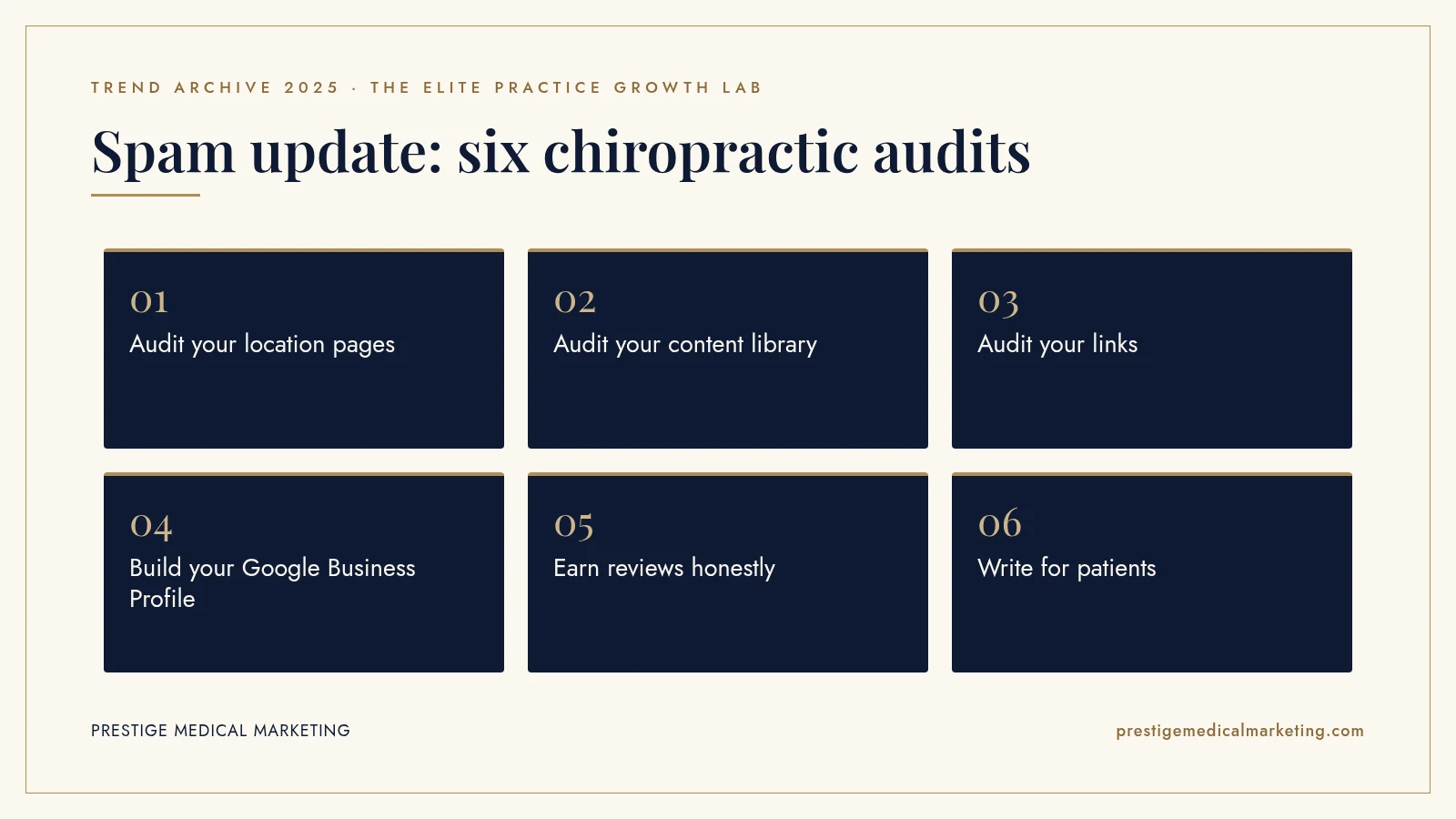
1. Audit your location pages
List every page on your site that targets a town or city. For each, ask: do we have a real location there or genuinely serve patients there, and does this page offer distinct, useful information? Consolidate or remove near-duplicate pages. Keep pages for real locations and make them excellent.
2. Audit your content library
Review your articles. Remove or rewrite thin, generic or inaccurate pieces. Keep and improve content that answers real patient questions and reflects your clinical approach. A smaller library of strong pages beats a large library of weak ones.
3. Audit your links
Ask your vendor exactly how links were built. If the answer involves paid placements, private networks or exchanges, stop. Focus on links you earn: local business associations, community events, sports teams you support, referral partners and local media.
4. Build your Google Business Profile
For chiropractic, the map results often matter more than the organic results. A complete, accurate profile with real photos, correct categories, services, hours and regular updates is the foundation. Our guide on optimizing your Google Business Profile applies to chiropractic practices too.
5. Earn reviews honestly
Ask every patient for an honest review at the right moment, without incentives or gating. Our retrospective on the FTC’s 2025 review enforcement explains why that matters more than ever.
6. Write for patients
Create service pages for what you actually do, such as adjustments, sports care, prenatal chiropractic or rehabilitation, with clear explanations, clinician information and honest answers about what to expect. Avoid claims you cannot support. The FTC has a long history of action against unsupported health claims.

Real location pages done right
If your practice has more than one location, or genuinely serves a nearby area, location pages are worthwhile when they are real. A strong location page includes the exact address and a map, parking and access details, hours, the chiropractors who practice there with photos, services offered at that location, nearby landmarks patients use and reviews from that location’s Google profile.
That information is distinct for each location and genuinely helpful. It is the opposite of a doorway page. It also gives Google and AI assistants accurate details to use when recommending your practice.
How to recover if you were hit
If your traffic dropped during the August 26 to September 22 window, start by checking Search Console for manual actions. If there are none, the drop was likely algorithmic. Identify which pages lost traffic and look honestly at whether they fit the spam policies. Fix the underlying problems: remove or consolidate doorway pages, rewrite thin content and stop link schemes.
Recovery from algorithmic spam signals is not instant. Google’s guidance on spam updates says making changes may help a site improve if its automated systems learn over a period of months that the site complies with its spam policies. It also says that after a link spam update, making changes might not generate an improvement, because the value lost from spammy links will not return. That is frustrating, but it is also the strongest argument for doing things properly from the start.
While you wait, keep building the things that do not depend on organic rankings: your Google Business Profile, your reviews, referral relationships with personal trainers, massage therapists, physical therapists and primary care offices, and fast follow-up on every call and form. Our guide on call handling and lead leakage shows how much opportunity many practices lose after the patient has already found them.
Document exactly what you changed and when. If traffic returns months later, you will know which fixes mattered, and you will have a clear record to share with your team and any future marketing partner.
Search, maps and AI together
In 2025, chiropractic visibility increasingly meant showing up in three places at once: the map pack, organic results and AI answers. Google’s AI Overviews and AI Mode, and assistants like ChatGPT, draw on the same signals that matter for local search: accurate business information, reviews and trustworthy content. Spam tactics do not help in any of them, and they can undermine trust in all of them.
Our guides on the Ask Maps local search shift and getting recommended by AI explain how the pieces fit together.
Questions to ask your SEO vendor
If you work with an outside SEO provider, a few direct questions will tell you whether your site is exposed. How many location pages do we have, and do we really serve each of those areas? Who writes our articles, and does a chiropractor review them? How were our links built, and can we see the list? What happened to our traffic during each 2025 Google update, and what did you change in response? Which of our pages bring patients who actually book?
A good partner will answer every question openly and show the data. Evasive answers, refusals to share link sources or reports full of rankings with no booking data are warning signs. You own your website and your reputation, and you are entitled to know exactly what is being done in your name.
Measure what matters
Many chiropractic SEO reports list rankings for dozens of keywords. Rankings alone say little about the business. Track new patient calls and bookings by source, the share of new patients from Google search and maps, conversion from first visit to care plan, and which pages patients view before booking. When an update hits, those numbers tell you whether it actually affected patient flow, and they keep everyone focused on what really pays the bills.
What 2025 does not tell us
Google does not publish which sites or industries are affected by a spam update, and we do not have reliable public data on how chiropractic sites specifically fared in August 2025. Individual results depend on each site’s history and tactics. Some traffic changes during the window may also have come from other factors, such as seasonal patterns or competitors’ changes. Look at your own data before drawing conclusions.
The premium practice advantage
Practices that compete on volume often chase every possible keyword and every nearby town. Premium chiropractic practices win by being clearly the best choice in their real market: excellent clinicians, a great patient experience, honest reviews and a website that reflects all of it. That kind of visibility does not disappear with the next update.
That is how we approach marketing for chiropractic practices: real local authority through our maps and AI search service, custom websites with no template doorway pages and fast patient follow-up. See our chiropractic marketing guide for the full approach. Our team works from Austin with practices nationwide, one per specialty per market.
The bottom line
Google’s August 2025 spam update ran from August 26 to September 22 and enforced policies against doorway pages, scaled content, link spam and other manipulative tactics. Many common chiropractic SEO shortcuts fit those descriptions. Practices that audit their sites, keep only real location pages, write genuinely useful content, earn links honestly and invest in their Google profiles and reviews build visibility that survives every update.
Check if your market is open. We take one practice per specialty per market. Request a market check or call (716) 400-0084.
Put this playbook to work: see how it applies to the Prestige System for medical practice marketing.
Frequently asked questions
When was Google's August 2025 spam update?
According to Google's Search Status Dashboard, the August 2025 spam update began on August 26, 2025 and completed on September 22, 2025. It applied globally and to all languages.
What does a Google spam update target?
Spam updates improve Google's systems for detecting content and practices that violate its spam policies. Those policies cover tactics including cloaking, doorway pages, expired domain abuse, hidden text, keyword stuffing, link spam, scaled content abuse, site reputation abuse and thin affiliation, among others.
Are city pages for chiropractors spam?
Not automatically. Pages for real locations with real, distinct information are fine. But many sites create dozens of near-identical pages for nearby towns where the practice has no presence, which Google's spam policies describe as doorway pages. Those can hurt rather than help.
Can AI-written content get a chiropractic site penalized?
Google's policies focus on scaled content abuse: producing many pages mainly to manipulate rankings rather than help people, regardless of how they are produced. AI-assisted content that is reviewed, accurate and genuinely useful is a different matter from mass-produced pages.
How do I know if my site was affected?
Compare your Search Console clicks and impressions before, during and after the rollout window. Check for any manual actions in Search Console. If traffic fell for specific page groups, such as location pages or articles, look closely at whether those pages meet Google's guidelines.
What should a chiropractor focus on instead of shortcuts?
A complete Google Business Profile, a steady flow of honest reviews, specific service and condition pages written for patients, real clinician information, accurate location details and links earned through genuine local relationships and community involvement.