
On November 4, 2021, Google announced that Google My Business was being renamed Google Business Profile, that businesses could claim and verify profiles directly on Google Search or the Google Maps app, that owners could message customers from Search and that merchants in the US and Canada could see call history from their profiles. Google said it would retire the Google My Business app in 2022. For chiropractic practices, the lesson was to treat the profile as a core, actively managed patient channel.
For many chiropractic practices, the Google listing is the front door. Someone wakes up with a stiff back, searches for a chiropractor nearby and picks from the map. They look at hours, photos, reviews and the phone number before they ever visit a website. In that moment, the listing does more selling than almost anything else the practice controls.
In November 2021, Google gave that listing a new name and a new home. On November 4, it announced that Google My Business would be renamed Google Business Profile, and that owners could claim, verify and update their profiles directly in Google Search and Google Maps. The standalone Google My Business app would be retired in 2022.
This retrospective covers what changed, why it mattered for chiropractors and what still holds. For the chapters that followed, see our pieces on the 2022 retirement of the Google My Business app, the 2024 shutdown of Business Profile websites and the end of chat and call history in 2024.
What actually happened in 2021
November 4: the rename. In a post titled Connect with local holiday shoppers, Google’s Matt Madrigal wrote that, to keep things simple, Google My Business was being renamed Google Business Profile.
Editing in Search and Maps. Google said businesses could now claim and verify their Business Profile directly on Google Search or the Google Maps app, and update and engage with customers directly from Search and Maps.
New ways to engage. Google said owners could message customers directly from Search, and that merchants in the US and Canada could use call history to see which inbound customer calls came from their Business Profile.
The app and the web tool. Google said it would retire the Google My Business app in 2022, and that the existing web experience would transition to primarily support larger businesses with multiple locations under the name Business Profile Manager.
Why it mattered for chiropractic practices
Chiropractic care is often local and often urgent. Patients look for someone nearby who can see them soon. The Business Profile shows exactly the information they need to decide: location, hours, reviews, photos and a phone number. Keeping that information accurate is one of the highest-value marketing tasks a practice has.
Moving editing into Search and Maps made that easier. A practice owner could search for the practice, see the profile as patients saw it and make changes in place. That lowered the barrier for small practices that had found the old dashboard confusing.
Call history also offered a glimpse of how many calls came from the profile, which helped some practices understand the value of their listing. It was a useful signal, even if Google later retired it.
What typical agencies did
Many agencies treated the rename as trivia. They updated their reports to say Business Profile and moved on, without changing how they managed the listing.
Some kept managing profiles through tools and processes the practice could not see, leaving owners unaware of what their own listing said.
The better approach used the change as a moment to tidy up. It meant confirming ownership and access, reviewing categories and services, updating hours and photos, setting up a process for responding to reviews and showing the practice how to make simple updates themselves.
What it means for a chiropractic practice today
Business Profile features have continued to change since 2021. These habits have stayed valuable throughout.
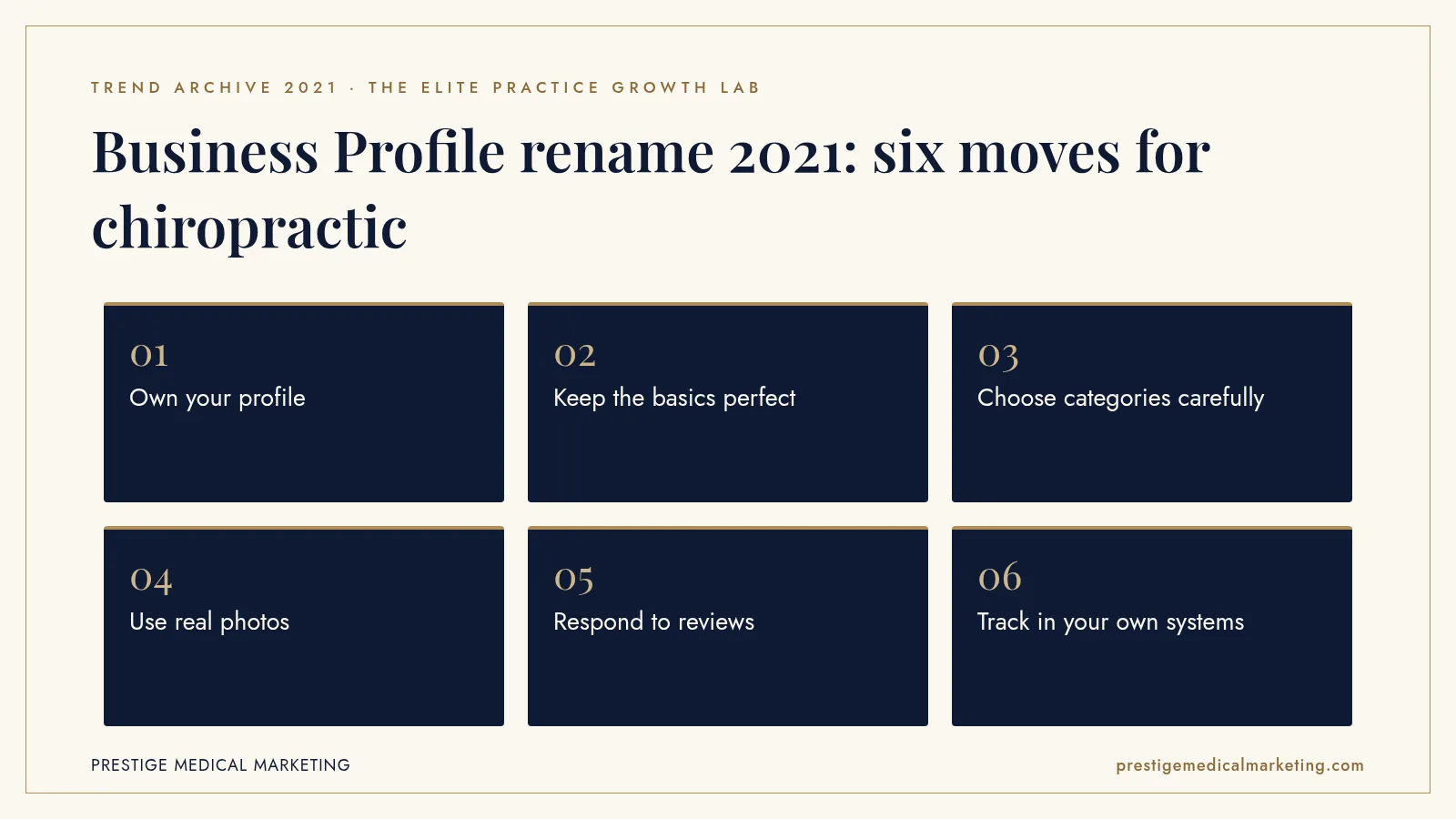
1. Own your profile
Make sure the practice, not just a vendor, has owner access to its Business Profile.
2. Keep the basics perfect
Hours, holiday hours, address, phone number and website link should always be accurate.
3. Choose categories carefully
Primary and secondary categories should reflect what the practice actually offers.
4. Use real photos
Show the actual office, treatment rooms and team. Patients want to know what to expect.
5. Respond to reviews
Thank patients, address concerns calmly and never share health information in replies.
6. Track in your own systems
Do not rely on any single Google feature for measurement. Track calls and bookings in the practice’s own tools.

Features come and go
The 2021 announcement introduced or highlighted features, such as messaging and call history, that Google later ended. That pattern is common. Google tests, launches and retires features regularly. Practices that built workflows around a feature had to rebuild when it disappeared. Practices that focused on the fundamentals, accurate information, genuine reviews and fast response, were barely affected.
The lesson is not to ignore new features. It is to use them while they help and to keep the practice’s core processes independent of any one of them.
Profile accuracy as patient experience
An incorrect listing creates real problems. A patient arrives during hours the profile says are open and finds a locked door. A caller dials an old number. Someone drives to a previous address. Each mistake costs a patient and often produces a frustrated review. Regular checks, especially around holidays and schedule changes, prevent those experiences.
Services and descriptions
Business Profiles allow practices to describe their services. For chiropractors, that may include adjustments, soft tissue work, rehabilitation exercises or other services the practice genuinely provides. Descriptions should be accurate and avoid unsupported health claims. Clear service information helps Google match the profile to relevant searches and helps patients understand what the practice does.
Reviews and response
Reviews are one of the most visible parts of the profile. A steady flow of genuine reviews from satisfied patients tells newcomers what to expect. Practices can ask every patient for feedback in a consistent way, without incentives and without selectively asking only happy patients. Responses should be professional and should never confirm that a reviewer is a patient or discuss treatment.
Who should manage the profile
Even if an agency helps, someone at the practice should understand the profile and be able to make basic updates. Owner access should stay with the practice. When staff change or vendors change, access should be reviewed. Practices that lost control of their profiles because a former employee or vendor held the only access learned that lesson the hard way.
Connecting the profile to the website
The Business Profile and the website work together. The profile should link to a fast, mobile-friendly page that confirms the practice’s location, explains its services and makes booking easy. Information should match across both, including name, address, phone number and hours. Consistency builds trust with patients and with Google.
Photos that set expectations
Many people decide whether to call a chiropractic practice partly on what they see in its photos. A clean, welcoming reception area, well-kept treatment rooms and friendly team portraits tell a patient that the practice is professional and comfortable. Photos should be real, current and representative. Practices should refresh them when the office changes and remove outdated images that no longer reflect the space.
Posts and updates
Business Profiles let practices share short updates, such as holiday hours, new services or community events. These posts are not a substitute for a strong website, but they show that the practice is active and attentive. A simple monthly rhythm of useful, accurate updates is usually enough. Updates should match what the website says, avoid promotional health claims and be written in the same calm, professional voice the practice uses everywhere else.
Why the name change mattered more than it seemed
A rename can look cosmetic, but this one reflected a real shift in how Google wanted businesses to work. The old name suggested a separate product that owners logged into. The new name emphasized the profile itself, the thing patients actually see, and Google moved the editing experience to the same places patients use. For a small practice, that made the listing feel less like a back-office tool and more like a living storefront.
It also changed how owners talked about it. Practices that once said they needed to update their Google account began to think about their profile as something to keep polished, the way they would keep a reception area tidy. That mental shift encouraged more regular attention, which is exactly what an accurate listing needs.
Verification and protecting the listing
Easier claiming and verification in Search and Maps helped legitimate owners, but it also raised the importance of watching who has access. Practices should know exactly which people and vendors are listed as owners and managers, remove anyone who no longer needs access and keep login details secure. Suggested edits from the public can also change a listing, so checking the profile periodically for unexpected changes is wise.
Listings for medical practices sometimes attract incorrect information, such as merged profiles for different clinicians or outdated addresses after a move. A practice that monitors its profile catches those issues early, before they confuse patients.
Multi-location chiropractic groups
Google said the web experience would become Business Profile Manager, primarily supporting larger businesses with multiple locations. Chiropractic groups with several offices benefit from managing their listings centrally, with consistent names, categories and standards across locations, while still keeping each profile specific to its own hours, team and photos. Each location should feel like a real place with real people, not a copy of the others.
Central management also makes it easier to keep reviews responded to across all locations and to spot patterns, such as one office receiving more complaints about wait times, that deserve operational attention. Names change over time, but accurate information, genuine reviews and a responsive practice remain what patients notice. Keep it current.
What 2021 does not tell us
The 2021 rename did not tell us which features would last, how the profile experience would evolve or how changes would affect individual practices’ visibility. Google did not publish data on how the move to editing in Search and Maps changed listing accuracy. There is no reliable public data on how chiropractic practices specifically responded. What 2021 does show is that the Business Profile remained central to local discovery, and that practices which owned and actively managed it were best positioned for whatever came next.
The premium practice advantage
A premium chiropractic practice is easy to find, accurately represented and consistently well reviewed. The work is keeping the profile precise and connecting it to a smooth path to booking. See our chiropractic services, our chiropractic marketing guide, our Maps and AI search work, our reputation and premium pricing work and our full services. Our team works from Austin with practices nationwide.
The bottom line
When Google My Business became Google Business Profile in November 2021, editing moved into Search and Maps and the old app was set for retirement. For chiropractic practices, the lasting lesson was to own the profile, keep it accurate, respond to reviews and measure results in the practice’s own systems, because features change but the fundamentals do not.
Check if your market is open. We take one practice per specialty per market. Request a market check or call (716) 400-0084.
Put this playbook to work: see how it applies to med spa marketing.
Frequently asked questions
What did Google announce in November 2021?
Google said Google My Business was being renamed Google Business Profile and that businesses could claim, verify and update their profiles directly on Google Search and Google Maps.
What new features were mentioned?
Google said owners could message customers directly from Search, and merchants in the US and Canada could use call history to see which inbound calls came from their Business Profile.
What happened to the Google My Business app?
Google said it would retire the Google My Business app in 2022 and that the web experience would be renamed Business Profile Manager, primarily supporting larger businesses with multiple locations.
Why did this matter for chiropractors?
Many chiropractic patients find a practice through Google Maps. Easier editing in Search and Maps made it simpler for practices to keep their most visible listing accurate.
Are call history and messaging still available?
No. Google later ended some of these features, including Business Profile chat and call history in 2024, which is a reminder not to build processes around any single feature.
What should a chiropractic practice do with its profile today?
Keep hours, services, categories and photos accurate, respond to reviews professionally, post useful updates and track calls and bookings in the practice's own systems.