
Google confirmed that a local search update ran from November 30 to December 8, 2021, and said it involved a rebalancing of various factors considered in generating local search results. Google's own guidance says local results are based mainly on relevance, distance and how well known a business is. For chiropractic practices, the lesson was to build Maps visibility on accurate, guideline-compliant profiles, genuine reviews and real local prominence rather than keyword-stuffed names or tricks.
Chiropractic is one of the most locally driven specialties in healthcare. People rarely travel far for an adjustment. They search for a chiropractor near them, look at the map and choose from the handful of practices that appear. Small changes in how Google ranks those map results can mean a noticeable difference in new patient calls.
In December 2021, Google confirmed one of those changes. It said a local search update had run from November 30 to December 8, and that it involved a rebalancing of the various factors it considers in generating local search results. Practices across many categories noticed their visibility shift, and some that had climbed using keyword-stuffed business names found the advantage gone.
This retrospective covers what Google confirmed, why it mattered for chiropractors and how to build durable local visibility. For related chapters, see our pieces on the 2021 rename of Google My Business, the September 2023 helpful content update and the 2025 spam update.
What actually happened in 2021
The confirmation. As Search Engine Roundtable reported, Google said the local update began November 30 and ran through December 8, 2021, and that it involved a rebalancing of various factors considered in generating local search results. Google’s Danny Sullivan confirmed it was a global update.
The factors. Google’s help article on improving local ranking explains that local results are based mainly on relevance, how well a profile matches the search, distance, how far the business is from the searcher, and prominence, how well known a business is.
The community name. Local search specialist Joy Hawkins named it the Vicinity update, a label that stuck among practitioners. Google did not give it that name or publish details on how specific factors changed.
The guidelines. Google’s guidelines for representing your business say a Business Profile name should reflect the business’s real-world name and that including unnecessary information in the name is not permitted and could result in suspension.
Why it mattered for chiropractic practices
Many chiropractic practices compete in dense local markets, with several practices within a short drive. Map visibility is often decided by small differences. For years, some practices added service and city keywords to their business names, such as appending back pain and the city name, because it seemed to help rankings. That violated Google’s guidelines, but it was common.
When Google rebalanced local factors, many observers reported that keyword-heavy names appeared to lose some of their advantage, and that proximity seemed to play a larger role. Google did not confirm those specifics, but the experience pushed practices back toward the fundamentals.
For honest practices that had followed the guidelines all along, the update was a reminder that compliance was the safer long-term strategy.
What typical agencies did
Some agencies panicked and made rapid changes, adding more keywords, creating additional listings or chasing rankings from a grid of locations. Those reactions often created new problems.
Others told clients nothing, leaving practices to wonder why calls had changed.
The better approach was calm. It meant checking whether the profile followed Google’s guidelines, removing keyword stuffing, confirming categories and services, encouraging genuine reviews, strengthening the website’s local relevance and measuring calls and bookings rather than daily rank positions.
What it means for a chiropractic practice today
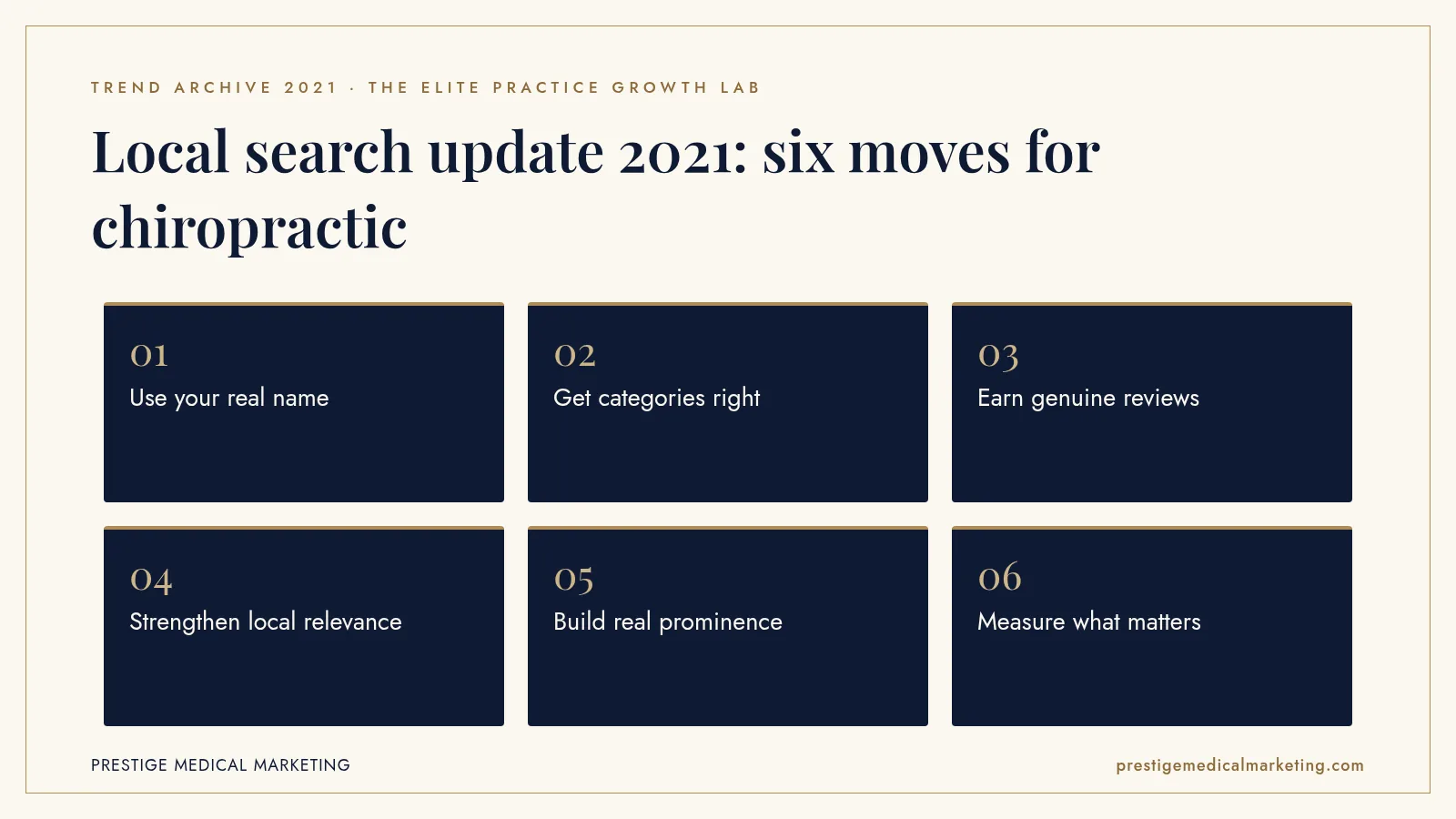
Local search continues to evolve. These habits build visibility that survives updates.
1. Use your real name
Your Business Profile name should match your real-world name on signage, website and stationery.
2. Get categories right
Choose the categories that best describe the practice, without adding unrelated ones for keyword reach.
3. Earn genuine reviews
Ask every patient for feedback consistently, without incentives or selective requests.
4. Strengthen local relevance
A website with clear service pages and accurate location information supports relevance.
5. Build real prominence
Community involvement, local partnerships and genuine mentions help a practice become well known.
6. Measure what matters
Track calls, bookings and new patients over time rather than reacting to daily rank changes.

Understanding distance
Distance is the factor practices cannot change. A searcher close to another practice may see that practice first, regardless of reviews or website quality. That is not a failure; it reflects how local search is designed. Practices can focus their efforts where they have influence: relevance, prominence and the experience patients have once they find the practice.
Understanding distance also helps practices set realistic expectations. A practice will usually be most visible near its own location. Trying to rank prominently across an entire metro area from one office is often unrealistic, and tactics aimed at doing so tend to violate guidelines.
Keyword stuffing and suspension risk
Adding keywords to a business name may seem harmless, but Google’s guidelines state it is not permitted and could result in suspension. Competitors and members of the public can also suggest edits or report listings that violate guidelines. A suspended profile can disappear from Maps, which is far more damaging than any ranking boost the keywords might have provided.
Relevance through clear services
Relevance depends on how well the profile and website match what people search for. A chiropractic practice that clearly describes its services, such as care for back pain, neck pain, headaches or sports injuries where appropriate, gives Google more to work with. Each service page should be accurate, helpful and specific to what the practice actually offers, without exaggerated claims about outcomes.
Prominence through reputation
Google describes prominence as how well known a business is, drawing on information from across the web, including reviews and links. A practice that serves its community well, participates in local events and earns steady reviews builds prominence naturally. There is no shortcut that reliably replaces it.
Tracking without obsessing
Rank tracking tools can show fluctuations from day to day and from street to street. Those numbers can be useful for spotting trends, but they can also cause unnecessary anxiety. A better measure of local performance is the number of calls, direction requests, website visits and bookings that come from the profile, viewed over months rather than days.
Multiple practitioners and locations
Chiropractic practices with several practitioners or offices should follow Google’s guidelines for individual practitioners and multiple locations. Creating extra listings to capture more map space violates guidelines and risks suspension. Accurate, compliant listings for real locations and public-facing practitioners are the safer approach.
The patient experience behind the ranking
Ranking well brings a patient to the profile, but the experience after that decides whether they book and return. A phone answered promptly, a clear booking process and a welcoming first visit lead to genuine reviews, which in turn support prominence. Local visibility and patient experience reinforce each other.
Why updates feel bigger in dense markets
In a small town with two chiropractors, a local update may barely register. In a busy suburb or city neighborhood with a dozen practices within a few miles, the same update can reshuffle the map noticeably. The more closely matched practices are, the more a small change in how factors are weighted can move the order. That is why practices in competitive areas often feel local updates more sharply and why they benefit most from steady, compliant work rather than tactics that could be undone overnight.
It also explains why two practices can have very different experiences of the same update. One may see little change while another, a few miles away, sees a clear drop or gain. The update is the same; the competitive context is not.
Reading the data after an update
When visibility shifts, the first instinct is often to change something immediately. A better first step is to look carefully at the data. Business Profile performance figures, website analytics and the practice’s own call and booking records can show whether new patient activity actually changed, and if so, where. A drop in profile views that does not translate into fewer bookings may matter less than it seems. A real decline in calls deserves a closer look at the profile, the competitive landscape and the patient experience.
Patience matters too. Local updates take days to roll out, and results can fluctuate during that time. Making major changes in the middle of an update makes it harder to understand what caused any later movement.
Competitor spam and how to respond
Chiropractors sometimes notice competitors with keyword-stuffed names, fake listings or addresses that do not seem real. Google provides ways to suggest edits and report listings that violate its guidelines. Practices can use those tools when they see clear violations, focusing on accurate, factual reports. It is not worth becoming consumed by competitors’ behavior, but reporting genuine spam helps keep the map fair for everyone, including patients who deserve accurate results.
The website still matters for local
Although the map pack draws heavily on the Business Profile, the website supports relevance and prominence. A fast, mobile-friendly site with a clear location page, accurate contact information that matches the profile, helpful service pages and genuine reviews or testimonials presented properly gives Google consistent signals. It also gives patients the confidence to book once they click through from the map, which is the step that actually matters to the practice.
Seasonal patterns and local demand
The update ran in early December, a time when many practices see changes in patient demand anyway, with holidays, travel and end-of-year insurance considerations all affecting schedules. That made it harder to separate the update’s effect from normal seasonal patterns. Comparing results with the same period in previous years, rather than only with the previous week, gives a more accurate picture of what really changed. Always.
What 2021 does not tell us
Google did not publish details about which factors changed in the November 2021 update or by how much. Observations from the local search community, including the apparent role of proximity and keyword names, were informed but not confirmed by Google. There is no reliable public data on how chiropractic practices as a group were affected. What 2021 does show is that local ranking factors can be rebalanced at any time, and that practices built on compliant profiles and genuine prominence are the least exposed.
The premium practice advantage
A premium chiropractic practice earns its place on the map through accuracy, reputation and care. The work is keeping the profile compliant and connected to a smooth booking experience. See our chiropractic services, our chiropractic marketing guide, our Maps and AI search work, our reputation and premium pricing work and our full services. Our team works from Austin with practices nationwide.
The bottom line
Google’s November 2021 local search update rebalanced the factors behind local results and reminded practices that tricks are fragile. For chiropractors, the lasting lesson was to use their real name, keep their profile accurate, earn genuine reviews, build real local prominence and measure success by patients rather than positions.
Check if your market is open. We take one practice per specialty per market. Request a market check or call (716) 400-0084.
Put this playbook to work: see how it applies to med spa marketing.
Frequently asked questions
When did the November 2021 local search update happen?
Google said the update began November 30, 2021 and ran through December 8, 2021.
What did Google say the update did?
Google said it involved a rebalancing of various factors it considers in generating local search results.
What factors does Google say drive local results?
Google's Business Profile help center says local results are based mainly on relevance, distance and prominence, meaning how well known a business is.
Why was it called the Vicinity update?
That name came from the local search community, not from Google. Industry observers used it because many noticed shifts that seemed related to proximity.
Can a chiropractor add keywords to a Business Profile name?
Google's guidelines say the name should reflect the business's real-world name, and that adding unnecessary information to the name is not permitted and could result in suspension.
How should a chiropractic practice respond to local updates?
Keep the profile accurate and compliant, earn genuine reviews, strengthen the website's local relevance and track calls and bookings rather than chasing daily rank changes.