
According to the Google Search Status Dashboard, Google released core updates on March 15 (about 13 days to roll out), August 22 (about 16 days), October 5 (about 14 days) and November 2 (about 26 days) in 2023. An October spam update and a reported ranking issue overlapped with the October update. Google says core updates are broad changes that do not target specific sites. For men's health clinics, the lesson was to build genuinely helpful, accurate, expert-reviewed content and measure carefully rather than react to every fluctuation.
Men’s health clinics compete in some of the most heavily promoted search results online. Testosterone therapy, erectile dysfunction treatment, hair restoration and weight loss attract telehealth brands, affiliate sites and local clinics all at once. Rankings in these results can shift quickly, and in 2023 they shifted often and sometimes sharply.
Google released four core updates that year, along with a helpful content update, a spam update and two reviews updates. For clinic owners watching their traffic, it could feel like constant turbulence. For clinics with strong foundations, it was also an opportunity.
This retrospective covers what happened and what it means today. It connects to our coverage of the September 2023 helpful content update, the March 2024 core update and the 2025 testosterone label changes.
What actually happened in 2023
Four core updates. The Google Search Status Dashboard lists core updates beginning March 15 (13 days, 7 hours), August 22 (16 days, 3 hours), October 5 (13 days, 23 hours) and November 2 (25 days, 21 hours).
Overlapping updates. The dashboard also lists a September 14 helpful content update, an October 4 spam update, a ranking issue beginning October 5 and reviews updates in April and November.
Google’s guidance. Google’s core updates documentation says core updates are broad changes designed to deliver helpful and reliable results, and that they “don’t target specific sites or individual web pages.”
How to analyze drops. Google recommends confirming that an update has finished, waiting at least a full week, comparing with a week before the update and taking no drastic action for small drops. For large, sustained drops, it suggests an objective self-assessment of whether the site is helpful, reliable and people-first.
Why it mattered for men’s health clinics
Men’s health content touches health and money, the kind of topics where Google holds results to high standards for reliability. Sites that relied on thin service pages, aggressive claims or copied content were exposed when Google reassessed quality across the web. Clinics that had grown on those tactics found their visibility less secure than it looked.
The overlapping updates made analysis harder. With a spam update, a ranking issue and a core update all landing in early October, it was difficult to tell which change affected a site. Clinics that reacted quickly risked fixing the wrong problem, and sometimes damaged pages that had been performing well.
For clinics that had invested in clear, accurate, expert-reviewed content, the year often brought stability or gains as weaker competitors slipped.
What typical agencies did
Many agencies reacted to each update with rapid content changes, new pages or link building. Some produced large volumes of generic content targeting every possible keyword variation. Others blamed updates for losses without examining the quality of the site, and some promised to recover rankings within weeks, a promise no one can honestly make.
The better approach followed Google’s own guidance: wait, measure carefully, assess the site objectively and improve substance over time. It also kept clinic owners informed with plain explanations instead of alarm.
What it means for a men’s health clinic today
These steps build a site that holds up through future updates.
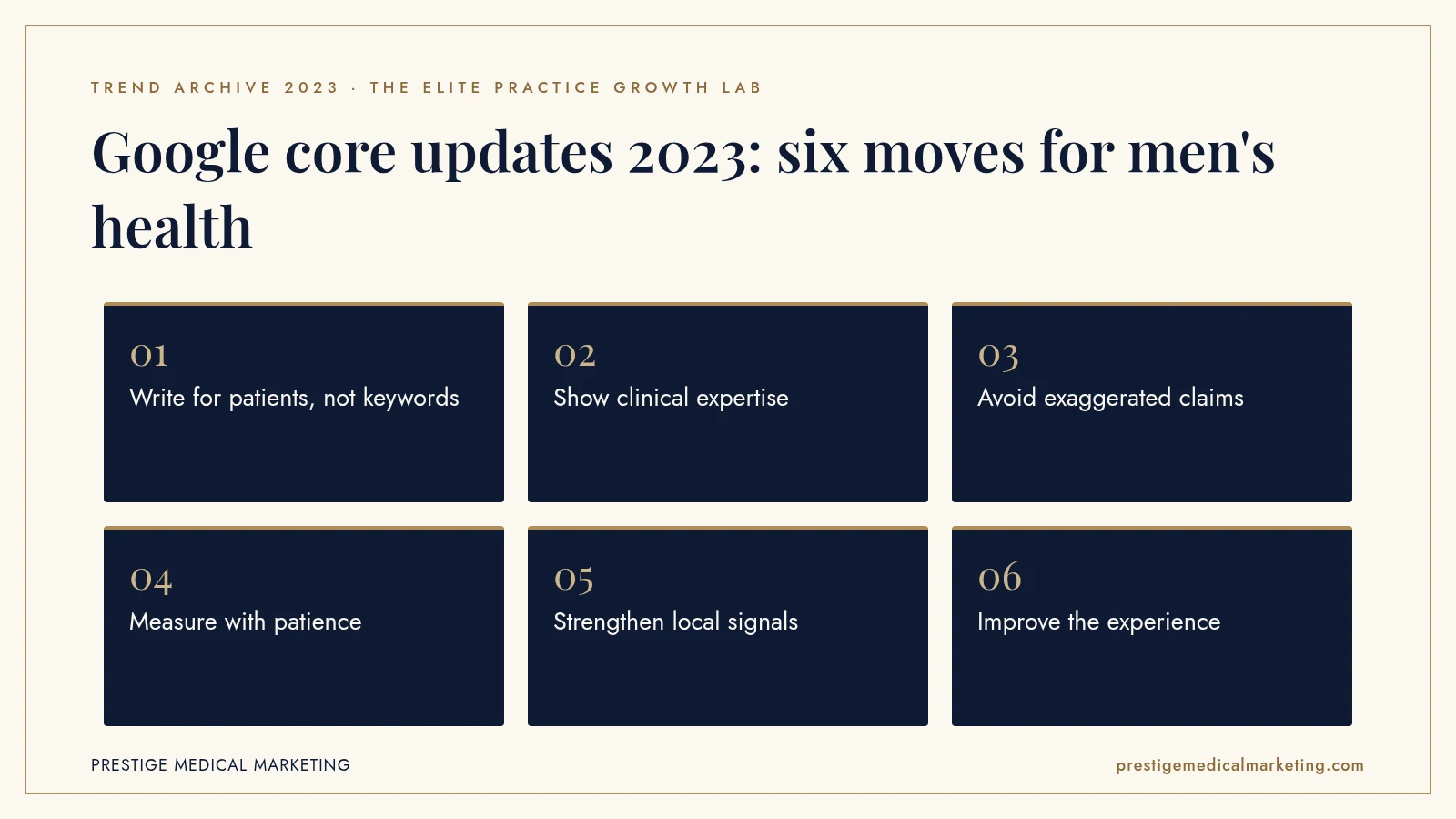
1. Write for patients, not keywords
Create pages that answer real patient questions clearly, explain options honestly and help people decide whether to book a consultation. Avoid near-duplicate pages created only to capture keyword variations. One thorough page on testosterone therapy that covers evaluation, options, monitoring and risks will usually serve patients better than five thin pages with slightly different titles.
2. Show clinical expertise
Name the clinicians who provide and review care, with their credentials. Add review dates to clinical content so patients and search engines can see it is maintained. Google’s guidance repeatedly emphasizes making it clear who created content and why, and an identifiable clinical reviewer answers both questions.
3. Avoid exaggerated claims
Do not promise results, overstate benefits or minimize risks. Accurate, balanced content is more trustworthy and better aligned with advertising rules. It also reduces the chance that patients arrive with unrealistic expectations, which protects reviews and retention.
4. Measure with patience
Wait until an update has finished, then compare full weeks before and after. Focus on large, sustained changes rather than daily swings. Track leads and booked consultations alongside rankings, because those are the numbers that actually matter to the clinic.
5. Strengthen local signals
Keep the Google Business Profile complete, accurate and active, and earn steady, genuine reviews. Local visibility in Maps often holds steady even when organic rankings shift during an update.
6. Improve the experience
Make the site fast, easy to read and simple to book from, especially on a phone. Many men research these topics privately on mobile, so a discreet, frictionless path to a consultation matters. Our custom website service is built around that experience.

Sensitive topics and trust
Men’s health covers subjects many patients find difficult to discuss: sexual health, hormone levels, hair loss and weight. Content that is respectful, discreet and clear helps patients take the first step. It also tends to be the content Google wants to rank: specific, accurate and written by or reviewed by people who understand the subject.
Trust also depends on what surrounds the content. Clear contact information, real clinician profiles, transparent pricing and a professional design all signal that the clinic is legitimate. Our men’s health clinic marketing guide covers how to build that trust.
Competing with national telehealth brands
National telehealth brands have large content teams and ad budgets. Local clinics cannot outspend them, but they can offer what those brands cannot: in-person evaluation, a relationship with a local clinician and coordinated care. Content that explains that difference, honestly and without disparaging competitors, gives patients a reason to choose a local clinic.
Local search is where clinics have an edge. A strong Google Business Profile, consistent reviews and location-specific pages help clinics appear for searches near them, where national brands are weaker. Our approach to Google Maps and AI search visibility focuses on that advantage.
Accurate content after TRAVERSE and label changes
Clinical facts change. The 2023 TRAVERSE trial reported on testosterone and heart events, and the FDA later updated testosterone labeling. Content that does not keep pace with those changes becomes inaccurate over time, which is a quality problem for patients and for search.
A content review calendar, with clinical review of key pages at least once a year and after major news, keeps the site accurate. Updating the review date shows patients that the clinic stays current, and it gives the clinical team a regular moment to confirm that every claim on the site still reflects the evidence.
Location pages that deserve to rank
Clinics with several locations often create a page for each one. Those pages help patients when they contain useful, specific information: the address, hours, parking, the clinicians at that location, the services offered there and directions from nearby areas. They become a liability when they are copies of each other with only the city name changed. Google’s spam policies describe doorway pages as a problem for exactly that reason. A smaller number of genuinely distinct location pages is safer and more useful than a long list of near-identical ones.
Avoiding shortcuts
The October 2023 spam update was a reminder that Google acts against manipulative tactics. Buying links, publishing scaled low-value content and creating doorway pages for every town may produce short-term gains but carry real risk. Men’s health is a competitive space where these shortcuts are tempting, and where losses can be severe when they stop working.
Sustainable visibility comes from content patients find useful, a site that works well and a reputation earned through good care. Our coverage of Google’s 2025 spam update explains how spam policies have continued to evolve.
Content that also works for AI answers
Since 2023, AI-generated answers have become part of search. The same qualities that help clinics through core updates, such as clear, accurate, specific content from identifiable experts, also make it more likely that AI tools reference a clinic’s information. Our guide to getting recommended by AI covers how to structure content for both.
A calm process for update weeks
Clinics benefit from a simple routine when Google announces an update. First, note the start date and do not make major site changes while it rolls out. Second, once the dashboard shows it has finished, wait a week and compare full weeks in Search Console. Third, separate branded searches from non-branded ones, since branded traffic usually reflects demand rather than rankings. Fourth, look at which pages moved and whether competitors with stronger content took their place.
Only then decide what to change. This approach avoids the costly mistake of rewriting pages that were never the problem, and it keeps the team focused on improvements that hold up over time.
Reviews and reputation in a volatile year
Google also released reviews updates in April and November 2023, which focused on review content such as product and service evaluations rather than patient reviews on business profiles. Still, reputation matters for men’s health clinics in every channel. Patients considering sensitive care read reviews closely, looking for signs of discretion, professionalism and clear communication. Steady, genuine reviews and thoughtful, private responses to concerns support both conversions and local visibility. Our reputation and premium pricing guide explains why.
Connecting search to consultations
Rankings only matter if they lead to patients. Many clinics lose search visitors at the next step: slow pages, unclear pricing, hard-to-find booking or unanswered calls. Measuring the path from search visit to booked consultation shows where those losses happen. Often the fastest gains come not from more traffic but from converting more of the traffic the clinic already has. Our guide to call handling and lead leakage covers the common gaps.
What 2023 does not tell us
Google does not publish how each core update affected particular industries, and we do not have reliable data on how men’s health clinics fared as a group. Third-party tools reported volatility, but those measurements vary widely. Google’s systems have also changed since 2023, including the integration of helpful content signals into core ranking in 2024. What 2023 does show is the documented schedule of updates and Google’s guidance on how to respond.
The premium practice advantage
Premium men’s health clinics build visibility on substance. Visit our men’s health marketing service, our services and who we help. Our team works from Austin with practices nationwide.
The bottom line
Google’s four 2023 core updates rewarded sites that were genuinely helpful and reliable. Men’s health clinics that build accurate, expert-reviewed content and measure with patience are positioned to hold steady through future updates. Google will keep releasing core updates, and the clinics that treat each one as a check on quality, not a crisis, tend to come out ahead.
Check if your market is open. We take one practice per specialty per market. Request a market check or call (716) 400-0084.
Frequently asked questions
How many core updates did Google release in 2023?
Four, according to the Google Search Status Dashboard: March 15, August 22, October 5 and November 2, 2023.
How long did they take to roll out?
About 13 days for March, 16 days for August, 14 days for October and nearly 26 days for November, based on the dashboard's listed durations.
Did core updates target men's health sites?
Google says core updates are broad in nature and do not target specific sites or individual pages.
What else happened in 2023?
Google also listed a September helpful content update, an October spam update, an October ranking issue and reviews updates in April and November.
How should a clinic analyze a ranking drop?
Google recommends waiting at least a full week after an update finishes, comparing with a week before it began, and doing a deeper assessment only for large drops.
What is the main lesson for men's health clinics?
Build accurate, expert-reviewed, people-first content, avoid aggressive claims, and judge performance over months rather than days.