
TRAVERSE, published in the New England Journal of Medicine in June 2023, randomized 5,246 men aged 45 to 80 with hypogonadism and existing or high risk of cardiovascular disease to testosterone gel or placebo. Major adverse cardiac events occurred in 7.0% of the testosterone group and 7.3% of the placebo group, meeting the trial's noninferiority standard. Atrial fibrillation, acute kidney injury and pulmonary embolism were more common with testosterone. For men's health clinics, the trial supports balanced, accurate safety discussions, not blanket claims.
For years, testosterone therapy marketing had a cloud over it, and men’s health clinics felt it in consultations. Earlier studies and regulatory warnings had raised questions about cardiovascular risk, and men’s health clinics often either avoided the topic or dismissed it. In June 2023, a large randomized trial offered much clearer evidence.
The TRAVERSE trial, published in the New England Journal of Medicine, studied testosterone therapy in middle-aged and older men with hypogonadism and existing or elevated cardiovascular risk. Its findings were reassuring on major heart events and cautionary on several other outcomes. For men’s health clinics, it changed what could responsibly be said about safety.
This retrospective covers what happened and what it means today. It connects to our coverage of the FDA’s 2025 testosterone label changes, the 2024 DEA telemedicine extension and the 2023 Google core updates.
What actually happened in 2023
June 2023: publication. The New England Journal of Medicine published TRAVERSE, a randomized, double-blind, placebo-controlled noninferiority trial. The trial is registered as NCT03518034.
The population. The trial enrolled 5,246 men aged 45 to 80 with hypogonadism, defined by symptoms and low testosterone levels, who had preexisting cardiovascular disease or a high risk of it. Participants received testosterone gel or placebo gel.
The primary result. Major adverse cardiac events occurred in 7.0% of the testosterone group and 7.3% of the placebo group, a hazard ratio of 0.96 with a 95% confidence interval of 0.78 to 1.17. That met the trial’s prespecified noninferiority standard.
Other findings. Atrial fibrillation, acute kidney injury and pulmonary embolism occurred more often in the testosterone group.
What it was designed to answer. TRAVERSE was built to assess cardiovascular safety, a question regulators had raised for years. It was not designed to prove broad benefits such as energy, mood or longevity. Its size and design made it one of the most informative studies on the question to date, which is why it drew wide attention from clinicians, regulators and patients alike.
Why it mattered for men’s health clinics
Men’s health clinics market testosterone therapy heavily, and safety questions shape patient decisions. Before TRAVERSE, clinics had limited high-quality evidence to discuss cardiovascular risk. The trial gave them a credible, peer-reviewed source, published in one of the most widely respected journals in medicine.
But it also created a temptation to overstate. “Testosterone is proven safe for your heart” is not what the trial showed. It showed noninferiority for major cardiac events in a specific population with diagnosed hypogonadism over the study period, alongside higher rates of some other problems. Clinics that summarized it accurately built trust; those that turned it into a slogan created risk. Regulators, competitors and informed patients can all read the original paper, and overstated claims are easy to spot.
The trial also reinforced the importance of diagnosis. Its participants had confirmed hypogonadism. Marketing testosterone to men without a confirmed deficiency, for general vitality or “optimization,” falls outside what the trial studied.
What typical agencies did
Some agencies seized on the headline and wrote “safe for your heart” copy. Others ignored the trial and kept vague wellness messaging. Very few explained the findings in balanced, plain terms or linked to the source. Many clinic websites still carried pages written years earlier that did not mention the trial at all, leaving patients to sort through conflicting headlines on their own.
The better approach treated TRAVERSE as an opportunity for credible education: explain what it studied, what it found, what it did not address and why evaluation and monitoring matter. Clinics that did this gained a page patients shared with partners and family members who had their own concerns, which is a quiet but powerful source of referrals.
What it means for a men’s health clinic today
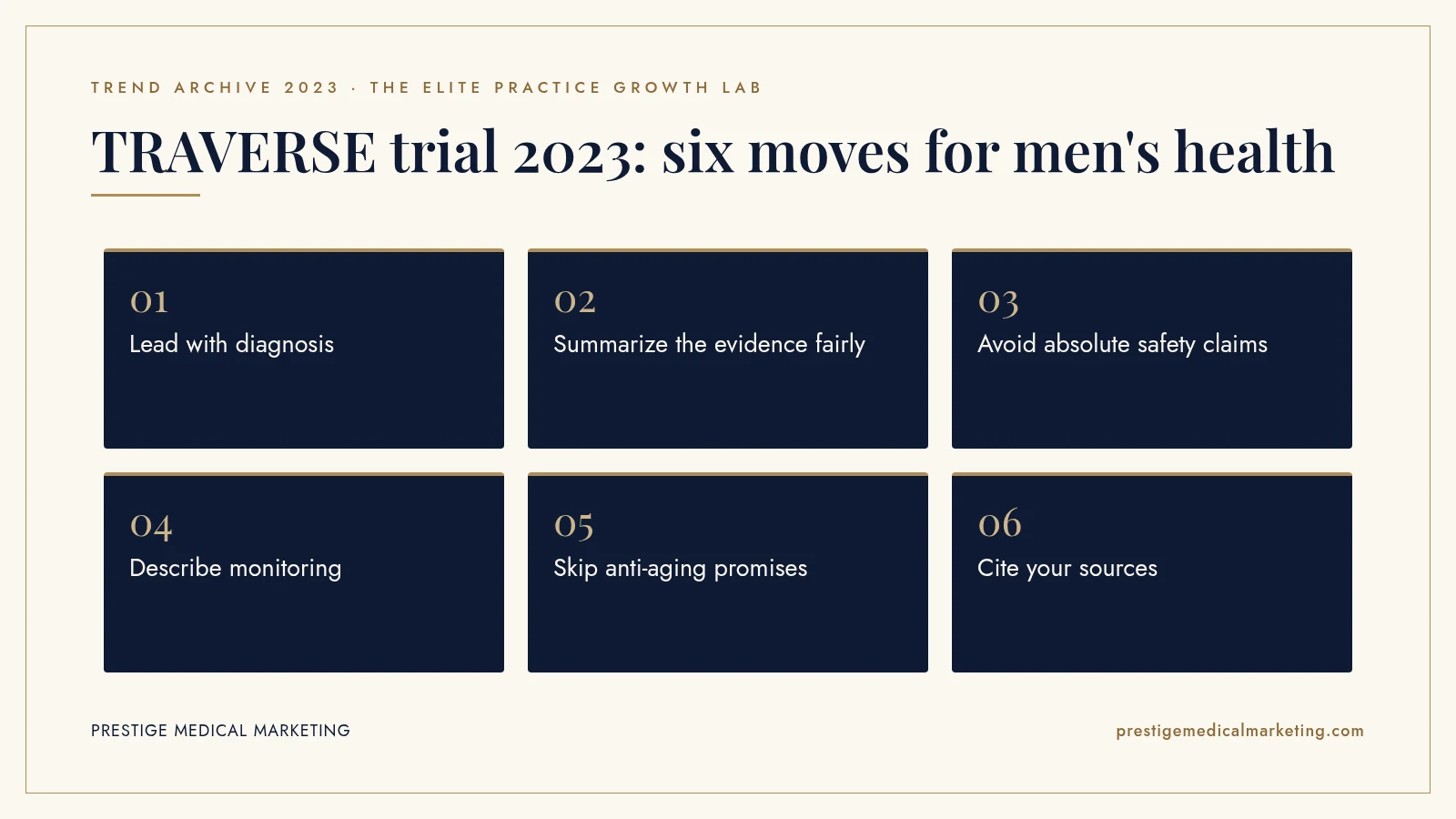
These steps help a clinic discuss testosterone accurately and persuasively.
1. Lead with diagnosis
Explain how the clinic evaluates symptoms and confirms low testosterone with appropriate testing before treatment. TRAVERSE enrolled men with confirmed hypogonadism, and that standard is the strongest foundation for treatment and for marketing.
2. Summarize the evidence fairly
Describe TRAVERSE’s population and findings accurately, including the risks that were higher with testosterone. Balanced summaries read as more trustworthy than selective ones.
3. Avoid absolute safety claims
Do not call testosterone “safe” or “risk-free.” Explain that risks are evaluated individually, based on history, labs and goals.
4. Describe monitoring
Explain how the clinic monitors labs, blood counts and symptoms over time, and how often patients can expect follow-up visits.
5. Skip anti-aging promises
Avoid claims about reversing aging or extending life, which the trial did not test. Describe realistic goals, such as addressing symptoms of diagnosed deficiency.
6. Cite your sources
Link to reliable sources such as the published trial and FDA labeling information. Update those links when new evidence or labeling appears.

The label changes that followed
Regulators took note of the trial. In 2025, the FDA announced class-wide labeling changes for testosterone products related to cardiovascular risk information and blood pressure. We cover those changes in detail in our 2025 testosterone label retrospective. The sequence shows how evidence moves from a journal into official labeling over time, and why clinics should keep their content current. A page written in 2022 that warns broadly about heart risk without mentioning TRAVERSE, or a page written in 2023 that ignores the later labeling, both leave patients with an incomplete picture. Reviewing key medical pages at least once a year, with a clinician involved, keeps them accurate.
Telehealth testosterone and controlled substances
Testosterone is a controlled substance, which matters for telehealth prescribing. Rules for prescribing controlled substances via telemedicine have been extended several times since the pandemic. Clinics that market online testosterone programs should explain how evaluations work, which licensed clinicians prescribe and how the clinic follows current rules. We cover those rules in our DEA telemedicine retrospective.
Search visibility and medical accuracy
Men’s health content falls under the kinds of topics where Google applies high quality expectations, because health information affects people’s well-being. Accurate, well-sourced pages written or reviewed by qualified clinicians tend to perform better over time than generic content. TRAVERSE gave clinics a strong primary source to cite, which supports both trust and visibility. Our men’s health clinic marketing guide covers content structure.
Advertising platforms and testosterone
Paid advertising for testosterone therapy faces restrictions on major platforms, which treat prescription drugs and certain health claims cautiously. Ads that promise vitality, youth or dramatic body changes are more likely to be disapproved and more likely to attract scrutiny. Clinics that advertise the evaluation, such as a consultation and lab testing, rather than the drug itself tend to have fewer problems and attract more serious patients.
Local search is often the most dependable channel for men’s health clinics. Men looking for care nearby compare Google Business Profiles, reviews and websites, and a clinic that looks credible and explains its process wins those comparisons.
Building a premium positioning
The men’s health market includes many low-cost online programs. Premium clinics stand apart by emphasizing thorough evaluation, physician involvement, regular monitoring and a broader approach to health that may include sleep, weight, fitness and cardiovascular risk. Balanced, evidence-based communication is part of that positioning, and patients who value it tend to stay longer. Those patients are also more likely to accept the clinic’s pricing, because they see the value in physician time and careful monitoring rather than comparing the cost of a vial.
How to explain noninferiority to patients
“Noninferior” is a technical term that patients rarely encounter. In TRAVERSE, it meant that the rate of major cardiac events with testosterone was not meaningfully worse than with placebo, within a margin the researchers set in advance. It does not mean testosterone protects the heart, and it does not mean there is no risk.
Clinics can explain this plainly: in a large, well-designed study of men with diagnosed low testosterone and heart risk, testosterone did not increase major heart events compared with placebo over the study period, but some other problems were more common. That sentence is accurate, understandable and far more credible than a slogan. It also prepares patients for an honest conversation about their own risk profile.
The patients who ask the hardest questions
Many men considering testosterone have done their own research. Some have read older headlines about heart risk and remain worried. Others have seen aggressive online advertising and are rightly skeptical. These patients often become the most loyal when a clinic answers their questions directly.
A clinic website that addresses heart risk openly, explains what TRAVERSE studied and describes how the clinic screens for cardiovascular risk meets these patients where they are. It signals that the clinic takes safety seriously and does not hide behind marketing language. Reviews that mention thorough explanations reinforce the same message.
Blood counts, fertility and other conversations
Cardiovascular risk is only one part of the testosterone safety conversation. Clinicians commonly monitor blood counts because testosterone can raise hematocrit, and they discuss effects on fertility, since external testosterone can suppress sperm production. Men planning to have children need to understand that before starting therapy.
Marketing does not need to cover every clinical detail, but the website should acknowledge that testosterone therapy requires careful evaluation and monitoring, and invite patients to discuss their goals and concerns. Leaving these topics out entirely can make a clinic look like a prescription mill rather than a medical practice.
Content that answers real questions
Search behavior around testosterone reflects real concerns: symptoms, testing, side effects, costs and whether treatment is right for a given person. Clinics that build pages answering those questions with clinical review perform better over time than those publishing thin promotional pages. A page about cardiovascular safety that cites TRAVERSE and later labeling changes is a strong example.
That kind of content also positions the clinic well in AI-generated answers, which draw on clear, well-sourced explanations. We discuss that shift in our guide to getting recommended by AI.
What 2023 does not tell us
TRAVERSE studied one population and one formulation over a defined period. It does not tell us about long-term outcomes beyond the study, men without hypogonadism or every delivery method. It also did not settle questions about benefits such as energy or longevity. Clinics should present it as one important piece of evidence, not the final word.
The premium practice advantage
Premium men’s health clinics earn trust by being precise about evidence. Visit our men’s health marketing service, our services, who we help and our approach to Google Maps and AI search visibility. Our team works from Austin with practices nationwide.
The bottom line
The 2023 TRAVERSE trial offered reassuring evidence on major heart events and caution on other risks. Men’s health clinics that explain it accurately, lead with diagnosis and avoid absolute claims build lasting credibility.
Check if your market is open. We take one practice per specialty per market. Request a market check or call (716) 400-0084.
Frequently asked questions
What was the TRAVERSE trial?
A randomized, double-blind, placebo-controlled trial of testosterone gel in 5,246 men aged 45 to 80 with hypogonadism and existing cardiovascular disease or high cardiovascular risk, published in the New England Journal of Medicine in June 2023.
What did TRAVERSE find about heart risk?
Major adverse cardiac events occurred in 7.0% of men on testosterone and 7.3% on placebo, a hazard ratio of 0.96, meeting the trial's prespecified noninferiority standard.
Were any risks higher with testosterone?
Yes. The trial reported higher incidences of atrial fibrillation, acute kidney injury and pulmonary embolism in the testosterone group.
Does TRAVERSE mean testosterone is safe for everyone?
No. The trial studied a specific population with diagnosed hypogonadism. It does not support testosterone for men without a confirmed deficiency, and individual risks still need clinical evaluation.
Did regulators respond to TRAVERSE?
In 2025, the FDA announced class-wide testosterone labeling changes related to cardiovascular risk information. We cover those changes in our 2025 retrospective.
How should men's health clinics talk about testosterone?
Describe diagnosis, evaluation and monitoring clearly, present benefits and risks in balance, avoid "safe" or "anti-aging" absolutes and cite reliable sources.