
Men's health clinic marketing works when it is discreet, physician-led and compliant. Build clear service pages for testosterone therapy, ED and related care, show real providers, keep ads inside Google and Meta prescription drug rules, win local searches with a complete Google Business Profile, and track every inquiry to a patient who starts treatment.
Most men put off a call about low energy, low drive or erectile dysfunction for months. When they finally search, they are looking for two things: a clinic that looks legitimate and a first step that feels private. Get those two right and men’s health marketing becomes much simpler. Get them wrong, with loud ads, shirtless photos and “guaranteed results,” and you attract the wrong patients while the right ones keep scrolling.
What men’s health clinic marketing has to do
A men’s health clinic is a medical practice with a consumer buying process. The marketing job has four parts:
- Look like a medical practice, not a supplement brand. Real providers, real credentials, clear explanations, calm design.
- Make the first step private and easy. Online booking, text options, no pressure.
- Stay inside ad policy. Testosterone and ED medications are prescription drugs. Ad platforms treat them that way.
- Track to patients who start care. Inquiries are easy to buy. Patients who start and stay are the business.
Where men’s health marketing goes wrong, and how we do it instead
They run hype. We run trust.
“Feel 25 again” and “guaranteed results” headlines draw clicks and complaints. They also fall short of the FTC’s expectation that health claims be backed by competent and reliable scientific evidence, as described in its health products guidance. We write plain, confident copy about evaluation, lab work, treatment options and follow-up. It reads like a practice a man can trust with his health.
They ignore ad policy. We build within it.
Google’s healthcare and medicines policy restricts prescription drug promotion, and online pharmacies and telehealth providers often need certification through Google or LegitScript. Meta’s drugs and pharmaceuticals policy adds its own limits. We plan campaigns around those rules instead of waiting for disapprovals and account suspensions.
They use cheap imagery. We use polished, respectful imagery.
Shirtless gym photos and suggestive couples send the wrong signal and can trip ad review. We show well-dressed, confident men, real providers and a clinic that looks like a place you would want to walk into.
They count form fills. We count patients who start care.
Our monthly ROI reporting follows every inquiry to consult, treatment start and retention, with revenue by source.
They work for every clinic in town. We don’t.
One men’s health practice per market. Month-to-month terms, so we earn the next month every month.

Check if your market is open. We work with one men’s health clinic per market. Request a market check or call (716) 400-0084.
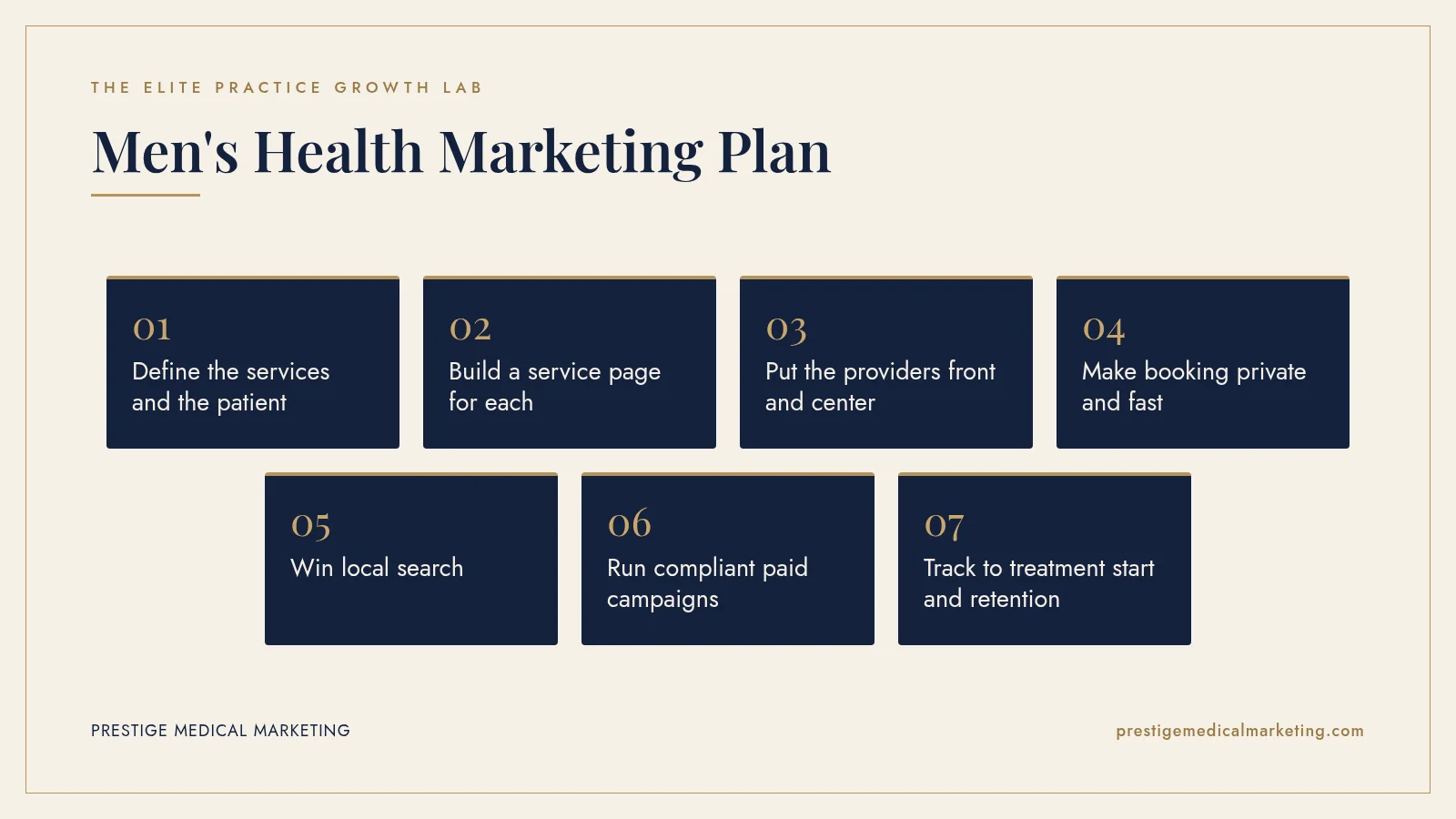
The men’s health marketing plan, step by step
Step 1: Define the services and the patient
List each service you offer: testosterone evaluation and therapy, ED treatment, weight management, hair restoration, general wellness. Define the patient for each one by age, concern and how he searches. A 38-year-old who lifts and a 58-year-old executive search differently and respond to different messages.
Step 2: Build a service page for each
Each page explains symptoms and causes in plain language, how evaluation works, what labs are run, treatment options and how the provider chooses among them, risks and monitoring, cost guidance and how to book. No exaggerated claims. A man should finish the page knowing what his first visit looks like.
Step 3: Put the providers front and center
Full bios with credentials and training, a real photo and a short video explaining the clinic’s approach. Men want to know who is responsible for their care. Visible medical oversight is also what separates a legitimate clinic from a pill mill in the patient’s mind.
Step 4: Make booking private and fast
Online booking, a short and discreet intake form, a text option and a 24/7 AI receptionist that answers after-hours calls. Reminders should be generic: “your appointment at the clinic,” not a list of services.
Step 5: Win local search
A complete Google Business Profile with accurate categories, every service listed, real photos of the clinic and team, and a booking link. Consistent listings everywhere. Steady reviews from patients who are comfortable leaving one; many men are, when asked privately and simply.
Step 6: Run compliant paid campaigns
Search campaigns around consultations, evaluations and the clinic itself, with landing pages that match the ad. Certification where it is required. Every ad and landing page reviewed against current policy before it goes live.
Step 7: Track to treatment start and retention
Call tracking, form and booking tracking connected to your practice software so every patient who starts treatment traces back to his first click. Retention at three and six months shows which channels bring patients who stay.
Messaging that works for men
Men respond to directness. A few rules we follow on every page and ad:
- Say what happens. “Thirty-minute evaluation, lab work the same week, a provider review of your results.” Clarity beats hype.
- Use medical language plainly. “Low testosterone” and “erectile dysfunction” are fine. Euphemisms confuse and slang cheapens.
- Lead with health, not performance. Energy, focus, strength and long-term health are the honest reasons most men seek care.
- Show the price path. Starting costs or membership ranges. Men hate surprise bills more than they hate prices.
- Respect privacy. Say how you protect it, then prove it in every follow-up.
Content that brings men in
The content that works answers the questions men type when no one is watching:
- “Signs of low testosterone in men over 40”
- “What happens at a men’s health clinic first visit”
- “TRT vs. other options: how a doctor decides”
- “How much does testosterone therapy cost”
- “ED treatment options and what to expect”
Each piece links to the matching service page and ends with a simple next step. Over time this library builds the authority that search engines and AI assistants look for when they recommend a clinic. Our guide on getting your practice recommended by AI explains how that works.
Website essentials for a men’s health clinic
- A homepage that says who you help and how, in one sentence
- Service pages for every treatment line
- Provider pages with credentials and photos
- Pricing guidance or membership ranges
- Booking reachable in two taps on a phone
- Discreet forms that ask only what is needed
- Privacy information in plain language
Keep tracking pixels off pages where patients enter health details, and review HHS guidance on online tracking with your compliance advisor. Our website efficiency playbook covers how a site should save your staff time, and our call handling guide shows how to keep every inquiry from leaking out of the funnel.
Retention is where the revenue lives
Men’s health programs are ongoing care. A patient who starts and stops after one month costs more to acquire than he pays. Build retention into the plan: clear follow-up schedules, reminders for labs and visits, easy refills where appropriate, a provider check-in after the first few weeks and simple membership terms. Ask for a review after a strong follow-up visit, privately and without pressure. Track retention by source; the channels that bring patients who stay deserve the budget. A channel that brings twice the inquiries but half the retention is not your best channel, and only tracking to month six shows that.
Questions to ask before you hire a men’s health marketing agency
- How do you handle prescription drug ad policies? A good answer names Google’s healthcare policy, certification requirements and how landing pages are reviewed. A vague answer means suspended accounts later.
- What will you report on? Look for consults, treatment starts and revenue by source, not impressions and clicks.
- Who owns the accounts? Your ad accounts, website, tracking numbers and data should stay in your name.
- Do you work with competitors in my market? If they do, your best ideas end up in a rival’s campaigns.
- What are the contract terms? Long lock-ins protect the agency. Month-to-month terms keep everyone honest.
- How do you protect patient privacy? Ask how tracking is set up on pages with health information and how follow-up messages are worded.
An agency that answers these clearly has done this work before. One that changes the subject has not.
What good looks like
In the first ninety days: clean service pages, visible providers, a complete map listing, compliant campaigns and tracking in place. By month six: steady consults, a rising share of patients from organic search and the map, and a clear view of which channels bring men who start and stay in care. See more on our men’s health practice page and our full services overview.
Ready to grow the clinic the right way? Check if your market is open or call (716) 400-0084. We’re based in Austin, Texas, and work with clinics nationwide.
Put this playbook to work: see how it applies to men's health clinic marketing and med spa marketing.
Frequently asked questions
Can a men's health clinic advertise testosterone therapy on Google?
Google restricts ads that promote prescription drugs, and testosterone is a controlled substance in the U.S. Many clinics need certification, such as through LegitScript or Google's own application, before running ads that mention treatments. Campaigns built around consults, evaluations and provider expertise often run with fewer restrictions. Check current policy before launching.
How do men's health clinics get patients without paid ads?
Local SEO and the Google Business Profile carry most of the load. Searches like "men's clinic near me" and "low T doctor [city]" are local. Detailed service pages, real provider bios, steady reviews and fast, discreet booking win those searches without paying per click.
What should men's health marketing avoid?
Avoid guaranteed results, before-and-after body claims, "no side effects" language, sexual imagery and urgency gimmicks. They violate ad policies, attract the wrong patients and erode trust. Plain, confident medical language converts better.
How do you keep marketing discreet for men's health patients?
Use neutral language on the website and in follow-up, offer online booking and text options, keep reminders generic, and train staff to confirm details privately. Many men choose a clinic because the first contact felt private and easy.
What should a men's health clinic track?
Inquiries by service, consults booked and attended, patients who start treatment, retention at three and six months, and revenue by source. Those numbers show which campaigns bring patients who stay.
How long does SEO take for a men's health clinic?
Map listing and long-tail service searches often move in the first two to three months. Competitive terms in large metros usually take six months or more of steady content, reviews and technical work.
Should a men's health clinic offer telehealth?
Telehealth can widen reach for follow-ups and some consults, within state licensing rules. It also brings tighter ad restrictions, since Google and Meta often require certification for telehealth providers that prescribe. Many clinics market the in-person evaluation locally and use telehealth for ongoing care.