
On February 28, 2025, FDA directed class-wide labeling changes for testosterone products. It removed Boxed Warning language about increased risk of adverse cardiovascular outcomes, added the TRAVERSE trial results, kept the Limitation of Use language for age-related hypogonadism, and added or expanded warnings about increased blood pressure. For men's health clinics, it supports a confident but careful message: proper diagnosis, monitored treatment and honest risk discussion.
Men’s health clinics spent most of the last decade marketing testosterone under a shadow. In 2015, FDA added language to testosterone labels about a possible increased risk of heart attack and stroke. Patients asked about it. Primary care physicians worried about it. Competitors used it. And every clinic had to explain it.
On February 28, 2025, FDA changed the label. The change was meaningful, and it was widely misunderstood. Some marketers read it as “testosterone is safe now.” That is not what FDA said, and clinics that market it that way take on real risk.
Here is what actually changed, what did not, and how a men’s health clinic should market testosterone therapy today.
What actually happened in 2025
In its February 28, 2025 announcement, FDA said it had informed sponsors of testosterone products about class-wide labeling changes after reviewing two sets of evidence: the TRAVERSE clinical trial and required ambulatory blood pressure monitoring studies.
Based on TRAVERSE, FDA recommended:
- adding the results of the TRAVERSE trial to all testosterone products;
- retaining the “Limitation of Use” language for age-related hypogonadism;
- removing language from the Boxed Warning related to an increased risk of adverse cardiovascular outcomes for all testosterone products.
Based on the blood pressure studies, FDA required:
- adding product-specific information on increased blood pressure for products with completed studies;
- adding a new warning about increased blood pressure for products that did not already have one.
FDA explained the history. In September 2014, it convened advisory committees after increased reports of stroke, heart attack and death in men taking testosterone. That led to an industry-wide clinical trial, TRAVERSE, to assess safety in men with age-related hypogonadism. FDA said the results, submitted in 2023, concluded there was no increase in the risk of adverse cardiovascular outcomes in men using testosterone for hypogonadism. Separately, ambulatory blood pressure studies confirmed an increase in blood pressure with testosterone products. Reuters covered the announcement the same day.
What changed, and what did not
This is where many marketers went wrong in 2025, so it is worth being precise.
What changed: the cardiovascular outcomes language came out of the Boxed Warning, and the TRAVERSE results went into the label. That gives clinics a credible, FDA-referenced answer to the most common safety question patients ask.
What did not change: testosterone is still approved for men who lack or have low testosterone in conjunction with an associated medical condition. The Limitation of Use language for age-related hypogonadism stayed. Blood pressure warnings were added or expanded. And all the other usual considerations for prescribing testosterone remain.
In other words, FDA lowered one concern and raised another, while keeping the boundaries on who the drug is approved for. That is a nuanced message, and nuance is exactly what most testosterone advertising lacks.
Why this matters for men’s health marketing
Men researching testosterone are often skeptical and private. They worry about side effects, about their heart, about being sold something they do not need, and about committing to a long-term treatment. They also see a flood of online ads promising energy, muscle and drive.
The 2025 label change gave legitimate clinics a better story to tell about safety, grounded in a major trial and an FDA decision. But it also raised the bar. A clinic that now says “proven safe” is overstating it. A clinic that says “FDA updated the label after a large trial found no increase in cardiovascular outcome risk in men treated for hypogonadism, and we monitor blood pressure and labs throughout your treatment” is telling the truth, and it sounds more credible.
What typical agencies did
Most men’s health advertising before and after the label change looked the same: bold promises about energy, muscle, libido and youth; a free consultation; and very little about diagnosis, monitoring or risk. Some agencies jumped on the 2025 news with headlines that implied testosterone had been cleared of all risk.
That approach has two problems. It invites regulatory and platform trouble, because health claims need support and medication ads need balance. And it attracts patients who want a prescription, not a medical relationship, which tends to mean poor retention and more complaints.
We build the opposite. Men’s health marketing that reads like medicine, and patients who stay because the care is real.
What it means for a men’s health clinic today
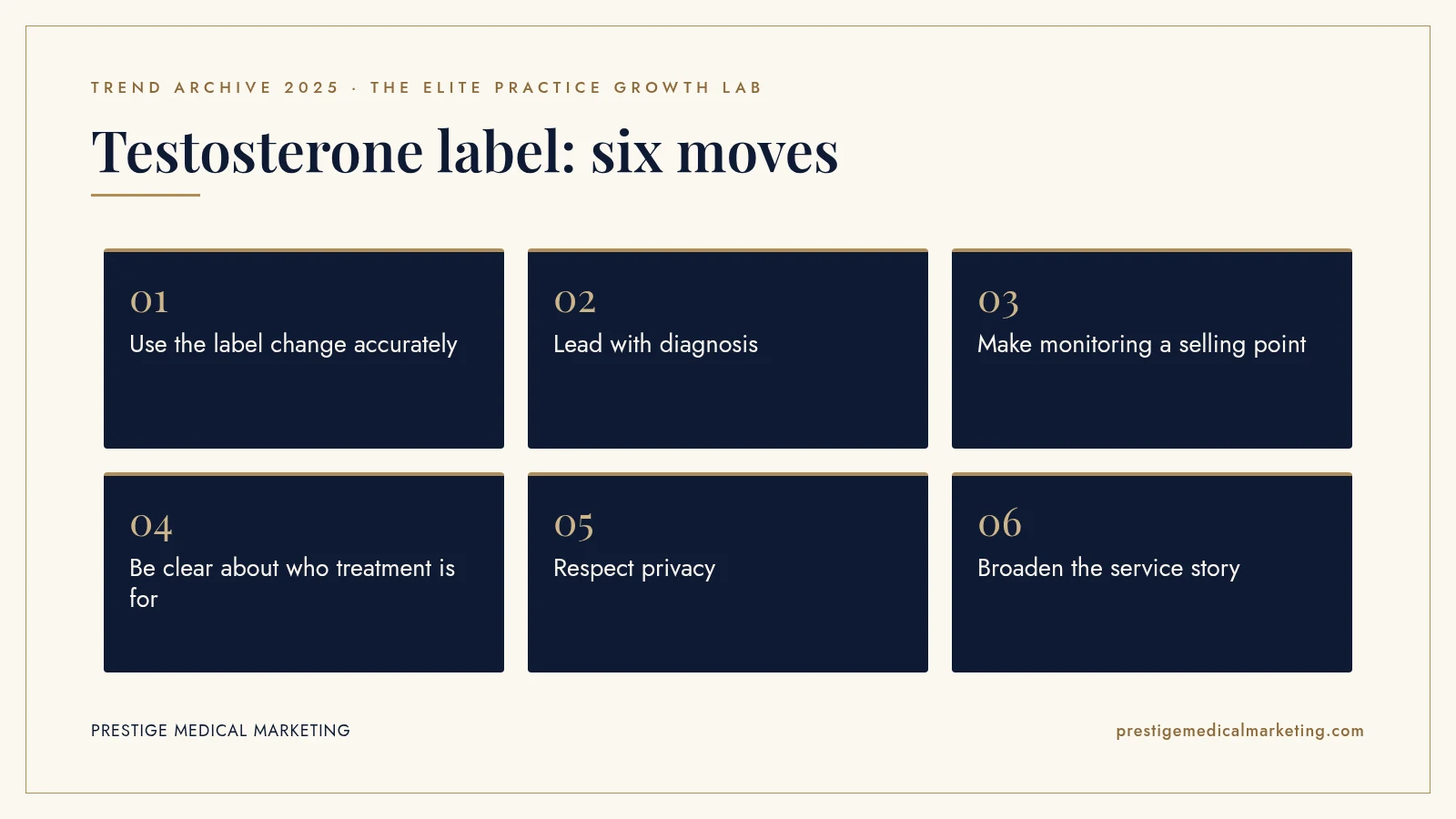
1. Use the label change accurately
It is fair to tell patients that FDA updated testosterone labeling in 2025 after the TRAVERSE trial, removing the Boxed Warning language about cardiovascular outcomes. Link to FDA’s announcement. Do not say testosterone is risk-free or “proven safe,” and do mention that FDA added blood pressure warnings.
2. Lead with diagnosis
The strongest message a men’s health clinic has is a proper diagnostic process: symptoms, history, lab testing, and a physician’s assessment of whether treatment is appropriate. Make that the center of your pages and your ads. Our men’s health clinic marketing guide covers the page structure we recommend.
3. Make monitoring a selling point
Ongoing labs, blood pressure checks and regular visits are not just clinical requirements. They are the difference between your clinic and an online prescription. Tell patients exactly how you monitor treatment and why.
4. Be clear about who treatment is for
Because the Limitation of Use for age-related hypogonadism remains, avoid positioning testosterone as a general anti-aging or performance product. Describe the evaluation honestly, including that some men will not be candidates and will be offered other options.
5. Respect privacy
Many men are uncomfortable discussing these concerns. Discreet scheduling, clear privacy practices, respectful staff and a polished, professional environment matter. So does careful handling of health data in your website tracking and ad platforms.
6. Broaden the service story
Men’s health is more than testosterone: weight management, metabolic health, sexual health, hair restoration, sleep and overall wellness. A clinic that addresses the whole man builds longer relationships and depends less on one medication’s headlines.

A better way to answer the safety question
Every men’s health clinic gets the question: “Is testosterone bad for my heart?” Here is how we would help a clinic answer it on its website, in plain language reviewed by its physicians.
Start with the history. FDA added cardiovascular language to labels years ago after reports of heart attacks and strokes. Then explain the trial. A large study called TRAVERSE was done to answer the question, and in 2025 FDA updated the label after reviewing it, removing the Boxed Warning language about cardiovascular outcomes. Then explain what remains. Testosterone can raise blood pressure, so the clinic checks it regularly, along with labs, and adjusts or stops treatment when needed. Finish with the process. A physician evaluates each patient individually.
That answer is honest, specific and reassuring. It also shows the patient that this clinic knows the evidence, which is the single best reason to choose it.
Put that answer on a dedicated page, link to FDA’s announcement, and have your medical director review it at least once a year. When the evidence or the label changes again, update the page and note the date. Patients notice when a clinic keeps its information current.
Questions your testosterone page should answer
Men rarely call a clinic with their real questions on the first try. They read first. A strong testosterone therapy page answers what they are actually wondering, in the order they wonder it.
Do I actually have low testosterone? Explain the symptoms that bring men in, and make clear that symptoms alone are not a diagnosis. Describe the lab testing you use and how a physician interprets it.
What does treatment involve? Describe the formulations your clinic uses, how often patients come in, and what the first few months look like. Be specific about follow-up labs and blood pressure checks.
What are the risks? Cover the main ones honestly, including blood pressure, and explain how your monitoring addresses them. Mention fertility considerations for younger men, which many patients do not know to ask about.
What if I am not a candidate? Say plainly that some men will not be, and describe the other paths your clinic offers, such as sleep, weight, metabolic or lifestyle approaches.
What does it cost? Give a clear picture of pricing or pricing ranges, what is included and whether memberships apply.
A page that answers those questions well does more than rank. It pre-qualifies patients, reduces anxious phone calls and makes the consultation more productive. It also gives AI search tools clear, credible material to draw from when men ask them the same questions.
The rules still apply
A label change does not change advertising law. The FTC requires health claims to be truthful and supported, as its health products compliance guidance explains. State medical boards police misleading advertising by practices. Ad platforms restrict prescription drug promotion and some health targeting. And in September 2025, FDA announced a broad crackdown on misleading drug advertising, which we cover in our retrospective on FDA’s 2025 drug ad crackdown.
The safest path is also the most persuasive one: describe the medical process, use evidence accurately and leave the hype to others.
What the 2025 change does not tell us
FDA’s announcement addressed labeling. It did not publish new prescribing volume data, and we are not aware of reliable public data on how the label change affected patient demand at men’s health clinics. Any marketer claiming a specific surge in testosterone inquiries since February 2025 should show you the source. What we can say is that the most common safety objection now has a clearer, FDA-referenced answer.
If you want to measure the effect in your own clinic, track it directly. Note how often new patients raise cardiovascular concerns at consultation, how often they mention the label change, and how your conversion rate from consultation to treatment moves over time. Your own numbers will tell you more than any industry headline.
The premium men’s health advantage
The online market for testosterone is crowded with fast, cheap and faceless options. The label change did not make that market more trustworthy. It made the contrast sharper. Patients who learn that the safety picture has improved will still want a physician who diagnoses properly, monitors carefully and tells them the truth.
That is how we build men’s health clinic marketing: physician-led pages, accurate claims, a private and premium patient experience, strong local visibility and an AI receptionist that answers every call, including the ones that come in after hours. Our team works from Austin with clinics nationwide, one per specialty per market.
The bottom line
On February 28, 2025, FDA removed cardiovascular outcomes language from the testosterone Boxed Warning, added the TRAVERSE results, kept the Limitation of Use for age-related hypogonadism and added blood pressure warnings. For men’s health clinics, it was a real improvement in the safety conversation and a reason to market with more confidence, not less care.
Check if your market is open. We take one practice per specialty per market. Request a market check or call (716) 400-0084.
Put this playbook to work: see how it applies to the Prestige System for medical practice marketing and med spa marketing.
Frequently asked questions
What did FDA change on testosterone labels in 2025?
On February 28, 2025, FDA told sponsors of testosterone products to add the TRAVERSE trial results to labeling, retain the Limitation of Use language for age-related hypogonadism, and remove Boxed Warning language about an increased risk of adverse cardiovascular outcomes. It also required product-specific blood pressure information and a new warning about increased blood pressure where one did not exist.
What was the TRAVERSE trial?
TRAVERSE was a large clinical trial requested after a 2014 FDA advisory committee meeting, designed to assess the cardiovascular safety of testosterone in men with hypogonadism. FDA said its results, submitted in 2023, showed no increase in the risk of adverse cardiovascular outcomes in men using testosterone for hypogonadism.
Does the label change mean testosterone is now approved for aging?
No. FDA retained the Limitation of Use language for age-related hypogonadism. Testosterone is approved for men who lack or have low testosterone in conjunction with an associated medical condition. Marketing should not suggest it is approved as a general anti-aging or performance treatment.
Why does the blood pressure warning matter for clinics?
FDA said ambulatory blood pressure studies confirmed testosterone products can increase blood pressure. That supports careful patient selection and monitoring, and it is something clinics should discuss openly with patients rather than leave out of their marketing.
Can men's health clinics advertise testosterone therapy?
Clinics commonly advertise evaluation and treatment for low testosterone, but they must follow FTC truth-in-advertising rules, state medical board rules and platform policies. Avoid outcome promises, avoid implying approval for uses FDA has not approved, and have counsel review medication-related ads.
What makes a men's health clinic stand out in marketing today?
Medical credibility. Named physicians, a real diagnostic process with lab work, ongoing monitoring, honest discussion of risks and benefits, and a respectful, private patient experience. Men researching testosterone increasingly look for a clinic that treats it as medicine.