
On October 31, 2024, OpenAI launched ChatGPT search, letting ChatGPT answer questions with timely information from the web and links to sources. It followed the SearchGPT prototype announced in July 2024 and began with paid users before expanding to logged-in free users in December 2024. For longevity clinics, it meant patients could research treatments and providers inside a chat, so clear, well-sourced content and consistent practice information became more important.
For most of its first two years, ChatGPT was a conversation partner, not a search engine. It could explain a concept or draft a message, but it was not built to tell a patient which clinics near them offered a particular service, or to point them to a current source.
That changed in 2024. In July, OpenAI announced a search prototype. On October 31, it launched ChatGPT search for paid users, and by December it had opened search to logged-in free users. A tool that millions of people already used for advice could now pull in timely web information and link to sources.
For longevity clinics, the timing mattered. Longevity patients are researchers. They read about testing, hormones, metabolic health and preventive care, often for weeks or months, before they choose a provider. This retrospective covers what happened in 2024, why it mattered and what a longevity clinic should do now. For a broader view of how we market these practices, see our longevity clinic marketing guide.
What actually happened in 2024
The prototype. In July 2024, OpenAI announced SearchGPT, a prototype that combined its models with information from the web. It was offered to a limited group of users, and OpenAI said it planned to fold the best features into ChatGPT.
The launch. On October 31, 2024, OpenAI introduced ChatGPT search. OpenAI said ChatGPT could now search the web and give fast, timely answers with links to relevant web sources. Search could be triggered automatically based on the question, or chosen manually.
Who got it first. At launch, search was available to ChatGPT Plus and Team users and to people on the SearchGPT waitlist. OpenAI said it would roll out to enterprise and education users and then to free users over the following months. In December 2024, OpenAI expanded search to logged-in free users.
Sources and partners. OpenAI said it had worked with news and data providers and that answers would include inline citations and a sources panel. That design meant a business or publisher could be named in an answer and receive a visit from it.
The wider context. ChatGPT search arrived in the same year Google rolled out AI Overviews in the United States. By the end of 2024, two of the most widely used information tools were giving people written answers rather than just lists of links.
Why it mattered for longevity clinics
Longevity care is a considered purchase. Patients are often paying out of pocket for testing, consultations, memberships and ongoing programs. They want to understand the science, the risks and the costs before they commit. That research used to happen across search results, forums, podcasts and practice websites.
ChatGPT search compressed part of that research into a single conversation. A patient could ask what a comprehensive longevity assessment usually includes, what questions to ask a provider, or which clinics offer a particular service in their area, and get a synthesized answer with sources. If a clinic’s information was thin, vague or hard to find, it was less likely to be part of that answer.
It also changed what a first impression looks like. In a list of search results, a patient sees a title and a snippet. In an AI answer, they may see a summary of what a clinic offers, drawn from its website and other pages. If those sources disagree, or if the clinic’s own site does not explain its services clearly, the summary can be incomplete or inaccurate.
What typical agencies did
Many agencies treated ChatGPT search as a curiosity. Some told clients it was too early to matter. Others jumped to selling a new service without changing the underlying work, promising rankings in AI answers that nobody could guarantee.
A common mistake was producing more content rather than better content. Clinics were given long, generic articles about longevity that repeated what thousands of other pages already said. That kind of content gives an AI system little reason to cite a specific clinic, because it adds nothing a patient cannot find elsewhere.
Few agencies did the less glamorous work: making sure the clinic’s services, providers, locations, prices where appropriate and policies were clearly explained on its own site and consistent across the web.
What it means for a longevity clinic today
AI answers reward clarity, consistency and evidence. Here is how we approach visibility for longevity clinics.
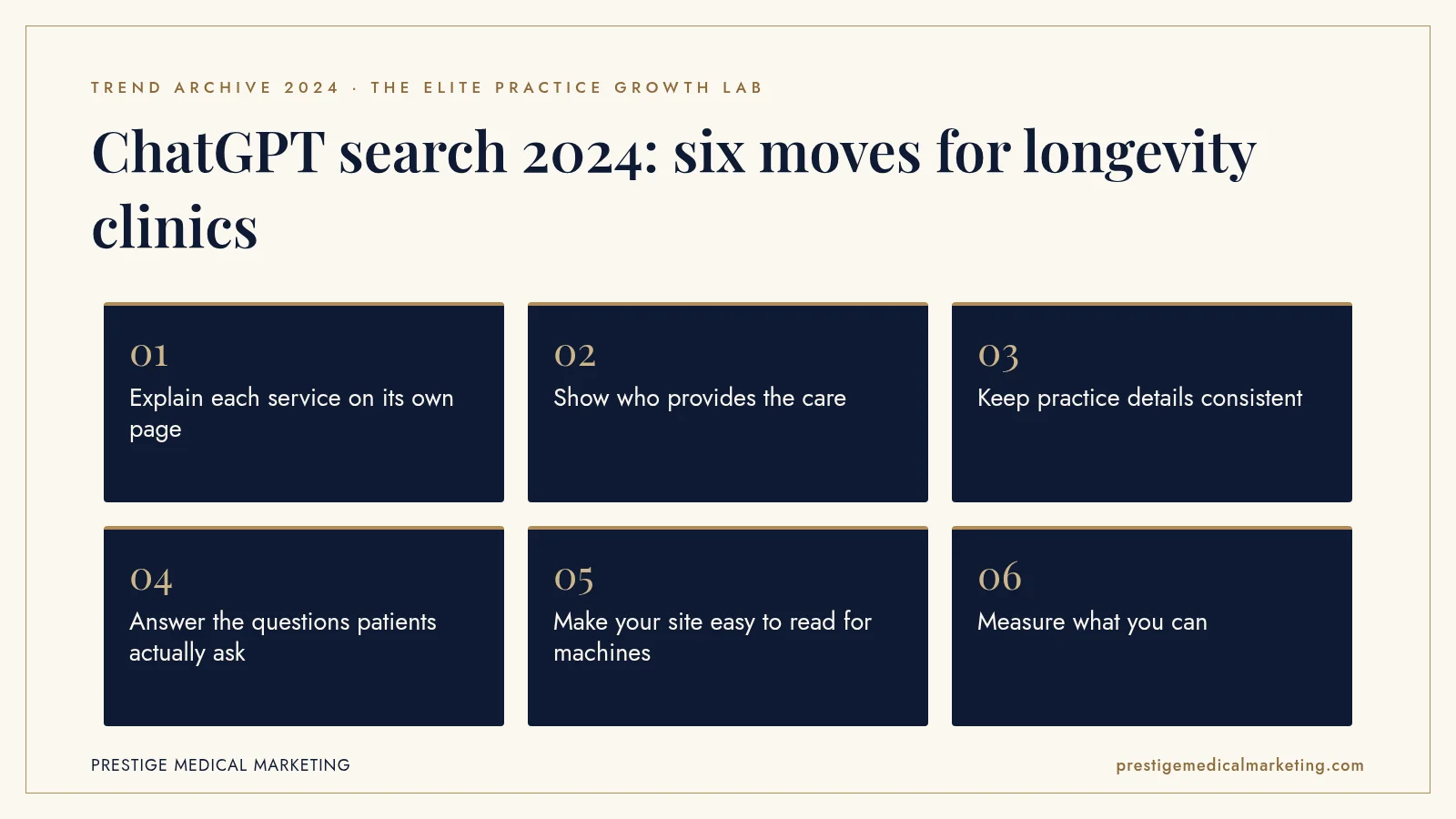
1. Explain each service on its own page
A page for each core service should say what it is, who it is for, what the process involves, what it costs or how pricing works, and what results can and cannot be expected. Vague pages are hard to summarize accurately.
2. Show who provides the care
Provider pages with real credentials, training and areas of focus help patients and help AI systems understand who stands behind the clinic. Keep them current.
3. Keep practice details consistent
Name, address, phone, hours and services should match across your website, Google Business Profile and major directories. Inconsistent details create inconsistent answers.
4. Answer the questions patients actually ask
Collect the questions your team hears on consultation calls and answer them in plain language, with sources where claims need support. Our guide to getting your practice recommended by AI goes deeper.
5. Make your site easy to read for machines
Fast pages, clean structure, descriptive headings and appropriate structured data help any system understand your content. Avoid hiding key information inside images or downloads.
6. Measure what you can
Watch referral traffic from AI tools in your analytics, ask new patients how they found you, and test common questions in AI assistants regularly to see how your clinic is described.

How longevity patients research before they book
Longevity patients tend to arrive informed. Many have read about biomarkers, hormone health, sleep, metabolic markers and fitness testing. They may have listened to long interviews with researchers and clinicians. By the time they call, they often have a specific question about whether a clinic offers what they have been reading about.
That research style fits AI assistants well. A patient can ask follow-up questions, compare approaches and ask for sources in one place. It also means patients may come to a consultation with a summary in mind. If that summary came from a clinic’s own clear content, the conversation starts on solid ground. If it came from a vague or outdated description, the team has to correct misunderstandings first.
Clinics that publish thoughtful, specific explanations of their approach help shape that research. Explaining how a program is structured, what testing is included, how often patients are seen and how progress is tracked gives patients and AI tools something concrete to work with.
Accuracy and responsibility in longevity content
Longevity is a field where claims can run ahead of evidence. Content that promises to reverse aging, guarantee a longer life or replace standard medical care is risky for patients and for the clinic. It can also undermine trust with the very people a clinic most wants to reach: informed, skeptical, high-value patients.
The safer and more effective approach is to be precise. Describe what a service involves and what the evidence supports, note where evidence is still developing, and explain how the clinic individualizes care. Link to reputable sources when you reference research. That kind of careful content is more useful to patients and more likely to be represented accurately in AI answers.
It also protects the clinic. Regulators and platforms pay attention to health claims. Content that stays within what the clinic can support is easier to defend and easier to keep updated as the science changes.
Where Google still fits
ChatGPT search did not replace Google in 2024. Google remained the default search engine for most people, and Google Maps remained central to local decisions. For a longevity clinic, the Google Business Profile, local rankings and reviews still drive a large share of discovery.
The good news is that the work overlaps. Clear service pages, consistent practice details, strong reviews and helpful answers to patient questions serve Google, AI Overviews and ChatGPT search at the same time. A clinic does not need separate strategies for each platform. It needs one strong foundation that every system can read. See our approach to the shift in local search for more on how Maps fits.
Testing how AI describes your clinic
A simple habit helps. Once a month, ask a few AI assistants the questions a new patient might ask: what your clinic offers, what a first visit involves, how your programs are priced and how you compare with other options in your area. Note what they get right, what they get wrong and which sources they cite.
When an answer is wrong, look for the source of the error. It may be an outdated directory listing, an old page on your own site or a third-party article. Fixing the source is more reliable than hoping the answer changes on its own. Over time, this habit builds a clear picture of how your clinic is represented and where to focus your content.
Keep the results in a shared document so the team can see changes over time. When a new service launches or a price changes, add a test question for it. The goal is not to chase every answer, but to catch errors that could confuse a patient before they call.
Why the prototype came first
OpenAI did not launch search all at once. Its SearchGPT prototype announcement in July 2024 described a temporary test with a small group of users and publishers, with feedback shaping the final product. For clinics, that staged approach is a reminder that AI search features keep changing. A tactic built around one interface can break when the interface changes, while clear content and accurate practice details keep working across versions.
What 2024 does not tell us
OpenAI did not publish detailed data on how often ChatGPT search sent visitors to local healthcare businesses, and there was no reliable public data on how many longevity patients used AI assistants to choose a clinic in 2024. AI products also change quickly, so features and rollout details from 2024 may differ from what is available today. What 2024 does show is that patients gained a new way to research, and clinics with clear, consistent information were better prepared for it.
The premium practice advantage
A premium longevity clinic sells expertise and trust. Content that explains your approach clearly, provider pages that show real credentials and consistent information everywhere a patient looks are part of that experience before the first visit.
That is how we approach visibility: Google Maps and AI search visibility built on accurate, specific content and practice information you control. See our services and who we help, including longevity and anti-aging clinics. Our team works from Austin with practices nationwide.
The bottom line
OpenAI launched ChatGPT search on October 31, 2024, and opened it to logged-in free users that December. For longevity clinics, it moved part of patient research into AI answers. The clinics best placed to benefit are the ones with clear service pages, credible providers, consistent details and careful, well-sourced content.
Check if your market is open. We take one practice per specialty per market. Request a market check or call (716) 400-0084.
Frequently asked questions
When did ChatGPT search launch?
OpenAI announced ChatGPT search on October 31, 2024. It started with ChatGPT Plus and Team users and waitlisted SearchGPT users, and OpenAI expanded it to logged-in free users in December 2024.
What was SearchGPT?
SearchGPT was a prototype OpenAI announced in July 2024 to test search features with a limited group of users. OpenAI said the lessons from that prototype were brought into ChatGPT search.
How does ChatGPT search show sources?
OpenAI said answers would include links to relevant web sources, so users could click through to learn more. That gave publishers and businesses a path to be cited and visited from inside ChatGPT.
Why does this matter for a longevity clinic?
Longevity patients often research for a long time before booking, comparing approaches, testing and providers. When part of that research happens in an AI assistant, a clinic needs content and information the assistant can find, understand and cite.
Can a clinic pay to appear in ChatGPT search answers?
OpenAI did not offer a way to pay for placement in ChatGPT search answers when it launched. Visibility depends on being findable on the open web, with clear, trustworthy information.
Should a clinic stop focusing on Google?
No. Google remained the dominant way people searched in 2024. The practical approach is to build content and practice information that serve both traditional search and AI answers.