
Google introduced MUM, the Multitask Unified Model, on May 18, 2021. Google said MUM was 1,000 times more powerful than BERT, trained across 75 languages and multimodal, and designed to help with complex tasks that took people eight queries on average. Its first public application identified more than 800 COVID-19 vaccine name variations in over 50 languages. For longevity clinics, MUM signaled that search would increasingly reward clear, expert answers to complex questions rather than pages built around single keywords.
Longevity medicine attracts curious, well-researched patients. Before they ever book a consultation, many have read about biomarkers, metabolic health, sleep, strength training, hormone changes and advanced testing. Their questions are rarely simple. They want to know how a comprehensive assessment differs from an annual physical, which tests are worth doing, what the evidence says and how a program would fit their life.
For most of search history, answering a question like that took many searches. In May 2021, Google publicly acknowledged the problem and introduced a model designed to address it. The Multitask Unified Model, or MUM, was described as a step toward helping people with complex tasks in fewer searches. It did not transform search overnight, but it was one of the clearest early signals of the AI-driven search that arrived in later years.
This retrospective covers what Google actually announced in 2021, why it mattered for longevity clinics and what a clinic should do about it today. For the later chapters, see our look at the launch of ChatGPT in 2022, Bing Chat and Bard in 2023 and ChatGPT search in 2024.
What actually happened in 2021
May 18: the introduction. In a post titled MUM: A new AI milestone for understanding information, Google’s Pandu Nayak described a common problem: people issue eight queries on average for complex tasks. Google’s example was a hiker who had climbed one mountain and wanted to know how to prepare differently for another.
The claims. Google said MUM uses the T5 text-to-text framework and is 1,000 times more powerful than BERT, the language model it had introduced to Search in 2019. MUM not only understands language but also generates it. It was trained across 75 languages and many tasks at once, and it was multimodal, meaning it could understand information across text and images, with the potential to expand to video and audio.
Responsible rollout. Google said it would apply MUM to Search features carefully, with internal testing and evaluation, and noted that it was working to reduce bias and the carbon footprint of large models.
June 29: the first application. Google published how MUM improved searches for vaccine information. It said MUM identified over 800 variations of COVID-19 vaccine names in more than 50 languages in a matter of seconds, a task that would otherwise have taken hundreds of human hours. After validating the findings, Google applied them so people could find timely, high-quality vaccine information.
Why it mattered for longevity clinics
Longevity patients rarely search for a single service. They are trying to solve a complex problem: how to stay healthy, strong and sharp for as long as possible, often after a family history, a health scare or a milestone birthday. The questions they bring are layered and personal, and they often mix science, lifestyle and logistics.
MUM showed that Google intended to understand those layered questions better. A search engine that grasps the full intent behind a question will tend to favor content that addresses it fully and accurately. A page that repeats a keyword like anti-aging clinic without explaining the approach, the evidence or the experience offers little to a system trying to answer the real question.
The vaccine example also mattered for health content generally. Google used MUM to connect people with reliable information from trusted health authorities. That reinforced a theme that runs through Google’s approach to health topics: in areas that affect people’s health, reliability and expertise carry particular weight.
What typical agencies did
Most agencies took little notice. MUM was announced at a developer conference and did not come with a ranking update or a new report in Search Console, so it was easy to file under future technology. Some marketers seized on it as a buzzword and promised MUM optimization without being able to say what that meant.
Meanwhile, many longevity and anti-aging websites continued to publish short, keyword-focused pages about individual treatments, sometimes with bold claims about reversing aging that were not supported by evidence. That approach was already risky in health search and became riskier as Google’s understanding improved.
The better response was to treat MUM as a direction rather than a tactic: invest in content that answers complex questions completely and honestly, with real clinical expertise behind it.
What it means for a longevity clinic today
Search and AI assistants now handle complex questions routinely. These habits position a clinic well.
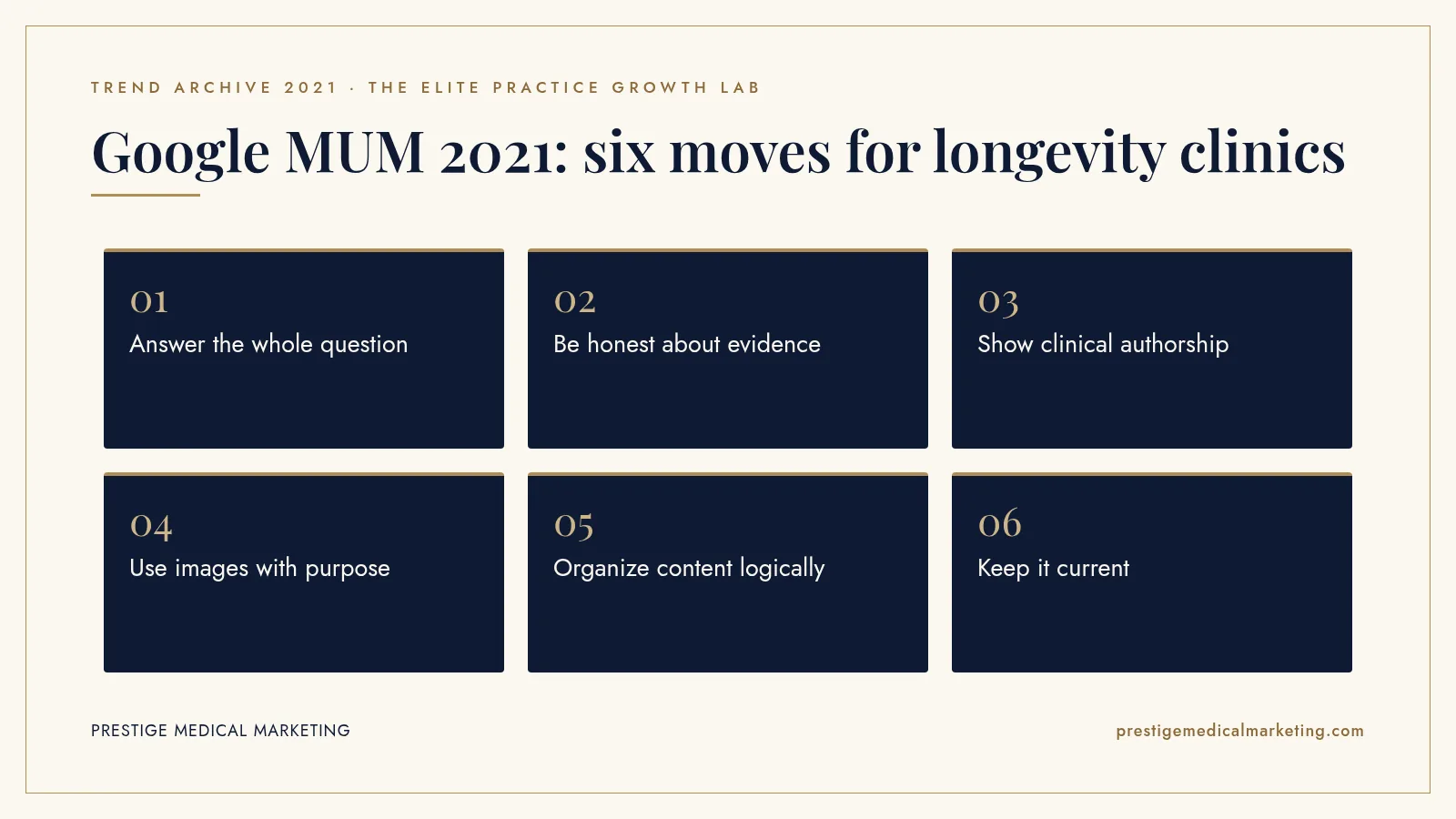
1. Answer the whole question
Build pages around the questions patients actually ask, such as what a comprehensive longevity assessment includes and how it differs from standard care, and answer them fully.
2. Be honest about evidence
Distinguish established practice from emerging research. Explain what testing can and cannot tell a patient, and avoid promises about reversing aging.
3. Show clinical authorship
Identify the physicians and clinicians behind your content, with accurate credentials, and have medical content reviewed by them.
4. Use images with purpose
Multimodal search reads images too. Use real photographs of your clinic and team with descriptive alt text rather than generic illustrations.
5. Organize content logically
Clear headings, a sensible site structure and internal links between related topics help both people and systems understand how your information fits together.
6. Keep it current
Longevity science moves quickly. Review key pages periodically, update them when guidance changes and show when content was last reviewed.

Complex questions, clear structure
A practical way to apply the MUM lesson is to map the journey of a typical prospective patient. They might start with a broad question about healthy aging, move to questions about specific assessments, compare a clinic-based program with what their primary care physician offers, consider cost and time commitment and finally look for a clinician they trust. Each stage deserves content that answers the question at that stage clearly.
That might mean a central page explaining the clinic’s philosophy and program, supporting pages on assessments, nutrition, exercise, sleep and hormone health where the clinic offers those services, a page on what a first visit involves, transparent information about membership structure and honest answers to common concerns. Linking these pages thoughtfully lets a reader, or a search system, follow the thread.
The structure also helps the clinic avoid a common problem: dozens of overlapping pages on similar topics that compete with one another. A smaller set of thorough, interconnected pages is easier to maintain and easier for search systems to understand.
Trust signals for health content
Longevity medicine sits at the edge of established and emerging science. That makes trust especially important. Prospective patients look for signs that the clinic is grounded in medicine: licensed physicians, clear explanations of what is evidence-based and what is exploratory, and a willingness to say when something is not appropriate.
Those same qualities matter in search. Google has long emphasized expertise and trustworthiness for health topics. A clinic that writes carefully, cites reputable sources where appropriate and avoids sensational claims is better aligned with how search systems evaluate health information, and with how discerning patients evaluate clinics.
Reviews and reputation complete the picture. Genuine patient reviews that describe the experience, the clinicians and the thoroughness of the process reinforce the clinic’s credibility in a way no marketing copy can.
Language and accessibility
MUM’s training across many languages was a reminder that search increasingly understands concepts rather than exact words. A patient may search for healthy aging, longevity medicine, preventive health or anti-aging and mean similar things. Content written naturally, using the terms patients use, tends to serve that range of searches without awkward keyword repetition.
For clinics that serve patients who prefer another language, offering accurate, professionally translated content can genuinely help those patients. Machine translation without review is risky for medical information, so any translated pages should be reviewed by a qualified speaker.
From search results to conversations
MUM was an early step toward search that holds something closer to a conversation. Patients now ask AI assistants complex questions about longevity and receive synthesized answers. Clinics that have published clear, accurate and well-organized information are more likely to be understood correctly by those systems, and more likely to be the place a patient goes when they want a real clinician’s view.
That does not mean writing for machines. It means writing well for people who ask hard questions, which is what longevity patients have always done.
Building pages around real journeys
People researching longevity care rarely ask a single question. They move from understanding a concept to comparing approaches to wondering what a first visit involves, what it costs and who provides care. A website that mirrors that journey, with clear pathways from educational pages to service pages to booking, serves both the patient and any search system trying to connect complex questions with relevant answers. Each page should do one job well and point clearly to the next step.
Caution with emerging science
Longevity is a field where research moves quickly and where enthusiasm can outrun evidence. Content should distinguish between established practice and emerging research, avoid presenting early findings as settled and never promise extended lifespan or specific results. Careful wording protects patients, keeps the practice within advertising and professional rules and builds the kind of credibility that serious patients look for.
Media that explains, not just decorates
Video, diagrams and images can help explain complex topics, such as what a comprehensive assessment includes or how a care plan is structured. They should be accurate, clearly labeled and supported by text so the information is accessible to everyone. Decorative media that adds nothing to understanding slows pages without helping patients. Every image, chart or clip should earn its place by making a difficult idea easier to grasp. Thoughtful media choices also respect visitors on slower connections.
What 2021 does not tell us
Google did not publish detailed information about how MUM was used in ranking, and its 2021 applications were limited and specific. We do not have public data showing how MUM affected visibility for longevity clinics or any health category. What 2021 does show is Google’s stated direction: understanding complex questions across languages and formats, and connecting people with reliable information, especially on health.
The premium practice advantage
A premium longevity clinic already has what complex search rewards: rigorous clinicians, a coherent method and patients who value depth. The work is presenting it clearly. See our longevity and anti-aging services, our longevity clinic marketing guide, our full services, who we help and how we approach Google Maps and AI search visibility. Our team works from Austin with practices nationwide.
The bottom line
Google introduced MUM in May 2021 as a model built for complex questions across languages and formats, and first used it to improve vaccine information. For longevity clinics, the lasting lesson was to answer complex questions completely, honestly and with real clinical authority.
Check if your market is open. We take one practice per specialty per market. Request a market check or call (716) 400-0084.
Frequently asked questions
What is MUM?
MUM stands for Multitask Unified Model. Google introduced it on May 18, 2021 as an AI model designed to understand and generate language, work across many languages and understand information across text and images.
How did Google describe its capabilities?
Google said MUM uses the T5 text-to-text framework, is 1,000 times more powerful than BERT, is trained across 75 languages and many tasks at once and is multimodal.
How was MUM first used in Search?
In June 2021, Google said MUM identified over 800 variations of COVID-19 vaccine names in more than 50 languages in seconds, helping Search surface reliable vaccine information.
Why does MUM matter to longevity clinics?
Prospective longevity patients ask complex, multi-part questions about aging, testing, prevention and lifestyle. MUM signaled that Google would get better at understanding those questions and matching them with genuinely expert content.
Did MUM change rankings overnight?
No. Google described MUM as a milestone and applied it to specific uses over time rather than replacing its ranking systems in one step.
How should a clinic prepare its content?
Write clear, accurate, clinician-reviewed pages that answer whole questions, explain trade-offs honestly and show who is behind the advice, rather than thin pages aimed at single keywords.