
OpenAI introduced ChatGPT on November 30, 2022 as a free research preview of a conversational model that could answer follow-up questions, admit mistakes and decline inappropriate requests. OpenAI also warned it could write plausible-sounding but incorrect answers. For longevity clinics, it marked the moment prospective patients began asking an AI assistant about testing, therapies and clinics, which made clear, accurate, consistent information about a practice more important.
Longevity medicine attracts some of the most research-driven patients in healthcare. Before they book, many have read about biomarkers, hormone optimization, advanced imaging, peptides and the latest trial results. They compare clinics carefully, because programs are often premium, cash-pay and long-term. For years, that research happened on search engines, podcasts, forums and practice websites.
On November 30, 2022, a new place to ask those questions appeared. OpenAI released ChatGPT, a conversational model anyone could use for free. It did not search the web, it made mistakes and OpenAI said so plainly. But it changed how people expected to get answers: by asking in their own words and following up, rather than scanning ten links.
This retrospective covers what OpenAI actually launched in 2022 and what it means for a longevity clinic today. For the next steps in the story, see our look at Bing Chat and Bard in 2023, ChatGPT search in 2024 and ChatGPT’s scale in 2025.
What actually happened in 2022
November 30: the research preview. OpenAI published “Introducing ChatGPT”, describing a model trained to interact conversationally. OpenAI said the dialogue format made it possible for ChatGPT to answer follow-up questions, admit its mistakes, challenge incorrect premises and reject inappropriate requests.
Free to use. OpenAI made ChatGPT available free during the research preview, inviting people to try it and give feedback on problems.
How it was trained. OpenAI described ChatGPT as a sibling model to InstructGPT, trained using reinforcement learning from human feedback, in which human trainers ranked responses to help the model learn preferred answers.
Limitations in writing. OpenAI listed limitations in the announcement. ChatGPT sometimes wrote plausible-sounding but incorrect or nonsensical answers. It was sensitive to small changes in phrasing. It was often excessively verbose. And rather than asking clarifying questions when a request was ambiguous, it usually guessed what the user intended.
No live web. The 2022 preview answered from what it had learned in training rather than by searching the web in real time, so it could not reliably reflect a clinic’s current services, pricing or staff.
Why it mattered for longevity clinics
Longevity is a field full of complex, fast-moving and sometimes contested topics. A prospective patient might want to understand what a particular biomarker panel measures, whether a therapy has good evidence, how hormone therapy decisions are made or what a comprehensive assessment involves. Those are exactly the kinds of questions people found themselves asking a conversational AI, because it would explain in plain language and answer follow-ups.
That created two risks and one opportunity. The first risk was accuracy: OpenAI’s own warning about plausible but incorrect answers is particularly serious in health. The second was invisibility: in 2022, ChatGPT could not see a clinic’s website at all, so it had no way to recommend a specific practice reliably. The opportunity was that patients arrived at clinic websites better informed and with sharper questions, which rewarded clinics whose content could meet them at that level.
It also set expectations. Once people experienced conversational answers, many found a wall of marketing copy less satisfying. Clinics that explained their approach clearly and directly felt more aligned with how patients now wanted to learn.
What typical agencies did
The most common agency reaction to ChatGPT was not about patients at all. It was about production. Within weeks, many agencies began using ChatGPT to generate articles at volume, sometimes with little clinical review. For a longevity clinic, that meant a risk of publishing exactly the kind of plausible but inaccurate health content OpenAI warned about, under the clinic’s name.
Others dismissed it as a novelty. That underestimated how quickly AI answers would move into search itself, through Bing Chat and Bard in 2023, Google’s AI Overviews in 2024 and ChatGPT’s own search features.
The more useful response was to ask how a clinic would be represented when AI systems did start reading the web, and to make the clinic’s information clear, accurate and consistent everywhere it appeared.
What it means for a longevity clinic today
AI assistants are now a real part of how patients research care. These steps help a clinic show up accurately.
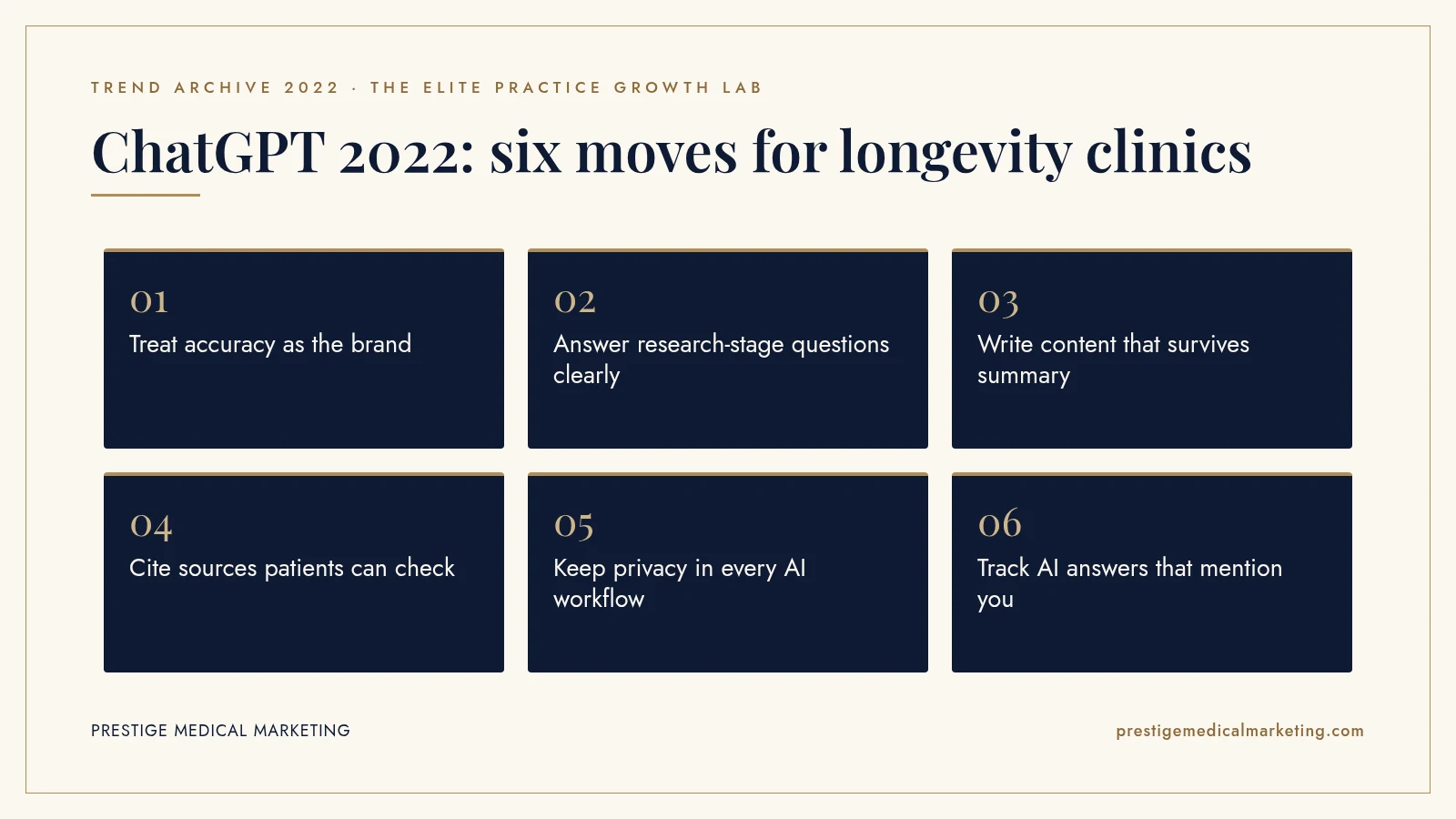
1. Publish clear, factual service pages
Explain each program in plain language: what it includes, who it suits, how assessments work and how pricing or membership is structured. Clear pages are easier for people and AI systems to summarize correctly.
2. Keep facts consistent everywhere
Your name, address, phone, hours, clinicians and services should match across your website, Google Business Profile and major directories. Conflicting details create conflicting answers.
3. Review all AI-assisted content clinically
If you use AI tools to draft, a qualified clinician must check every claim before publishing. Accuracy is the whole point.
4. Answer real patient questions directly
Write concise, accurate answers to the questions patients actually ask at consultations. That content serves visitors and gives AI systems something reliable to draw on.
5. Be honest about evidence
Distinguish what is well established from what is emerging. Overstated claims are a trust problem for patients and can be repeated by AI systems.
6. Check how AI describes you
Periodically ask major AI assistants about your clinic and correct the public sources behind any inaccuracies.

Accuracy is the brand
For a longevity clinic, accuracy is not a compliance box. It is the brand. Patients choose a premium longevity program because they believe the clinicians are rigorous, current and honest about what the science supports. Any content that contradicts that belief, whether written by a person or an AI, undermines the reason patients are there.
That makes the AI era a reason to raise standards rather than lower them. A clinic can use AI tools to save time on structure, summaries or first drafts, but the substance of health content still needs to come from, and be checked by, the people responsible for care. OpenAI’s 2022 warning that the model could produce plausible but incorrect answers remains good advice for anyone publishing with these tools.
It also helps to keep a simple editorial record. Note who drafted a page, who reviewed it and when it was last checked. That record supports accuracy internally and gives readers visible evidence that someone is accountable for what they are reading.
How AI answers changed the research journey
Before conversational AI, a prospective longevity patient might type a query, open several tabs and piece together an understanding. After ChatGPT, many started with a conversation instead: ask a broad question, then narrow it down. By the time they reached a clinic’s website, they had often formed a view of the field and were evaluating whether this clinic matched it.
That shifts what a website has to do. It needs to confirm, quickly, that the clinic is credible, that its approach is clear and that the next step is simple. It needs to show the clinicians, explain the assessment, set honest expectations and make booking a consultation easy. Long, vague introductions that delay the substance tend to lose a patient who arrived with specific questions.
Consultations change too. Patients who have researched with AI often bring printed notes or screenshots of answers. Clinicians who acknowledge that research respectfully, and correct it where needed, build trust quickly. A website that anticipates the same corrections, in a short section on common misconceptions, can do some of that work before the first visit.
Content that holds up when summarized
One practical test for any longevity page is whether its key facts survive being summarized. If an assistant, or a busy patient, reduced the page to three sentences, would those sentences be accurate and useful? Pages that bury the substance under general wellness language tend to fail that test, because there is little concrete to summarize.
Pages that pass usually share a few traits. They state plainly what the program includes, such as the type of assessment, the clinicians involved and how follow-up works. They describe who the program is designed for and who should look elsewhere. They explain pricing structure, even if exact figures depend on a consultation. And they separate what the clinic does from what the wider field claims, so a reader does not mistake an industry trend for a promise.
Structured details help as well. Clear headings, short answers to common questions and accurate practice information in a consistent format make a page easier to read for people and easier to interpret for any system that summarizes it.
From research preview to search layer
In 2022, ChatGPT was a research preview without live web access. That changed quickly. In 2023, Microsoft and Google launched AI chat experiences connected to search. In 2024, Google rolled out AI Overviews widely in the US and OpenAI launched ChatGPT search. By 2025, OpenAI said ChatGPT had 800 million weekly users. Each step made it more likely that an AI system would read and summarize a clinic’s actual web presence.
That progression is why the 2022 launch is worth revisiting. It was the start of a layer between patient questions and practice websites, and the clinics that prepared early, with clear content and consistent information, were better placed when that layer began reading the web.
Privacy belongs in the conversation
As practices adopted AI tools, a further question arose: what information goes into them. Patient details should never be pasted into consumer AI tools without appropriate agreements and safeguards. Any AI used for patient-facing tasks, such as answering questions on a website, should be configured carefully, reviewed regularly and clear about its limits.
The same caution applies to website chat features and intake forms that use third-party AI services. Before adding one, a clinic should understand where conversations are stored, who can access them and whether the vendor will sign the agreements health data requires. A tool that saves staff time but creates a privacy problem is not a saving.
What 2022 does not tell us
The 2022 launch tells us nothing reliable about how many patients used ChatGPT to research longevity care, and we do not have public data on that. It also does not tell us how today’s AI search systems choose which clinics to mention, which they do not fully disclose. What it shows is the start of a shift in patient behavior that later products expanded.
The premium practice advantage
A premium longevity clinic already has what AI systems and patients both reward: rigorous clinicians, a clear method and accurate information. See our longevity and anti-aging services, our longevity clinic marketing guide, our full services, who we help and how we approach Google Maps and AI search visibility. Our team works from Austin with practices nationwide.
The bottom line
ChatGPT launched on November 30, 2022 as a free research preview with openly stated limits. For longevity clinics, it marked the start of AI answers in patient research and made accurate, consistent, clinically reviewed information the foundation of visibility.
Check if your market is open. We take one practice per specialty per market. Request a market check or call (716) 400-0084.
Frequently asked questions
When did ChatGPT launch?
OpenAI announced ChatGPT on November 30, 2022 and made it available as a free research preview.
What did OpenAI say ChatGPT could do?
OpenAI said the dialogue format let ChatGPT answer follow-up questions, admit its mistakes, challenge incorrect premises and reject inappropriate requests.
What limitations did OpenAI disclose at launch?
OpenAI said ChatGPT sometimes wrote plausible-sounding but incorrect or nonsensical answers, was sensitive to how questions were phrased and could be excessively verbose.
Did ChatGPT search the web in 2022?
No. The 2022 research preview answered from its training rather than live search. Web search came later, including ChatGPT search in 2024.
Why does this matter for a longevity clinic?
Longevity patients research heavily before booking. When they ask an AI assistant about a therapy or a clinic, the answer draws on what is published about the field and the practice, accurate or not.
Should a clinic publish content written by AI?
Only with clinical review. Google's guidance judges content on helpfulness and accuracy, and health content that contains AI errors damages trust.