
Microsoft announced the new AI-powered Bing and Edge on February 7, 2023, with a chat experience that cited sources. Google opened early access to Bard in the US and UK on March 21, 2023. In November 2023, OpenAI said ChatGPT had 100 million weekly active users. For longevity and anti-aging clinics, these launches meant that prospective patients began researching complex topics through conversational AI, rewarding clinics with clear, credible, well-sourced information.
Longevity medicine sits in an unusual place in search. The subject is fascinating, heavily discussed and full of competing claims. Prospective patients often spend weeks reading about biomarkers, hormone optimization, body composition, sleep, peptides and preventive testing before they ever contact a clinic. Many arrive with a long list of questions and a healthy dose of skepticism.
In 2023, the way they did that research started to change. Microsoft put a chat assistant inside Bing. Google opened Bard to the public. ChatGPT, launched at the very end of 2022, became a daily habit for tens of millions of people. For the first time, patients could ask a layered, follow-up-heavy question and get a conversational answer rather than a list of links.
This retrospective covers what launched in 2023 and what it means for a longevity or anti-aging clinic today. For what came next, see our coverage of the 2024 ChatGPT search launch and the 2025 decline in Safari searches.
What actually happened in 2023
February 7: the new Bing. Microsoft announced an AI-powered Bing and Edge, describing them as a copilot for the web. The new Bing included a chat experience that could answer questions conversationally and cite its sources, and it launched first as a limited preview on desktop.
Microsoft’s framing. In the announcement, Microsoft said there were 10 billion search queries a day and estimated that half of them went unanswered, because people were using search for things it was not originally designed to do. That was Microsoft’s own estimate, but it explained the bet: conversational AI could handle the complex questions that a list of links handled poorly.
March 21: Bard opens. Google opened early access to Bard for users in the US and UK. Google described it as an experiment powered by a lightweight version of its LaMDA model and was direct that large language models can provide inaccurate information. Bard included a “Google it” button so users could check answers in regular search.
November 6: 100 million weekly users. At OpenAI’s first developer conference, the company said ChatGPT had about 100 million weekly active users. Conversational AI had moved from novelty to routine in less than a year.
Google’s own experiment. In May, Google also began testing its Search Generative Experience, putting AI answers directly into search results for opted-in users. Read our 2023 SGE retrospective for that part of the story.
Why it mattered for longevity clinics
Longevity is one of the clearest examples of a category built on complex questions. Should someone in their forties get advanced lipid testing? What does a body composition scan show that a scale does not? How do different clinics approach hormone therapy? What is the evidence behind a given intervention, and what is still speculative? These are not questions a single search result answers well.
Conversational AI is good at exactly this kind of layered exploration. A prospective patient can ask a broad question, then narrow it, then ask for a comparison, then ask what to look for in a clinic. Each answer shapes the next question. By the time that person searches for a specific clinic, their expectations have already been set by what the AI told them.
That created two pressures at once. Clinics needed their information to be accurate and clear enough to be represented fairly. And they needed to be careful, because the same tools that summarize good information can also amplify confusion or overstated claims.
What typical agencies did
In 2023, most agencies treated AI chat as a curiosity. Some used it mainly as a way to generate more content faster, producing long articles on longevity topics with little expert input. Others told clients it would not affect them because it was not “real” search.
Both reactions missed the point. Mass-produced content on medical topics carries real risk, and patients were already using these tools to research care. The practical response was to make sure the clinic’s own information was the clearest, most accurate and most consistent source available.
What it means for a longevity clinic today
Conversational AI is now a major research channel. These steps help a longevity clinic be represented accurately and chosen.
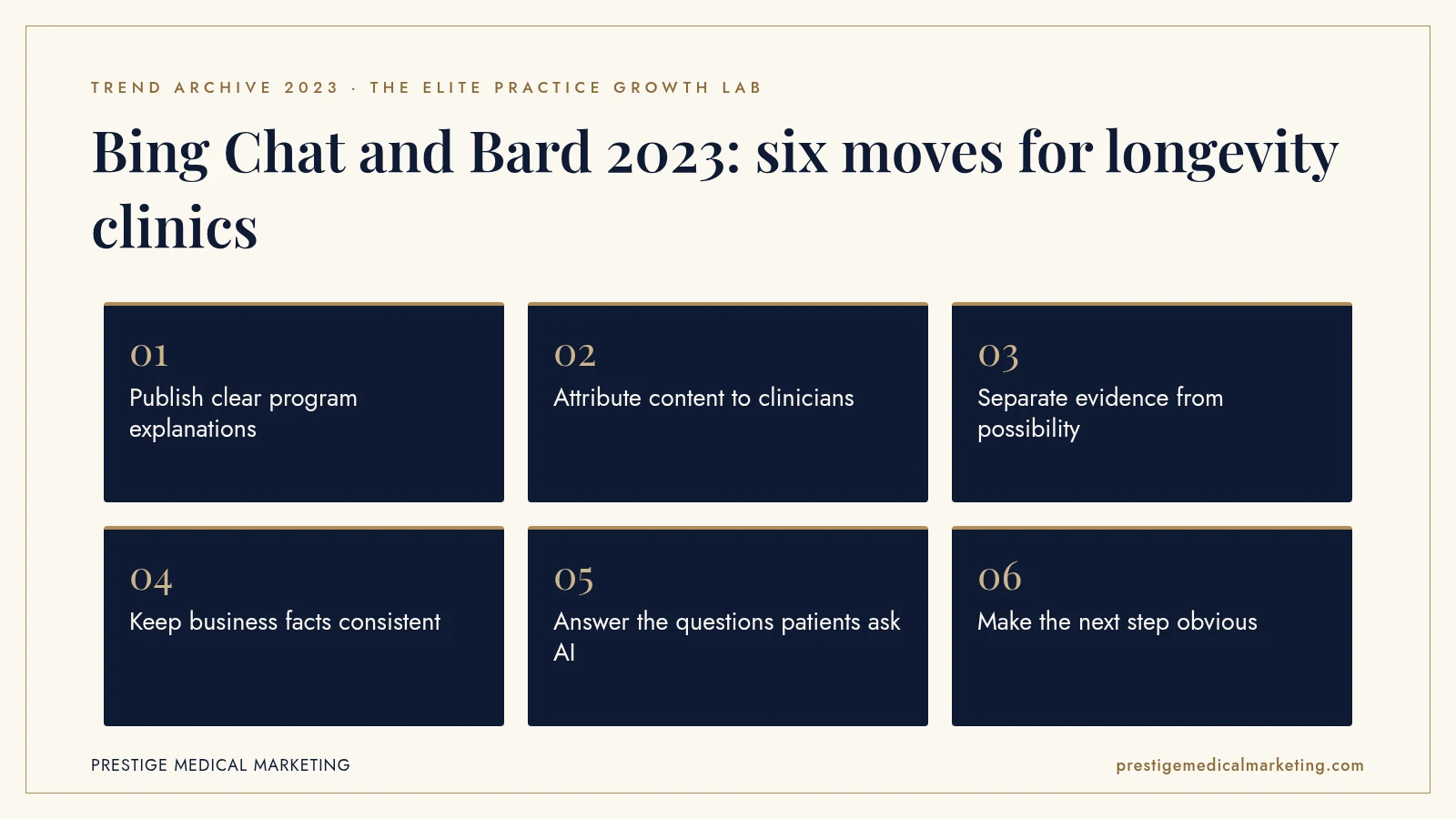
1. Publish clear program explanations
Explain what your programs include, who they are for, how assessment works and what follow-up looks like. Plain language beats jargon. A patient should be able to describe your program to a spouse after reading one page, and an AI tool should be able to summarize it without guessing.
2. Attribute content to clinicians
Name the physicians and clinicians who write or review content, with accurate credentials and roles. Add provider pages that explain training, areas of focus and how each clinician works with patients over time.
3. Separate evidence from possibility
Be clear about what is well established, what is emerging and what is not yet proven. Credibility is the asset. Research-minded patients notice when a clinic is candid about uncertainty, and they tend to trust its other claims more because of it.
4. Keep business facts consistent
Match your name, address, hours, services and pricing approach across your website, Google Business Profile and directories. Conflicting details are one of the most common reasons AI tools describe a business inaccurately.
5. Answer the questions patients ask AI
Build an FAQ around real consultation questions: cost, membership terms, testing, timelines and what a first visit involves. Use the exact phrasing patients use on the phone, not internal program names they have never heard.
6. Make the next step obvious
When a patient arrives after AI research, they want to act. Show how to book a consultation and what happens next, including how long the first visit takes and what testing, if any, comes before it.

How patients research longevity care now
A typical longevity research journey after 2023 often starts broad. Someone notices changes in energy, body composition, sleep or lab results and asks an AI tool what might be going on and what options exist. They learn the vocabulary: biomarkers, VO2 max, hormone panels, continuous glucose monitoring, preventive imaging. Then they compare approaches and, eventually, clinics.
Along the way, they form opinions about what good care looks like, what it should cost and which warning signs to watch for. That journey moves across tools. Someone might start in ChatGPT, check a claim in Google, read reviews on a Google Business Profile, look at a clinic’s website on their phone and ask a follow-up question in an AI app before calling. The clinic does not control that path, but it can make sure that wherever the patient lands, the information is accurate and consistent.
It also means the clinic’s website has to do more than look polished. It has to answer real questions with real substance: what a program includes, how pricing works, who the clinicians are and how results are tracked. Our longevity clinic marketing guide covers how to structure that.
The accuracy problem
Both Microsoft and Google were open in 2023 that their AI tools could be wrong. For a longevity clinic, that creates a specific risk: an AI tool might describe the clinic’s services, pricing or approach inaccurately, or attribute claims to it that it never made.
A clinic cannot fully prevent that, but it can reduce the odds. Consistent information across the website, Google Business Profile and major directories gives AI systems fewer conflicting signals. Clear, dated pages for programs and pricing help. So does avoiding vague marketing language that could be interpreted many ways.
It is also worth periodically asking the major AI tools about your clinic and your core services. If the answers are wrong, the fix is usually on your side: unclear pages, outdated listings or inconsistent details that need correcting at the source. Keep a simple log of what you checked and when, so changes over time are visible.
Claims, evidence and trust
Longevity marketing has a credibility problem, and 2023 made it more visible. Conversational AI tends to surface caution when a topic is uncertain, and patients increasingly arrive having heard that some interventions are well supported while others are not.
Clinics that overpromise put themselves on the wrong side of that conversation. Phrases implying guaranteed outcomes, reversal of aging or cures invite skepticism from patients and scrutiny from regulators. The Federal Trade Commission’s 2023 notices on health claim substantiation, covered in our 2023 substantiation retrospective, made the standard for health claims clear.
The stronger approach is honest specificity. Describe what you measure, how you interpret results, what you recommend and why, and how you track progress over time. That content is more persuasive to a skeptical, research-minded patient, and it is safer for the clinic.
Content built for conversation
Conversational tools reward a different shape of content than the classic keyword page. A patient does not type “longevity clinic benefits.” They ask, “I’m 52, my energy has dropped and my doctor says my labs are normal. What would a longevity clinic actually do differently?” The best answer to that question is specific and structured: what an assessment includes, how it differs from a standard annual physical, who tends to benefit and what it typically costs.
Clinics can build toward that by organizing content around real decisions instead of keywords. A page comparing membership and pay-per-visit models, a page explaining what a comprehensive assessment measures and why, and a page describing what the first ninety days look like all answer questions that patients actually ask AI tools. Each page should stand on its own, state its main point early and be reviewed by a clinician.
This kind of content also makes consultations better. Patients who have read clear explanations arrive with sharper questions and realistic expectations, which tends to make the first conversation more productive for everyone.
What 2023 does not tell us
In 2023, there was no reliable public data showing how often patients used Bing Chat, Bard or ChatGPT to choose a healthcare provider, or how that affected appointment volume for longevity clinics. Usage figures from Microsoft, Google and OpenAI describe the tools overall, not healthcare decisions. What 2023 does show is that conversational AI became a mainstream research habit very quickly.
The premium practice advantage
Premium longevity clinics already offer what research-minded patients look for: depth, clinical oversight and a thoughtful approach. The work is making that clear and consistent wherever patients look. See our longevity and anti-aging services, our full services, who we help and our approach to Google Maps and AI search visibility. Our team works from Austin with practices nationwide.
The bottom line
2023 was the year conversational AI became a normal way to research complex topics, and longevity care is about as complex as consumer health gets. Clinics that publish clear, credible, consistent information are the ones AI tools and patients are most likely to trust.
Check if your market is open. We take one practice per specialty per market. Request a market check or call (716) 400-0084.
Frequently asked questions
When did Bing Chat launch?
Microsoft announced the new AI-powered Bing and Edge, including a chat experience, on February 7, 2023. It began as a limited preview, with broader access following.
When did Google launch Bard?
Google opened early access to Bard for users in the US and UK on March 21, 2023, describing it as an experiment.
How many people were using ChatGPT by the end of 2023?
At its developer conference on November 6, 2023, OpenAI said ChatGPT had about 100 million weekly active users.
Why does conversational AI matter for longevity clinics?
Longevity questions are complex, layered and research-heavy. People increasingly ask AI tools to explain options and compare approaches, so clinics that publish clear, accurate and well-attributed information are better positioned to be referenced.
Can AI tools give wrong answers about a clinic?
Yes. Both Microsoft and Google acknowledged in 2023 that their AI could make mistakes. Consistent, accurate information across a clinic's website and listings reduces the chance of errors.
Should a longevity clinic make health claims to appear in AI answers?
No. Overstated or unsupported claims create regulatory risk and undermine trust. Accurate, evidence-aware content written or reviewed by qualified clinicians is the stronger long-term approach.